working against gerrymandering

At Tisch College and Tufts, we are extremely proud of Moon Duchin and her team in the Metric Geometry and Gerrymandering group. This new video takes less than two minutes to play and introduces their work:

Moon and her colleagues are generating tools, participating in legal processes, and training people (from k-12 students to expert witnesses)–all in the interests of democratizing influence on the redistricting process.

As an example, they develop algorithms that start with the existing map and randomly generate enormous numbers of additional maps. Observing that set of possible maps allows one to see whether any given one is more partisan–or otherwise less fair–than the norm. Often, the real or proposed map is an outlier because it reflects a political agenda.

I am pleased to help promote this initiative on the eve of an election that will be deeply shaped by gerrymandering–and likely to affect the electoral map for the next decade.

See also Rebooting the Mathematics Behind Gerrymandering by Moon Duchin and me.

2020 will also be tough for Senate Democrats

In 2016, everyone thinks the Senate “map” is terrible for Democrats. Forty-two Republican incumbents don’t face an election this year, whereas Democrats must defend 24 incumbents, 10 of them in states that Donald Trump won in 2016–sometimes by very large margins. Even a Blue Wave is expected to leave the Republicans in charge of the Senate.

You would think that 2020 would have to be better for Democrats. After all, Democratic voters outnumber Republicans in national votes for the president and the House. If, by the luck of the draw, the Democrats face a bad Senate map one year, the next time has to be better–right?

Actually, 2020 looks like another pretty hard year for the Dems. According to Nathaniel Rakich in FiveThirtyEight, 22 Republican Senators will face reelection. That sounds like fertile ground for Democrats, except that only two of those 22, Cory Gardner and Susan Collins, represent states that Hillary Clinton won in 2016. Based on that information, you might expect Republicans to lose just a seat or two. Meanwhile, 11 Democratic Senators will face reelection, and two of them represent states that Trump won in 2016: Jeanne Shaheen of New Hampshire (which was close) and Doug Jones of Alabama (which Trump won by 27 points). Based on that information, you might expect the Democrats to lose Jones and maybe one or two more.  If each party loses a seat or two to the other, it will be a wash, preserving the Republican majority.

How can this be? One reason is that a harder year will finally arrive for the Republicans in 2022. Twelve Democrats and 22 Republicans will have to defend seats that year, including several Republicans in swing states: Rubio in Florida, Grassley in Iowa (if he runs again at 89), Burr in North Carolina, Portman in Ohio, Toomey in Pennsylvania, and Johnson in Wisconsin. All the Dems who are up in 2022 are in either blue or purple states.

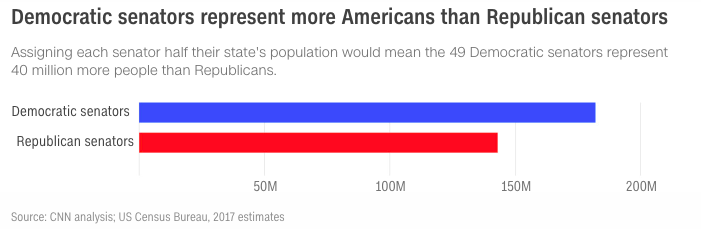
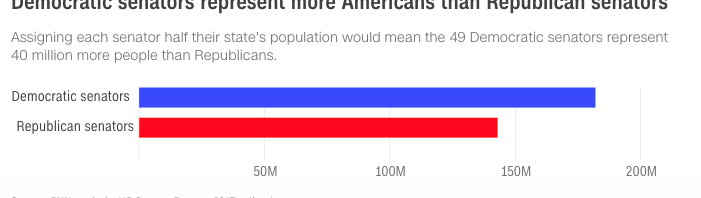
But the other reason is the extraordinary gap between the Senate and the American population. Even now, with the Senate controlled by Republicans, Democratic senators represent substantially more people:

The Constitution enshrines this imbalance. Anything in the whole document can be changed by amendment, “provided that… no state, without its consent, shall be deprived of its equal suffrage in the Senate.” This is is our only unamendable rule.

Long-term predictions are foolish, but I think you can imagine a pattern of Democratic presidents and House majorities being systematically stymied by Republican senates and the Supreme Court that the Senate has shaped. Then a significant majority of the public will be consistently blocked by an increasingly radicalized minority that is based in different parts of the country as we address climate crises, AI, and other truly profound challenges. Many people will not trace the failures of the government to specific provisions in our Constitution; they will perceive a government that’s inexplicably unresponsive and unrepresentative. And that, it seems to me, is a recipe for constitutional collapse.

See also: is our constitutional order doomed?two perspectives on our political paralysis; and are we seeing the fatal flaw of a presidential constitution?

courses that count for the Civic Studies major in spring 2019

More on the Civic Studies major at Tufts is here.

Required Introductory Course:

  • CVS 0020/PHIL 0020/PS 0020: Introduction to Civic Studies (Erin Kelly, Peter Levine) 

Thinking about Justice:

  • ANTH 140: Food Justice: Fair Food Activism and Social Movements (Alex Blanchette)
  • CVS 190/PHIL 192: Seminar: Political Philosophy of MLK, Jr
  • ECON 62: Economics of International Migration (Anna Hardman)
  • ENG 160 : Environmental Justice and World Literature (Ammons)
  • HIST 10: Colonialism in Global Perspective (Kris Manjapra)
  • MUSIC 132: Music and Ethics (Melinda Latour)
  • PHIL 195: Contemporary Political Philosophy (Lionel McPherson)
  • PHIL 25: Food Ethics (Sigrun Svavarsdottir)
  • PHIL 28: Feminist Philosophy (staff)
  • PS 151: Seminar: The Political Philosophy of Hobbes (Ioannis Evrigenis)
  • REL 08: Law, Religion and International Relations (Joseph Walser)
  • SOC 103-01: Sociological Theory (Freeden Blume Oeur)
  • SOC 94: Health, Policy, and Inequality (Brett Nava-Coulter) 

Social Conflict, Inequality, and Violence:

  • CH 0188: Health and Human Rights (Fernando Ona)
  • HIST 173: Black and Native New England (Kendra Field and Kerri Greenidge)
  • PS 108: Public Opinion and U.S. Democracy (Brian Schaffner)
  • PS 138: Democracy and Its Alternatives (David Art)
  • PSY 13: Social Psychology (Keith Maddox)
  • SOC 113: Urban Sociology: Global Perspectives on Space, Inequality and Resistance (Anjuli Fahlberg)
  • SOC 120 Sociology of War and Peace (Paul Joseph)
  • SOC 181 Seminar: War/Peace/State/Society (Paul Joseph)
  • SOC 188 Seminar: Intimate Violence (Anjuli Fahlberg) 

Civic Action and Social Movements:

  • CSHD 0034: Children, Nature, & the Ecology Movement (George Scarlett)
  • EC 117: Economics of Social Interactions and Social Networks (Yannis M. Ioannides)
  • FMS 22: Media Literacy (Julie Dobrow)
  • MUS 197: Social Justice, Advocacy and Music (Jeffrey A. Summit)
  • PS 108: Public Opinion and U.S. Democracy (Brian Schaffner)
  • PS 113: Nonprofits and Civil Society (Jeffrey Berry)
  • PS 118-02: Organizing for Social Change (Daniel LeBlanc & Ken Galdston)
  • PS 188-05: The Howard School of International Affairs (Pearl Robinson)
  • SOC 106: Political Sociology (Anjuli Fahlberg)
  • SOC 111: Making Social Change Happen (Margaret McGladrey)
  • SOC 113: Urban Sociology: Global Perspectives on Space, Inequality and Resistance (Anjuli Fahlberg)
  • UEP 278: Environmental Justice, Security, and Sustainability (Penn Loh)

Civic Skills:

  • ANTH 133: Anthropology of Journalism (Amahl Bishara)
  • CH 0188: Health and Human Rights (Fernando Ona)
  • CHEM 0094: Science and the Human Experience (Jonathan Garlick)
  • CSHD 004: Topics in Child Development: Identity, Community, and Voice (Jayanthi Mistry)
  • ED15: Social-Emotional & Civic Learning in Schools (Deborah Donahue-Keegan)
  • EE194 / ELS 109: Creating Children’s Media (Julie Dobrow)
  • ELS 109: Societal Aspects of Design: Integration, Innovation, and Impact (Ron Lasser)
  • ENG 311: Tufts 1+4 Foundation: Communicating for Change (Grace Talusan)
  • ENV 120: Introduction to Environmental Fieldwork (John de la Parra)
  • ENV 150: Environment, Communication, and Culture (Ninian Stein)
  • ENV 152: Seminar in Environmental Negotiations (Ninian Stein)
  • ExCollege: The President Has Tweeted: Official Government Communications in the Age of Trump (Nanda Chitre)
  • PHIL 24: Introduction to Ethics (Monica Link)
  • PS: Massachusetts State House Internships – Learning While Doing (State Sen. Ben Downing)
  • TBD: Project Citizen: Promoting Civic Engagement (Sherri Sklarwitz)
  • UEP 293-02: Community Practice Theory and Methods (Penn Loh)
  • UEP 294-02: Communications and Media for Policy and Planning (Penn Loh)
  • UEP 294: Teaching Democracy (Penn Loh)
  • WGSS 0185/AMER 0094: Mass Incarceration and the Literature of Confinement (Hilary Binda) 

Internship Seminar:

  • CVS 099: A required internship. This includes a weekly 2.5 hour class with graded assignments and a final project.


Capstone Seminar:

  • CVS 190/PHIL 192: Seminar: Political Philosophy of MLK, Jr.

youth vote 2018: what to expect and how to interpret the data

In The Washington Post, Amy Gardner reads some tea leaves that might foretell youth turnout in November.

On one hand, the good news: “In Pennsylvania, youth voters have made up nearly 60 percent of all new registrants, Target­Smart reported in September. The share of the electorate that is under age 30 has grown since 2017 in several key states, including Nevada, North Carolina and Florida, according to state voter registration data tracked by the firm L2. In Virginia, requests for student absentee ballots, at about 30,000, are about 50 percent higher than in last year’s gubernatorial election.”

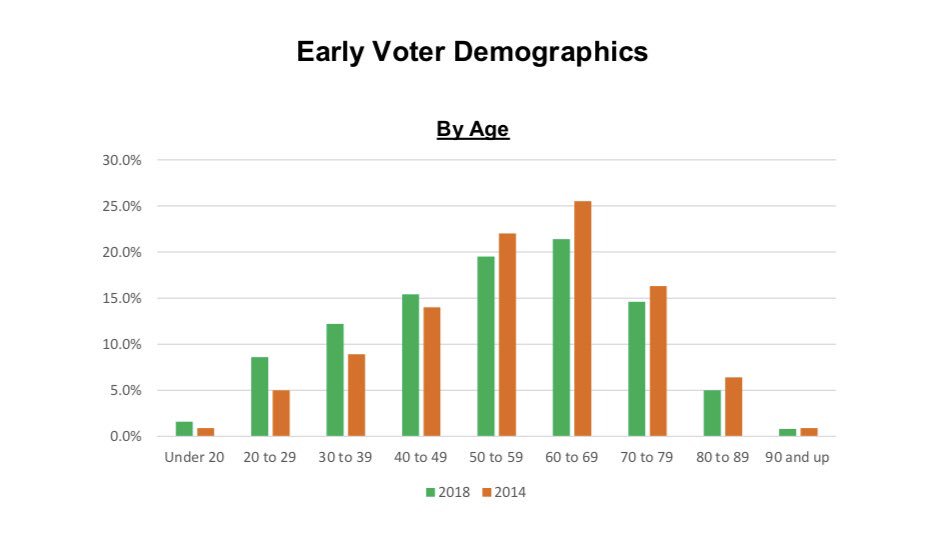
We could add that CIRCLE’s youth polling finds much higher levels of intent to vote than we have seen recently. And these data from Texas look promising:
On the other hand, Gardner notes,

There are plenty of reasons for skepticism about an age group that typically performs dismally at the polls. In 2016, young Americans were expected to turn out heavily against Trump, but the actual share of voters under 30 who cast ballots was 43 percent of eligible voters — about the same as the previous presidential election in 2012 and lower than 2008. (Overall turnout in 2016 was 60 percent.)

Midterm performance is typically far worse: Just 16 percent of young Americans cast ballots in 2014. The highest midterm turnout among voters under 30 in the past three decades was a mere 21 percent in 1994.

And some of the tea leaves seem to foretell just a modest improvement:

In Nevada, young voters’ share of the electorate was 18.6 percent in August, up from 17.5 percent in September 2017, according to L2. In North Carolina, it was 18.3 percent in October, up from 16.7 percent in September 2017. And in Florida, it was 16.6 percent in September, up from 15.6 percent a year earlier.

Meanwhile, in Politico, Marc Caputo, Matt Dixon, and Isabel Dobrin write:

THE YOUNG PEOPLE WILL … STAY HOME? — Remember all that talk of how “the young people will win” and come out in force in Florida, especially after the Parkland massacre? So far, it’s not happening. Voters between the ages of 18-29 are 17 percent of the registered voters in Florida but have only cast 5 percent of the ballots so far. They tend to vote more Democratic. Meanwhile, voters 65 and older are 18.4 percent of the electorate but have cast 51.4 percent of the ballots. And older voters tend to vote more Republican.

Their analysis is based on Daniel Smith’s chart of the early votes so far in Florida, which shows all age groups rising but youth by the smallest amount:
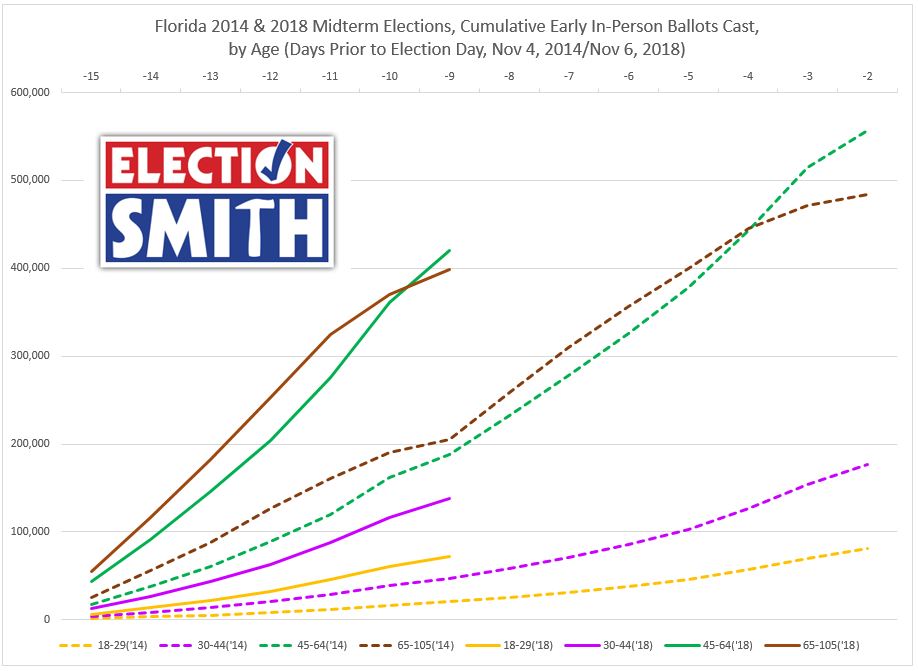
A bunch of different statistics are being cited here: the number of voters or registrants in various age groups, the turnout (the percentage of eligible people in each category who actually voted), and the share of the electorate (what proportion of all voters fit in each category). These articles also cite statistics about registration, early voting, and total voting. It’s easy to get confused.

I expect turnout to rise for the population as a whole, in large part because of the actual and perceived high stakes of the 2018 election. I think youth turnout will also rise but youth will face a challenge keeping pace with the general increase. The difference between them and older voters will probably look better than in Dan Smith’s chart, because early voting seems to appeal especially to older people.

But we could still see various scenarios.

If youth turnout and share of the electorate both rise, it will be a great year for youth voting. Youth turnout could actually fall, but that would really surprise me. If youth turnout rises but no faster than–or not as fast as–the turnout of older people, then youth share will shrink. This will be reported by many news outlets as a decline. That interpretation will not be an outright error. If you want to exercise more influence on the outcome, you must increase your share of the vote. A flat or shrinking share means having no more influence. Also, if turnout rises but youth turnout rises less than average, it will pose questions about the impact of the nonpartisan and partisan efforts specifically to engage youth.

But it will also be true that more youth have voted, which will be worth celebrating if you care about youth engagement. And it will break a pattern, because historically youth turnout has been remarkably flat in midterm elections. Breaking that pattern might be a small positive step even if youth share shrinks slightly.

Center on Democracy and Organizing Summer Institute 2019

I’m posting the following announcement with my enthusiastic recommendation. The Principal Investigators of the Center for Democracy and Organizing are the extraordinarily talented and engaged scholars Lisa Garcia Bedolla, Hahrie Han, and Taeku Lee. More information here.

The Center on Democracy and Organizing (CDO) seeks applications from advanced Ph.D. students and early career researchers and organizers for participation in a summer training institute in 2019 focused on the study of democracy and organizing. The institute will be held from July 31 to August 2 at the University of California, Berkeley. This summer institute will bring together faculty and practitioners interested in developing the capacity to do engaged research in partnership. This dynamic and interactive institute will give participants—10 researchers and 10 practitioners—the chance to learn to work together on research projects that help practitioners advance their strategic goals.

The institute will focus on articulating the benefits of building research partnerships between  academics

and organizers, developing the capacities needed among both academics and organizers to work together, and creating the opportunity for researcher-organizer pairs to work directly on a project of interest. The institute seeks to reframe how graduate students and early career scholars understand their role as researchers, focus on the ways engaging with practitioners can deepen and improve their theorizing about the socio-political world, and also help practitioners and scholars develop a common language in order to engage as equal partners in the research process.

Researchers and practitioners with similar interests and goals will either be paired by CDO, or can apply as a pair.

This institute is funded thanks to grants from the Ford Foundation and Open Society Foundations. Travel (U.S. domestic economy-class round-trip airfare), food, and lodging will be covered for accepted applicants. In addition, participants will be eligible to apply for seed funding of up to $5,000 from CDO to carry out research projects conceived and developed through the institute.