democracy is coming to the USA

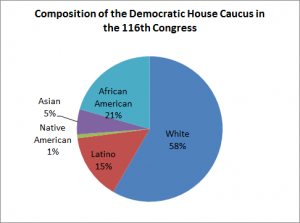
Here is the racial/ethnic composition of the Democratic House caucus for the next Congress.*

I do not display this ratio to endorse the Democrats (or to ignore the people of color who are GOP House members), but simply because the Democrats will control the business of the House. Any substantial voting bloc within the Democratic caucus will have leverage. Starting in January, 42 percent of the caucus will be people of color, and roughly another quarter will be white women.

Nobody awarded these representatives their jobs; they won campaigns. And within the caucus, two of the five top leaders will be African Americans; a third leader will be Latino.

In the great sweep of history, we have seen Europeans dominate the globe: genocidally replacing whole populations, transporting millions as enslaved people, and directly colonizing or else economically exploiting most other countries.

In North America, some of them created a republic on land that their ancestors had taken by force, writing slavery into its charter. But the republic also made an appeal to equality, and the indigenous and enslaved people helped to build its physical assets and its culture from the start. Its people gradually turned this republic into more of a democracy, often against the will of a majority of the citizens of European extraction, but with key support from some of them.

And now we are seeing glimpses of a future in which the descendants of enslaved people and dispossessed people and refugees and economic migrants will hold a controlling stake in the world’s most powerful nation. For eight years, the son of a Kenyan man was the chief executive and the head of state. The governing party in the US House is still majority-white, but now just by a whisker. Nothing will pass the House without substantial support from members of color within the Democratic caucus.

The prime minister of Ireland is of Indian extraction. Many European countries score higher than the US on standard measures of equity. But nowhere in Europe will descendants of the Global South form a durable governing majority. Nor have people of color been part of their cultures all along. In the US, the backlash to equality is powerful, resistance is strong, and success is by no means inevitable. Still, if we listen hard, we can hear some of Leonard Cohen’s music beginning to play:

It’s coming to America first
The cradle of the best and of the worst
It’s here they got the range
And the machinery for change
And it’s here they got the spiritual thirst
[…]
Democracy is coming to the USA

*Data from USA Today on Nov. 12. The current tally may be slightly different, and I did not fact-check whether anyone who belongs to two minority groups was counted twice. But this is close to accurate.
14 kinds of research we need for #reducinginequality

I leave a WT Grant Foundation grantees’ meeting on Reducing Inequality with a rough mental list of types of research that we need:

  1. Descriptive research on what is unequal, for whom, where.
  2. Causal research on what promotes inequality or inequality, and on the effects of various kinds of inequality.
  3. Descriptive and interpretive research on the lived experience of the poor or the relatively poor–including research that challenges simple assumptions about deficits and suffering. (E.g., Annette Lareau’s research on ways that working-class kids live better lives than middle-class kids.)
  4. Philosophical or other normative research that asks what should be equal for whom; how equality trades off against liberty, innovation, environmental sustainability, and other goods; and which interventions to enhance equity are ethically permissible–or obligatory–under various circumstances. (Cf. “we are for social justice, but what is it?”)
  5. Conceptual research: how should we define and operationalize such relevant concepts as human capital, political influence, or social capital. (See, e.g., this post on different theories of social capital or this one on defining equity versus equality..)
  6. Intervention research on programs and policies that improve the absolute or relative situation of the disadvantaged.
  7. Research about scaling: when and why do successful programs expand, and when is scaling beneficial? (A program that helps at scale X can be inappropriate or even counterproductive at 10X).
  8. Descriptive and interpretive research on the advantaged. What are their lives like, what deficits as well as advantages do they manifest, and how do they think about and treat the disadvantaged?
  9. Intervention research aimed at the advantaged. What works to change their behaviors to improve equity?
  10. Research on public opinion about inequality. Who thinks what, why, and how does that change?
  11. Research on what changes political decisions relevant to inequality. What are the effects of social movements, leadership, public rhetoric, and organizations?
  12. Research on when and why good research is used for policy or programming.
  13. Research on phenomena that lie between individuals and the whole society, such as networks, communities, movements, and markets. (See against methodological individualism.)
  14. Intellectual work that builds ideologies (in the good sense of that word): broad views that serve as heuristics. Think of the intellectual contributors to New Deal liberalism, Western European social democracy, libertarianism, or feminism.

(Thanks to Hiro Yoshikawa and Prudence Carter for stimulating some of these thoughts, but I’m responsible for omissions and mistakes.)

how to present mixed-methods research

(Washington, DC) I’m at a W.T. Grant Foundation grantees’ meeting on “reducing inequality” and currently listening to Tim Guetterman (University of Michigan) talking about mixed-methods research. Proponents and advanced practitioners of mixed-methods research form a community that is thinking hard about barriers and solutions to their research approaches. I’ve posted before about this community and its agenda. Meanwhile, I’m involved with colleagues on two fairly elaborate mixed-methods studies of our own: one on the effects of adolescents’ civic engagement on neighborhoods, the other on the role of an arts center in combatting the negative effects of gentrification.

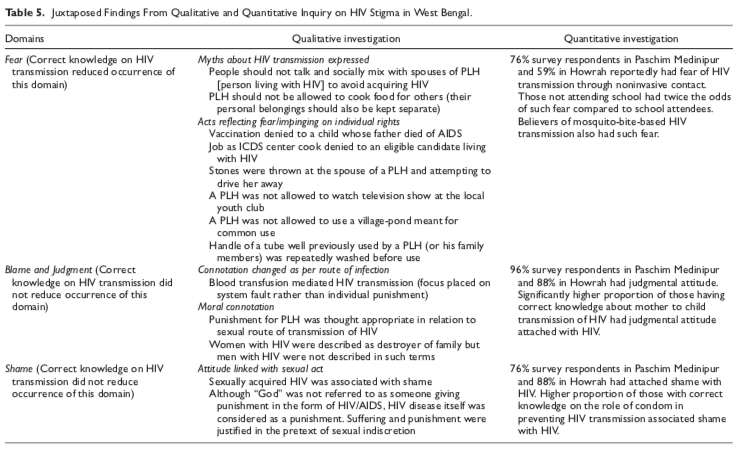
One question is how to present qualitative and quantitative information together in an efficient format (fitting within journals’ word limits). Guetterman showed a nice example from Panda et al. (2015). These authors present findings by theme, with columns for the qualitative summaries and quantitative statistics. A third column could present reflections on divergences and convergences.

Panda, Samiran, et al. “Exploring stigma in low HIV prevalence settings in rural West Bengal, India: Identification of intervention considerations.” Journal of Mixed Methods Research 9.4 (2015): 362-385

a discussion of Civic Studies at Tufts

Here is a recent discussion of Civic Studies. The audience was Tufts alumni. The speakers (from left to right) are Tisch College’s Associate Dean Diane Ryan; Prof. Hilary Binda, who runs the Tufts University Prison Initiative at Tisch College; Prof. Alnoor Ebrahim of the Fletcher School and Tisch College, whose next book is  Measuring Social Change: Performance & Accountability in a Complex World; and me. We discuss what “Civic Studies” means at Tufts. Much more is written about it here.


social media and the youth vote

CIRCLE has released a highly substantive analysis of social media and the 2018 youth vote that is worth reading in full.

It probably won’t surprise you that many young adults heard about the election on social media. In fact, it might be worth pausing over the fact that only 47 percent saw something about it on Facebook, Instagram, Snapchat, and/or Twitter. It is possible to go through an election cycle without seeing much about politics on social media if your friend-networks are apolitical. We talk a lot about polarization into left and right, but an equally significant phenomenon is the division between political and apolitical Americans. That was less of a problem when people got their information from sources like broadcast TV and newspapers, which forced everyone to see political headlines.

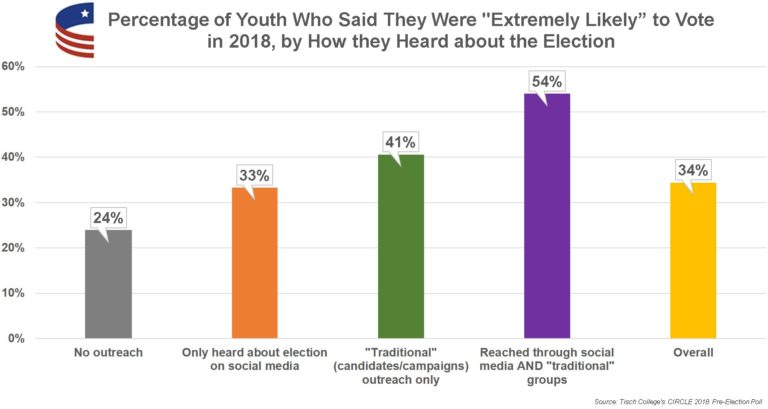
More than one quarter of young adults heard about the election only on social media, not from traditional outreach by campaigns, candidates, and parties. That probably means that social media is expanding the number of youth who are engaged in the election.

The more you hear about an election, the more likely you are to vote. Compared to young adults who had heard about the election both on social media and from campaigns or candidates, young adults who recalled no outreach were less than half as likely to say (in October) that they were extremely likely to vote.

Some selection is at play here. If you are already a likely voter or part of a community that is seen as active, campaigns are more likely to contact you. If you have friends who vote, you are more likely to see information about the election online, but you might have voted anyway. Maybe you even pick friends who are into politics. Still, evidence from randomized experiments shows that outreach boosts turnout, and at least some of these differences must be attributable to the effects of outreach.