a template for analyzing an institution

If you want to analyze an institution–whether it’s the local police department, marriage, or Facebook–an excellent guide is the Institutional Analysis and Development (IAD) Framework developed by Elinor Ostrom and colleagues, which is an encapsulation of the lifetime of work for which Ostrom won the Nobel Prize. It is shown below in a graphical form, and a very helpful, concise guide is McGinnis 2011.
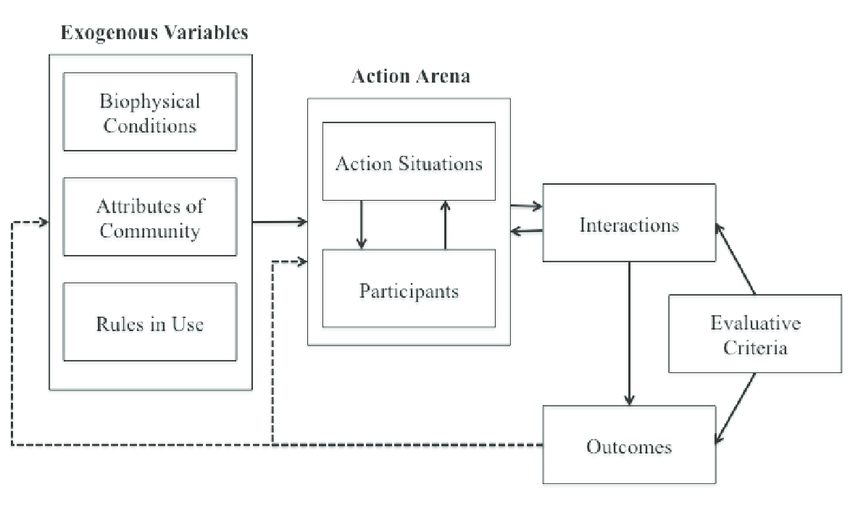
The Institutional Analysis and Development (IAD) Framework (Schoon, 2015 after Ostrom et al., 1994, p. 37)

I would divide the analysis into the following 23 questions. These questions basically cover the same issues as in the diagram above, working from left to right, but they don’t match up precisely because I draw on my own idiosyncratic influences.

  1. What is the institution? What is its name? How would you define it uniquely, and which people, resources, locations, etc. does it involve?
  2. What problem or set of problems interests you about it? This problem may be a failure (the institution doesn’t yield the intended results) or an injustice (it has bad results), or it could be the intellectual problem posed by its success: why does this institution work and can we replicate it?
  3. What other institutions are closely related to it, and how?
  4. Which institutional form(s) does it reflect, e.g., a government, a firm, a market, a network, an association, a community?
  5. What are important relevant biophysical conditions? What natural resources does it use, and which natural processes come into play? What characteristics of these resources and processes are relevant to the institution: e.g., scarcity, fragility, adaptability, ability to reproduce and grow, interdependence, tendency to move?
  6. What are important technological conditions, where “technology” means the relevant affordances and limitations that have been created–or will predictably be created–by human beings?
  7. What cultural meanings (in the sense of Geertz 1973) are involved? Are these meanings shared or disputed?
  8. To what extent can we detect wholes, rhythms, hierarchies, and networks in the institution (C. Levine 2015)? How do these forms interrelate?
  9. What official, formal, usually written rules govern the institution? What are its rules-in-use? (These may diverge from the official rules.)
  10. Are the rules grounded in phenomena beyond the institution? For instance, an institution might use a currency whose value is determined by other institutions. Tufts runs on an academic calendar related to the solar calendar, which is grounded in the motion of the earth. (Grounding is different from causation.)
  11. What goods are relevant? Who has which kinds of ownership over which goods? Are the goods subtractable? Are they excludable?
  12. Who are the relevant actors?
  13. What choices confront each actor? What does each actor know about the available choices?
  14. What does each actor value, and why?
  15. Under what conditions do the actors choose (e.g., with or without discussion, once or repeatedly, simultaneously or in turn, with or without knowledge of what the others are choosing)?
  16. What are the consequences of the most important or most likely combinations of choices made by all the actors?
  17. Are these consequences desired by the actors?
  18. Are these outcomes desired by people who are not among the actors?
  19. Are the outcomes fair or just by various normative criteria?
  20. Are they sustainable–meaning a) literally repeatable many times, and/or b) good for nature?
  21. How do the outcomes affect the issues raised in questions 1-15? In other words, do the outcomes of the institution change the institution itself, in a feedback loop?
  22. What deliberate changes in institutional forms (4), technologies (6), meanings (7), rules (9-10), or values (13) would produce preferable outcomes according to the criteria raised in questions 17-19? (I focus on 4, 6, 9-10, and 13 on the ground that these are the factors we can most readily change. Factors like the biophysical conditions and the relevance of other institutions are harder to influence.)
  23. How can we go about altering the institution in the light of 21?

Geertz, Clifford (1973) Thick description: Toward an interpretive theory of culture. The interpretation of cultures: Selected essays (pp. 3-30). New York, NY: Basic

Levine, C. (2015). Forms: Whole, rhythm, hierarchy, network. Princeton University Press.

Mcginnis, Michael. (2011). An Introduction to IAD and the Language of the Ostrom Workshop: A Simple Guide to a Complex Framework. Policy Studies Journal. 39. 169 – 183. 10.1111/j.1541-0072.2010.00401.x.

See also: insights on police reform from Elinor Ostrom and social choice theory; Elinor Ostrom, 1933-2012; why I still believe in institutions; should all institutions be democratic?; what defines an organization?; and against methodological individualism.

when political movements resemble religions

In The Atlantic, John McWhorter suggests analogies between current movements against racism and religious revivals:

Third-wave antiracism is a profoundly religious movement in everything but terminology. The idea that whites are permanently stained by their white privilege, gaining moral absolution only by eternally attesting to it, is the third wave’s version of original sin. The idea of a someday when America will “come to terms with race” is as vaguely specified a guidepost as Judgment Day. Explorations as to whether an opinion is “problematic” are equivalent to explorations of that which may be blasphemous. The social mauling of the person with “problematic” thoughts parallels the excommunication of the heretic. What is called “virtue signaling,” then, channels the impulse that might lead a Christian to an aggressive display of her faith in Jesus.

… The new religion, as a matter of faith, entails that one suspends disbelief at certain points out of respect to the larger narrative. ….

When someone attests to his white privilege with his hand up in the air, palm outward—which I have observed more than once—the resemblance to testifying in church need not surprise. Here, the agnostic or atheist American who sees fundamentalists and Mormons as quaint reveals himself as, of all things, a parishioner.

McWhorter presents this analogy as a critique. He advises: “Social concern and activism must not cease, but proceed minus the religious aspect they have taken on.”

One obvious question is whether McWhorter is right that the anti-racist left is losing because of its rhetorical style. Jeffrey Sachs, for example, thinks it is winning.

But I am interested in a different question: why does political ideology often resemble religion? After all, anti-racist politics is not unusual in this respect.

  • Environmentalism offers an account of original sin (human exploitation of nature), an eschatology (the planet will be wrecked by greed and waste), authorities (climate scientists) whose conclusions must be trusted even though we can’t see or replicate what they see, heretics (climate skeptics), a moral critique of everyday behavior, and a path to salvation through sacrifice.
  • Libertarians define original sin as the influence of the state, which relies on violent force. Its tentacles reach into everyday life through taxation and regulation, corrupting the free condition of voluntary exchange. The state has a satanic tendency to expand, preying on human weakness. Until freedom is restored, libertarians should gather to read scripture (Hayek, von Mises) and convert wavering souls.
  • Marxism offers the whole package: scripture, prophets, martyrs, hymns, icons, metaphysics, eschatology, multiple denominations and sectarian schisms, heretics and excommunications, revival movements, fundamentalist and revisionist strands …

This list could probably be extended to include New Deal liberalism, various forms of nationalism, third-wave feminism, Bonapartist populism, etc.

A resemblance to religion does not invalidate a political movement. I am an environmentalist and I am not shaken by the fact that environmentalism bears a point-by-point similarity to Protestant Christianity. Faith in climate science is a necessary step to saving the planet. Maybe confessing white privilege is a necessary step to racial justice.

But we might ask: do these political movements so closely resemble religions because we have mental habits that we lazily or uncritically apply to new domains? Could we be more effective if we were more original?

Alternatively, are these excellent ways for human beings to organize our thoughts, and that is why they have reappeared in secular contexts after first flourishing in religions?

Also, are these forms of thought characteristic of religion, or only of Abrahamic religions? Some aspects of environmentalism and libertarianism (original sin, individual responsibility as part of voluntary groups) remind me specifically of Lutheran Christianity. They don’t sound at all like Buddhism, for example. Does that mean that these movements are problematically “Western”? Or did the Reformation give us tools for understanding and improving the world that we should be glad to use for other purposes?

See also: is everyone religious?; are religions comprehensive doctrines?; the political advantages of organized religion; the I and the we: civic insights from Christian theology; and avoiding the labels of East and West.

what the humanities contribute to interdisciplinary research projects

Cases for Culture is an initiative that explores “a Hybrid Genre of Scholarship between STEM and the Humanities.” One of the cases on its website is an interdisciplinary study that I am part of. We are investigating the impact of a new arts center on Boston’s Chinatown, with a focus on whether it combats the negative consequences of gentrification. Our team encompasses humanists from Drama & Dance and social scientists from Public Health and Urban and Environmental Policy and Planning, with me (a philosopher morphed into some kind of social scientist) as the PI.

The question for this post is: What do the humanities contribute? What can they offer that is not available from the social and behavioral sciences? I’d suggest:

  1. Answers to the question: What is this thing? What should we call this human-made practice, artifact, or phenomenon? What adjectives may we apply to it?
  2. Is it good? “Good” here is a shorthand for other value-laden concepts, such as “authentic,” “equitable,” “beautiful,” “liberatory,” and many more.

In our study of the Pao Arts Center in Chinatown, I take these to be social science questions: Who attends arts events? Why? What happens to them as a result? What are the broader consequences? How and why is the Center supported?

But I take these to be humanities questions: What are the performances that people see at Pao? For instance, is a given performance rightly named a “classical Chinese opera”? If so, what does that mean? What are its origins and boundaries and how has it varied? Or: what is the building in which Pao is situated? Is it a “modern” high-rise? A work of “Western” architecture? And can we call a specific classical Chinese opera performed in a specific way in a particular 21st-century high-rise in Boston’s Chinatown “authentic,” “traditional,” “innovative,” “appropriated,” “self-conscious,” “popular,” “elitist,” or “subversive”?

To address those questions, one must interpret the cultural product itself. Putting the interpretation together with social scientific findings about causation creates a powerful hybrid. Only through this combination can one say whether it is desirableto introduce a certain genre or style of culture into this social context.

Some caveats:

First, the disciplines are not as sharply distinguishable as I have implied. Any person can contribute to inquiries within any discipline (if given appropriate support and a willingness to learn). And each discipline is continuous with everyday human cognition. Even astrophysics is a distant extension of our ordinary interactions with physical objects and our naked-eye stargazing. Still, disciplines extend our everyday cognition in impressive ways. Like other forms of specialization, they enable greater sophistication. The humanities dramatically extend our everyday capacity for interpreting the deliberate creations of other human beings.

Second, in claiming that the humanities address the question “What is this?” I do not imply that a given artifact has an essence. The Pao Arts Center, for example, is an assemblage of very diverse performances, each performed by many people who have diverse intentions, for notably heterogeneous audiences in a complex space that evolves over time. So any responsible answer to the question, “What is the Pao Arts Center?” must be long and complicated. It’s an essay question, not multiple-choice. But that simply reinforces the importance of the question. A cultural product is not like a chemical compound that has predictable effects in a body. Complex as chemistry may be, culture is much more so.

Third, I don’t mean that humanists monopolize normative (moral, ethical, political, and aesthetic) judgment. All human beings have rights to make their own judgments; claiming expertise about the right and the good is problematic. Still, the humanities tend to pose relatively subtle questions that have normative implications–not “Was that a good show?” but rather “Was that a traditional rendition of the opera?” “In what ways was it innovative?” Expertise is useful for these questions. Also, the humanities demand reasons for normative claims. In a peer-reviewed article, you don’t just assert that a work of art was (for example) “appropriated.” You argue for that thesis. Thus the humanities represent the everyday practice of deliberation–giving reasons for value-laden interpretations–made more sophisticated by specialization.

See also what are the humanities? (basic points for non-humanists)an empirical study of the humanitiescan the arts mitigate the harms of gentrification? A project in Boston’s Chinatown; the Tisch Program in Public Humanities; and how to tell if you’re doing good

Habermas with a Whiff of Tear Gas: Nonviolent Campaigns and Deliberation in an Era of Authoritarianism

Just published: Levine, Peter (2018) “Habermas with a Whiff of Tear Gas: Nonviolent Campaigns and Deliberation in an Era of Authoritarianism,” Journal of Public Deliberation: Vol. 14 : Iss. 2 , Article 4. 

Abstract:

Authoritarianism is gaining around the world. Statistics show that deliberation shrinks when authoritarianism grows. In the face of authoritarian repression, directly promoting and organizing deliberation is likely to fail. However, Erica Chenoweth and Maria J. Stephan (2011) find that nonviolent campaigns have a strong record of success against authoritarian states. Although nonviolent campaigns are not themselves deliberative or aimed at building deliberative democracy, I argue that some of the reasons that make them successful also stand to benefit public deliberation. Thus the most promising strategy for expanding deliberation in an increasingly authoritarian world is to support nonviolent campaigns and to reinforce strategies of nonviolent confrontation that also yield deliberation. Jürgen Habermas anticipated this argument in his defense of social movements. Revisiting that aspect of Habermas’ thought challenges interpretations that treat him as a theorist of calm, rational discourse.

I’m grateful to the Journal of Public Deliberation for commissioning this piece. At first, I wasn’t sure I had an article to contribute, but now I see its thesis as fairly central to my political philosophy. I’ve long been drawn to deliberative modes of politics, in which people listen and learn before they act. But I have also always believed in contentious politics: nonviolent but confrontational modes like strikes and occupations. Here I put them together.

This is also the first appearance in peer-reviewed form of my “SPUD” framework, which has proven useful in more practical contexts. For instance, I presented it at an #Indivisible gathering that ended up in this Washington Post article.

Finally, I’m grateful to appear in the special issue on “Deliberative Democracy in an Era of Authoritarianism.” The other articles are good and make a coherent whole. A running question is whether carefully designed deliberative fora (“minipublics”) are part of the solution to authoritarianism, irrelevant to authoritarianism, or a potential tool of repression. If they are part of the solution, what else is needed to accompany them? I’m close to the part of the spectrum that says “they’re irrelevant,” but the range is helpful.

you can go home again

(Syracuse, NY) I’m in the city where I was born and raised but haven’t resided in 33 years. 

One result of this kind of visit is to make the intervening years fold away like a picture book put back on its shelf. When we travel to foreign places, I find that all the vivid new experiences stretch time. The journey feels long; regular life feels distant. But as soon as we’re in the airport on the way back home, the days of travel shrink to a finite memory, as if we’d had a few moments away.

The same can happen to decades. A third of a century seems rich and complex while you live it, but returning to where you began shrinks those years back to size.

Another result is a reminder of how little detail we retain. I once knew all kinds of information: What would you see if you turned that corner? Who lives in that house? What minor joy or sorrow once accompanied that building for me? It’s all flattened by the slow passage of years.

See also Mike Kelley, Jim Shaw, and memories of Rust Belt adolescencethe Times’ poverty mapportrait of a librarymy home as described by Stephen Dunn; and three poems about the passage of time: nostalgia for nowechoes; and the hourglass.