What is the appropriate role for higher education at a time of social activism?

(Posted in Madrid) In the current issue (and available free online) is my article entitled, “Another Time for Freedom? Lessons from the Civil Rights Era for Today’s Campuses,” Liberal Education, Winter 2019, Vol. 105, No. 1.

This is the first of several pending articles in which I explore the interactions between social movements and institutions. My motive is to encourage people who sit in institutional settings to pay attention not only to activists who make demands but also to the movements to which these activists belong. In order to relate appropriately to a given movement, it’s important to assess whether it has robust internal discussions, whether it is a space for learning, how it develops leaders, what norms it enforces on its members, and other such characteristics. Interpreting a movement is valuable whether you want to be a good ally, merely treat the movement fairly, or actively counter it because you oppose its influence.

In this piece, I use as a hook a fascinating New York Times op-ed by Dr. Martin Luther King, Jr., in which he described the movement that had engulfed Historically Black Colleges and Universities by 1961. A sample passage from my article:

In the model of civic action that King describes, college students plug into national social movements that have leaders and organizations outside higher education. The students’ involvement is youth-driven: students recruit other students to participate. …

Like most participants in social movements, the students King describes in the Times essay have transformational goals. They do not aim to modify the policies and practices of existing institutions—such as their own colleges—but to rebuild or reconstitute the whole society. Student activists, King writes, are “seeking to save the soul of America. . . . One day historians will record this student movement as one of the most significant epics of our heritage.” Today, movements like Black Lives Matter and climate activism do not merely advocate specific policies but attempt to fundamentally transform society, from white supremacy to racial equity, or from carbon-dependence to global sustainability.

By contrast, colleges and universities—including the HBCUs of 1961—are institutions. As such, they are inevitably led by people who have extensive experience, who must therefore be older. Institutions can encourage youth voice and can change as a result of social movements. For instance, a range of curricular and policy reforms that promote greater racial equity and diversity can be traced back to the civil rights movement. But institutions will predictably resist more radical transformations. They are not movements; they are targets of movements.

The tension between movements and institutions is inevitable, but higher education has a particular commitment to ideological pluralism and debate. Although pure neutrality is impossible and a misleading ideal, colleges and universities must demonstrate a reasonable degree of impartiality about the contested issues of the day. As academic institutions, they value reflection and “organized skepticism.”11

When today’s colleges and universities go beyond classroom teaching to offer experiential civic education, a typical model involves supporting students to choose and define their own issues and to develop and implement plans of action—not signing them up for specific social movements that will demand sacrifice. Often, an institution’s recruitment takes the form of a general invitation to civic engagement, civic learning, or dialogue, not a call to join a movement.

See also: pay attention to movements, not just activists and events; the value of diversity and discussion within social movements; social movements of the sixties, seventies, and today; a sketch of a theory of social movements

how to improve the civil society of a school

Students learn to be citizens by joining, forming, leading, and influencing extracurricular groups in their own schools. A school’s whole array of groups is its “civil society.” The number, diversity, reach, purpose, vitality, and interconnection of these groups is important for youth development, generally, and for civic education, in particular.

Discussing this topic with teachers this morning, I received an excellent question. How should we encourage all students to participate? What should we do about the fact that 9th-graders sign up for many groups but membership trails off fast? How about the students who are too busy because they work? And what about the kid who wears headphones all day and just doesn’t want to connect?

I think I began my reply with two caveats. First, I don’t know how to motivate teenagers nearly as well as teachers do. And second, some kids really may face serious barriers to membership, no matter how hard you try to include them.

That said, the challenges of a school’s civil society are like those of any civil society. Like teenagers, adults exhibit different degrees of commitment. They drop out when they lose interest or as a response to disagreements. Many free-ride, staying in a group to get its benefits without doing a fair share of the work. Some work extra hard and well but aren’t noticed.

Addressing these problems constitutes Alexis de Tocqueville’s “art and science of association.” It’s never easy but there are good practices. Impose regular penalties for non-contribution but make initial penalties very light so that they are actually enforced and violators can recover easily from being penalized. Keep a clear and public list of who belongs and who doesn’t and clarify what constitutes membership versus exit. Rotate responsibilities. Incorporate low-cost methods of monitoring compliance, such as sign-in sheets. Implement efficient mechanisms for conflict-resolution. (For these principles, see, among other sources: Ostrom, Elinor. “Design principles and threats to sustainable organizations that manage commons.” Santiago, Chile, March. 1999.)

Learning these practices is a core task of civic education. We traditionally learn them only from experience, but it is possible to learn some of them from texts and discussion. Students who learn to lead groups are better placed than any adults to actually generate viable groups in their own schools. Thus I would recommend teaching strategies for recruitment and group-management explicitly, and then encouraging student leaders to be primarily responsible for the vitality of their own civil society.

See also a portrait of American teenagers’ out-of-school life; and class disparities in extracurricular activities.

the ethics of playing hardball with the federal budget

Congress must pass appropriation bills by late September and must raise the debt limit by about Oct. 1 to allow the government to pay its bills. Failure to do either will have substantial economic impact. Neglecting to raise the debt limit could be catastrophic, since the federal government has never defaulted before.

A solution could either be a real agreement or a mere patch–a bill that continues current spending levels for a few months and raises the debt limit enough to get us to the next short-term deal.

Since the economy seems fragile, and federal (and state) elections are a mere 16 months away, the political stakes are high. In fact, I think the negotiation over the budget and debt limit is the most important political story of the present moment.

Conventional wisdom holds that an incumbent president has more to lose from a sudden recession than members of Congress do. Thus Donald Trump is probably most at risk if there is no deal. Although most Americans disapprove of his economic policies, I still think his popularity would fall further if we entered a recession.

For their part, the Democrats must decide how hard to bargain. That is an ethically complex question, and it confronts not one actor (an imaginary, monolithic party) but many Democratic members of Congress who have disparate values and interests.

Democrats have good ethical reasons to play hardball. They have policy goals (spending, immigration, climate) that they can advance by forcing Trump to swallow compromises. By pushing hard, they risk a government shutdown or a default, but the moral responsibility for a crisis would be shared. Whatever happens, we are headed for a recession at some point, and the country may be better off if it comes in time to unseat Trump rather than late enough that we must weather the downturn during his second term.

On the other hand, Democrats shouldn’t intentionally drive Trump into an impasse because they are happy to hasten a recession. To see that that is wrong, apply Immanuel Kant’s test of publicity. It is unethical to do something unless you can admit you are doing it. That is especially true of political leaders in a republic, because it is definitive of republics that everyone must explain their actions to everyone else. I don’t think the Democrats could face the electorate saying that they had intentionally driven the economy into recession.

But there is a fine line between: (a) driving a hard bargain for good causes while not worrying overly about the collateral risk to the economy and (b) actively pushing a breakdown in order to cause a recession and win the next election. I would drive right up to the edge of (b) but not over that line.

A subtler question is what to do about raising the domestic discretionary spending limits. Democrats believe that raising these caps will truly help people. However, increasing spending without raising taxes is a fiscal stimulus. As such, it has some potential to forestall a recession. Thus raising the domestic spending limit is win/win for Trump and the congressional Democrats (although an ideological loss for congressional Republicans). The problem is that a win/win deal could get Trump re-elected. I think I would bargain hard on immigration and climate regulation and give way on domestic spending for this year.

See also: on playing hardball with the shutdown (2019); should Democrats play constitutional hardball in 2019-20?; avoiding arbitrary command

the First Ibero-American Meeting of Civic Studies

This week is the 11th annual Summer Institute of Civic Studies at Tufts’ Tisch College, and we are discussing such topics as identities versus interests and opinions and Gandhi versus Jinnah on means and ends. (The links are to my personal ruminations, but in the seminar, we discuss original texts.)

Coming up soon is the First Ibero-American Meeting of Civic Studies, which two of my friends explain in the video:

According to my translation from the website:

Improving a society requires the commitment of its citizens. Based on this conviction, the Camilo José Cela University Foundation presents the First Ibero-American Conference on Civic Studies, following the trail of the pioneering institution of this academic discipline, the Jonathan M. Tisch College of Civic Life of Tufts University (USA).

The objective is to create a theoretical and methodological framework to promote active citizenship. Civic Studies tries to answer the question “what should we do?” Combining ethical reflection (what is good and right?), analysis of the facts (“what is happening”?) and strategies (” What could work? “). Based on this eminently practical call, Civic Studies tries to make civic education in colleges and universities have a transformational purpose.

The First Ibero-American Meeting of Civic Studies is an initiative of the Camilo José Cela University Foundation. It aims to promote this understanding of civic education in the Ibero-American context. Despite the social and cultural diversity of the countries convened [Argentina, Brazil, Colombia, Ecuador, Guatemala, Mexico, and Spain], the UCJC Foundation believes that the development of this academic discipline can serve to cultivate active citizenship that contributes to the creation of more stable and just societies.

In this first edition, the theme of the meeting will be “The university as generator of citizenship.” We believe in a conception of the university in which both learning and research in any discipline is marked by the civic commitment of its environment. The meeting will involve a week of work between academics and experts with experience in citizenship training: through discussion and deliberation formats, attendees will work from a daily challenge posed by a guest expert, and exchange their own experiences when implementing civic education.”

what the student debt proposals convey

Elizabeth Warren proposes to pay off $50,000 of college debt for everyone with household income under $100,000. Bernie Sanders proposes to pay off all $1.5 trillion of today’s student debt. They also offer proposals for making college more affordable later.

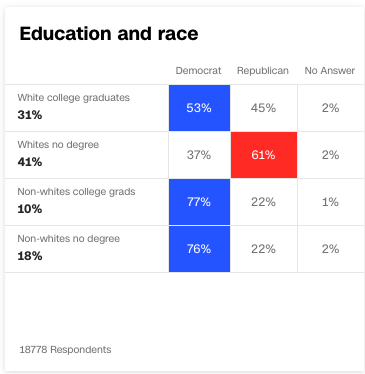
I am worried that both of these proposals–especially Sanders’–convey the message that Democrats and liberals represent high-status people who hold and value formal education. The reality is close to that: Democratic voters in 2018 were a coalition of whites with lots of education plus people of color from across the educational spectrum.

2018 national exit poll results

Directing financial support to higher education–and specifically retiring the debt of people who have already accumulated college debt–is an indication of the candidates’ priorities. I fear they will alienate people who don’t have or necessarily want advanced formal education. One of the major political cleavages of our age (also seen in Europe) divides knowledge-workers from people who work with their hands. The risk here is placing liberals and Democrats firmly on the knowledge-workers’ side. Or, as Antonio Gramsci would say, the “organic ideology” of a governing class dominated by the intelligentsia will favor spending money on education above almost anything else.

I do understand the following arguments. Education should be understood as a public good, not just an investment in the income prospects of the individual student. We already treat k-12 education as a public good and an entitlement. Since college now confers the same advantage that high school did half a century ago, it should be treated the same.

Furthermore, programs without means tests tend to be protected and reasonably well funded, whereas programs for the poor tend to be poor programs. Examples of successful universal programs include Social Security and Medicare here and most of the European welfare state.

Finally, even when a program covers wealthy people, federal income taxes (as opposed to other taxes) are collected in a pretty progressive way, so most of the cost falls on the wealthy.

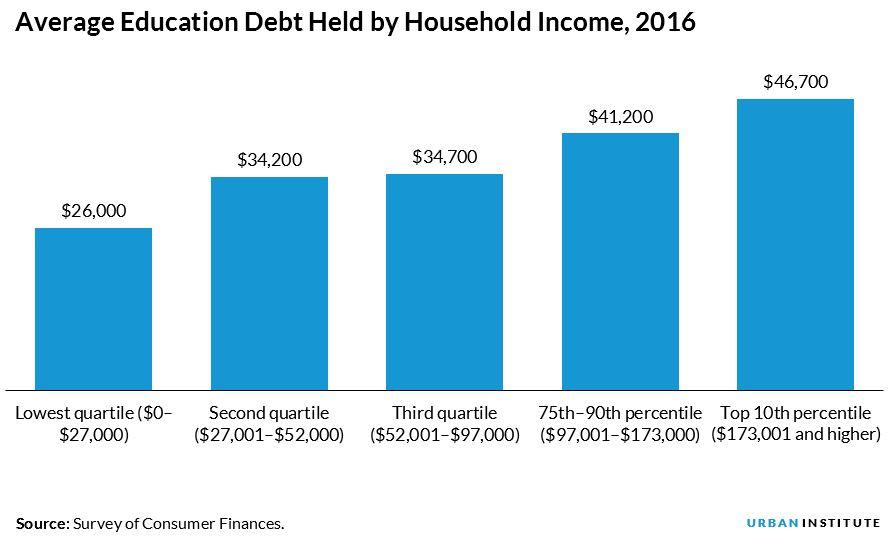
On the other hand, as Jordan Weissman notes, one-time debt cancellation is not an entitlement or a program built for sustainability. Moreover, Sanders’ plan involves truly regressive spending. Families earning $173k or more hold an average debt of nearly $50k, which the federal government would hand them as tax-free income under his plan.

You could counter that families in the bottom quartile–who have real need–hold an average of $26k in college debt, usually more than their whole annual household income, and forgiveness would make the most difference to them. But it would also cost $1.5 trillion that could be spent on other things. And yes, even if the President of the United States calls himself a socialist, he’ll have limited resources and will have to choose. For instance, that’s $1.5 trillion that could have been added to a Green New Deal.

These proposals have a communicative goal. They convey that education is a public good and that we should all benefit from government support. The proposals are very unlikely to pass as written, and if they fail, they will prove to be mainly symbolic. Even if they pass, they will still have symbolic elements. For instance, the message that they cover everyone is meant to change opinions about government.

So I worry about what these ideas–especially Sanders’–actually convey. Democrats, especially White Democrats, have typically benefited from formal education and value it in everything they say and do. They admire science, professionals, credentials. If a Democratic president and Congress spend $1.5 trillion to subsidize higher education for people like themselves, that will cement the party’s class position.

See also college and mobility; what does the European Green surge mean?; working-class people versus elites on education; and why the white working class must organize