My family and I were in Delhi and Rajasthan over the winter break, and I cannot resist some notes. I offer them with intellectual humility, understanding that India is a vastly complex place, our experience was superficial, and I cannot grasp many aspects of Indians’ experience, starting with what it’s like to live on $616/year (a plausible, although dated and contestable, estimate of the median per capita income).
Furthermore, we were tourists, often following a paid guide, riding in a van with a professional driver, or staying in a nice hotel. These are colonial experiences, almost literally; some of the hotels where we stayed had been residences for British authorities. Modes of interaction still harken to colonial days. When I dropped a tissue as I tried to say namaste to a hotel employee, he leapt to pick it up faster than I could have moved my hand downward.
I fully recognize how problematic all of that is, although my (debatable) justification goes as follows: We are already deeply tied to India, already affecting it with the goods we buy and the carbon we pump into the air—and in many other ways—and there is something to be gained by getting at least a bit closer. But there is also a risk of overestimating one’s own learning. A little knowledge is a dangerous thing; hence the need for serious humility.
(By the way, as a side-note on tourism: relatively few European sightseers are visible in India, except at the most famous locations. Almost everyone from the United States is visiting the homeland for a family function. This is not a country overwhelmed by global tourism, and developing the industry more may be beneficial. But you do see many Indian travelers and sightseers—crowds visiting temples and other holy places in relatively traditional ways, youth taking selfies outside of historical monuments, and large, affluent, multigenerational family parties speaking Hinglish.)
Politics
India is experiencing substantial protests against a set of policies introduced by the Modi Government that threaten India’s secularism and the equal standing of its Moslem citizens. We saw no signs of actual protests but did avoid certain parts of Delhi that we would otherwise have visited. I tried to follow local news and the commentary of Indians I respect, such as the excellent Ramachandra Guha. In general, I have nothing to add to their analysis and would question my right to express political opinions about India. But I will comment on one experience.
Our guides, to the extent that they were open to discussing politics, were all pro-Modi BJP voters. They identified strongly with specific kshatriya castes. They presented the history of India as the story of a Hindu “we” that has been conquered by waves of outsiders, including Moslems. In Mogul sites, they emphasized the Hindu temples that had been destroyed to build the visible mosques or mausolea. They complained about affirmative action. They blamed the current protests on Modi’s opponents for “politicizing” his proposals. They presented the Prime Minister as strong and effective and as finally addressing issues never before touched since Independence. (They may have been referring to corruption, but I suspect they also meant Hindu nationalist issues.) They romanticized the Rajput rulers of Rajasthan and their close relationships to British imperialism. They implied that Moslem invaders had wounded India but that Hindu feudalism and British colonialism were colorful episodes. One should adjust for possible politeness to white visitors, but I thought their “saffronisation” was sincere.
For what little it’s worth, I stand on the opposite side of all these issues. I think Islam is an integral part of India’s richness; caste is a problematic inheritance; affirmative action is appropriate (if it works, which I don’t know); and Modi’s India risks losing its character as a “sovereign socialist secular democratic republic” with “liberty of thought, expression, belief, faith and worship;” “equality of status and of opportunity”; and “fraternity” among all its people.
But our guides were also nice people—striving to raise good kids and to play constructive roles in their communities; kind to strangers. It was a little like spending time among solid #MAGA voters in the USA (except that Modi is much more competent than Trump, the left alternative is less credible in India, and there are ways of understanding Modi’s rise that make it seem almost inevitable—see Taylor Cowen).
It’s always smart to hold two thoughts in your mind. First, we should strive to identify justice and injustice. For instance, I think that BJP-style Hindu nationalism is unjust; it puts 200 million Indian Moslems at serious risk. Second, people who do not understand justice as I do are still complex, ambivalent, sensitive, fellow human beings, conditioned as I am by their circumstances and usually trying to do their best.
Streetscape
The following is a composite, based mainly on Jaipur and Bundi. It could be more accurate if I’d taken ethnographic notes, or even snapshots as reminders. But the ethics of that degree of scrutiny bothered me a bit, so I chose to just absorb and write much later from stored impressions.
I’m in a narrow but busy street in the town center, as opposed to one of the back alleys that are more residential.
It would be misleading to describe this spot as crowded—say, compared to a street in downtown Boston. The number of people per square mile is probably much lower in an Indian town, because the buildings average 2-3 stories and there is plenty of space among the people whom you can see outdoors. They are not pressed together. But the mix of activity is astonishing.
In the street itself: men working on small-scale industrial or mechanical tasks—banging on metal, for example—or women in saris squatted by vegetables for sale. Almost always, several dogs are sound asleep on their sides, oblivious to the traffic that navigates around them. A cow, ambling along, browsing on the garbage. Maybe a small bristly pig with piglets. A constant parade of motorcycles and scooters, with the occasional auto-rickshaw, and rarely a car or van. Almost every vehicle honks as it passes. Often the motorcyclist is a solo young man, but sometimes you see a pair of women in saris, or two men with a child between them, or an old man with a long white beard, curled mustache, and turban.
Parked motorcycles here and there; an open sewer along one side of the road. People walk up and down, some on cell phones, some with small children, some in traditional Rajasthani clothes, fabulously colorful, and some looking like they bought their wardrobes in an outlet mall.
Moving up: small stores selling food, drinks, and specialty items. Professionally printed signs announce the names of the businesses in English or Hindi. One proprietor is a Moslem man in a scullcap. A Jain temple with flags might be visible a little further down.
Some of the addresses are empty except for rubble or partial construction. A family of black-faced monkeys lopes along a wall. A German shepherd that must be a true family pet looks down from a balcony, barking at the street dogs below. Signs and advertisements are posted at various levels. A relief of Ganesh, covered in silver foil and daubed with yellow.
Higher up: small, square colorful kites, flown from rooftops. A cloudless sky with a thin haze. Sounds of horns, drumming and singing, the Call to Prayer.
Environment
We arrived in Delhi after the really bad smog season had ended for 2019. Yet the air was thick enough that you could easily see it even inside well-constructed modern buildings like the airport or the Marriott, swirling around the lighting.
Amartya Sen once argued that the average Indian should use more carbon. That will be necessary for such major life-improvements as full-sized apartments constructed of concrete, refrigeration, and heating in the chilly winter. Clearly, for each Indian to consume more carbon either means even deeper cuts in the developed world or a technological deus ex machina.
But the level of particulate emissions in Indian cities (not only Delhi; the air was just as bad in Jaipur) is a health crisis for residents, and local cuts are required to address that problem. In that sense, the global benefits of reducing emissions in India are consistent with local needs, not in conflict with them. The same is true of planting trees to lower local temperatures, which the Government is doing. You do see solar panels in the countryside—far fewer than in Europe, but quite a few.
In a small town like Narlai, Rajasthan, which appears to be subsidized (by tourism, remittances, or the major temples, I am not sure which) you can also see the local benefits of environmental investment. There, most of the sewers are covered and there is relatively little trash. Townspeople still live interspersed with street dogs, cows, pigs, and monkeys, but everything feels healthier. Narlai may be sanitized in some problematic way that I do not understand, but I think it is the result of spending more money per capita than in many other towns and cities.
Preserving heritage
Narlai is said to have 350 temples. Some are just roadside shrines, but there are several massive ones, including a stunning Jain building. Inside, its immaculate white surfaces are entirely covered in bas-reliefs and rococo architectural ornamentation, the whole making a peaceful and harmonious impression.
In a place like this, my own ignorance is deep. I am not even sure what language the signs are in, let alone their meaning. I know almost none of the iconography, I have the barest understanding of etiquette, and I cannot guess the history of the structure. Nor did I find any informative scholarly writing online about the Jain temple of Narlai.
But it seems that it dates from the 14th century. Many of the lovely and idiosyncratic reliefs are a bit weathered because they are seven centuries old. At the same time, the whole interior is as bright and symmetrical and perfect as if it had been constructed yesterday. And one can see that, in fact, new reliefs and ornaments are being carved and installed here and there right now. The 14th-century temple is at least partly a work of the 21st century—perhaps mostly so.
In a country like Britain or Italy, sophisticated viewers would recoil at this “restoration.” An old building should be left alone or restored only to the point of stability, with any additions clearly marked so that a viewer can see what is old and what is new. A massive renovation would be seen as destroying the historical record. That’s what Europeans used to do in the 1800s, dramatically reconfiguring buildings like Notre-Dame de Paris to meet their sense of what medieval buildings should look like. We don’t do that any more.
In India, too, the law forbids this kind of renovation. But that law appears not to be enforced, and the Jain community of Narlai—with evident wealth and influence—holds different values.
For my own part, I regret the loss of the 14th-century interior but am also a bit relativistic about the clash of values. After all, the Jains want their temple to look perfect and resplendently new for the same reason that 19th-century Europeans wanted to improve their gothic cathedrals. They believe. For believers, a religious structure is not a record of the past; an artistic style is not the mere expression of its time and place. The structure is a home for god; the style is right and good. If that’s the case, why not fix the building to make it look as good as possible? To turn it into a museum is to deny its intended meaning.
It is no coincidence that the countries that are most concerned about historic preservation are also the most secular; and in a way, the past is not at all conserved. We turn places like churches into something entirely new even as we strive to make them look as they did originally.
Perils of sentimentality
The Rajasthani town of Bundi is dominated by a great fortified palace built into a steep mountainside. With many layers of arches, doors, porticoes, terraces, and battlements, it looks like a background shot from the movie of The Lord of the Rings. Kipling said it must have been built by goblins, not men.
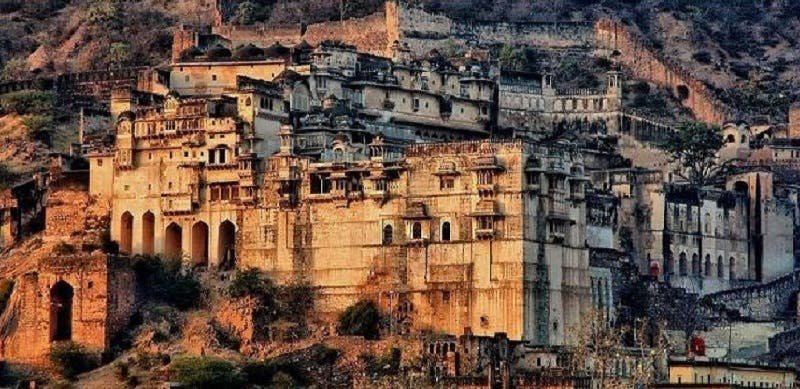
Its ownership has been tied up in a court case filed in 1984, so essentially no one holds property rights to it right now. Much of the vast and multistoried interior has been given over to bats and monkeys. But near the top is a well-preserved maharajah’s harem, with gardens, exquisite miniature paintings of Hindu texts on all the walls and ceilings, and elaborate mosaic inlays. In one small room, almost touching each other, are the henna handprints of five or six ladies with slender fingers. We were told that they placed these prints as they left for sati, to be burned alive on the funeral pyre of their deceased husband.
That is a touching sight in a place saturated with both beauty and subjugation. What did these women think as they pressed their hands to the wall? What did they expect after death? What did they think of the lives they were about to leave?
And yet, what are we doing here, listening to this story about sati (which may or may not be true), we four white people from Boston? The supression of sati was a major justification for British imperialism in India. In 1943, the British let 2.1 million-3 million Bengalis die by starvation. Why are we thinking about five possibly sacrificed princesses instead of millions of definitely sacrificed Bengalis? Why are we paying an Indian guide to tell us this story in this place? Why are we in India at all?
I think those are good questions, but I am definitely glad we went, grateful to all the gracious Indians who made the trip so easy, and hopeful to return. I would recommend that anyone go who can.