syllabus of a public policy course

I’m teaching Public Policy Analysis to undergraduate this spring–a new course. I’ve pasted the working syllabus (minus the grading rubric, rules about technology, and other practicalities) below. As always, comments and suggestions are welcome. I don’t think this design is a very unusual, but it may lean more toward institutional analysis (per Elinor Ostrom) than is common.

Objectives

To learn to analyze institutions and develop strategies that improve the world by changing these institutions or creating new ones. A good strategy must be just (which requires normative argument), effective, and politically viable.

Summary of Content

The class will first investigate one policy question together. That question is: Which students should attend which k-12 schools in the USA, and who should decide that matter? Concrete policy options include mandatory assignment to neighborhood public schools, school choice, charter schools, vouchers, etc. Every student will write a short paper on that topic.

Each student will then select one policy issue and write three 5-7-page essays that connect to produce one policy memo on that issue. As students conduct research for their individual papers, in class, we will discuss methods and theories of policy analysis.

Our overall framework will the Institutional Analysis and Design (IAD) framework developed by Elinor Ostrom and colleagues. We will use it both for the k-12 school example and for each student’s individual project.

IAD framework

Working with this framework, we will pose these questions:

  1. What is the institution? What is its name? How would you define it uniquely, and which people, resources, locations, etc. does it involve?
  2. What problem or set of problems interests you about it? This problem may be a failure (the institution doesn’t yield the intended results) or an injustice (it has bad results), or it could be the intellectual problem posed by its success: why does this institution work and can we replicate it?
  3. What other institutions are closely related to it, and how?
  4. Which institutional form(s) does it reflect, e.g., a government, a firm, a market, a network, an association, a community?
  5. What are important relevant biophysical conditions? What natural resources does it use, and which natural processes come into play? What characteristics of these resources and processes are relevant to the institution: e.g., scarcity, fragility, adaptability, ability to reproduce and grow, interdependence, tendency to move?
  6. What are important technological conditions, where “technology” means the relevant affordances and limitations that have been created–or will predictably be created–by human beings?
  7. What cultural meanings (in the sense of Geertz 1973) are involved? Are these meanings shared or disputed?
  8. To what extent can we detect wholes, rhythms, hierarchies, and networks (Links to an external site.) in the institution (C. Levine 2015)? How do these forms interrelate?
  9. What official, formal, usually written rules govern the institution? What are its rules-in-use? (These may diverge from the official rules.)
  10. Are the rules grounded  (Links to an external site.)in phenomena beyond the institution? For instance, an institution might use a currency whose value is determined by other institutions. Tufts runs on an academic calendar related to the solar calendar, which is grounded in the motion of the earth. (Grounding is different from causation.)
  11. What goods are relevant? Who has which kinds of ownership over which goods? Are the goods subtractable? Are they excludable?
  12. Who are the relevant actors?
  13. What choices confront each actor? What does each actor know about the available choices?
  14. What does each actor value, and why?
  15. Under what conditions do the actors choose (e.g., with or without discussion, once or repeatedly, simultaneously or in turn, with or without knowledge of what the others are choosing)?
  16. What are the consequences of the most important or most likely combinations of choices made by all the actors?
  17. Are these consequences desired by the actors?
  18. Are these outcomes desired by people who are not among the actors?
  19. Are the outcomes fair or just by various normative criteria?
  20. Are they sustainable–meaning a) literally repeatable many times, and/or b) good for nature?
  21. How do the outcomes affect the issues raised in questions 1-15? In other words, do the outcomes of the institution change the institution itself, in a feedback loop?
  22. What deliberate changes in institutional forms (4), technologies (6), meanings (7), rules (9-10), or values (13) would produce preferable outcomes according to the criteria raised in questions 18-20? 
  23. How can we go about altering the institution in the light of 22?

Book to purchase

  1. Sigal R. Ben-Porath and Michael C. Johanek, Making Up Our Mind: What School Choice is Really About (University of Chicago Press, 2019)
  2. Robert Pondiscio, How The Other Half Learns: Equality, Excellence, and the Battle Over School Choice (Avery 2019)

These will be in the bookstore but you are welcome to purchase electronic versions instead.

Criteria for assessing class participation:

  1. Attendance. 
  2. Engaging in a discussion that is informed by the assigned texts. 
  3. Focusing on the topic and the texts, which does not preclude drawing connections beyond them.
  4. Being responsive to other students. Responsiveness needn’t always be immediate, verbal, or occur within the class discussion itself.
  5. Building on others’ contributions, and sometimes making links among different people’s contributions or between what they have said and the text.
  6. Demonstrating genuine respect for the others, where respect does not require agreement. In fact, sometimes respect requires explicit disagreement because you take the other person’s ideas seriously.
  7. Taking risks, trying out ideas that you don’t necessarily endorse, and asking questions that might be perceived as naive or uninformed.
  8. Seeking truth or clarity or insight (instead of other objectives).
  9. Exercising freedom of speech along with a degree of tact and concern for the other people.
  10. Demonstrating responsibility for the other students’ learning in what you say (and occasionally by a decision not to speak).

Wed. Jan 15

Introductions. Some preliminary discussion of school choice based on our own experiences

Part I: School Choice

Wednesday, January 22

The original argument for choice

Mon, January 27

Historical overview

  • Sigal R. Ben-Porath and Michael C. Johanek, Making Up Our Mind: What School Choice is Really About, pp. vii-81

(Johanek will visit class via videoconference.)

Mon., January 29

Values: What are We Trying to Acccomplish?

  • Sigal R. Ben-Porath and Michael C. Johanek, pp. 83-129

Monday, February 3: no class (instructor is traveling)

Wed. Feb 5

Does Choice Work? Qualitative evidence

  • Robert Pondiscio, How the Other Half Learns: Equality, Excellence, and the Battle Over School Choice (2019); especially recommended pages: 3-51, 77-104, 111-113, 156-163, 175-179, 184-194, 210-219, 257-267, 271-279, 295-311, 320-340.

Visitor: Robert Pondiscio.

Monday, Feb. 10

Does choice work? Quantitative outcome studies

Wed. Feb 12

A Case Study with Multiple Perspectives

Meira Levinson, “Is Pandering Ethical? Power, Privilege, and School Assignment,” in Levinson and Jacob Fay, Dilemmas of Educational Ethics: Cases and Commentaries, pp.  143-78

(Feb 17: no class; President’s Day)

First paper due: 4-6 pages about school choice

Part II: Other Issues

Wed., February 19

Policy analysis: mainstream approaches

  • Bardach, E. A Practical Guide for Policy Analysis. (2000), excerpts

(Feb 17: no class; President’s Day)

Mon, Feb. 24

Unpacking institutions

 In class, we will build and operate an extremely simple institution by playing a “tragedy of the commons” game. We will apply the IAD framework to it.

  • Ostrom, Elinor. 1987. “An Agenda for the Study of Institutions.” Public Choice 48:3-25. Reprinted in McGinnis (2000), Chapter 3.  

Monday, March 2

Rules

  • Toulmin, Stephen. 1974. “Rules and Their Relevance for Understanding Human Behavior.” In Understanding Other People, ed. Theodore Mischel, 185-215. Oxford: Blackwell. Excerpts: pp. 189-214.

Wednesday, March 4

Attributes of community: Example # 1, the community’s social capital

  • Coleman, James S. “Social capital in the creation of human capital.” American journal of sociology 94 (1988): S95-S120.

Monday, March 9

Attributes of community: Example #2, the community’s culture

  • Geertz, Clifford. “Deep Play: Notes on the Balinese Cockfight.” Culture and Politics. Palgrave Macmillan, New York, 2000. 175-201.

Wednesday, March 11

Games: players, situations

  • Avinash K. Dixit  and Barry J. Nalebuff, Thinking Strategically: The Competitive Edge in Business, Politics, and Everyday Life: Competitive Edge in Business, Politics and Everyday Life, excerpts

Second paper due: 4-6 pages presenting a public policy issue in terms of “players,” choices, and outcomes.

Monday, March 9

Exit Voice and Loyalty 

Albert O. Hirschman, Exit, Voice, and Loyalty (1970), excerpts

Wednesday, March 11

Evaluative Criteria: 1) Cost-benefit analysis  

  • Richard Layard and Steven Glaister, eds., Cost-Benefit Analysis, second edition: chapters on Safety and the saving of life: The theory of equalizing differences, pp 272-289; by Sherwin Rosen; The environment: The environment and emerging development issues pp 319-348, by Partha Dasgupta, Karl-Göran Mäler ); Regulation and deregulation: Enhancing the performance of the deregulated air transportation system, pp 375-395 by Steven A. Morrison

(March 16-19 is Spring Break)

Monday, March 23

Evaluative Criteria: 2) Rule of law

  • Scalia, Antonin. “The rule of law as a law of rules.” U. Chi. l. reV. 56 (1989): 1175.

Wednesday, March 25: no class (instructor is traveling)

Monday, March 30

Evaluative Criteria: 3) Rights

  • Dworkin, Ronald, and Jeremy Waldron. “Rights as trumps.” Arguing about the Law (1984): 335-44.

Wednesday, April 1

Evaluative Criteria: 4) Equity or Equality

Monday, April 6

Types of institution

  • Levine, Caroline. Forms: Whole, rhythm, hierarchy, network. Princeton University Press, 2017, excerpts.

Third paper due: 4-6 pages analyzing the value conflicts and choices raised by your policy issue

Wednesday, April 8

Types of institution

  • Aligica, Paul Dragos, and Vlad Tarko. “Co-production, polycentricity, and value heterogeneity: the Ostroms’ public choice institutionalism revisited.” American Political Science Review 107.4 (2013): 726-741.

Feedback loops

  • Mettler, Suzanne, and Mallory SoRelle. “Policy feedback theory.” Theories of the policy process 3 (2014): 151-181.

Complexity and Wicked Problems

  • Rittel, H., M. Webber, “Dilemmas in a General Theory of Planning,” Policy Sciences 4(1) (1973) 155-169

Monday, April 13

How policy gets made

  • Sabatier. P.A. and C.M. Weible. The Advocacy-Coalition Framework: An Assessment. 189-220
  • Schlager, E., C.M. Weible (2013). New Theories of the Policy Process. Policy Studies Journal, 41(3), 389-396.

Fourth paper due: 4-6 pages presenting and defending a policy recommendation on your issue.

Wednesday, April 15

Discussions of students’ work in class

Monday, April 20: No class: Patriot’s Day

Discussions of students’ work in class

Wednesday, April 22

Discussions of students’ work in class

Monday, April 27

Discussions of students’ work in class
Apply for the Second Annual APSA Institute for Civically Engaged Research (ICER) at Tufts University’s Tisch College, June 15-18, 2020

Scholars in many disciplines are grappling with how to produce rigorous scholarship that addresses significant social challenges in collaboration with communities, organizations, and agencies. They strive to learn from those working outside of academia, to benefit from the insights of all kinds of groups and institutions, and to give back to communities rather than extract value from them. Although political scientists offer models of excellence in civically engaged research, relevant methods and strategies are not yet widely taught in the discipline’s graduate programs or sufficiently valued in the profession as a whole.

In 2019, in an effort to address this need, the APSA Presidential Task Force on New Partnerships launched the now-annual APSA Institute for Civically Engaged Research (ICER). ICER is intended for advanced graduate students in political science and political scientists at any stage of their careers who wish to shift to using civically engaged research. (It is not meant for scholars who are already experienced in that approach.)

To apply, please complete this formApplication deadline: March 1, 2020. 

Content of the Institute

Topics covered will include:

  • Expertise: what do political scientists uniquely contribute? What are the limitations of scholarly expertise? What types of expertise do those outside of academia have?
  • The ethics of collaboration: sharing of credit, funds and overhead, navigating IRB, dealing with disagreements.
  • Communicating results: to partners, relevant communities, the press, and directly to the broader public.
  • How to navigate common social science values and norms while doing civically engaged work
  • Career considerations: publication and credit, tenure and promotion, funding your research.
  • Mapping the different and varied ways that political scientists engage through research and beyond.

We will explore these issues by discussing relevant readings, by analyzing specific examples of civically engaged research from political science and cognate disciplines, and by considering the research plans and ideas of institute participants.

People

Speakers and visitors are currently being finalized. Confirmed speakers include: Anjuli Fahlburg (Tufts University), Michelle Fine (CUNY), Samantha Majic (John Jay College/CUNY), Jamila Michener (Cornell University), Pearl Robinson (Tufts), and Ethel Tungohan (York University).

The Institute Directors are Amy Cabrera Rasmussen (California State University Long Beach) Peter Levine (Tufts University), and Valeria Sinclair Chapman (Purdue University). If you have further questions about the institute, please contact APSA’s Centennial Center at centennial@apsanet.org

Practicalities

The Institute will take place on the campus of Tufts University, in the Boston area, from June 15-18, 2020. Approximately twenty participants will meet each day for intensive discussions and workshops. Thanks to support from the Ivywood Foundation, participation in the Institute for Civically Engaged Research is free, and scholarships are available to defray costs of travel, food, and housing on the Tufts campus. Applicants are expected to seek financial support from their home institution, but admission to the Institute for Civically Engaged Research will not be affected by financial need.

ICER participants are invited to attend the Frontiers of Democracy conference immediately following the institute, from the evening of June 18 until noon on June 20 in downtown Boston. Frontiers offers the opportunity to engage directly with over 120 activists, policymakers, and engaged scholars from across multiple disciplines, to present one’s work to and learn from potential partners about their interests and best practices for collaboration. ICER participants will have the Frontiers’ conference fee waived and be provided lodging assistance.

Applicants to ICER will be notified of decisions by late March.

confidence in local institutions–new data

For the Robert Wood Johnson Foundation, RAND’s Social and Economic Well-Being Team conducts a regular and large representative survey of National Health Attitudes (authors: Katherine Grace Carman, Anita Chandra, Sarah Weilant, Carolyn Miller, and Margaret Tait.) It includes items about civic engagement as well as health and healthcare and other topics. I look forward to detailed analysis that examines which kinds of Americans answer each question in various ways and how the various topics relate to each other.

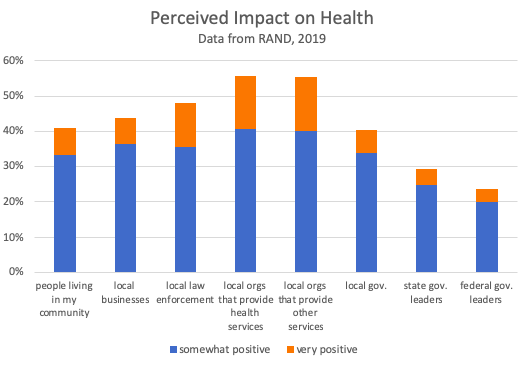
For now, here is my graph showing simple topline responses to a question about the impact (whether positive or negative) of various “groups or organizations” on health.

None of these groups and institutions scores very well. Only two (local nonprofits) barely satisfy a majority of the population as being good for health.

To be specific, respondents were asked about about “Local organizations that provide health services (e.g., health care, public health)” and “Local organizations that provide other social services (e.g., food assistance, job training) such as faith based orgs, nonprofits.” It’s interesting that the perceived health impact of these two types of groups was about the same. You might guess that health-service organizations would have a bigger impact. Perhaps people understand the importance of the social determinants of health, such as employment. Or perhaps the mention of “faith-based orgs” in the latter question boosted its score.

Local businesses were rated higher than any government entity and higher that other residents. Of course, businesses provide goods and services that benefit health; the drug store and the vegetable aisle of the supermarket are really important. Still, this answer shows a gap between public opinion and the progressive view that the net impact of business is probably negative, or at least less positive than the net impact of government. (Just 1.6% thought that the impact of local business was very negative.)

As in almost all surveys, local government scores better than state government, which scores better than federal government. In this case, the information is somewhat ambiguous because respondents are asked about “local government,” and then about “leaders” at the state and federal level. It’s not clear whether the difference in their responses results from the change in scale or the shift from government to leaders. After all, the most evident federal leader is Donald J. Trump. Still, I suspect that if the question had been about government (not about leaders) at each level, confidence would have decreased with scale.

One response to these data might be: See, most Americans are not aligned with strong progressive proposals to increase the imprint of the federal government on health. They trust business much more. But some respondents may think the government helps less than local businesses do because the government is insufficiently ambitious. In any case, these data may support policy recipes that involve more federal funding–with a key delivery role for local nonprofits and local businesses, including your neighborhood drug store and supermarket.

Frontiers of Democracy: June 18-20, 2020

Frontiers of Democracy is an annual conference hosted by the Jonathan M. Tisch College of Civic Life at Tufts University since 2009.

In 2020, the conference will take place from June 18 (5 pm) until June 20 (noon) at the downtown Boston campus of Tufts University: Tufts Center for Medical Education, Room 114; 145 Harrison Avenue, Boston. You are invited!

You can register for Frontiers now.

You can propose a concurrent session for Frontiers using this form. Proposals will be accepted until April 1, 2020

The agenda is still in development but will include short plenary talks, concurrent sessions, and interactive activities for the large group. Among other whole-group activities, we will experience Pre-Texts (“pedagogical acupuncture”) and will use several new “teaching cases” to prompt intensive discussions in small groups. (Teaching cases are short narratives about real events that conclude at a moment when the protagonists must make a difficult choice.)  

Frontiers will follow the American Political Science Association’s Institute for Civically Engaged Research and precede the Summer Institute of Civic Studies and will convene members of those two programs plus about 100 others: activists and practitioners in the public, private, and nonprofit sectors; scholars, educators, students; and others. Participants will come from many countries and many streams of work related to democracy–social movements, community organizing, civic education, arts and media work, political reform, civil liberties, dialogue and deliberation, political theory, and more.

A major objective is to build relationships among people who work in diverse ways at the frontiers of democracy in the United States and around the world.

draft syllabus of a course on Dr. Martin Luther King, Jr.

This spring, I will be teaching a capstone seminar on the life and thought of Dr. Martin Luther King, Jr. The draft syllabus is below (minus grading rubrics, policies, etc.). At this stage, I welcome suggestions!

Summary In this seminar, we will study Martin Luther King Jr. as a political thinker. The whole class will read major works by King and excerpts from biographies and historical documents. Additional readings will be distributed among students, who will contribute insights from their assigned texts to the seminar discussions. The additional readings will include works that influenced King, writings by some of his contemporaries, and interpretations from a recent volume, To Shape a New World: Essays on the Political Philosophy of Martin Luther King, Jr., edited by Tommie Shelby and Brandon M. Terry. We will investigate King’s understanding of the Civil Rights Movement—why it was necessary and what it aimed to achieve. Specifically, we will study his ideas about the political and economic organization of white supremacy, the impact of racial ideologies, and the importance of racial integration and the right to vote. We will investigate King’s philosophy of civil disobedience and nonviolence as well as a set of values he relates to that philosophy: dignity, sacrifice, self-reflection, self-improvement, love, faith, and freedom. We will relate these values to King’s understanding of justice. Criticisms of King will also be considered. Studying King and his critics will provide a window into post-WWII American political thought.

Syllabus

Wednesday, January 15: Introductions and overview

1. Predecessors and Early Influences

Monday, January 20:  Major African American political thinkers, 1885-1940

Students choose one of these authors and be prepared to discuss the author as well as the readings. 

  1. Booker T. Washington, “Letter to the Editor” (1885); “Atlanta Exposition Address” (1895); “Speech to the National Afro-American Council” (1895); “Letter to President Roosevelt” (1904); “Speech to the National Negro Business League” (1915); “My View of Segregation Laws” (1915); “The Talented Tenth” (1903).
  2. W.E.B. DuBois, “The Evolution of Negro Leadership” (1901); “Declaration of Principles” (1905); “The Crisis” and “Agitation” (1909); “Race Relations in the United States” (1928); “Marxism and the Negro Problem” (1933); “Pan -African and New Racial Philosophy” (1933); “The [NAACP] Board of Directors on Segregation” (1934); “A Negro Within the Nation” (1935).
  3. A. Phillip Randolph: “Lynching: Capitalism Its Cause; Socialism its Cure”; editorials on “Racial Equality” and “The Failure of the Negro Church,” “The Negro Radicals,” “Segregation in the Public Schools: A Promise or a Menace,” “Negroes and the Labor Movement,” “The Negro and Economic Radicalism,” and “The New Pullman Porter.”
  4. Another modern Black thinker of your choice likely to be influential in King’s early milieu. E.g., Ida B. Wells, Marcus Garvey …

(Unless otherwise noted in the PDFs, these readings are scanned from Gary D. Wintz, ed., African American Political Thought 1890-1930 (M.E. Sharpe, 1996).)

Wednesday, January 22: Theological Influences

Students choose one of these authors and be prepared to discuss the author as well as the readings

  1. Howard Thurman, Jesus and the Disinherited, pp. 7-35.
  2. Reinhold Niebhuhr, Moral Man and Immoral Society, pp. xv-xvii and 231-277
  3. Walter Raushenbush, A Theology for the Social Gospel, pp. 57-109

Monday, January 27: Biblical echoes

Students will choose one of these, read it, and also read a bit online about the context:

  1. Book of Exodus, Chapters 1-3, in the King James Version (click “next page” to read all three chapters)
  2. Book of Amos, Chapter 2, in the King James Version
  3. Book of Micah, in the King James Version (click “next page” to read the whole book)
  4. Book of Matthew, Chapter 26, in the King James Version

Wednesday, January 29: Precursors–Gandhi

Everyone will read:

  • Ramachandra Guha, Gandhi: The Years that Changed the World (2018), chapter 16 (“The March to the Sea”)

Choose one of these:

  1. Bikhu Parekh, Gandhi, Chapter 4 (“Satyagraha”), pp. 51-62;
  2. Gandhi, Satyagraha (Ahmedabad: Navajivan Publishing Co., 1951), excerpts; and Gandhi, Notes, May 22, 1924 – August 15, 1924, in The Collected Works of Mahatma Gandhi (Electronic Book), New Delhi, Publications Division Government of India, 1999, 98 volumes, vol. 28, pp. 307-310
  3. Karuna Mantena, “Showdown for Nonviolence: The Theory and Practice of Nonviolent Politics,” in Shelby and Terry, pp. 78-110
  4. Martha Nussbaum. “From Anger to Love: Self-Purification and Political Resistance,” in Shelby and Terry, pp. 114-135

Monday, February 3 – no class (instructor is away)

Wednesday, February 5: Precursors–African American campaigners against segregation

  • Everyone watches Episode 1 of Eyes on the Prize, “Awakenings, 1954-1956”

Choose among:

  1. Charles Payne, “Ella Baker and Models of Social Change“; and Ella Baker, “Developing Community Leadership
  2. Danielle McGuire, At The Dark End of the Street: Black Women, Rape, and Resistance–A New History of the Civil Rights Movement from Rosa Parks to the Rise of Black Power.
  3. James L. Farmer Jr., Lay Bare the Heart: An Autobiography of the Civil Rights Movement (excerpts)

2. Montgomery

Monday, February 10: What Happened?

Choose between:

  1. David Garrow, Bearing the Cross: Martin Luther King, Jr., and the Southern Christian Leadership Conference (1986), pp. 105-205.
  2. Taylor Branch, Parting the Waters: America in the King Years, 1954-63 , pp. 11-82.

Wednesday, February 12: How Does King Present What Happened?

  • Martin Luther King, Stride Toward Freedom, chapters 3, 4, and 5.

Wednesday, February 19: Theory of Social Movements

  • Charles Tilly, “Social Movements, 1768-2004
  • Marshall Ganz, “Why David Sometimes Wins: Strategic Capacity in Social Movements,” in Jeff Goodwin and James M. Jasper, Rethinking Social Movements: Structure, Meaning, and Emotion (Lanham, MD: Rowman and Littlefield, 2004) pp.177-98.

3. Albany and Birmingham

Thursday, Feb 20 (makeup day): What Happened?

Students will choose between:

  1. Episode 4 of Eyes on the Prize, “No Easy Walk: 1961-1963”
  2. David Garrow, Bearing the Cross: Martin Luther King, Jr., and the Southern Christian Leadership Conference (1986), 173-286.
  3. Taylor Branch, Parting the Waters: America in the King Years, 1954-63 , pp. 524-561; 673-802

Monday, February 24: How Does King Present What is Happening?

  • Martin Luther King, Jr., Letter from Birmingham Jail

Wednesday, February 26: More Analysis of the Letter

  • Martin Luther King, Jr., Letter from Birmingham Jail

Monday, March 2: King’s version versus the Supreme Court’s

4. March on Washington, Selma

Wednesday, March 4: Protest and Politics

Everyone reads:

Monday, March 9: Selma to Montgomery

Everyone watches/listens and/or reads the text of:

Students will choose between:

  1. David Garrow, Bearing the Cross: Martin Luther King, Jr., and the Southern Christian Leadership Conference (1986), pp. 357-430
  2. Taylor Branch, Pillar of Fire: America in the King Years, 1963-65 , pp. .

5. Issues During the “Heroic Moment” of the Civil Rights Movement

Wednesday, March 11: What Should be the Goal? 

Choose among:

  1. Martin Luther King, “The Ethical Demands for Integration” (1962) and Danielle Allen, “Integration, Freedom, and the Affirmation of Life,” in Shelby and Terry, pp. 155-169
  2. Stokely Carmichael, “Toward Black Liberation,” The Massachusetts Review, Autumn 1966
  3. Derrick Darby, “A Vindication of Voting Rights,” in Shelby and Terry, pp. 170-83

Wednesday, March 25 – midterm in class

Monday, March 30: Change from Below or from Above?

  • Patrick Healy and Jeff Zeleny, “Clinton and Obama Spar Over Remark About Dr. King,” The New York Times, Jan 13, 2008
  • Garth E. Pauley, “Presidential rhetoric and interest group politics: Lyndon B. Johnson and the civil rights act of 1964,” Southern Communication Journal, vol. 63, no 1 (1997), pp. 1-19
  • Original text of the Civil Rights Act of 1964

April 1: Martin Luther King and Malcolm X

Everyone reads these primary texts:

  • King’s remarks on Malcolm X in 1965 (from a Playboy Magazine interview)
  • Malcolm X., “Message to the Grass Roots” (Nov 9-10, 1963) in Malcolm X Speaks: Selected Speeches and Statements (Grove Press 1990), pp. 3-17.
  • Malcolm X, “The Ballot or the Bullet,” 1964 (audio and/or text)

Choose among:

  1. Episode 7 of Eyes on the Prize, “The Time Has Come: 1964-66
  2. August H. Nimtz, “Violence and/or Nonviolence in the Success of the Civil Rights Movement: The Malcolm X–Martin Luther King, Jr. Nexus.” New Political Science 38.1 (2016): 1-22.
  3. Clayborn Carson, “The Unfinished Dialogue of Martin Luther King and Malcolm X” (1998)

6. Later Writings and Issues

Monday, April 6: The North and Poverty

Everyone watches:

Episode 8 of Eyes on the Prize, “Two Societies:  1965-68”

Choose from:

  1. Tommy Shelby, “Prisons of the Forgotten: Ghettos and Economic Injustice,” in pp. 196-213

Wednesday, April 8: War

Listen to audio and/or read the text:

Monday, April 13: The end

Everyone watches/listens to:

21st-Century Appraisals

Wednesday, April 15

Peniel E. Joseph, “Waiting till the midnight hour: Reconceptualizing the heroic period of the civil rights movement, 1954–1965

[April 20: Patriot’s Day, no class.]

Wednesday, April 22: The right and the left of King after his death

Choose among:

  1. Glenn C. Loury, “Achieving the ‘Dream’; A Challenge to Liberals and to Conservativesin the Spirit of Martin Luther King, Jr
  2. Ronald R. Sundstrom, “The Prophetic Tension Between Race Consciousness and the Ideal of Color-Blindness,” pp. 136-154
  3. Cornel West, “Hope and Despair: Past and Present,” in Shelby and Terry, pp. 334-346

Monday, April 27: Reading King in the light of 21st-century concerns

  1. Shatema Threadcraft and Brandon M. Terry, “Gender Trouble: Manhood, Inclusion, and Justice, in 214-244
  2. Brandon M. Terry, “Requiem for a Dream: The Problem-Space of Black Power,” in Shelby and Terry, pp. 299-333