decoding institutions

Today I presented at Tufts’ Science, Technology & Society lunch seminar series on how knowledge and power interrelate. My basic thesis was that knowledge is produced by institutions, which are fields of power. Assessing knowledge therefore requires analyzing institutions (not claims about facts by themselves).

The general model I am assuming works like this.

Actors can be individual people or (at larger scales) such entities as firms, bureaus, or even nations. They have goals; mental constructs such as philosophies, identities, or ideologies; and relations with each other.

They interact in an Action Space, such as a market, a democratic election, or a scholarly publication. Their interactions vary, but actors always make choices shaped by rules, norms, and goods.

A “norm” is a shared expectation that has a positive moral valence. For instance, Robert K. Merton’s CUDOS Norms for science are values that are widely expected. An actual “rule,” on the other hand, structures outcomes but may not have a positive moral valence. Merton also coined the phrase “Matthew Principle” for the general rule that, in science, the person who is already most famous gets the most credit. That rule conflicts with the CUDOS norm of Universalism.

Action Spaces affect, and are influenced by, biophysical conditions, general social circumstances (e.g., poverty), and other institutions.

The institution as a whole has Inputs and Outputs. Insofar as the institution involves knowledge, Inputs may include ideas, opinions, and knowledge-claims and it may produce new ideas, opinions, and knowledge-claims.

We can assess the whole process in terms of value criteria, such as justice. Such assessments not only influence institutions; they are also shaped by institutions. In fact, we don’t have information or values that we can use for assessment except for those that have emerged from institutions. The interaction is reciprocal.

Each element of the whole system is a target for power. To use Stephen Lukes’ Faces of Power framework: one “face” involves actors influencing other actors within an Action Space; a second “face” involves changing the rules of the Action Space; and a “third face” involves changing either norms or the actors’ mentalities, or both. But we could add many more “faces” as we consider each element in the diagram.

We rarely assess knowledge directly, because we are rarely in a position to have justified true beliefs all on our own. Instead, we must assess knowledge as the product of institutions. But that is not a relativist claim, because some institutions are better than others. Assessing the value of an institution requires taking it apart and assessing its components.

See also: adding democracy to Robert Merton’s CUDOS norms for science; is all truth scientific truth?; tools for the #resistance; and a template for analyzing an institution

revisiting Against Deliberation in the age of Trump

In Introduction to Civic Studies, we recently discussed Lynn M. Sanders, “Against Deliberation,” Political Theory, June 1997 v.25 no. 3

Here are some illustrative arguments from her important piece:

“Appeals to deliberation, I will argue, have often been fraught with connotations of rationality, reserve, cautiousness, quietude, community, selflessness, and universalism, connotations which in fact probably undermine deliberation’s democratic claims.” (p. 2)

“Some citizens are better than others at articulating their arguments in rational, reasonable terms. Some citizens, then, appear already to be deliberating, and, given the tight link between democracy and deliberation, appear already to be acting democratically.” (p.2)

“Deliberation is a request for a certain kind of talk: rational, contained, and oriented to a shared problem” (p. 13). “Arguing that democratic discussion should be rational, moderate, and not selfish implicitly excludes public talk that is impassioned, extreme, and the product of particular interests. (p. 14)

“Prejudice and privilege do not emerge in deliberative settings as bad reasons, and they are not countered by good arguments. They are too sneaky, invisible, and pernicious for that reasonable process. So worrying about specifying what counts as a good argument, or trying to enhance reason-giving either via the formulation of better rules and procedures or by providing the time, money, and education necessary to become a responsible deliberative citizen, does not engage some of the most serious challenges to the possibility of achieving democratic deliberation. Some people might be ignored no matter how good their reasons are, no matter how skillfully they articulate them, and when this happens, democratic theory doesn’t have an answer, because one cannot counter a pernicious group dynamic with a good reason.” (p. 4)

I see these as serious concerns. Rose Marie Nierras and I found that many activists from the Global South felt them acutely. (Levine, Peter and Nierras, Rose Marie [2007] “Activists’ Views of Deliberation,” Journal of Public Deliberation: Vol. 3 : Iss. 1 , Article 4.)

But I also sense that the main problem has shifted, requiring a reevaluation of these arguments against deliberation.

It’s true that reason-giving can favor the privileged because they are good at it (or they can hire professional reason-givers, such as lawyers), and because they are basically OK with the social system in which reasons are exchanged.

But it is also a characteristic of privilege not to feel any compulsion to give reasons. It is the autocrat who says, “Because I said so.” Donald Trump is completely unwilling to give or hear reasons, and he may have developed that attitude as a result of extreme socio-economic privilege. His opponents and critics want reasons from him and are willing to give reasons for their demands.

Indeed, there is a long tradition of the people demanding reasons, and authoritarian elites trying to evade reason-giving. When we have that tradition in mind, it’s natural to equate deliberation with political equity. On the other hand, when we think about formal deliberative bodies within a stable but imperfect state–American juries, for example–we worry that deliberation and equity can conflict, because those with advantage prevail in such discussions.

As with many issues, Donald Trump reminds us of the positive case.

See also Habermas with a Whiff of Tear Gas: Nonviolent Campaigns and Deliberation in an Era of Authoritarianism; postmodernism and Trump;

new chapter on Elinor Ostrom and Civic Studies

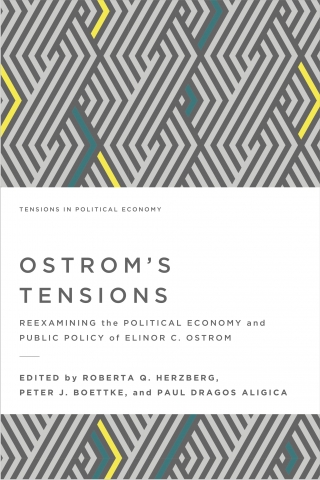
A newly published volume: Ostrom’s Tensions: Reexamining the Political Economy and Public Policy of Elinor C. Ostrom, edited by Paul Dragos Aligica, Peter J. Boettke, and Roberta Q. Herzberg.

I contribute a chapter entitled “’What Should We Do?’ The Bloomington School and the Citizen’s Core Question.”

I argue that Elinor Ostrom’s thought offers powerful resources for people who see themselves as active members of communities (“citizens”). I discuss her emphasis on means, not ends; her vantage point as a citizen, not a state; how she deals with value questions in policy; and her work as a complement to deliberative theory and non-violent social movement theory (Habermas and Gandhi).

Gandhi: The Years That Changed the World, 1914-1948 by Ramachandra Guha

Guha’s biography is the essential work on Gandhi: much more detailed, better researched, and more persuasive than the earlier biographies that I know of. Volume Two, focusing on India, is 1,104 pages long but moves at a brisk pace. It’s detailed but never ponderous. The story is often suspenseful, even if you know how it will turn out in broad outlines. For example, just when all seems lost, Gandhi suddenly pulls off the Salt March. And the end of his life has the inexorability of a classical tragedy.

Guha generally proceeds chronologically, but now and then he pauses for an essay on a special topic, such as “Gandhi’s personal faith, his personal morality, as expressed in his words and actions in this decade of the 1920s.” The narrative is enlivened by numerous quotations from original documents, many never printed before. Along with Gandhi’s voice, we hear an amazing range of human beings who interacted with him or commented on him in one way or another, from Black American pastors to anarchists to the advertisers who used his silhouette as a brand.

One of the larger themes that emerged for me was Gandhi as polemicist. The Mahatma relished arguments, even though some of his opponents alienated and infuriated him. You could summarize his thought by capturing his long-lived debates with a few key rivals, especially B.R. Ambedkar and Muhammad Ali Jinnah. But he also sparred with many others.

For instance, I love to think of Margaret Sanger, the sex educator and popularizer of the phrase “birth control,” staying in Gandhi’s ashram and arguing with the celibate old man about first-wave feminism:

‘both seemed to be agreed that woman should be emancipated, that woman should be the arbiter of her destiny’. But whereas Mrs Sanger believed that contraceptives were the safest route to emancipation, Gandhi argued that women should resist their husbands, while men for their part should seek to curb ‘animal passion’. (p. 585)

Sanger was just one of scores of such visitors.

Guha is even-handed, judicious, and open-minded. Only at the end, in an epilogue on contemporary interpretations of Gandhi, does he emerge as a defender of his subject. By then, Guha has explored many flaws, errors, and vices, but he insists that Gandhi was far more complex and responsive than some of his critics have been. For instance:

[Arundhati Roy] presented Gandhi as a thoroughgoing apologist for caste, further arguing that this was in line with his views on race. Gandhi, she suggested, was casteist in India because he had been racist in South Africa. Roy claimed that Gandhi ‘feared and despised Africans’; this he certainly did in his twenties, but just as certainly did not in his forties and fifties. Reading Roy, one would not know that Gandhi decisively outgrew the racism of his youth, a fact that people of colour themselves acknowledged, and appreciated. … Roy has all of Ambedkar’s polemical zeal but none of his scholarship or sociological insight. … [She seeks] —by the technique of suppressio veri, suggestio falsi so beloved of ideologues down the ages—to prove a verdict they have arrived at beforehand.” (p. 876)

In contrast, Guha situates Gandhi in his time and cultural context, appreciates the Mahatma’s critics and opponents, explores his flaws and limitations (and occasional weirdness) at length, and paints a real-life portrait–which thereby emerges as a portrait of greatness.

Guha, Ramachandra. Gandhi: The Years That Changed the World, 1914-1948. Knopf Doubleday Publishing Group. See also: the question of sacrifice in politics (on Gandhi and Ambedkar); Gandhi versus Jinnah on means and ends; Gandhi on the primacy of means over ends; and notes on the metaphysics of Gandhi and King

Event: The Role of Play in Human Evolution and Public Life: Work, or Play?

Please join us for this month’s Ludics Seminar at Harvard’s Mahindra Center to explore the role of play in human evolution and public life. Details are below:

Peter Gray, Boston College

Peter Levine, Tufts University

The Role of Play in Human Evolution and Public Life: Work, or Play?

Monday, October 28, 2019 – 6:00pm

Location TBA

PANEL SYNOPSIS

The Ludics Seminar, Mahindra Humanities Center, Harvard University will kick off its 2019-2020 series of talks with a panel discussion between Professor Peter Gray, Boston College, and Professor Peter Levine, Tufts University, on play and public life. Peter Gray will speak about his recent work on play and egalitarianism in hunter and gatherer cultures. Peter Levine will speak about Harry Boyte’s notion of public work, teasing out this binary between work and play in public life. If play is a corollary to egalitarianism as Peter Gray suggests, then why is the business of contributing to public life most often associated with work?

“The Role of Play in Human Evolution”
Peter Gray, Boston College
Humans are the only primate (apparently) that can live peacefully, or at least relatively so, in multi-male, multi-female social groups. From an evolutionary point of view, how did we manage that? I will suggest here, based on research among contemporary band hunter-gatherers, that we did it at least in part by expanding upon the general mammalian capacity for play and bringing it into adult social interactions.

“Civic Engagement as Public Work, or Play?”
Peter Levine, Tufts University
Often, acts of civic engagement are defined as acts that people undertake voluntarily without being paid, such as voting, protest, or discussing issues. The very definition of “volunteer service” is any work for other people that isn’t remunerated. This distinction between work and citizenship goes back to Aristotle. Harry Boyte and other proponents of “Public Work” have criticized it, arguing that it trivializes civic life by reducing it to after-work voluntarism and marginalizes the many ways that paid, employed people contribute to public spaces and institutions. The democracy of ancient Athens was not just a discussion among gentlemen; it was also a set of physical spaces–like the Pnyx, where discussions occurred–that people had built with their hands. However, we are not just public workers and artisans in the common world; we also like to play. We are homo ludens as well as homo faber. Designing civic engagement to be more play-like or game-like has been shown to make it more attractive and productive. So how should we think about the relationship between work and play in the civic domain? And what may happen to that relationship if work disappears for many human beings while opportunities for play expand?

BIOS
Peter Gray is a research professor of psychology at Boston College who has conducted and published research in neuroendocrinology, developmental psychology, anthropology, and education. He is author of an internationally acclaimed introductory psychology textbook (Psychology, Worth Publishers, now in its 8th edition, co-authored with David Bjorklund), which views all of psychology from an evolutionary perspective. His recent research focuses on the role of play in human evolution and how children educate themselves, through play and exploration, when they are free to do so. He has expanded on these ideas in his book, Free to Learn: Why Unleashing the Instinct to Play Will Make Our Children Happier, More Self-Reliant, and Better Students for Life (Basic Books). He also authors a regular blog called Freedom to Learn, for Psychology Today magazine. He is a founding member and president of the nonprofit Alliance for Self-Directed Education (ASDE), which is aimed at creating a world in which children’s natural ways of learning are facilitated rather than suppressed. He is also a founding board director of the nonprofit Let Grow, the mission of which is to renew children’s freedom to play and explore outdoors, independently of adults. He earned his undergraduate degree at Columbia College and Ph.D. in biological sciences at the Rockefeller University many years ago. His own current play includes kayaking, long-distance bicycling, backwoods skiing, and vegetable gardening.

Peter Levine is the Academic Dean and Lincoln Filene Professor of Citizenship & Public Affairs in Tufts University’s Jonathan Tisch College of Civic Life. He has tenure in Tufts’ Political Science Department, and he also has secondary appointments in the Tufts Philosophy Department and the Tufts Clinical and Translational Sciences Institute. He directs the Civic Studies Major at Tufts. Levine graduated from Yale in 1989 with a degree in philosophy. He studied philosophy at Oxford on a Rhodes Scholarship, receiving his doctorate in 1992. From 1991 until 1993, he was a research associate at Common Cause. From 1993-2008, he was a member of the Institute for Philosophy & Public Policy in the University of Maryland’s School of Public Policy. During the late 1990s, he was also Deputy Director of the National Commission on Civic Renewal. Levine was the founding deputy director (2001-6) and then the second director (2006-15) of Tisch College’s CIRCLE, The Center for Information and Research on Civic Learning and Engagement.
Levine is the author of We Are the Ones We Have Been Waiting For: The Promise of Civic Renewal in America (Oxford University Press, 2013), five other scholarly books on philosophy and politics, and a novel. He has served on the boards or steering committees of AmericaSpeaks, Street Law Inc., the Newspaper Association of America Foundation, the Campaign for the Civic Mission of Schools, Discovering Justice, the Kettering Foundation, the American Bar Association’s Committee for Public Education, the Paul J. Aicher Foundation, and the Deliberative Democracy Consortium.