a Green recovery

“We have a responsibility to recover better” than after the financial crisis in 2008, UN secretary general António Guterres warned. “We have a framework for action – the 2030 Agenda for Sustainable Development and the Paris Agreement on Climate Change. We must keep our promises for people and planet,” he added.

On this topic, I would yield to people who understand economics and the environment better than I do. I also recognize obstacles to making sure the recovery benefits the environment. (Will we have a recovery at all within a reasonable amount of time? Will the political elites in any important country allocate resources well?) But it seems worth discussing principles, because a decent outcome will depend on public pressure. We should decide what to demand.

I would propose four principles:

  1. The fiscal stimulus should be large and carbon-negative. Governments can and should spend heavily, because borrowing costs are extraordinarily low and social needs are critical. Once the pandemic ends, to the maximum extent possible, unemployed people should be paid to build and install renewable energy sources, to improve the power grid, to enhance public transportation (which will face a crisis of confidence in response to the pandemic), to restore natural resources, and to change agriculture.
  2. Bailouts should be carbon-neutral. I am not callous about people whose livelihoods depend on mining or drilling for carbon. But nowhere is it written that oil, gas, and coal companies deserve public subsidies, especially given the massive negative externalities of their industries. There is an immense amount of carbon underground and enormous incentives to extract and burn it. Our best hope is to cut the supply in the short term so that alternatives can become more affordable. Turmoil in carbon markets will have human costs, but also benefits. Thus: no bailouts for carbon.
  3. Financing should be equitable and carbon-neutral. I think the wisest macroeconomic policy is to borrow in the short term and pay it back with new taxes only later on–that’s the most stimulative approach. But we could negotiate an agreement now to pay it back later in a good way. That could mean phasing in carbon taxes along with highly progressive wealth taxes while permanently holding down income and payroll taxes for households with lower incomes.
  4. Spending should be planned and allocated in a participatory and deliberative way. This is not just a matter of justice or a way of generating civic benefits from the pandemic crisis. It is also an urgent practical need. Let’s say you want to build a new transit line to reduce carbon use. If a community organizes against it, it won’t go through. Also, people won’t ride the line unless it meets their needs, and transit without many passengers does no good for the environment. Therefore, effective spending depends on genuine support, which can be earned by creating opportunities for people to discuss and decide. Ideally, such discussions will also influence individuals’ decisions as workers, consumers, and investors, giving many people a justified sense that we are rebuilding the economy, and saving nature, together.
unveiling CIRCLE’s data tool

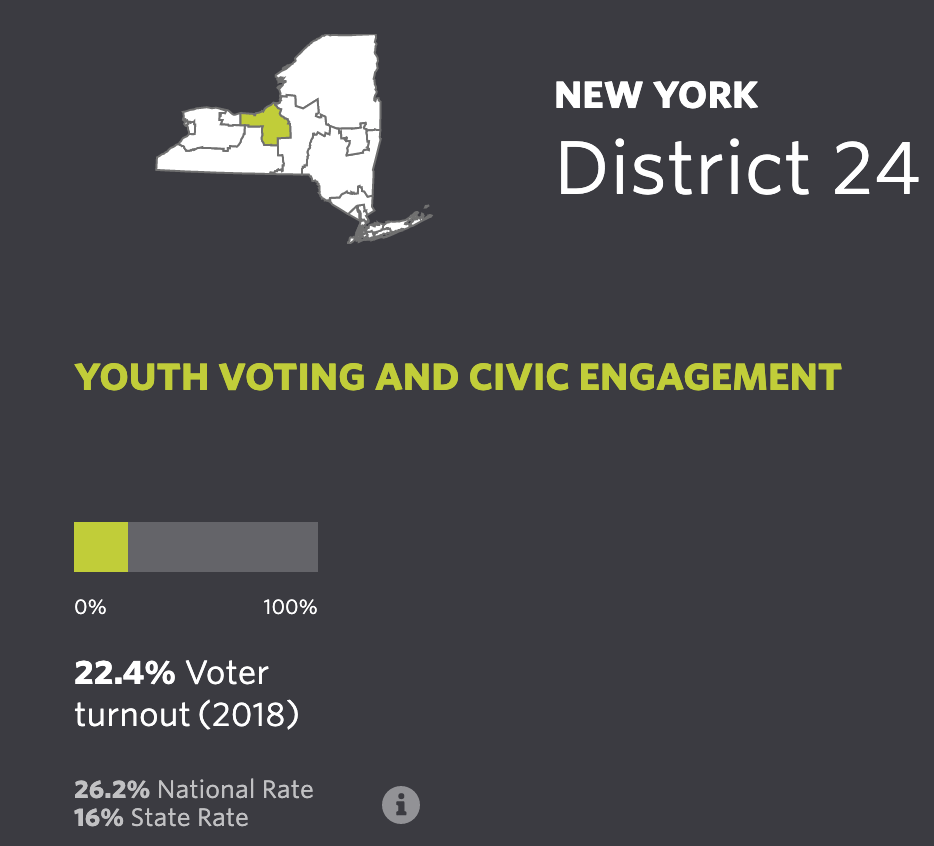
Although it’s hard to concentrate on politics right now, a massively consequential election is coming up, and today CIRCLE unveils a data tool that can help nonpartisan groups, partisan outfits, campaigns, and the media make smart decisions regarding young voters.

If you head to youthdata.circle.tufts.edu, you can explore youth registration and turnout, youth demographics, and an array of relevant civic factors for states and congressional districts over time–setting your own queries and seeing the results.

For instance, here is youth turnout in my hometown’s congressional district:

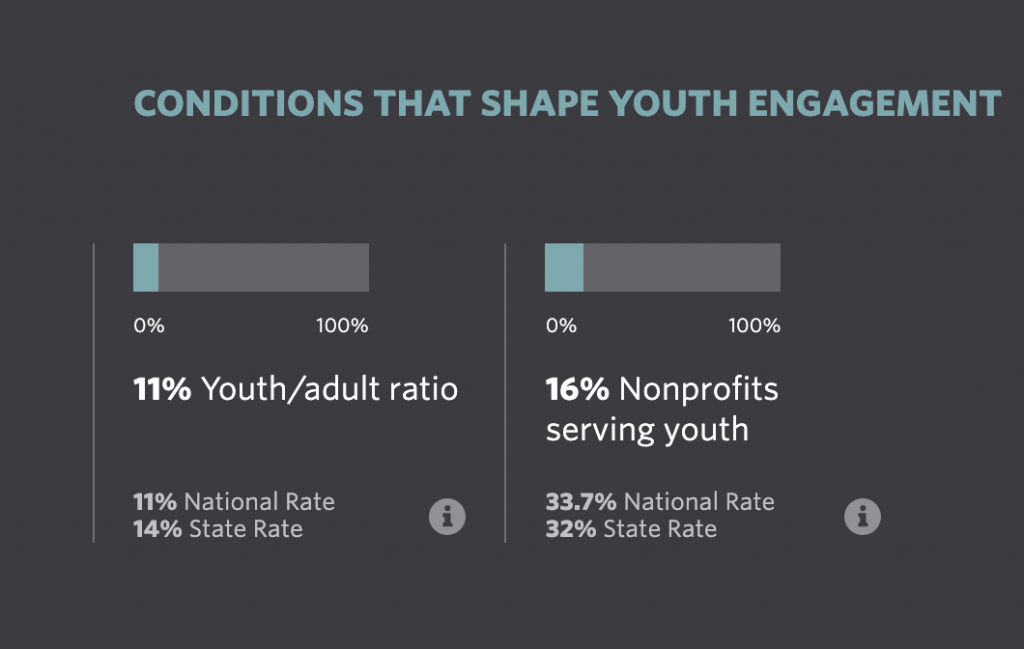
I also explored various underlying factors that might affect youth engagement in that district.

(The team has come a long way since the days when we’d generate a few charts and put them in a document that we expected people to print.)

mobilizing higher education against COVID-19

Tufts’ president, Anthony Monaco (an MD/PhD) has an op-ed in the Boston Globe calling on colleges and universities to deploy their resources to fight the public health emergency. He is not only talking about closing our campuses to reduce contagion or providing research and education for the public–although those are important contributions–but also about turning our dorms into quarantine centers and our college parking lots into “drive-through triage centers.” A longer list of highly tangible ideas is in his op-ed.

the virus, the election, and democratic theory

[It] seems to have been reserved to the people of this country, by their conduct and example, to decide the important question, whether societies of men are really capable or not of establishing good government from reflection and choice, or whether they are forever destined to depend for their political constitutions on accident and force.

Alexander Hamilton, Federalist 1

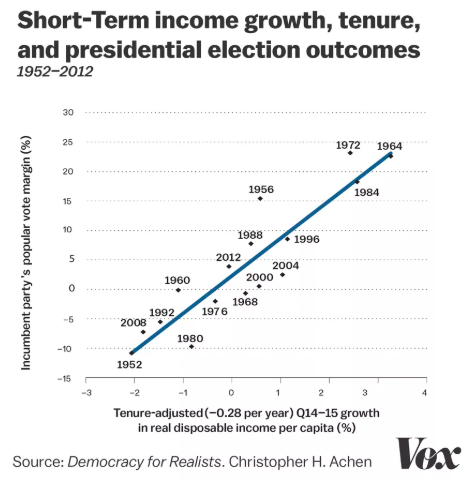
The answer may be “accident and force.” This graph, derived from Christopher Achen, shows an almost perfect correlation between presidential election results and economic growth during two quarters before the election, adjusted for how many years the incumbent party has held office. It implies that who wins the White House in November will depend almost entirely on what the COVID-19 virus does to GDP during this quarter and next. If the US economy manages 1.5% positive growth despite COVID-19, Trump should win. If it declines, he will probably be done, regardless of the Democratic nominee.

One should always be careful about correlation graphs with relatively small numbers of data points and carefully contrived axes. You can fish for combinations of variables that generate uncannily neat pictures. However, this graph shows the result that you would predict if you hold a theory of electoral politics that goes back at least to Joseph Schumpeter in 1942:

  • People have better things to do than follow politics closely, let alone form and test careful hypotheses about the impact of political positions on outcomes (holding other factors constant). Voters are not going to be rigorous social scientists.
  • Instead, voters will assess the most prominent political leaders of the moment by evaluating their own circumstances. They won’t only think about economics, and certainly not only about the nation’s GDP. However, GDP growth is a decent proxy for how well a whole population is faring in their everyday lives compared to last year.
  • People will judge politicians using other heuristics, such as partisanship, demographics, and ideological labels. These factors also determine what we hear or read about the world beyond our doors. (Watching the Fox News homepage during the COVID-19 crisis, as I have done, is an object lesson in ideological framing.) However, in a system like ours, two closely equal voting blocs with their own media networks will emerge as an equilibrium. Who actually wins any given election depends on the main variable that changes from month to month: GDP growth.

This is bad news for any theory of democracy that envisions millions of people deliberating about ideas and making choices. With Schumpeter, we might at least hope that a national election functions as a test of performance, rotating failures out of office. We would expect Trump to lose in November because things will go badly between now and then, and that will serve as a vivid test of his fitness for office, his allies in the media and Congress, and his ideology (nationalism), which has guided his response to the epidemic. The voters would demonstrate collective rationality by throwing him out.

The problem with that theory is the massive element of randomness. The signal can easily be lost in noise. If COVID-19 hadn’t hit now, Trump wouldn’t be seriously tested. If Hillary Clinton or Bernie Sanders were president now, the government’s public health policy would be better than Trump’s, but we would still face a global pandemic and probable recession. Then the signal would convey that neoliberalism or democratic socialism–not nationalism–was the failed ideology.

To make matters worse, politicians are systematically rewarded for the wrong things. Andrew Healy and Neil Malhorta show that spending (or not spending) money on prevention has no effect on electoral outcomes. However, relief spending is a big boost to an incumbent. This means that Trump may benefit from COVID-19 if things play out fortuitously for him. If we are in recovery by November and Trump is handing out stimulus relief, the crisis may carry him to reelection. In that case, not only would the public receive a false signal about his competence and ideology, but his policy of doing nothing to prevent a crisis would have been rewarded.

Should we therefore give up on democracy? I definitely think not, for these reasons (and I leave aside the tired argument that it is better than the alternatives):

First, all the models discussed above are based on political leaders who are plausibly competent and whose stances and worldviews put them in sync with close to 50% of voters. Trump has always risked not quite meeting those criteria. Up to now, his approval ratings have been well below what you would expect for an incumbent presiding over historically low unemployment. If he were to lose because his statements and policy choices have alienated a significant minority of voters who would have voted for him otherwise, then we’ll learn that national elections at least serve to weed out true losers. Four years too late, but better now than never.

Second, it matters which groups coalesce into the two large blocs of active voters. Those groups are better served when their side wins. Therefore, it matters which citizens we engage and motivate to vote.

Third, a national election, although important, is an outlier among all forms of politics. It is episodic and short-term. Millions of people participate, each having a microscopic impact. It is entirely mediated, since only a tiny proportion of us actually know the candidates. Given our electoral system, it is filtered through a party duopoly.

Local politics can be much better. So can national politics, over a longer time-span. Consider the improvement in mainstream attitudes toward sexual minorities in the US, which affects the stances of presidential candidates as well as many other aspects of our society. That, too, is politics: the result of advocacy, organizing, discussion, and learning. Our expectations for self-governance should be much higher than our expectations for presidential elections, where we must hope that Alexander Hamilton’s “accident” is benign.

my thoughts for students as we move online

Like many other universities, Tufts has decided to close physically for the semester and switch to online education. I am sure my colleagues across the country are discussing this shift with their students as they meet for the last time this week–or virtually, if students have already dispersed.

This is what I’m saying. The text is “open source” in case anyone wants to copy some of it, although I’m sure my colleagues will want to say different things or make similar points better.

First, I am disappointed that we will not meet again in person. I thought the conversations were fascinating and compelling. I have been impressed by your commitment and intellectual and emotional investment.

For my part, I was committed to continuously improving the class. We recently made a shift to more small-group discussions, and I would have sought to make more such changes. My goal would have been to end the semester very strong, better than we began it. It frustrates me to have to move into a kind of triage mode.

But we need to do the best we can. The point is to give you the best learning experience possible under the circumstances, which will vary from person to person and over time. Of course, that’s always supposed to be the point. A college class is not a transaction, with you doing what the professor wants in order to get a grade. It’s always supposed to be a joint creation with the objective of learning. Now we’ll really have to accomplish that together.

Usually, students want predictability. A syllabus nowadays looks almost like a contract: you do this, I will do that, and the results are guaranteed. I don’t think we can be predictable this semester. Who knows how many of us (if any) will be directly affected by the disease? Or whether videoconferencing platforms will hold up under the strain? On the bright side, I assume that professors and teachers will invent successful new strategies that will go viral. We don’t know now how we’ll teach and learn in April.

In the absence of predictability, we need communication. It’s your responsibility to share feedback and ideas with me–especially since we will not be meeting face-to-face. I can’t know what you are experiencing or how you assess the course unless you tell me.

I assume that your circumstances and responses will vary. Some may find it hard–for practical and/or emotional reasons–to participate in various ways. But some may be bored and frustrated that they’re not learning enough during one of only eight semesters of a conventional undergraduate education. I need to hear from you, wherever you stand.

I cannot customize perfectly because I have more than 50 students and more than 20 advisees, plus other responsibilities beyond teaching. However, we can differentiate the experience to some extent. We can add optional activities for students who want more and make accommodations for those who are struggling to keep up.

As always, assigning grades is an inevitable task, and I’m not saying that everyone will get an A because of the circumstances. Still, I am hoping that, even more than usual, we can put the assignment of grades somewhat aside and focus on maximizing the learning for everyone. Your responsibility is not only to try to learn but also, to the extent possible, to help others to learn. Those are the two overarching criteria of assessment. We will succeed if we co-produce this class and fail if we give up on it.

With all that being said, my current plan is to form you into groups of 4-5, with changing membership each time. Those groups will hold videoconferences during each of the scheduled class times. I will provide detailed discussion questions with suggested allocations of time for each topic. Each group will write succinct overview notes on a shared document. I will comment substantively on that document when I see places to weigh in. Individual writing assignments will remain the same as on the syllabus.

Now and throughout the semester, suggestions and critiques of this plan are not only welcome, but expected.