better governments tend to be bigger

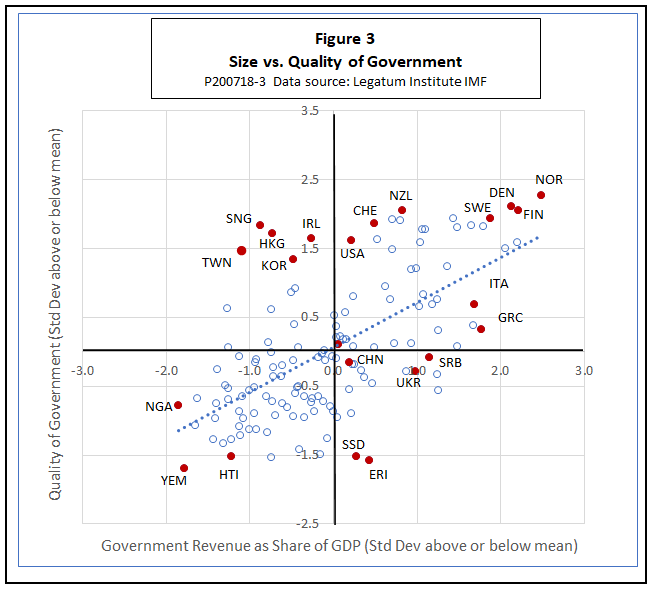
In an article entitled “Quality of Government: A Statistical Portrait,” Ed Dolan displays a positive relationship between the size and the quality of government:

It’s true that richer countries tend to have both better and larger governments, so this correlation could be driven by wealth. However, in a regression model that controls for GDP, the relationship between the size of government and the quality of government remains strong and positive.

Here, size of government means state revenue as a share of GDP. Dolan omits petro-dependent countries, because they are on their own path, but suffice it to say that some of them have a lot of revenue and poor government. (They would go in the bottom-right quadrant, which is almost empty without them.) Dolan’s measure of quality comes from the Legatum Institute and is an index of the following components:

  1. Rule of law
  2. Government integrity 
  3. Protection of property rights
  4. Contract enforcement
  5. Protection of investor rights
  6. Executive constraints
  7. Government effectiveness
  8. Regulatory quality
  9. Government accountability

Dolan also provides suggestive evidence that “life is better in countries that have high-quality governments, and even more so when those governments are both higher-quality and larger. That is true both when a ‘better life’ is defined in terms of the satisfaction of basic human needs and when it is defined in terms of human freedom.” 

This article appears on the website of the Niskanen Center, which leans libertarian or pro-market, in a pragmatic and open-minded way. Most of the nine quality measures above are ones that a market-oriented economist would endorse. When someone like me, who usually votes for the left wing of the Democratic Party, cites this kind of study from this kind of source, it can look like a kind of gotcha. “See, pro-market economists admit that government helps.” But that is actually not my motivation. I am genuinely committed to individual rights and liberty, including economic liberty, and I want to be pragmatically open to what works.

I’d acknowledge, too, that if this chart measures “quality” accurately, then the USA gets more bang for our buck than, say, Sweden. We spend less of our GDP on government yet get almost as good a government. The only reason to prefer the Swedish model would be a somewhat different definition of “quality” (which I would probably defend).

Still, it seems intuitive to me that people are more free–in all senses, including libertarian ones–in the countries at the top-right of Dolan’s chart. (See: the Nordic model.) It is also intuitive that few countries other than petro-states spend a lot and get poor government and individual freedom. So this graph should be the premise for discussions of how we can obtain both more and better government.

Hilary Mantel and Walter Benjamin

Both the Mishna (Sanhedrin, 4) and the Quran (5:32) advise that to kill one person is like killing all human beings.* The Mishna says that God created humanity in the form of one original person to remind us of that fact. It means that when Henry VIII had Thomas Cromwell’s head chopped off on July 28, 1540, Henry destroyed a whole world.

Hilary Mantel proves this fundamental moral truth by richly imagining the inner life of the Tudor politician in the three volumes of her Wolf Hall trilogy. The main character (almost always called “he,” without a name), progresses through time and interacts with other people like an ordinary fictional protagonist, but often the narration traces his mind as it jumps to the past or envisions possible futures. Much of the trilogy is devoted to daydreams.

Cromwell is an unlikely candidate to be liked–a shrewd and sometimes ruthless political actor, a Protestant fundamentalist (in our terms), and a royalist. He’s also poorly documented. Most people have seen him as the villain or–at best–the cipher who killed Thomas More and Anne Boleyn. His portrait by Hans Holbein makes him seem private and distant. He is literally set further away than Holbein’s other subjects.

I’m guessing that is why Mantel chose him: to exercise her genius for sympathetic imagination. She must invent most of his past and his inner life, presenting a whole subjective world that would otherwise be opaque. We care for Cromwell not because we agree with him or have behaved like him, but because we can see a whole world through his eyes.

Mantel’s imagination is extraordinary, whether she is conjuring ordinary physical things like plums and footstools or spinning stories around the documented facts. Just for example, Elizabeth Seymour is sure she has been chosen to marry Thomas Cromwell. But he has invited her to marry his son. They talk at cross-purposes for a whole conversation until the awkward misunderstanding dawns on both of them. Who but Mantel would have thought to insert that twist?

In his essay “The Storyteller,” Walter Benjamin explores a distinction between a story and a novel. A story is succinct, vivid, subject to many interpretations, meant to be remembered in full and retold to others. It is a communal object, recited orally to a group of people who enjoy each other’s company as they listen and speak in turn.

In contrast, a novel is profoundly individual, a silent communication from one author to one reader at a time. It provides so much detail and interpretation that the reader’s creativity is constrained by the author’s intentions; and it’s too long and carefully constructed to be paraphrased, let alone memorized and retold. Although novels have diverse subjects, the classic topic is one person’s inner life as he or she progresses toward a conclusion; and the clearest conclusion is death. Don Quixote is the “first great book of the genre.”

The novel arises once words can be mass produced for private consumption. It is a capitalist object, meant for a market. It also arises when people become truly afraid of death–not just of dying, but of observing and talking about death. “Dying was once a public process in the life of the individual and a most exemplary one.” But in the bourgeois 19th century, “the general consciousness the thought of death … declined in omnipresence and vividness.” The novel fills a gap by allowing us to imagine the death of an individual who is safely fictional as a way of contemplating our own mortality.

In a story, the hero is admirable beyond realism but hard to imagine from the inside. In a novel, the protagonist is flawed, and the more you read, the more flaws you see. Don Quixote “teaches how the spiritual greatness, the boldness, the helpfulness of one of the noblest of men, Don Quixote, are completely devoid of counsel and do not contain the slightest scintilla of wisdom.” Yet we identify with the protagonist because her or his life functions like ours. Any life is a vast array of experiences, memories, and hopes, banal in their totality but unique in their details. A novel consoles us by implying that our life, too, is worthy. Benjamin says:

To write a novel means to carry the incommensurable to extremes in the representation of human life. In the midst of life’s fullness, and through the representation of this fullness, the novel gives evidence of the profound perplexity of the living.

A life is coherent because the present person has memories of her or his own past. Each of us has a unique collection of memories, and we are sufficiently attached to it that we are sad to think it will vanish with our deaths. We vainly counter that fate with monuments and memoirs and by boring children with our recollections. But a novel allows us to see someone else’s memories as a permanent object:

“No one,” Pascal once said, “dies so poor that he does not leave something behind.” Surely it is the same with memories too—although these do not always find an heir. The novelist takes charge of this bequest, and seldom without profound melancholy. …

The novel is significant, therefore, not because it presents someone else’s fate to us, perhaps didactically, but because this stranger’s fate by virtue of the flame which consumes it yields us the warmth which we never draw from our own fate. What draws the reader to the novel is the hope of warming his shivering life with a death he reads about.

Benjamin means to criticize the novel and lament the decline of the story. But his real target is capitalism, and the novel gets caught in the crossfire. Certainly, he understands what an achievement a novel is. And none seems to fit his theory better than Mantel’s trilogy.

Particularly as Cromwell approaches his end, he seems obsessive about cataloging his past, as if he could leave it as a coherent legacy. He thinks:

All your life you tramp the empty road with the wind at your back. You are hungry and your spirit is perturbed as you journey on into the gloom. But when you get to your destination the doorkeeper knows you. A torch goes before you as you cross the court. Inside there is a fire and a flask of wine, there is a candle and beside the candle your book. You pick it up and find your place is marked. You sit down by the fire, open it, and begin your story. You read on, into the night.

This scene of reading is exactly how Benjamin understands the novel, in general. It is a private experience of taking stock of a life to persuade oneself that it has meaning, even though each of us is but one among billions and fated to vanish.

Benjamin would probably emphasize that Thomas Cromwell was an early bourgeois, building a commercial commonwealth at the expense of the aristocracy and the clergy. Mantel describes foreign and court politics more than domestic policy, but the novel probably conveys–and it is plausibly true–that Cromwell revolutionized English society along bourgeois lines. That would make him a perfect choice for the protagonist of a Benjamin-style novel.

Benjamin doesn’t mention that Quixote is about two men, not one. So is the Wolf Hall trilogy. Cromwell tells Henry:

“What would I want with the Emperor, were he the emperor of all the world? Your Majesty is the only prince. The mirror and the light of other kings.”

Henry repeats the phrase, as if cherishing it: the mirror and the light. He says, “You know, Crumb, I may from time to time reprove you. I may belittle you. I may even speak roughly.”

He bows.

“It is for show,” Henry says. “So they think we are divided.”

As this passage suggests, Cromwell and Henry are mirror and light to each other. We can see their relationship either way, Cromwell reflecting the royal will or Henry shining because of Cromwell’s brilliance. Cromwell can also see himself as a combination of the mirror and the light. “The silver plate, reflecting himself to himself: the mirror and the light of all councillors that are in Christendom.”

As in the original master-slave dialectic, Henry needs Cromwell as much as vice-versa. Both are appealing in their respective ways, mixing needs and interests with a strong sense of responsibility. Each embodies his proper role–much like Archbishop Cranmer, who “does what is in him. It is all any man can do.”

It’s important that the trilogy is historical fiction. Mantel gives us access to an unfamiliar objective world along with an unfamiliar subjectivity. The implication is that a lifeworld can survive for five hundred years after the observer dies; maybe the same can happen to you or me. Yet the result feels fragile and precious, dependent on Cromwell’s survival as a character and Mantel’s art. That fragility charges the novel with suspense even though most readers will have a pretty good sense of how things must end. (Well, it’s how all things must end.)

Mantel has invented a diction to summon the world of her novel: 21st-century English that closely describes 16th-century England, with a dose of free indirect discourse (third-person narration that adopts some of the tone of the character being described). Clear anachronisms are rare and may be mistakes. “Why do we not, as the tennis players say, cut to the chase?” asks Ambassador Chapuys, using a phrase that originated in early Hollywood. Several characters refer wittily to the sentence, “Et in Arcadia ego,” which was coined ca. 1618. And Cromwell’s thought, “Florence made me … London unmade me,” suggests a reference to Purgatorio, V. 133, which only became famous after 1800. If these are flaws, they are tiny, and perhaps it’s best to think of the book as a loose translation of 16th century speech into modern English.

In sum, Mantel seeks to build something that is a terrible shame to end. That is exactly what we should say about any human life: even the life of a renaissance courtier who had many other people’s deaths on his conscience. In this sense, the novel is a moral achievement as well as a creative one.

*I ignore knotty questions about these two texts and how they relate. Most of the online commentary about them is sectarian and uncharitable toward other people’s faiths. Let’s assume that many Jews and many Moslems have read these passages in the way I am suggesting here.

See also: Hilary Mantel, Wolf Hall; Hilary Mantel, Bring Up the Bodies; history and fiction in Hilary Mantel’s A Place of Greater Safety; Calvino’s free hyper-indirect discourse; and Kieran Setiya on midlife: reviving philosophy as a way of life (with a digression on Benjamin and the importance of death in the novel). My own effort at a Tudor novel is The Anachronist. Finally, Clair Wills offers a much less favorable review in The New York Review. I don’t share her verdict, but she makes significant points.
where youth will make the most difference

CIRCLE‘s Youth Electoral Significance Index (YESI) shows where young people are likely to have the most influence on the outcome of the election. The goal is to encourage investment in the youth vote, at least in those places.

CIRCLE has crunched the latest data to produce the final, revised YESI, with these changes since the last time:

  • Georgia: In our presidential rankings, several states moved up or down one or two spots and, notably, Georgia replaced Maine on the #10 slot. Georgia’s recent emergence as a battleground state also informed our Senate rankings. The state has two Senate races in 2020 and the one for the seat held by Kelly Loeffler was #8 in our earlier rankings; the updated version sees that race move up to #7 and the race for David Perdue’s seat enter the top-10 at #6. 
  • Alaska: The Alaska Senate race also makes it into our updated rankings (at #10), while Kansas and Alabama (#9 and #10, respectively, in the previous ranking), drop out of the top 10 entirely—though just barely, as they’re now ranked 11th and 12th.
  • House of Reprensetatives: In our ranking for U.S. House races, the Georgia 7th climbed from #5 to #3 and the Georgia 6th, absent from our previous ranking, is now the #10 race. The Utah 4th and the New Jersey 3rd drop out of the top 10, while the Virginia 7th enters at #8.

This map shows the Senate YESI, but click through for much more detail on the House, the Electoral College, and specific races.

spirituality and science

Following Foucault, let’s use the word “spirituality” for this cluster of ideas: What is true (i.e., most actually real) is the same as what is most right and most beautiful. To know this truth requires being a better person; truth comes to one whose mind or soul is in an appropriate condition. In turn, perceiving the truth improves the perceiver.

Several modes of spirituality have been taught (and sometimes combined). In the ecstatic mode, the seeker loves truth, longs for it, and expects ecstasy from its attainment. In the ascetic mode, the seeker renounces ordinary desires and comforts to merit truth. In the diligent mode, the seeker labors for years at ritual or memorization–or literal labor–until rewarded with truth. In the mode of faith, the seeker ignores the evidence of senses and the pull of desires to believe in what is not directly known.

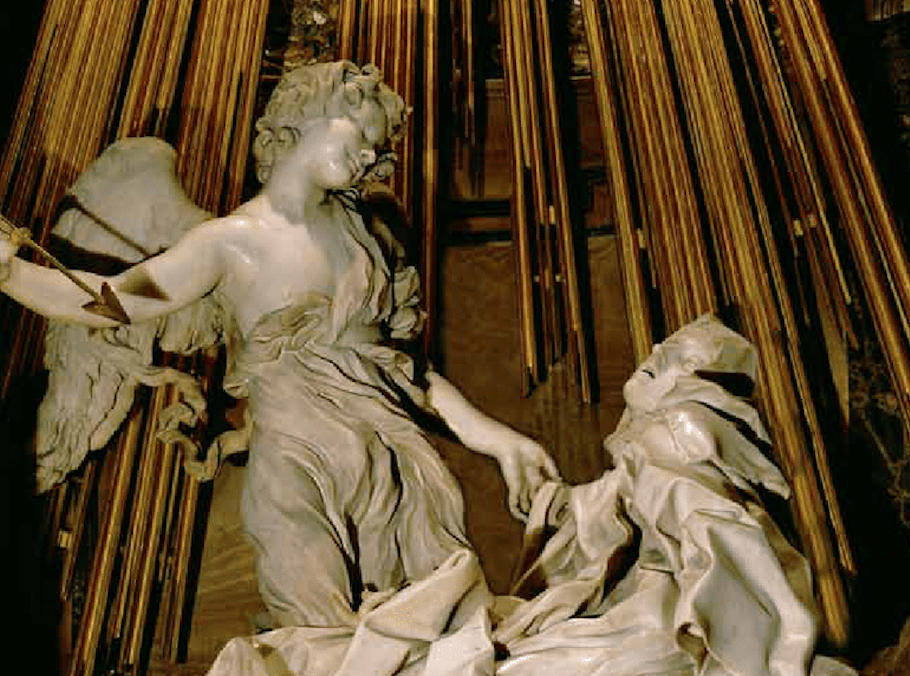
Bernini, Ecstasy of Saint Teresa (1652)

Seekers may be solitary or may benefit from community, but the spiritual seeker’s encounter with the truth is ultimately private and direct.

Although spirituality encompasses–and sometimes encourages–tensions, struggles, and paradoxes, the whole package is neat. Truth, goodness, and beauty cohere; improving the soul yields knowledge, which further improves the soul.

Now consider science, viewed as this cluster of ideas: There is a real world, and it is strictly a domain of causes and effects (“nature”) which is not moral or beautiful in itself. Goodness and beauty are our subjective categories. In seeking to know nature, we are hampered by biases. However, we can use impersonal techniques and tools, such as careful quantitative measurement, to counter our biases. Moral and aesthetic preferences are among the many biases that interfere with our grasp of nature if we don’t control for them.

The Compact Muon Solenoid (CMS) at CERN 

Since the truth is replicable, it will be known just the same by a bad person and a good one. Instead of putting ourselves in maximally direct contact with the truth in order to improve or save ourselves, we should generally put instruments in direct contact with nature and review the data that they yield. (Instruments may be as simple as rulers or as elaborate as particle accelerators). The data should then be made available to as many people–and for as many uses–as possible. Whether these uses are good is not a scientific question, and possibly not an answerable one.

Are hybrids possible? Some famous scientists have testified to their own spiritual inclinations. Einstein is the most obvious example: “Everyone who is seriously involved in the pursuit of science becomes convinced that a spirit is manifest in the laws of the universe.” Such combinations shouldn’t surprise us, since both the spiritual and the scientific traditions are prominent and influential. The same person can be affected by both. Having a spiritual side may help some scientists to be happy and may motivate them to be devoted scientists.

However, other scientists are successful without being happy or are happily motivated by non-spiritual factors, such as fame, power, competitiveness, or even wealth. If spirituality correlates with scientific acumen, that is an empirical generalization, not a law–and it may not even be a valid generalization. Claims that science and spirituality are intrinsically or logically related are romantic and naive. Their logics (as described above) are incompatible. Some individual scientists manage to hold them together, but some individuals also combine kindness to family with cruelty on the battlefield, or love of country with love of money. We can contain multitudes.

Still, it is important to avoid the Hobson’s Choice of either science or spirituality. We need a robust discussion of what is right, both for individuals and for institutions and societies. That discussion is not helped by the widespread scientific premise that answers to the question “What is right?” are merely subjective.

This premise doesn’t damage the conversation as much as you’d expect. Plenty of people claim that moral beliefs are subjective and relative yet strongly endorse actual moral principles and exchange reasons about them. A student last semester wrote an impassioned paper in favor of affordable housing, and ended it: “Overall, what makes a policy ‘good’ is completely subjective–in this paper, however, I have argued that in my view, …” No harm done; again, we contain multitudes. But there is harm at a more institutional level, where we fail to invest in the normative disciplines and in public deliberation while we pour resources into applied science.

Science does have an ethic of its own, including the obligation to make findings public, the principle of blindness to scientists’ personal identities, and cosmopolitanism. The fact that actual science violates these principles does not invalidate them; it just means there is important work to be done.

But the ethics of science is insufficient. Even if science worked exactly as advertised, it would still have little to say about what makes a good life or a good society, particularly for non-scientists.

Here’s where spirituality offers resources. Especially important is its insistence that you probably won’t be good just because you know what is good, intellectually. Since people are habitual and reflective creatures, we need methods for self-improvement–things like rituals.

The problem, for me, is spirituality’s premise that truth and goodness cohere. I see no reason to assume that, and therefore no reason to presume that what is good is also true. If that premise is false, then the tools of science are likely more reliable than those of spirituality–if our goal is to understand nature. But understanding nature should not be our only goal.

See also: adding democracy to Robert Merton’s CUDOS norms for science; is all truth scientific truth?; Philosophy as a Way of Life (on Pierre Hadot); Foucault’s spiritual exercises; notes on the social role of science: 1. the example of fetal ultrasounds; and science, UFOs, and the diminishment of humankind.

navigating the disciplines

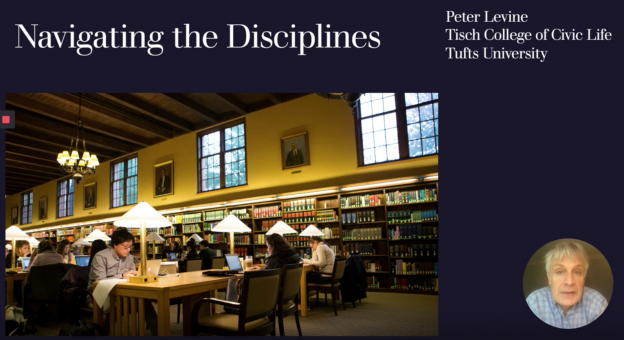
In a year of virtual orientations, I made a video to help inform Tufts undergraduates who may be thinking about what disciplines to explore as they choose courses and–later on–majors. I addressed “civically engaged” students: those who want to improve their communities, nations, and the world and are trying to decide what academic disciplines might help them to do that.

My presentation is not argumentative or judgmental in the sense that I advocate some disciplines over others. But I do impose an organizational scheme with classifications and generalizations that would probably be controversial. For example, I say what I think a “science” is and why the social sciences are scientific. I acknowledge that these definitions are personal and contentious, but they might make the video interesting for some people beyond Tufts.