spirituality and science

Following Foucault, let’s use the word “spirituality” for this cluster of ideas: What is true (i.e., most actually real) is the same as what is most right and most beautiful. To know this truth requires being a better person; truth comes to one whose mind or soul is in an appropriate condition. In turn, perceiving the truth improves the perceiver.

Several modes of spirituality have been taught (and sometimes combined). In the ecstatic mode, the seeker loves truth, longs for it, and expects ecstasy from its attainment. In the ascetic mode, the seeker renounces ordinary desires and comforts to merit truth. In the diligent mode, the seeker labors for years at ritual or memorization–or literal labor–until rewarded with truth. In the mode of faith, the seeker ignores the evidence of senses and the pull of desires to believe in what is not directly known.

Bernini, Ecstasy of Saint Teresa (1652)

Seekers may be solitary or may benefit from community, but the spiritual seeker’s encounter with the truth is ultimately private and direct.

Although spirituality encompasses–and sometimes encourages–tensions, struggles, and paradoxes, the whole package is neat. Truth, goodness, and beauty cohere; improving the soul yields knowledge, which further improves the soul.

Now consider science, viewed as this cluster of ideas: There is a real world, and it is strictly a domain of causes and effects (“nature”) which is not moral or beautiful in itself. Goodness and beauty are our subjective categories. In seeking to know nature, we are hampered by biases. However, we can use impersonal techniques and tools, such as careful quantitative measurement, to counter our biases. Moral and aesthetic preferences are among the many biases that interfere with our grasp of nature if we don’t control for them.

The Compact Muon Solenoid (CMS) at CERN 

Since the truth is replicable, it will be known just the same by a bad person and a good one. Instead of putting ourselves in maximally direct contact with the truth in order to improve or save ourselves, we should generally put instruments in direct contact with nature and review the data that they yield. (Instruments may be as simple as rulers or as elaborate as particle accelerators). The data should then be made available to as many people–and for as many uses–as possible. Whether these uses are good is not a scientific question, and possibly not an answerable one.

Are hybrids possible? Some famous scientists have testified to their own spiritual inclinations. Einstein is the most obvious example: “Everyone who is seriously involved in the pursuit of science becomes convinced that a spirit is manifest in the laws of the universe.” Such combinations shouldn’t surprise us, since both the spiritual and the scientific traditions are prominent and influential. The same person can be affected by both. Having a spiritual side may help some scientists to be happy and may motivate them to be devoted scientists.

However, other scientists are successful without being happy or are happily motivated by non-spiritual factors, such as fame, power, competitiveness, or even wealth. If spirituality correlates with scientific acumen, that is an empirical generalization, not a law–and it may not even be a valid generalization. Claims that science and spirituality are intrinsically or logically related are romantic and naive. Their logics (as described above) are incompatible. Some individual scientists manage to hold them together, but some individuals also combine kindness to family with cruelty on the battlefield, or love of country with love of money. We can contain multitudes.

Still, it is important to avoid the Hobson’s Choice of either science or spirituality. We need a robust discussion of what is right, both for individuals and for institutions and societies. That discussion is not helped by the widespread scientific premise that answers to the question “What is right?” are merely subjective.

This premise doesn’t damage the conversation as much as you’d expect. Plenty of people claim that moral beliefs are subjective and relative yet strongly endorse actual moral principles and exchange reasons about them. A student last semester wrote an impassioned paper in favor of affordable housing, and ended it: “Overall, what makes a policy ‘good’ is completely subjective–in this paper, however, I have argued that in my view, …” No harm done; again, we contain multitudes. But there is harm at a more institutional level, where we fail to invest in the normative disciplines and in public deliberation while we pour resources into applied science.

Science does have an ethic of its own, including the obligation to make findings public, the principle of blindness to scientists’ personal identities, and cosmopolitanism. The fact that actual science violates these principles does not invalidate them; it just means there is important work to be done.

But the ethics of science is insufficient. Even if science worked exactly as advertised, it would still have little to say about what makes a good life or a good society, particularly for non-scientists.

Here’s where spirituality offers resources. Especially important is its insistence that you probably won’t be good just because you know what is good, intellectually. Since people are habitual and reflective creatures, we need methods for self-improvement–things like rituals.

The problem, for me, is spirituality’s premise that truth and goodness cohere. I see no reason to assume that, and therefore no reason to presume that what is good is also true. If that premise is false, then the tools of science are likely more reliable than those of spirituality–if our goal is to understand nature. But understanding nature should not be our only goal.

See also: adding democracy to Robert Merton’s CUDOS norms for science; is all truth scientific truth?; Philosophy as a Way of Life (on Pierre Hadot); Foucault’s spiritual exercises; notes on the social role of science: 1. the example of fetal ultrasounds; and science, UFOs, and the diminishment of humankind.
navigating the disciplines

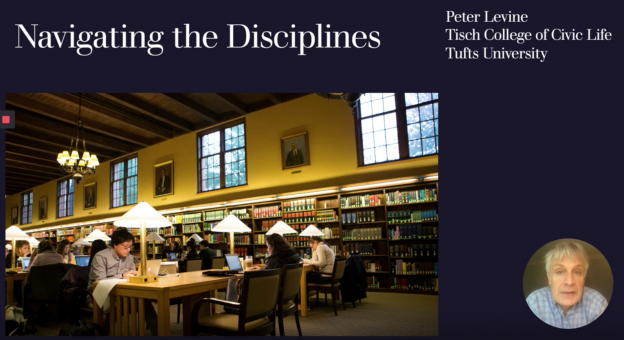
In a year of virtual orientations, I made a video to help inform Tufts undergraduates who may be thinking about what disciplines to explore as they choose courses and–later on–majors. I addressed “civically engaged” students: those who want to improve their communities, nations, and the world and are trying to decide what academic disciplines might help them to do that.

My presentation is not argumentative or judgmental in the sense that I advocate some disciplines over others. But I do impose an organizational scheme with classifications and generalizations that would probably be controversial. For example, I say what I think a “science” is and why the social sciences are scientific. I acknowledge that these definitions are personal and contentious, but they might make the video interesting for some people beyond Tufts.

College graduates, high income earners most likely to feel helped by government during pandemic

Latinos, those with only high school education, and under-30s hit harder by layoffs than other groups, according to new Tufts University national survey

This is the latest from the Tufts Priority Research Area on Equity, which I co-lead.

MEDFORD/SOMERVILLE, Mass. (July 30, 2020)—College graduates and high earners with incomes between $85,000 and $150,000 are most likely to feel that the government has helped them during the pandemic or that other individuals have assisted them, according to a national survey from Tufts University.

At the same time, the national survey found that Latinos, people under the age of 30, and those with only a high school diploma were more likely to have been laid off than other groups.

“The survey results provide insight into Americans’ differing perceptions of who is helping them through these unprecedented times, and who is bearing the brunt of the pandemic’s economic impacts,” said Wenhui Feng, assistant professor of Public Health and Community Medicine at Tufts University School of Medicine, who contributed to the study. “Layoffs have affected all population subgroups, but the economic toll of COVID-19 has hit particularly hard a segment of the population that was struggling even before the pandemic.”

The survey was designed and analyzed by Tufts University’s Research Group on Equity in Health, Wealth and Civic Engagement. The research group previously released data showing that only 57 percent of Americans would get vaccinated for COVID-19 if a vaccine were available. It also has released additional research about who has been more likely to self-isolate and to be tested for the virus during the pandemic.

Government, nonprofits provide assistance

About one third (33%) of survey respondents say that the government has helped them deal with COVID-19 or its effects. The survey did not ask specifically how people were helped, but the federal government has provided financial assistance to some individuals and companies, and various federal, state and local governmental entities have provided testing, information and healthcare.

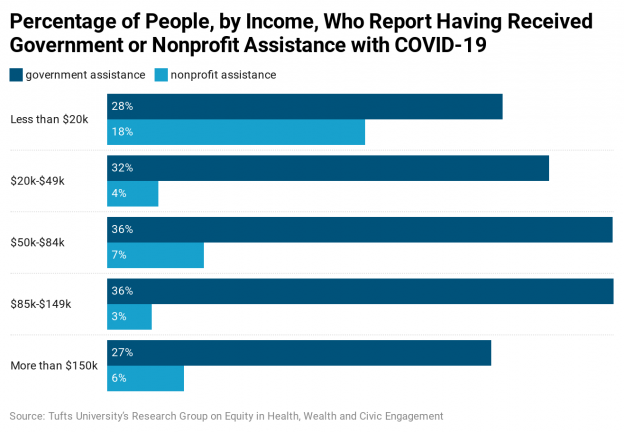
Individuals with higher education levels are more likely to feel that they have received assistance. About a quarter of people (24.5%) without a high school degree, 29% of high school graduates, 32% of people with some college, and 39% of people with at least a bachelor’s degree say they feel they have been helped. People from households with incomes between $85,000 and $150,000 are most likely to report that the government has assisted them. 

By contrast, the study reveals that nonprofits have been a critical source of assistance for underserved segments of the population. Overall, 6% of Americans say a nonprofit has helped them with the virus or its impact, but that rate is triple (18%) among those with an income below $20,000/year. Latinos are most likely to report receiving assistance from nonprofits (13%), compared with 8% of non-Latino Black individuals, 4% of non-Latino white individuals, and 8% of those with less than a high school degree.

Employment also impacted

About one in seven (14%) of those surveyed say they were laid off due to COVID-19. Layoffs are more than twice as common for people with only a high school degree than for those with a bachelor’s degree or higher (17% versus 9%). Layoffs have been more common for Latinos (20%) than for African Americans (13.5%) or whites (12%). They have been most common for people under 30 (23%) and least common for those 60 and older (8.5%).

Other research conducted by the Center for Information & Research on Civic Learning and Engagement, part of Tufts University’s Tisch College of Civic Life, has also documented the adverse economic impacts of COVID-19 on youth—particularly on youth of color.

About the study

The survey was designed and analyzed by Tufts University’s Research Group on Equity in Health, Wealth and Civic Engagement. It was fielded online by Ipsos between May 29 and June 10, 2020, using its KnowledgePanel. The sample was nationally representative, and the number of complete responses was 1,267 non-institutionalized adult residents of the United States.

More technical information about the survey is at https://equityresearch.tufts.edu/the-survey/.

Tufts University’s Research Group on Equity in Health, Wealth and Civic Engagement was established in 2019 as part of a strategic effort to use resources and expertise across the university to address major global issues. It brings together researchers from across the university to discuss and investigate aspects of equity and inequity in the United States and the world. The research has been funded by Tufts University’s Office of the Vice Provost for Research as one of several such initiatives.

The group’s principal investigators are Jennifer Allen, professor of Community Health in Tufts’ School of Arts and Sciences; Peter Levine, associate dean for academic affairs and Lincoln Filene Professor of Citizenship & Public Affairs at Tisch College of Civic Life at Tufts; and Tom Stopka, an epidemiologist and associate professor at Tufts School of Medicine. Other members of the group can be found here.

By September 2020, the Research Group will launch a website at https://equityresearch.tufts.edu that will allow anyone to explore numerous dimensions of equity and inequity with an interactive data-visualization tool. Tufts’ Jonathan M. Tisch College of Civic Life is funding the data-visualization tool.

###

For more information o, contact: Robin Smyton robin.smyton@tufts.edu 617.627.5392 or Jen McAndrew jennifer.mcandrew@tufts.edu 617.627.2029.

About Tufts University

Tufts University, located on campuses in Boston, Medford/Somerville and Grafton, Massachusetts, and in Talloires, France, is recognized among the premier research universities in the United States. Tufts enjoys a global reputation for academic excellence and for the preparation of students as leaders in a wide range of professions. A growing number of innovative teaching and research initiatives span all Tufts campuses, and collaboration among the faculty and students in the undergraduate, graduate and professional programs across the university’s schools is widely encouraged.

party identification and ideology over time

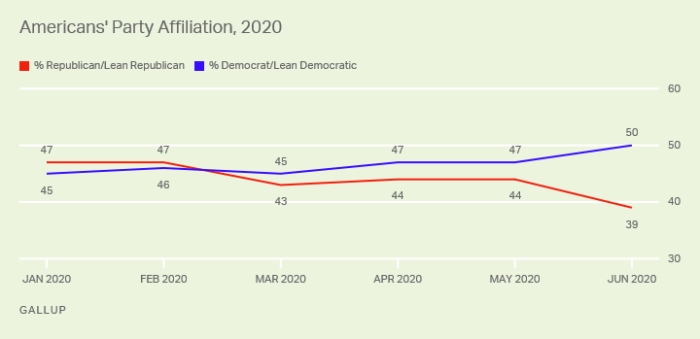
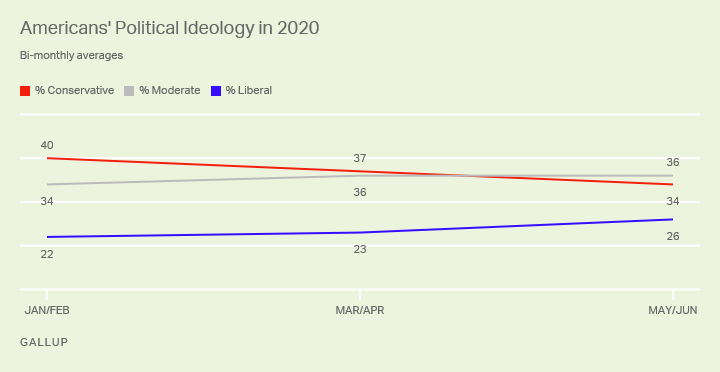
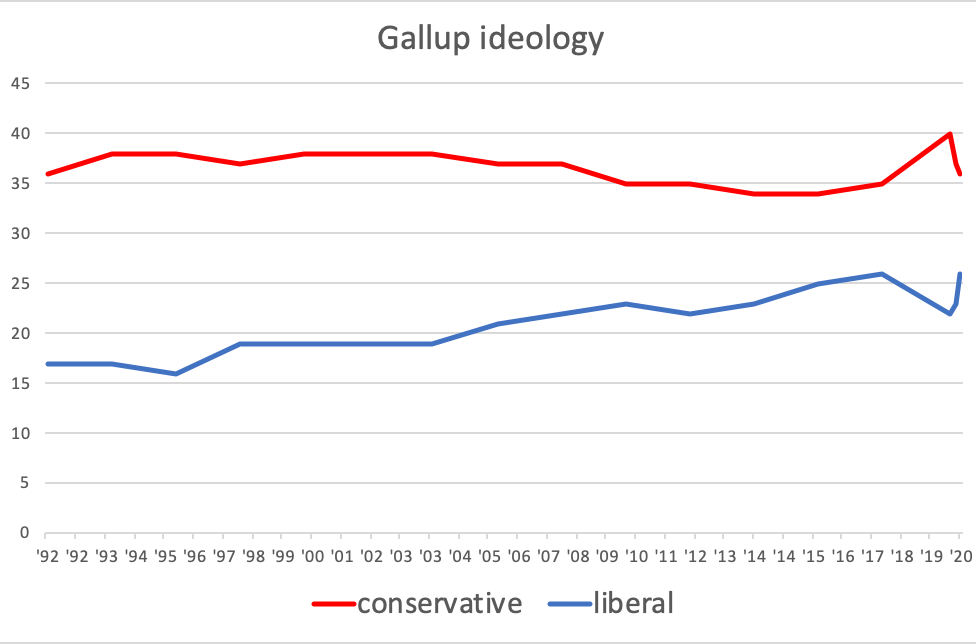
Jeffrey Jacobs of Gallup writes, “U.S. Party Preferences Have Swung Sharply Toward Democrats.” And Gallup’s Lydia Saad reports, “Americans’ ideological bent has shifted in the first half of 2020 with fewer people self-identifying as politically conservative in May and June than at the start of the year. There has been a corresponding increase in self-described liberals while the percentage moderate has been fairly steady.”

Here is the evidence:

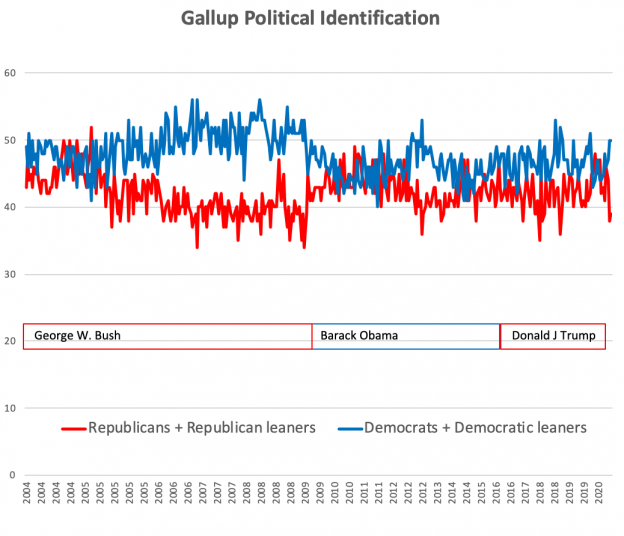
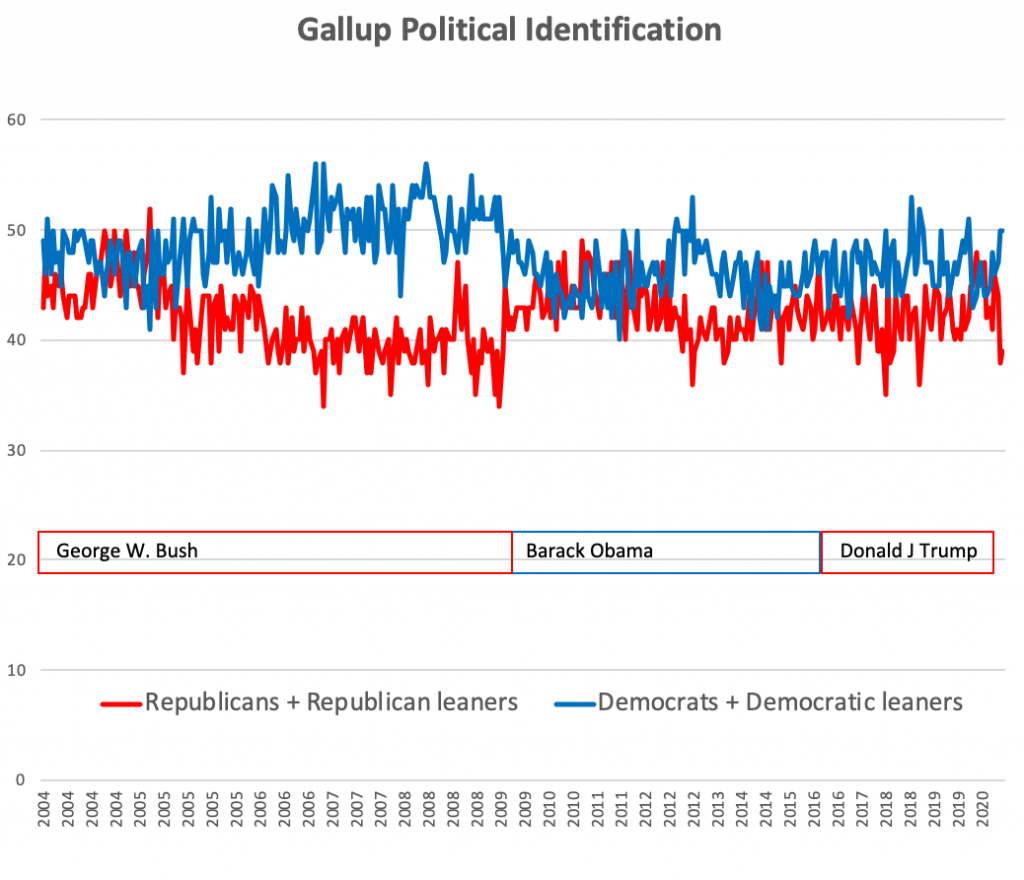
These reports of 2020 Gallup polls made me curious about the longer term trend. Here are Gallup results for party ID since 2004.

And here are the trends for conservatives and liberals, showing one annual result for every year until 2019, and then the three polls this year:

(By depicting the ideology data this way, I have made 2020 look uniquely volatile. I can’t find more data points before 2020, but I’m sure the lines would zig-zag more.)

A few observations:

  • Many more Americans are always comfortable calling themselves conservatives than liberals. It is not the case that many people place themselves left of liberal or identify as “progressives” instead of liberals, because almost everyone picks either conservative, liberal, or moderate. However, the content of those labels shifts. To be liberal in 2020 means different things than it meant in 1992, and that is where the left has a greater advantage.
  • The beginning of 2020 was one of the peaks for conservative identification. The level this June was typical.
  • Republican identification in June 2020 (39%) was lower than it was in 82% of Gallup’s surveys since 2004, but it was not unprecedented. Republican identification was at 36% as recently as January 2019.
  • Democrats have a longterm advantage in party ID. Republicans have been ahead in 12% of Gallup’s surveys since 2004.
  • Each party tends to get more support when the other one holds the presidency, but George W. Bush boosted Democratic identification more than Barack Obama helped Republicans. Bush also did more damage to his own party than Trump has done to his, so far. However, I think the bottom may well fall out for the GOP between now and the end of the year. They could reach the same level as in fall 2006, when they trailed the Dems. by 56%-34%, and Nancy Pelosi became Speaker.

how change is made

From June 1-June 11, 2020, “support for the [anti-racism] protests grew 10 points among Mixed Feelings voters, 14 points among Lean Biden voters, and a head-spinning 25 points among Lean Trump voters. ‘I had never in my research career seen public opinion shift on the scale in this time frame,’ Michiah Prull said.’”

But how much does this change matter? Beyond affecting the vote in November, what does the shift in public opinion portend?

I’d offer the following general observations.

Public opinion is subject to fairly quick and major shifts when people assess something that doesn’t affect them directly and substantially. For instance, the Civil Rights Movement persuaded many white Northerners to turn strongly against segregation in the South ca. 1958-65. This mattered because it changed votes in the US Congress, yet Northerners were not asked to renounce any of their own advantages. The Civil Rights Movement struggled when it shifted to the North and the issue became White Northerners’ behavior.

People will voluntarily renounce advantages over other people (“privileges”) so long as they don’t have to pay a tangible price or undergo a serious risk as a result. Most straight people have decided that it’s no problem if gay people also marry. In a way, this means renouncing a privilege or a status advantage. But since straight people can still marry, it’s not really a sacrifice. Marriage equality is win/win. To be sure, some people take challenges to their status advantage as threats, but they can often be outvoted by people who are willing to give up merely symbolic privileges.

It is not true that people always act out of self-interest. More than 600,000 Americans died in the US Civil War (putting both sides together), which is hard to explain in terms of individual self-interest — or coercion. Many were eager to sacrifice. But when human beings sacrifice, it is very rarely for other people. It is usually for some “we” to which the individual feels loyalty. And that “we” usually takes a tangible, concrete form as well as an abstract one. Maybe Americans will sacrifice for America because it’s part of our identity, but each soldier is more likely to sacrifice for his own buddies in the squad.

Although people sacrifice when they belong to cohesive groups or during moments of dramatic change, self-interest tends to prevail over the longer term. Relative advantages are astoundingly durable, surviving even revolutions and invasions. The descendants of pagan, Roman gentry became medieval French bishops. Even in the hardest circumstances, people find ways to pass relative advantage to their own offspring and justify doing so using the ideological materials of their time and place.

Still, we are capable of building fairer societies, ones that guarantee more security and opportunity to the least advantaged. Typically, those societies are also democratic, and a substantial majority sees the social contract as beneficial to them.

People will also make concessions to organized groups who can extract a price. For instance, we’ll pay more for a good if the people who manufacture it can strike for better wages. We’ll give up a social advantage to calm a restive group so that they leave us alone. In these cases, a majority yields to a minority for pragmatic reasons.

If these generalizations generally apply, then it’s unlikely that White Americans will voluntarily change their behavior in ways that are actually costly to them or their descendants. I believe that efforts to educate people about their relative advantage are apolitical in the sense that they do not reflect a coherent strategy for addressing power. I fear that these efforts can actually alert people to their own advantages and cause them to dig in. As Steve Biko wrote, “No amount of moral lecturing will persuade the white man to ‘correct’ the situation.” Trainings in diversity, equity and inclusion may be ways for institutions to maintain the status quo, not tools for changing it.

But that does not mean that change is impossible. In fact, I am optimistic that change is coming. It will come in other ways.

First, a majority of the American electorate is shifting on issues that they see as not directly costly to themselves, although these issues matter. Aggressive, racially biased policing and mass incarceration really don’t benefit you if you happen to be white and middle class. In fact, you may suffer collateral damage. Even though African Americans are much more likely than whites to report discriminatory treatment by the police, a plurality of all the people who report such treatment are white. White people can definitely be persuaded to oppose militarized, muscle-bound (and expensive) policing.

We may shift toward a new social contract that prevails because a broad cross-section of voters see it as beneficial to them–and it reduces racial injustice. Many Americans will vote for universal health care or cheaper college because of their self-interest. A society with better access to health and education should also be more racially equitable.

Second, the composition of the public shifting. Although a majority of the electorate remains White, about half of Democrats are now people of color. Their concentration on one side of the aisle poses risks but also offers advantages. When Republicans falter for any reason, people of color suddenly have a lot of leverage.

Third, skillfully organized people of color can (and are) extracting concessions by protesting, boycotting, and otherwise challenging institutions that need them in various ways.

Finally, change can result from random events that are skillfully exploited. I think, for example, that both childhood and gender have been transformed by the rise of girls’ team sports. One reason was Title IX (1972), which was not intended to popularize girls’ athletics. Girls’ sports didn’t arise automatically as a consequence of Title IX; many women and girls (and some men) had to work hard to create teams, leagues, training programs, role models, etc. However, the law created an opening–more or less by accident–and people took advantage of it. We should look for such opportunities today.

See also: the significance of the progressive primary victories; when social advantage persists for millennia; why some forms of advantage are more stubborn than others; the remarkable persistence of social advantage.