Options for responding to a Trump Administration

how did we respond? what next?

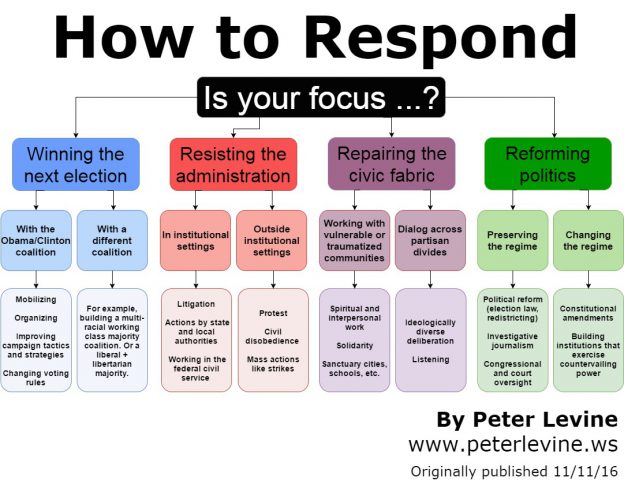
A few days after the 2016 election, I posted a flowchart with options for responses. It was by far my most-shared post in decades of blogging and was used a fair amount in grassroots meetings between 2016 and 2018.

This is a better version of the same graphic:
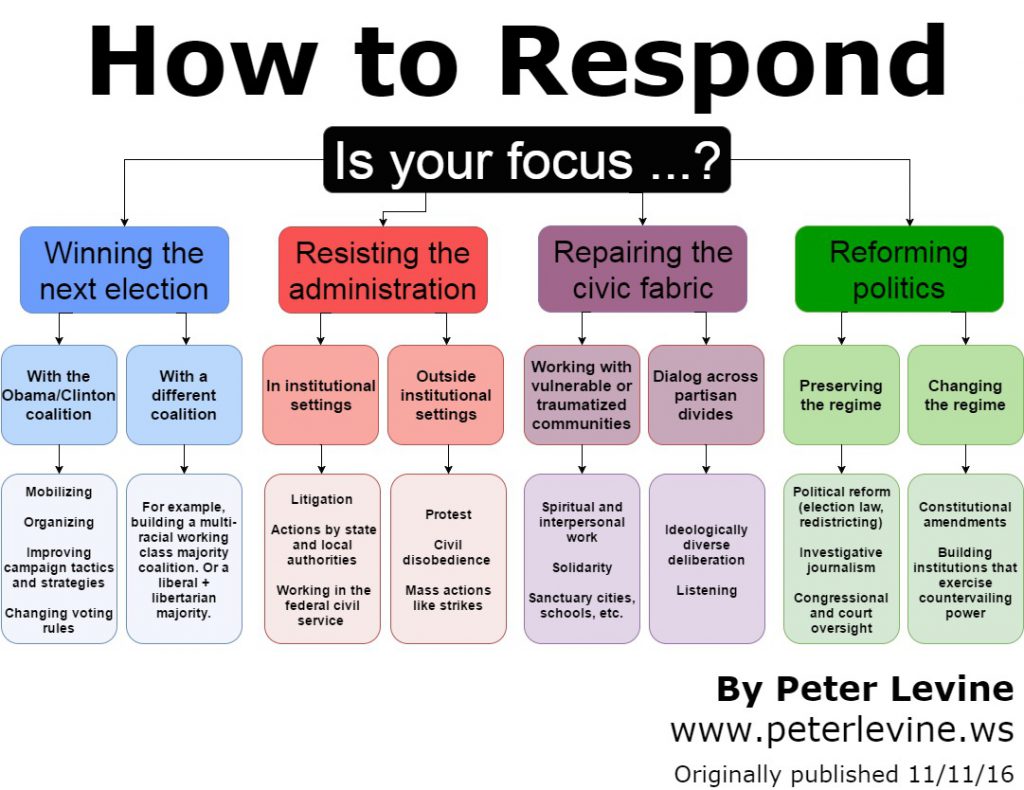
Two questions: How much was done in each of these boxes in 2016-18? And what is most important now?

The anti-Trump side did win the next two elections, although by a closer margin in ’20 than some might have expected. I think we observed a complex mix of all the ideas in that column, from changing some voting rules to building new coalitions. However, at the national level, the majority coalition is mainly the same as the one that elected Obama, and not larger as a percentage of the population.

Characterizing Black Lives Matter and climate mobilization as “resistance to Trump” is reductive: those movements were already underway before his election and will continue after, frequently targeting Democrats. Still, the combination of protest and litigation has been pretty effective.

Under “repairing the fabric” are two importantly different paths. Many people have worked hard on both. For examples of work in the cross-partisan lane, see Braver Angels, the Bridge Alliance, the Civic Health Project, and many other groups. Meanwhile, institutions and communities are paying attention to vulnerable people.

Both strategies are very hard, and the main trends are against them. Trauma and affective partisanship have intensified, which doesn’t take anything away from the people who are combatting either or both. The situation might well be even worse without these people, but now is a time to reflect on larger-scale strategies.

The last column is about preserving or changing the “regime.” I didn’t mean that word as pejorative; it’s just political-science talk for the government plus the other institutions that connect to it, such as parties and the media. The current regime survived but is surely fragile–see a recent piece of mine for some reasons.

Which of these paths should we emphasize next? My predictable answer is: all of them. I thought that a Biden administration would face a genuine dilemma: either fighting for valuable political reforms that would be seen as partisan or else reducing partisanship. GOP control of the Senate may simply preclude political reform at the national level, which might be an argument for focusing a four-year Biden administration on lowering the partisan temperature. That doesn’t mean that political reform is dead, because it has potential at the state and city level.

I remain interested in policy approaches that could possibly expand the majority while disrupting partisanship by assembling strange bedfellows. For instance, libertarians should be (and often are) appalled by Trump and can find substantive common ground with left-liberals on some policies, e.g., criminal justice reform.

A related strategy is to emphasize certain bread-and-butter policies that involve the government less in people’s lives while still boosting economic equity. A minimum wage referendum passed in Florida even as Trump won the state. The reason could be that there’s a latent majority for left-economic policies that the Democrats missed by nominating a moderate. (That’s the “Bernie would have won” argument.) A different explanation is that people don’t like the government or taxes, partly because they see the government as the representative of hostile cultural values, but they’re happy to pass unfunded mandates on the private sector. This kind of social policy has promise if the outcomes are actually beneficial.

See also white working class alienation from government; promoting democracy and reducing polarization; some remarks on Elinor Ostrom and police reform; political reform in Massachusetts, etc.
post-election resolution #3: don’t argue on the basis of election counterfactuals

On Tuesday night, when things looked dimmest for Biden-Harris, I saw plenty of “Bernie would have won” tweets, and also some arguments that the Democrats would gave done better if they had been more moderate on immigration. On the GOP side, too, there will be arguments about whether the party would have performed better if all their candidates were more Trumpian or whether Trump cost them the White House despite strong economic fundamentals.

It is important to argue about: (a) what is valuable and (b) what is politically feasible. The union of those two circles is what we ought to support. People disagree about both questions, and discussion can be helpful.

Our values can influence our estimates of what would win. If you are further left, you may be biased to believe that leftist policies would win–and the same for people all across the spectrum.

However, disciplined political thinkers try to separate the two matters in case what they want may mislead them about what they can win.

It almost never helps to argue with counterfactuals about past elections. The problem with “Bernie would have won” is not that it’s false. It’s unfalsifiable, untestable. It provides no analytic clarity.

I acknowledge that social science often seeks to estimate counterfactuals. For instance, a regression model estimates what would happen to the dependent variable if the independent variable changed from what it actually is. (If we spent more on preventive healthcare, the data may suggest, fewer people would get sick.) This kind of reasoning is essential for thoughtful planning. However, to make counterfactual inferences, we need the right conditions: usually lots of cases, each with many variables, from which we can infer trends. Natural experiments also work nicely. A given election is one ambiguous datapoint that can fit countless theories.

So my resolution is: I will argue about what I value and whether it can win the next election, but not what would have won in 2020. I think that’s a recipe for confusion. In any case, I am not looking forward to that particular form of debate.

post-election resolutions #1 and #2 (less forecasting and less hobbyism)

Today seems an auspicious occasion to begin posting resolutions for becoming a better person and citizen after the 2020 election.

The first and second resolutions are simple:

  1. Less forecasting, more living in the present. Surveys are valid research tools, but they are particularly hard-pressed to predict future behavior with precision. The polling error that shows up in forecasting sites like FiveThirtyEight reflects the complexity of screening for likely voters–it doesn’t invalidate survey research. But why are we checking FiveThirtyEight in the first place? All the sages teach that we should live in the present or work to change the future. Forecasting violates that advice, but it is almost literally addictive: you get a little dose of pleasure every time a prediction is favorable, and when it isn’t, you can go back for another fix. I hope I can use the methodological limitations of electoral forecasting as a reason to pry myself away from the habit of forecasting everything (COVID-19, the stock market, my own life expectancy).
  2. Less “political hobbyism.People gave $100 million to Amy McGrath. In many cases, they were doing something to harm Mitch McConnell after he did or said something that made them mad. It didn’t work; he won by 20 points. One hundred million dollars is a lot of money. You could start a new college for that. Part of the problem is a profession–political consultancy–whose interests align poorly with the public interest. Someone made a fortune by fundraising for McGrath. (I wrote an article about this in 1994.) Expressing anger by giving money also has an allure; it’s an easy thing to do after observing something that makes you angry. I actually didn’t donate to Amy McGrath (ironically, I was too aware of the skeptical forecasts for her), but I exhibited other symptoms of political hobbyism in this cycle.

time again for civic courage

The day after the 2016 election, I posted a blog entitled “Time for Civic Courage” that seemed to strike a chord; it was shared much more than I’m used to. I mainly wrote it for people like myself– those who would not face much personal risk under Trump but who needed to step up. Compared to our fellow human beings, Americans have more leverage over the US government, and we had to protect them by resisting here. I wrote: “no jokes about moving to Canada. No thoughts about giving up on the nation you belong to, even if its majority and its institutions anger you. No opting out.”

On Election Day 2020, I am cautiously optimistic about the outcome, sharing the conventional view that Biden has roughly a 90% chance of winning, and even a 30% chance of a landslide. But there is certainly a risk of another Trump win. And it is now–not after a loss–when we should pledge Civic Courage. Regardless of what happens, we Americans must keep working and struggling for justice and peace. We’ll need plenty of courage and perseverance even if the election turns out well; and if not–that’s the time to show civic character.

youth voting 2020: Tisch College analysis so far

This is your regular reminder to follow Tisch College’s CIRCLE (@civicyouth) for the best data and analysis on youth voting. A list of their recent releases follows. They will have lots of timely data as the actual election unfolds.

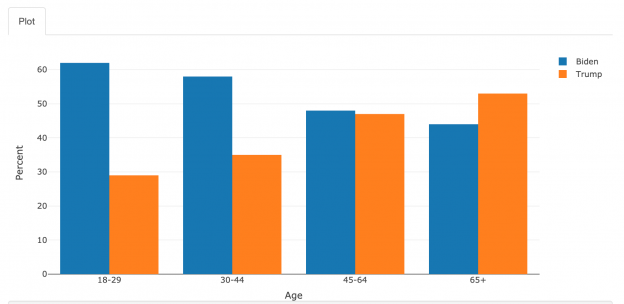
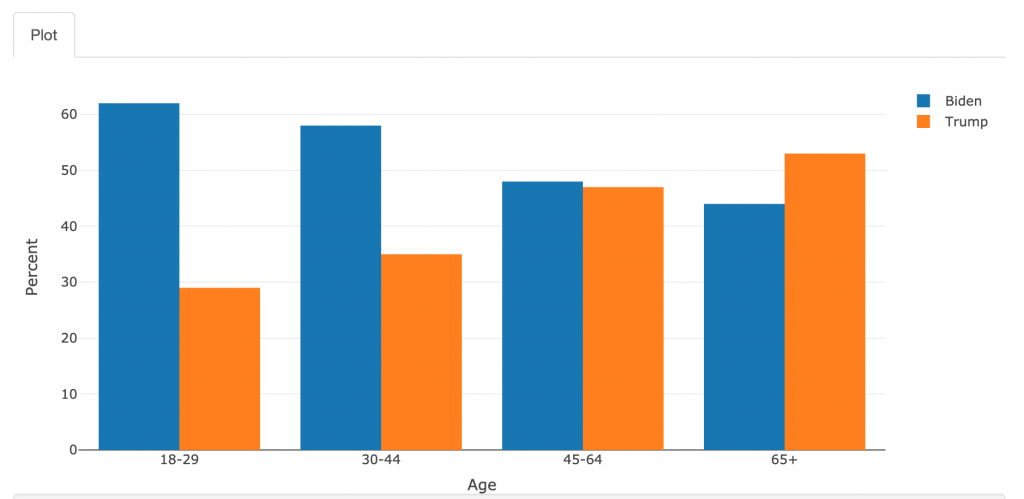
Brian Schaffner is also part of Tisch College. He co-leads the Cooperative Election Study (previously the CCES), which surveyed 71,789 people between Sept. 29th and Oct. 27th. (That is an enormous sample). His analysis of the likely voters in the CES shows why the youth vote is pivotal.

2020 CES Presidential vote preferences (likely voters)

Meanwhile, follow Tisch’s Institute for Democracy and Higher Education for detailed information on college students, our Metric Geometry and Gerrymandering Group for research on districting, and our Center for State Policy and Analysis for Massachusetts-related information, including work on the ranked-choice voting ballot initiative here.