putting the civic back in civil service

Problem 1: Donald Trump has left the federal civil service demoralized and denuded. The Partnership for Public Service reports:

The Department of Education, for example, which has championed many controversial policies, lost more than 14% of its career workforce, while employment at the Department of Agriculture fell by almost 8%. … Non-foreign-service employment at the State Department fell by nearly 9% from December 2016 to December 2019, a period that saw nine senior positions turn over at least once. Currently, more than one-third of the assistant secretary or undersecretary positions are vacant or filled by acting officials, leaving career diplomats and civil-service staff without direction and many initiatives adrift. 

Problem 2: new and recent college graduates need jobs, yet few (at least in my experience) look to the federal civil service. That was true even when they admired the president. Note that the federal government employs 2.1 million civilians, so it is a big part of the labor market. It is ironic that many college students favor a larger role for the government but wouldn’t think of working for it.

Problem 3: many people do not trust the federal government or see it as their friend. As I wrote yesterday, “Maybe progressives are wrong about the advantages of government; maybe white working-class people are wrong about the drawbacks of government; but either way, it is hard to build a party of the left if the largest racial group in the lowest income stratum wants less government.” (Support for government among other racial and class groups is not very impressive, either.)

Problem 4: Affective polarization (meaning hatred of people from the other party) is a real threat to democratic institutions, and specifically to any chance of progress during the Biden Administration.

There might be one solution to all four problems. Federal civil servants can be, and often have been, very capable organizers and supporters of local collaborations. They have helped Americans to come together and address problems that communities define. See Carmen Sirianni’s Investing in Democracy: Engaging Citizens in Collaborative Governance (Brookings Institution Press, 2009) and his Sustainable Cities in American Democracy (University Press of Kansas, 2020) for good examples. Although the latter book is about cities, see p. 37 and elsewhere for the constructive role of federal agencies.

To strengthen this federal role requires leadership at the cabinet level, professional development for civil servants at all levels, conferences and other gatherings to share best practices, awards for excellent work, and other concrete steps. It does not require congressional action.

The objective would be to repopulate the federal civil service with capable civic actors who strengthen communities, bring people together across lines of difference, make government actually work better, and help people to feel that it is their instrument.

See also from government to collaborative governance; welcome to CivicGreen; public participation helps environmental policy; the path not taken (so far): civic engagement for reform; investing in democracy: the case of CARE, etc
who wants less government?

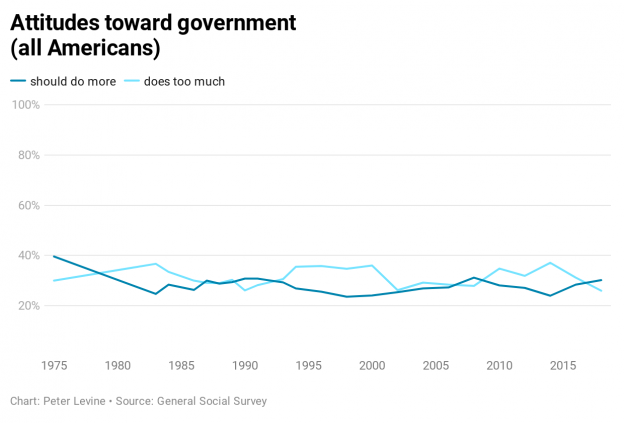
The General Social Survey asks respondents whether the government should do more or whether it already does too much. Here are the responses over time for representative samples of Americans (omitting those who place themselves halfway between those two views):

The balance of opinion swings back and forth. Sometimes, more people want to expand government; sometimes, more people think it already does too much. Obama saw a rise in government skepticism; Trump saw the opposite trend, culminating in the strong Democratic year of 2018.

And here are the results for two groups that are much debated right now.

First, white members of the working class, here defined as white people with family incomes in the bottom quintile.

These are the people who, according to progressives, would benefit from more government but don’t see things that way. Maybe progressives are wrong about the advantages of government; maybe white working-class people are wrong about the drawbacks of government; but either way, it is hard to build a party of the left if the largest racial group in the lowest income stratum wants less government.

Note, however, that the anti-government stance of this group is not hard-wired. In several years, a plurality of them have wanted more government. That was clearly true in 1975, and the next year, Jimmy Carter won the whole of Appalachia and the whole Gulf Coast. Instead of (only) complaining about the tilted electoral map, Democrats should be asking–as some are–why they aren’t the majority party in the country’s poorest states.

And here is the trend for African Americans. Combining all the years together would suggest that Blacks are more favorable than other Americans to government. But note their rising level of support for “government does too much.” I wouldn’t read much into the zigzag pattern; given the number of African American respondents, the margin of error for each year is +/- 8 points. But pretty clearly, African Americans were more favorable to government until ca. 1992 than since.

Finally, I should acknowledge that the question is very simplistic. The government should do more of what? Banning abortions? Stopping-and-frisking? Sending me checks? Covering the cost of seeing private-sector physicians? Curing cancer? I’m treating the results as proxy measures of support for social welfare, but that is not necessarily accurate.

See also: white working class alienation from government; what do the Democrats offer the working class?

The Educating for Democracy Act of 2020

Senator Chris Coons (D-DE) and Senator John Cornyn (R-TX) have introduced the Educating for Democracy Act of 2020. It would significantly increase federal investment in civic and history education. It is the Senate companion to the U.S. House version of the Educating for Democracy Act that was introduced on September 17th by Congresswoman Rosa DeLauro (D-CT) and Congressman Tom Cole (R-OK). 

Note those D’s and R’s–this is bipartisan legislation with support from influential Members on both sides of the aisle.

The Act would authorize $1 billion in federal investment in civic and history education, including research, innovation and teacher professional development. Funds would go to state and local education agencies to strengthen and improve civic and history education; to non-profit entities to develop or expand access to curricula, instructional models, and other programs; and to colleges and universities to educate future elementary and secondary school teachers. The bill would also require the National Assessments of Educational Progress (NAEPs) in civic and history education to be conducted every two years at grades 4, 8 and 12, with state level results made publicly available so that states can be tracked and assessed.

The full bill summary is available here

Senators Coons and Cornyn and Representatives DeLauro and Cole will reintroduce this legislation in the new congress in January, but it is important to persuade U.S. Senators to co-sponsor the bill now. Please be in touch with your own Senators.

we are just more pretentious than the other beasts

The dog bounds into the house. If he were human, he’d be saying, “Mom! Mom! Guess what? We saw this squirrel? It walked right onto the sidewalk and then ran away! You should have seen it!”

I don’t believe that he has this thought or that his objective is to transfer information about the squirrel to a human. But his behavior–other than the words–is exactly like that of a 7-year-old who just had an exciting experience outside.

It makes me think that the behavior is generic: both species like to communicate excitement when seeing a loved one. You can imagine that this desire is adaptive for social animals. Humans just happen to use words for the purpose.

A bunch of geese gather in a rough circle. One is backed up and hissing. Most of them are honking and splashing their wings aggressively, perhaps forming two opposing groups. If they were humans, they would be deeply invested in the precise content of their words. “You always say …” “Yeah, well, you promised …” “I know what you’ve been saying behind my back …”

Again, the behavior is exactly the same as ours, but we care about the propositional content of our words, and the geese don’t need that to establish boundaries.

These are just some untutored speculations at the border of ethology and linguistics–which is, of course, a topic for real science. For me, the takeaway is existential. Let’s recognize that all the detailed things we think and say are not all that important; we’re just exhibiting behaviors.

who needs civic education?

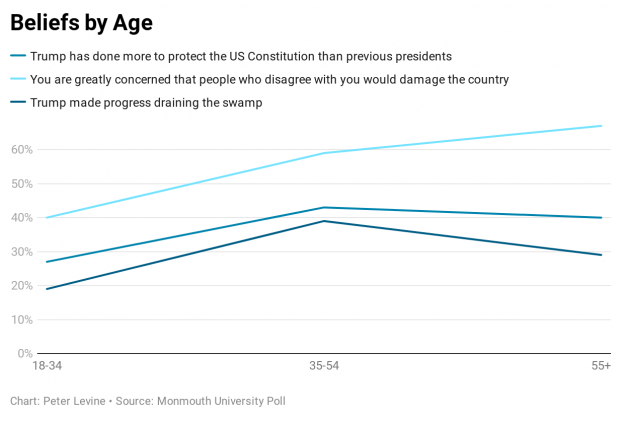
The Monmouth University Poll released on Nov. 19 asked people (among other questions), whether Trump has done more than other presidents to undermine or to uphold the Constitution, whether respondents fear what their political opponents would do to the country, and whether Donald Trump has “drained the swamp” or made corruption worse. Here are the responses by age group.

Young people are the least likely to think that Trump upheld the Constitution, least afraid of their opponents governing, and most likely to believe that Trump worsened corruption.

I suppose reasonable people might debate these questions. A very conservative person might believe that Trump’s judicial appointments are saving the Constitution. A thoughtful progressive might fear what Trumpian Republicans would do to the country.

But generally, we would want people to answer these questions in the negative. Citizens should know that Trump disparages the Constitution, that it’s important to cede power when opponents win elections, and that the forms of corruption reported during the Trump administration are deeply problematic.

Of course, everyone needs civic education. The young need it most because they are the future and because they must be equipped to become more effective as citizens. But if you want to know who demonstrates the greatest deficits in basic civic dispositions, it is not the young.