how predictable is the rest of your life?

Last year, I had a chance to add this question to the Tufts national survey of equity:

Imagine that someone summarized your life, long after your lifetime. To what extent do you already know what that summary would say?

I was interested in how people’s life circumstances might lead them to answer that question differently, and what different answers might mean. For instance, you might be a successful young student for whom the unpredictability of the rest of your life is a sign of broad options and unlimited possibility. You might hate your current situation and feel depressed because you don’t believe it will ever change. You might feel precarious, so that your uncertainty about the remainder of your life is mostly stressful.

I hope to investigate how various subgroups answer the question. In the meantime, I ran a very simple regression to try to predict answers based on people’s demographics (age, race, gender), their perception of their own economic trajectory (Are you better of than your parents, will you be better off next year, and will your children be better of than you?), their sense of civic or political efficacy (Can you make a change in your community by working with others?), a measure of stability at work (How far in advance do you know how many hours you will be working per day?), and a measure of stress about climate change (to see whether worries about the climate were making some people uncertain about their lives).

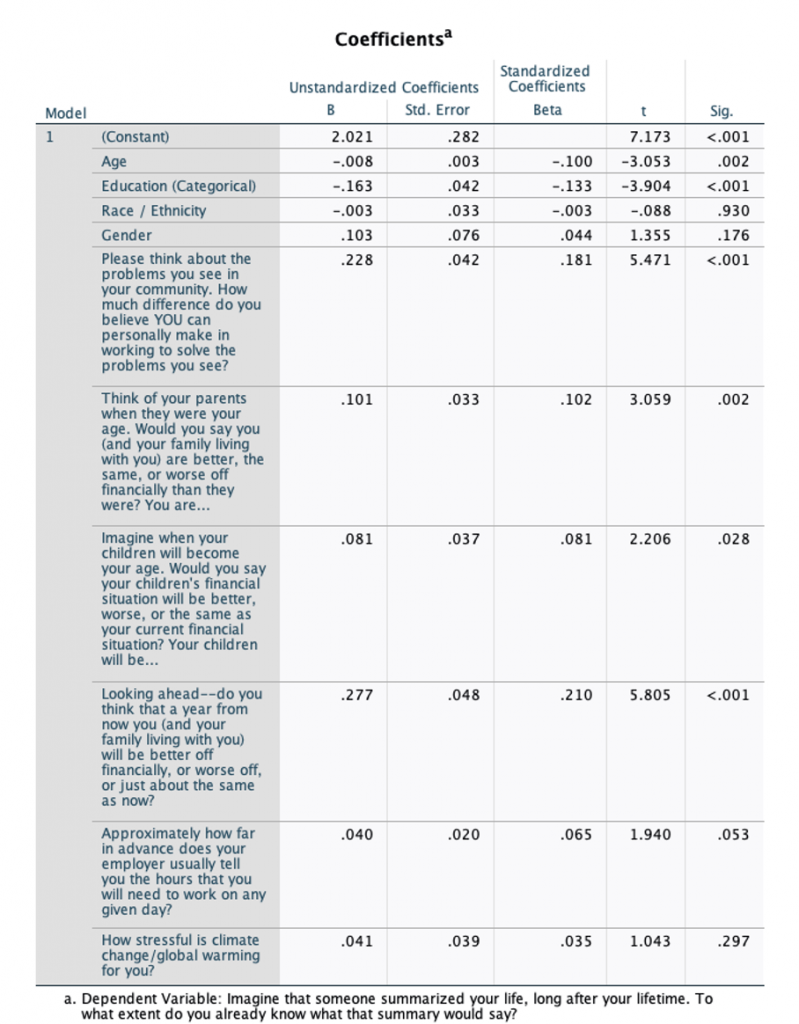
The results are below. (A positive coefficient indicates less certainty.) I’ll summarize the results that are statistically significant (p<.005):

  • Certainty about the story of one’s whole life rises with age, but the coefficient is small. People tend to get just a tiny bit more certain with each passing year. I am more interested in the small relationship than its statistical significance.
  • Certainty rises with more education. At least if you put the whole sample together, it seems that people who have more education don’t feel greater uncertainty because their options are expanded. Rather, they feel more certain, perhaps because they are more secure or feel more control over their lives.
  • Certainty falls with civic efficacy. Apparently, if you think you can make a difference in the world around you, you are less confident that you know the whole story of your life. I hope this is because you believe that unexpected good options might open up.
  • Certainty is lower for people who see their own families on a positive economic trajectory. Maybe perceiving that you are getting wealthier makes you hope for unexpected futures. I find it interesting that economic optimism and education have the opposite relationship to this outcome.
  • The demographic measures, stability at work, and climate stress are not related to this outcome.

As always, I would welcome any thoughts about these very preliminary findings.
See also: youth, midlife & old-age as states of mind; Kieran Setiya on midlife: reviving philosophy as a way of life; to what extent do you already know the story of your life?; the aspiration curve from youth to old age

scholasticism in global context

In The Sound of Two Hands Clapping, Georges B.J. Dreyfus describes Tibetan monasteries as homes for “scholasticism,” using a word originally coined to describe a form of Catholic thought and practice that was most influential in the thirteenth and fourteenth centuries–later to be mocked and repudiated by both Protestants and Catholic Humanists. As Dreyfus notes, this word has also been used to describe specific traditions in Islam, and more recently in Hinduism and Buddhism. In his book, he explores strong parallels in Judaism.

It could be that scholasticism is an option within any heavily organized and sustained tradition of thought, whether we classify it as a religion or as something else.

One core component is a belief in argument–not just discussion and disagreement, but contentious, often competitive pro/con debate. Debates in Tibetan monasteries are high-pressure, competitive affairs conducted before active audiences. The same was true in medieval universities, where students paid the lecturers individually and enjoyed competitive showdowns. King and Arling write that Abelard’s “quick wit, sharp tongue, perfect memory and boundless arrogance made him unbeatable in debate—he was said by supporter and detractor alike never to have lost an argument.” Dreyfus recalls the Jewish practice of havruta, learning in pairs, and emphasizes that these pairs debate each other.

In scholastic traditions, debate is not seen as a temporary necessity while we sort out important topics once and for all. Instead, it is a form of religious practice, comparable to meditation or ritual and something like an end in itself.

Martin Luther hated it for just that reason. Luther was a formidable debater, but he was trying to defeat heresy. He would have been deeply disappointed to learn that people are still debating theology centuries later. In contrast, I think that Tibetan monks work to keep the debate going. They see it as a good way of life.

Debating what is actually said in the most revered texts of any tradition is risky. While arguing about such texts, it is hard to avoid arguing with them. Therefore, an interesting pattern in scholasticism is a tendency to argue about the previous commentators. According to Dreyfus, “Tibetans emphasize less the inspirational words of the founder (the sutras) and more the study of their content as summarized by the great Indian treatises.” In theory, “the authority of the Indian commentaries is extremely important; practically, they are used in Tibetan education relatively rarely by teachers and students.” Instead, Tibetan monks memorize and debate Tibetan commentaries on the Indian summaries of the sutras that are attributed to the Buddha. My sense is that Catholic commentaries on Aristotle, Jewish Talmudic study, and Islamic jurisprudence have a similar flavor.

Again, this style drove Luther crazy. The truth was in the original Word of God (sola scriptura) not in pedantic commentaries. Erasmus opposed scholasticism for a different but compatible reason. For him, the ancient texts–including but not limited to the Bible–made better literature than the ponderous tomes of the scholastics. The classics had style and form. However, if you want to keep on debating forever, then it makes sense to focus on the commentaries and let them accumulate, layer upon layer.

Another common feature is a focus on law–not necessarily in the literal sense of state-enforced rules and punishments, but at least the question of what counts as the right action in all kinds of circumstances; call it casuistry, jurisprudence, or applied ethics. I’m guessing this is a fruitful focus because we can invent new ethical questions endlessly. Besides, if the real purpose of the debate is self-improvement, then good behavior makes an ideal topic.

Social stratification often emerges in these traditions, to the point where the scholastic authorities can be quasi-hereditary. Yet the traditions offer stories about talented teachers who came up from nowhere. That is the point of the opening story of the Platform Sutra, when an illiterate monk grasps the point that the educated ones have missed and becomes a great authority. (This is my example, not Dreyfus’, and it might not be germane.) Jean Gerson, who became the most senior scholar in Paris, was born as one of twelve children of pious peasants. Of course, meritocratic anecdotes serve as great justifications for hierarchical systems.

I share this generic definition of scholasticism without a value-judgment. I am not sure how much I admire these traditions or resonate to them. Presumably, they are best assessed as parts of much larger social orders that offer other options as well. In any case, it seems valuable to recognize a form of life that recurs so widely.

See also: Foucault’s spiritual exercises; does focusing philosophy on how to live broaden or narrow it?; Hannah Arendt and philosophy as a way of life; avoiding the labels of East and West; Owen Flanagan, The Bodhisattva’s Brain: Buddhism Naturalized; is everyone religious?; etc.

“Just teach the facts”

Apparently, at public meetings about social studies curricula, some people are saying: “Just teach facts.” Insofar as this call is coming from people incensed about Critical Race Theory in our k-12 schools, the irony is hard to ignore. CRT is very rarely, if ever, taught, and some of the ideas being attributed to it are factual. Yet I think there is also something else going on. Across many issues and in many political subcultures, it’s common to demand facts instead of opinions, as if the facts are all on our side and the other side is the opinionated one. I have encountered liberals who make versions of this argument, whether about COVID-19 or about history and politics.

In their 2002 book Stealth Democracy, John R. Hibbing and Elizabeth Theiss-Morse argue that about 70% of Americans are drawn to the idea that gives their book its title. These people basically see disagreement as a sign of corruption. It should not be necessary to disagree about matters of political or moral importance. People who express contrasting opinions must have bad motives or be sadly misguided. Since disagreement is rife, it would be “better if decisions were left up to nonelected, independent experts.”

In a great 2010 paper, Michael Neblo, Kevin Esterling, Ryan Kennedy, David Lazer, and Anand Sokhey showed that fewer people probably held the stealth democracy position than Hibbing and Theiss-Morse had found, and Americans were more tolerant of disagreement. However, Neblo and colleagues didn’t find zero support for stealth democracy, and I think it pops up fairly often.

It may reflect frustration about opinions that one strongly dislikes: Why can’t those misguided people just acknowledge the facts? But it may also reflect a deeper problem.

In an era when science (as popularly defined) has enormous prestige and purports to distinguish facts sharply from values, people don’t know what to make of value-laden disagreements. Justin McBrayer found this sign hanging in his son’s second-grade classroom:

Fact: Something that is true about a subject and can be tested or proven.

Opinion: What someone thinks, feels, or believes.

McBrayer attributes this distinction to the Common Core. I think the text of the Common Core is actually a bit subtler, and the sign reflects a widespread view. In any case, the distinction is untenable.

First of all, we must select which facts to investigate. We could teach George Washington’s achievements or slavery in colonial America–or neither, or both–but the facts themselves can’t tell us which of those things to study.

Second, the information we possess always reflects other people’s interests and concerns. American historians, for example, study marginalized and oppressed people more than they did a half century ago. This shift reflects ethical principles. Historians do not, and cannot, pursue all facts indiscriminately. You might dispute their emphasis, but then you’re arguing for different values, not rejecting their facts.

Third, it is very hard to identify a fact that is free of value-judgments or a value-judgment that does not encompass empirical beliefs about the way the world works.

Fourth, many of the most important facts about history are the opinions people held. Lincoln’s response to secession was his opinion, but attributing a position to him is either correct or incorrect. You cannot teach history without teaching–and spending a lot of your time teaching–opinions.

Perhaps most importantly, not all values are just opinions that people happen to hold. Valuing chocolate ice cream over vanilla ice cream is subjective, in this sense. Believing that genocide is evil is not. It isn’t a fact “that can be tested or proven,” but it also isn’t just something I happen to feel. It is something we are all obliged to feel.

Education inevitably involves choices about what to teach and how to talk about and interpret information. It inevitably conveys values and causes students to make judgments–whether as intended or in reaction to what the school wants them to think. Education is better when it helps students to develop political and intellectual virtues. But adults disagree about virtues, and our disagreements reflect our freedom, our diversity, and our nature as finite, embodied, fallible creatures. Therefore, disagreement about what and how to teach is inevitable, permanent, and a sign that free people care about the future. “Just teach the facts” is a call to stop this debate, when what we need is more and better.

See also: first year college students and moral relativism;  science, democracy, and civic lifeis science republican (with a little r)?some thoughts on natural lawis all truth scientific truth?; etc.

public opinion on Critical Race Theory

The Economist/YouGov has released a survey of 1,500 U.S. Adult Citizens (fielded from
June 13 – 15, 2021) that asks some questions about Critical Race Theory (CRT). This is their summary.

This issue is deeply partisan and breaks in Republicans’ favor. Eighty-five percent of Republicans are very unfavorable to CRT, whereas 58% of Democrats are very favorable. But the public as a whole breaks against CRT, 58%-38%, due to Independents’ opposition (71% are very unfavorable) and Democrats’ somewhat mixed support.

Party ID appears more significant than demographics. For instance, a slight majority of Blacks (52%) are very favorable to CRT, but 16% are very unfavorable: a less positive balance than we see among Democrats. Women, college graduates, and young people are a bit more favorable than others, but those differences are small. (With access only to the printed report, I can’t run a regression to see how these variables may interact.)

Fifty-four percent of Americans say they have a very good idea what CRT is. The remainder are split between not being sure whether they know and being sure that they do not know what it is: 23% each. Thirty-five percent have heard nothing at all about CRT, 38% a little, and 26% a lot.

I think most of the people who say they know what CRT is are giving themselves too much credit. It names a rather specific academic movement that few of us understand. I would not claim that I have reliable knowledge of CRT (when knowledge = justified true belief) even though I study this general topic. But 54% of Americans are confident that they know what it is.

Although almost half of people are not sure what CRT is, 96% of respondents state a favorable or unfavorable view of it, and a total of 78% hold either a very favorable or a very unfavorable view. In other words, many people have opinions–even strong ones–about CRT even though they do not believe they know what it is and have heard nothing at all about it.

A mainstream position in political science these days is that Americans lack well-justified and autonomous opinions about most political issues. Achen and Bartels argue that even politically conscious citizens usually display “just a rather mechanical reflection of what their favorite group and party leaders have instructed them to think” (Achen and Bartels 2017, p. 12).

I dissent from this general view and have spent the past week on a methodological paper that aims to show that individuals hold more complex and individualized structures of opinions than one can glean from standard survey research. Yet the nature of public opinion depends on the issue, and especially on whether political professionals are exploiting it.

CRT is a great example of an issue on which public opinion reflects partisan heuristics and cues from leaders rather than careful thought. It’s bound to stay near the top of the national agenda, not only because it serves as a proxy for deeper issues related to race, but also because of the partisan politics. Republicans aren’t going to drop an issue that polls so well for them, but Democratic leaders–even if they wanted to–can’t strongly oppose CRT while 58% of their voters strongly favor it.

Civic Studies at Tufts

In this summer’s issue of Jumbo Magazine (which is sent to prospective Tufts students), I say that Tufts offers “the best mix of experiential [opportunities], like internships and service learning, with academic rigor about civic engagement.”

In this public forum, I should apologize for my competitive claim. If other campuses do more or better than we do, that is good news. But I can elaborate on what I meant.

Virtually every US college or university offers experiential civic education, in the form of student-led groups, service placements and internships, and projects assigned in courses.

Meanwhile, all colleges and universities offer courses relevant to being an effective and responsible citizen, from “Intro to American Government” in political science to courses on specific social issues, to courses that help one to understand cultural identities and differences. Indeed, the liberal arts curriculum as a whole is civic education, if it is done well. (It can be civic mis-education, if it is done very badly.)

However, there is typically a gap between students’ civic experiences and the curriculum. When they are engaged in civic activities, students–like all human beings–usually interact with finite numbers of other individuals within voluntary groups and networks, formal organizations, or enterprises. As individuals and collectively in these groups, they make value-judgments: What counts as a problem? What would be a good outcome? They create and enforce (or undermine and revise) norms that influence their collective behavior. They work together in various ways, producing products and outcomes. And they face characteristic challenges. Some people may slack off, some may misinterpret the purpose of the group, some may mistreat others, and so on.

These issues are addressed in the curriculum, but in a scattered way and not as a major focus. One can learn about ethical judgments in philosophy, about free-rider problems in economics, and about voting procedures in political science. But a student would be hard pressed to identify these relevant aspects of many different courses from various disciplines and put them together.

Hence the Civic Studies Major at Tufts. Our introductory and capstone courses and the electives (including internships) are specifically designed to address the problems of acting together in voluntary groups. These problems have practical significance, and one can learn how to manage them from practical experience. But these problems are also intellectually complex, and one can learn from theory, history, and empirical studies. Our aspiration is put those forms of knowledge together.

See also civic education and the science of association.