Equity Research Symposium

All are welcome to a webinar symposium presented by the Tufts Research Group on Equity in Health, Wealth, and Civic Engagement on Friday, November 19, 2021 from 10:00 am to noon ET. Register here

Agenda

(10-11:15) Presentations of current research, moderated by Shikhar Shrestha:

  • Jennifer Allen, ScD, MPH, Parents’ Willingness to Vaccinate Children for COVID-19: Conspiracy Theories, Information Sources, and Perceived Responsibility.
  • Eden Shaveet, BA, Marissa Gallegos, BS, Catie Urquhart, Web-Based Health Information Seeking Methods and Time Since Provider Engagement: Reflections on Access Equity.
  • Wenhui Feng, PhD, Ideology and health behavior.
  • Megan Mueller, PhD, Equity and the “pet effect”: Complexities in understanding how pets support health outcomes.

(11:15-noon) Panel discussion: Examining our Definition of Equity

What is implicit conception of “equity” is represented on the website, with its data-visualization tool? How should people think about equity?

  • Peter Levine, PhD, Associate Dean of Academic Affairs, Tufts Johnathan M. Tisch College of Civic Life (moderator)
  • Lionel McPherson, PhD Tufts Department of Philosophy
  • Felipe Dias, PhD, Tufts Department of Sociology
  • Elizabeth Setren, PhD, Tufts Department of Economics 

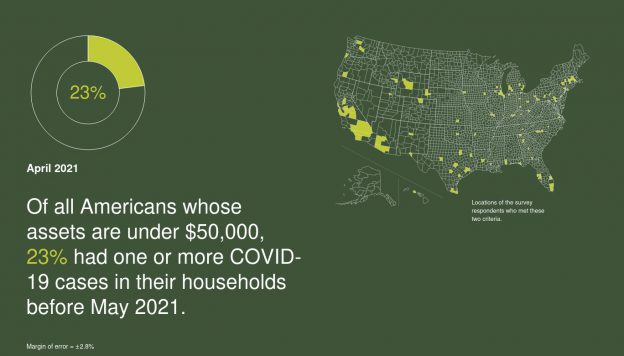
(The graphic above is a sample result from the tool on the homepage.)

Society is corrupt? Found a new college!

I have all kinds of (unoriginal) doubts about the new venture called University of Austin. The promise to create a novel financial model sounds empty until they actually describe it. (Since more than 3,500 US colleges and universities compete today, I would guess that great ideas for saving money have already been tried.) At least in Bari Weiss’ version, the case for a new university rests on a damning portrait of the existing ones that doesn’t match what I observe. And, as someone who values freedom of expression and robust debate, I don’t see a serious effort to grapple with the challenges to freedom, such as directives by donors and foundations, state regulations, the decline of tenure, and shrinking liberal arts enrollments. (Liberal arts courses are the most natural homes of vibrant debate.)

On the other hand, there is nothing more traditional than a group of Americans issuing a jeremiad against their doomed and corrupt society and founding a new college as a solution. That describes Calvinist pilgrims, Jeffersonian democrats, Catholic immigrants, Midwestern progressives, formerly enslaved people, Mormons in Utah, boosters of new Western states, sixties idealists, fundamentalist revivalists, and more.

If anything, it is disappointing that the rate of founding new colleges and universities has slowed so much. Many of the new ones appear to be conventional branch-campuses of existing state systems–important for meeting demand but not necessarily innovations.

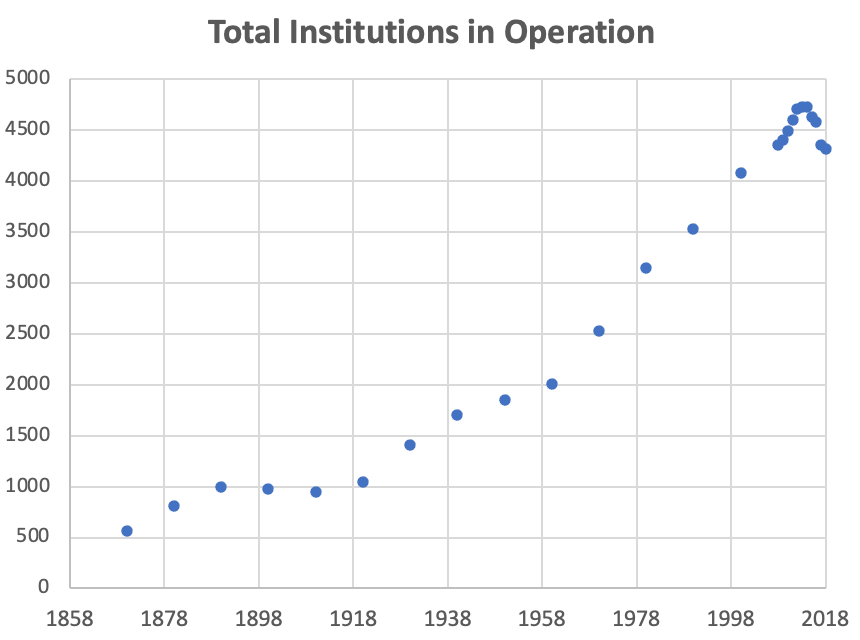
Fig 1, shows that the total number of colleges and universities rose rapidly from 1918 to 1998 but peaked around 2013 and has fallen since.

Data from Thomas D. Snyder, 120 Years of American Education: A Statistical Portrait, U.S. Department of Education, National Center for Education Statistics, 1993 (to 1970) and NCES Digest of Education Statistics, 2019 (NCES 2021-009) after that date

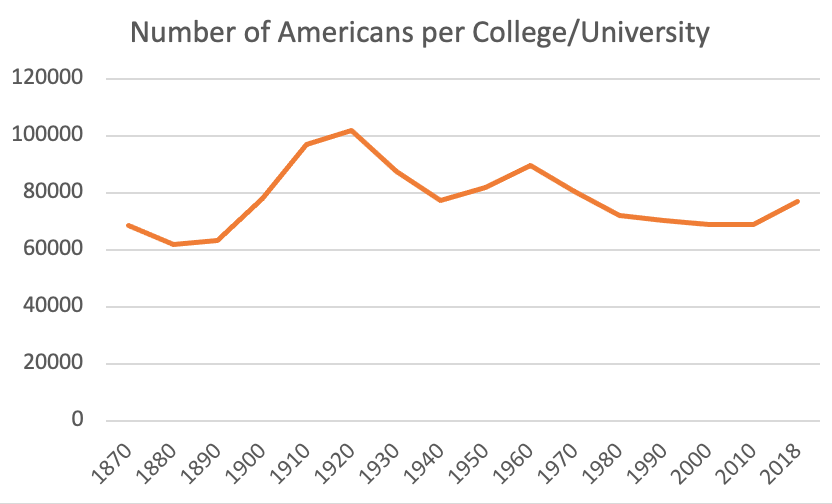
That graph does not adjust for population growth. If we value choice and innovation, we might like to see more colleges and universities per capita, which would mean fewer people per existing colleges (shown in my second graph).

The nineteenth century actually exhibited a worsening of this measure, because population growth outpaced even the rapid formation of new institutions. Much of the 20th century saw improvement, although the number of new institutions could not quite keep up with the Baby Boom in the 1960s. Of late, we have seen more people per college.

Same data as fig. 1, with population adjustments by author

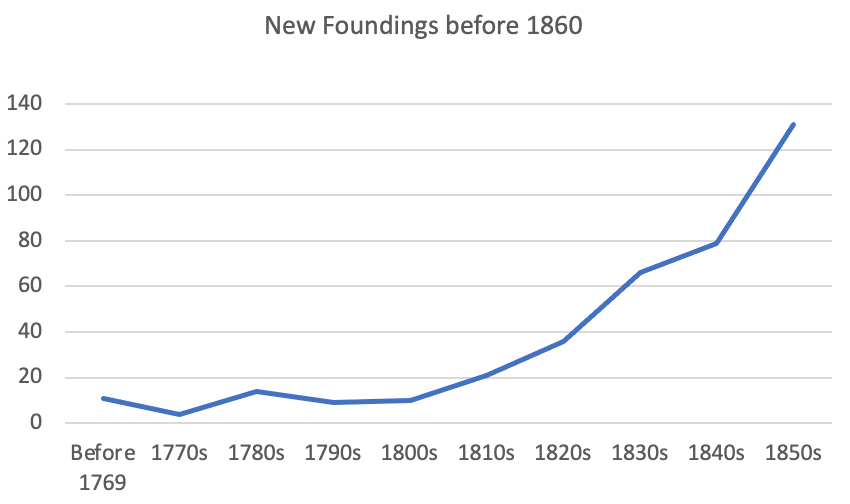
The total number of colleges and universities that are open in a given year doesn’t quite indicate the rate of foundings, because older institutions go out of business. Tewksbury (1932) estimated that four out of five antebellum colleges failed. I can’t find continuous data on new foundings for US history as a whole, but the third graph indicates a rapid increase in that measure from 1820-1860.

Data from Snyder, table 27

I would place University of Austin in that tradition. I am not enthusiastic about their diagnosis or plan, but I think it’s appropriate for disaffected people to start new institutions so that we (and they) can find out what their ideas would really mean in practice. That is how we got the array of colleges and universities that we see today, from Oberlin College to Liberty University, from UCF (with 66k students) to Deep Springs College (with fewer than 30), from Notre Dame to Naropa University in Boulder, CO. I’ve mentioned some outliers, but the overall trend is increasing similarity or “institutional isomorphism.” I’m for innovations that mix things up.

See also: the Harper’s letter is fatally vague; the ROI for philosophy; rationales for private research universitiesthe weirdness of the higher ed marketplacewhat kind of a good is education?; a way forward for high culture etc.

Enjoy the Flight

You can’t track swans across the sky. No trace.
The air they’ve passed as clean as what they breathe.
This is because they never cling nor hoard,
Just stretch their necks and feet and beat their wings.
Or so it was said in a treasured verse:
Words uttered and echoed and inked and taught.
Yes, but what of those other travelers?
The ones who have stowed their treasures aboard?
The carpeted cabin is dimmed and hushed.
The engines that thrum and gently shake them
Churn and burn and scrawl a long vaporous line,
Orbiting the orb where swans swim in breeze.

(Weimar, Germany, Nov. 5-6)

the ROI for philosophy

In Monday’s Washington Post, Jon Marcus writes that “one of the most basic measures of student success” is whether a degree in a particular subject “will provide [graduates] with the gainful employment they need to make it worth the price.” As an example of a bad outcome, he notes that “a philosophy degree from Oberlin costs $142,220 and graduates two years later make $18,154, on average.”

This fact comes from a study by the Foundation for Research on Equal Opportunity (FREO), which “conclude[s] that more than a quarter of programs — including most of those in art, music, philosophy, religion and psychology — leave students financially worse off than if they’d never enrolled.” I’ll raise a few methodological questions later, but first–how should we think about the values at stake here?

Preston Cooper of FREO writes:

This isn’t to say that lower-earning majors are worthless. Society needs artists and musicians. But low incomes for these majors signal a supply-demand mismatch. Universities are producing too many art majors and too few engineering majors relative to the number of jobs available in each of these fields. As a result, employers bid up the wages of engineers while surplus artists flood the labor market. The answer is not to eliminate low-earning majors nationwide, but to reduce their scale.

Many (not all) art majors want to be artists, and if artists’ earnings are very low, that suggests a problem. One solution would be to reduce the number of art majors. Another would be to expand society’s demand for artists (which doesn’t necessarily imply government funding for arts, although that could be one strategy). A third response is to expect artists to tolerate low pay–as we have long done. Which solution we prefer depends on how important we think art is for the society as a whole.

Liberal arts majors are different. Few philosophy majors, for instance, ever enter the job market for philosophy. They end up as lawyers, k-12 educators, business people, founders of LinkedIn–and of course, the proverbial taxi drivers who can quote Kant. The purely economic question is not whether we are producing too many historians, philosophers, and literary critics, but whether a liberal arts education has sufficient value in the general job market.

If philosophy majors get good jobs, that is because employers value clear writing and good reading skills, or because completing a liberal arts degree signals “cultural capital” and membership in an elite.

If, on the other hand, the data show that fields like history and philosophy produce low wages, that suggests two significant problems. First, if majoring in these disciplines is financially costly, they will be luxury goods that only wealthy families can afford–which is bad for the disciplines and unfair to young people of other backgrounds. Second, if we assign most of the society’s work of historical and philosophical inquiry and art criticism (etc.), to professors of those subjects, and if the number of jobs for professors is affected by the number of majors in their disciplines, then these social functions will be limited. We won’t get a very impressive culture under those circumstances.

We need philosophical inquiry, historical depth, cross-cultural understanding, and aesthetic excellence. Those ideals would not, by themselves, justify liberal arts majors that turn out to be costly for individuals. After all, there are other ways for a society to inquire into philosophical questions than to educate a very small number of undergraduates as philosophy majors. I am especially interested in strengthening the liberal arts outside of academia. (See a way forward for high culture.) We could consider organizing undergraduate education in ways that did not depend on majors. However, as long as we are not actually implementing any alternative strategy for producing excellent forms of culture, then poor financial returns to liberal arts majors would be a problem.

But is the empirical finding correct? The lifetime returns for a philosophy degree vary enormously by institution. According to the FREO study, majoring in philosophy at the University of Pennsylvania would net you a handsome $1,250,711 over your lifetime, but a philosophy degree from Loyola University Chicago would cost you $419,352 compared to not having a degree at all. From those two examples, one might hypothesize that philosophy pays at highly prestigious institutions, but if that’s a trend, it admits much variation. Philosophy majors from Illinois State do pretty well (ROI = $197,864), while graduates of the excellent NYU department are $259,265 worse off for having obtained a BA. This looks like noise.

One solution would be to combine the people with a given major from all universities. Apparently, 80% of philosophy & religious studies programs have negative returns if you remove financial aid and assume that students must pay the whole cost. But with a variance among philosophy programs of nearly $1.7 million–from very profitable to very costly–I am somewhat skeptical about the meaning of this aggregate statistic.

Also, the FREO study assumes (with some grounding in previous research) that 80% of the benefit of a graduate degree over a BA is attributable to the graduate degree. But it could be that majors in subjects like philosophy help students to obtain valuable professional degrees next. If that is true, the study underestimates their economic returns.

In any case, the economic question is not the only one to consider. To me, the really important question is how our society as a whole addresses ethical, interpretative, aesthetic, and conceptual matters. Offering liberal arts majors and using the revenue to fund scholarship in those disciplines is only one model. It may be a flawed one. But if it is flawed, we need better ways to accomplish the task.

See also: rationales for private research universities; the weirdness of the higher ed marketplace; David Brooks/Pierre Bourdieu; what kind of a good is education?
a simulation to teach civic theory and practice

My book entitled What Should We Do? A Theory of Civic Life will be released in April 2022. It summarizes the concepts and ideas that I believe are most useful for people who want to improve their communities and the world. It is based on many years of teaching undergraduates and advanced graduate students and seasoned practitioners, while studying and promoting civic education in K-12 schools.

Obviously, my list of concepts and how I think about them are completely debatable. But what if we wanted to teach many people some set of such concepts without explaining them all (as in a book or a series of lectures)? Could we teach these ideas experientially, so that students consulted manageable bites of theory as they worked together on civic problems? And could we make the learning scalable, so that students could experience it in many schools, colleges, and community settings?

I am thinking about an online simulation along these lines. …

The setting would be a fictional community–maybe a smallish US city with a declining industrial base and a diverse population. (Other versions could be built with different settings). Players could consult summary statistics about this community at any time, such as its unemployment rate, the ratio of arrests by race, or the number of people using its main park. Those statistics would be affected by the players’ choices and behavior–as well as by random factors beyond their control.

Each player would simulate a fictional character who would have personal characteristics, values, and goals; various roles (e.g., a parent of a child in the public schools; the mayor of the city); some money; and the ability to make menu-driven choices at any moment. These choices would sometimes be affected by other players’ actions. Examples might be expanding or contracting one’s own business, voting for various candidates in a mayoral election, or attending a protest, among others.

There would also be organizations: governmental agencies (such as the school board), private associations, and media platforms.* Players would have roles in these organizations, such as a member, a leader, or a subscriber. They would be able to start new associations and media platforms. Governmental agencies would be able to create new agencies under certain circumstances.

Each organization would be able to make choices, such as how to allocate its resources and govern its assets. It would have rules for making these choices, for determining who belongs and holds various roles, and for changing its own rules. For instance, the members of the school board might be elected, they might make decisions regarding the schools by majority vote, but only the city government could change these rules. Meanwhile, a private association might be structured so that anyone could join and might simply be a space for conversation, with hardly any rules.

Players would not be able to communicate with each other at will. True, in a real city, it might be possible for anyone to get any official’s email address and contact that person. But a senior official is unlikely to give a random person much attention–if any. To simulate the friction and inequality of communication in the real world, players would only be able to contact others through organizations, and each organization would have rules for interaction. For instance, members of the school board would be able to message each other freely. When they were together in a group chat, their messages would be open for anyone to read (simulating a public meeting). They could message all parents on a one-way basis. And they could maintain a message board where parents could post comments for them to read. A protest group or a newspaper would have different rules for communication. This means that if you wanted to influence the mayor, you might have to join an association in which the mayor is active, or persuade the newspaper to cover your issue and hope that the mayor reads messages from the newspaper.

The game would start with characters already holding memberships in organizations, and organizations already having rules. Characters might even have drafts of messages ready to send that would start the business of the community. (For instance, the editor of the newspaper would have almost everyone as a subscriber and would have a draft message ready to send to solicit news tips.) Once the game got underway, characters would begin to change their status in many ways and communicate with each other. As a result of all their choices, the community’s statistics would gradually shift.

Finally, each player would have a student page for work outside the game, such as short written assignments that could be graded. Here the student would also see links to accessible summaries of concepts relevant to current events in the game. For instance, if your character is dealing with a good (such as green space or public safety), you would see a link to a wiki-like entry on types of goods, drawn from Elinor Ostrom, that could inform your behavior and give you material to write about. If your character faces a conflict, you would see a short reading on negotiation. If your character is involved in a protest, you would see an entry on social movements.

I can also imagine a hybrid version, with face-to-face meetings of characters plus “meta-discussion” of issues that arise in the game occurring during class time.

*The organizations would not include for-profit firms or markets. My instinct is that fully simulating an economy would make the game too complex, even though the economy is certainly relevant. The focus would be civil society and the state, with the market somewhat to the side. However, individuals and organizations would have economic choices to make, and some characters would have disproportionate economic influence as business owners or investors. Getting them to make helpful individual choices would often be an important strategy for shifting the community’s outcomes.