what if people’s political opinions are very heterogeneous?

Here is what I will call a “top-down” theory of public opinion: Everyone should assess the most important issues of the day. An example might be the federal budget. Individuals are entitled to their personal beliefs or preferences about taxation, spending, and deficits; nevertheless, these three topics have an objective logical structure. If you want lower taxes and no deficits, you must favor spending cuts. If you want more spending, you must support either tax increases or bigger deficits. It is a civic obligation to think through your own complete view of these issues.

Analyzing a nationally representative survey of such matters should reveal that: a) most citizens hold opinions about them, and b) everyone recognizes the same underlying logic, even as they disagree about priorities. Citizens should vote according to their priorities, and the majority should prevail.

If, however, a) and b) are false, then democracy is flawed. Perhaps people should learn more and pay more attention, or the political system should offer greater clarity, or perhaps democracy is simply a false ideal.

Philip Converse’s “The Nature of Belief Systems in Mass Publics” (1964) has been enormously influential (cited more that 11,000 times). He does not employ exactly the framework with which I began this post, but his analysis suggests that democracy is a flawed ideal.

Analyzing surveys of political specialists, such as congressional candidates, Converse finds that these respondents meet both tests mentioned above. Professional politicians and other experts hold opinions on the great issues of the day that fit together in similar ways, even as they debate the contested questions. However, according to Converse, surveys of representative Americans reveal scant opinions and no consistent structure among opinions. Ordinary people are not, therefore, in a position to weigh in on the debates of the day.

Converse doesn’t use network analysis, but I can convert his core findings into network maps. (For those interested, I turned every tau-gamma coefficient above .05 in Converse’s Table 7 into an edge in these graphs.)

Congressional candidates share the following model of the political debate ca. 1962.
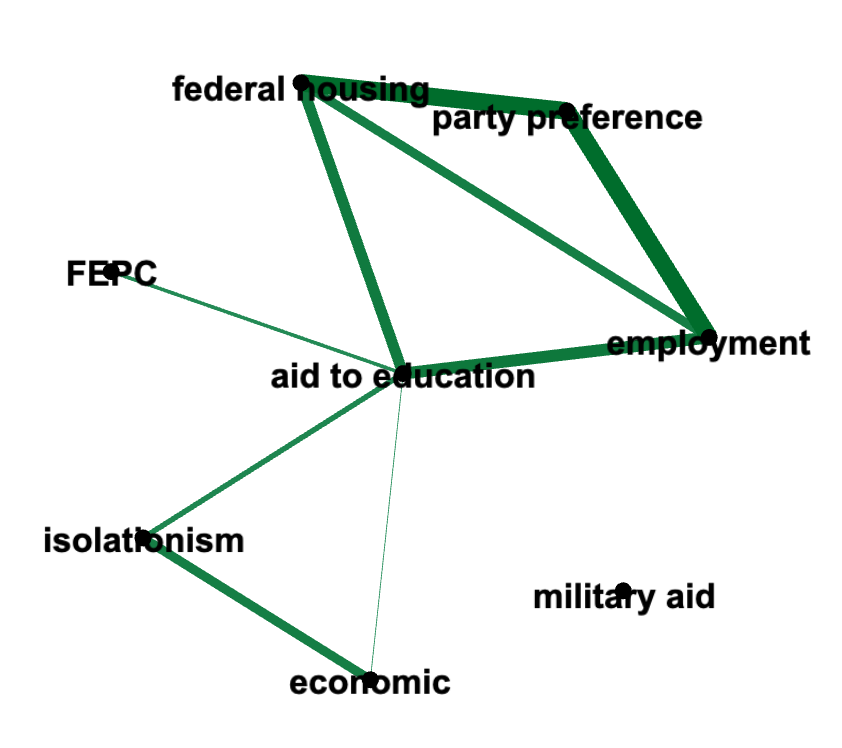
Whether candidates are Democrats or Republicans is strongly related to their views of federal interventions on education, housing, and employment, and those issues are linked together. Military aid to foreign countries is not connected–it stands alone as a topic. (“FEPC” means the proposed Fair Employment Practices Commission.)

Meanwhile, this is the result of using the same method with Converse’s data from representative adults at the same time:
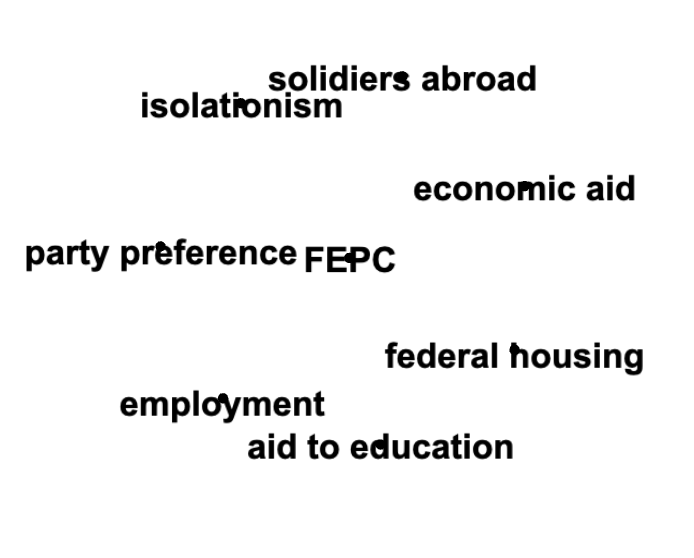
There are no links at at all among the ideas (meaning no coefficients > .5). Converse suggests that people are not in a position to play the role expected in a “civics class” theory of democracy, assessing and voting on the issues of the day.

Now here is a rival, “bottom up” theory: The social world is enormously complex. Responsible people may hold opinions on myriad issues, and no one can have a view about everything. Even if we focus on a single domain, such as the federal budget, it is highly complex. Federal spending includes funds for many different purposes. Each federal program has a financial cost, but it also has moral significance, behavioral impact, symbolic meaning, likelihood of success, etc. If people are diverse and free, they will naturally form many different structures of opinions about the range of topics that they have considered so far.

Imagine a sample of people, each of whom holds a thoughtful and carefully considered view of public issues and connects each opinion to other opinions in rigorous ways. However, each person holds a unique structure. Then, if researchers contact each person and ask a short list of survey questions (out of the innumerable questions that they could ask), and the aggregate survey data is analyzed using the methods pioneered by Converse, it will reveal no significant links at all. The heterogeneity of individuals’ beliefs will yield very low coefficients at the group level. Their graph will look just like the second graph above–not because they are tuned out of politics or undisciplined in their thinking, but because they differ.

Converse (p. 44) explicitly acknowledges this possibility. He notes that if people’s opinions become “increasingly idiosyncratic” as they move away from the elite, we will find “little aggregative patterning of belief combinations” in their data, because they will not know “what goes with what” (presumably, according to the elites) and will “therefore put belief elements together in a great variety of ways.”

However, Converse counters with a different kind of evidence. According to his analysis of longitudinal data from the American National Election Studies from 1958-60, most people’s opinions on most issues change as if by sheer chance as time passed. This implies that they do not hold “well knit but highly idiosyncratic belief systems” (p. 47). Instead, they have no “meaningful beliefs” at all (p. 51). The exceptions are various small and specialized “issue publics” who hold stable opinions about specific concerns, including many Blacks and some White Southerners on questions of race.

On this point, I would only note that an enormous number of longitudinal studies have been conducted since 1962, and some find stability over time (e.g., Kustov, Laaker & Reller 2021), unexplained–and perhaps random–change (Jaeger, M. M. 2006), or a mix of the two, depending on this issue (Kiley & Vaisey 2020). For instance, according to the last of those studies, the proportion of individuals who change their opinions about abortion is extraordinarily low. Converse’s blanket claim that most people’s opinions on most issues change randomly seems overstated.

I do not assume that all of my fellow Americans (or anyone else) holds complex and rigorous mental models of politics. Some people hardly hold any opinions, or cannot connect their opinions together, or do so in illogical ways. My point is that we cannot tell from aggregate data what proportion of people hold thoughtful views unless we assume that all worthy views must manifest the same structure. Converse uses scare quotes around the word “proper” when he mentions “the sophisticated observer’s assumption of what beliefs go with other beliefs,” but if we seriously doubt that elites understand the “proper” arrangement, then we should expect regular people to exhibit great diversity.

In that case, we should seek to understand the heterogeneous structures of ordinary people’s views. This kind of research has three important purposes:

  1. It may counter the very low assessment of public capacity that is fashionable now in political science, deriving from Converse. That skepticism may prove self-reinforcing, since experts who doubt the public’s ability to reason will not be motivated to defend or improve democracy.
  2. It may yield specific findings about structures of thought shared by sub-groups. Those insights will be invisible as long as we only we ask whether the public shares the structures assumed by political elites.
  3. It offers a perspective on political institutions. Even if many people hold worthy but heterogeneous structures of ideas, we probably still need mass elections to address prominent topics, such as whether to raise or cut taxes. I support that kind of democracy. But it will always be frustrating, because the structure presented by elites will fail to match the reasonable structures in many people’s minds. Fortunately, we can complement mass majoritarian democracy with other forms of participation. Civil society provides an enormous range of specialized groups, and individuals can choose to join the groups that match their personal ideologies, exit ones that don’t, advocate for adjustments within the groups they belong to, and compete for new members. Meanwhile, relatively small and relatively discursive bodies, such as local town meetings or Participatory Budgeting sessions, offer individuals opportunities to share their idiosyncratic views in public. We might understand those venues as opportunities for deliberation that can yield wiser judgments. Or we might understand such venues as places where people can display their uniqueness, as Hannah Arendt advocated. Thus a “bottom up” theory supports decentralization, pluralism, or polycentricity.

See also: Moral and Political Discussion and Epistemic Networks; modeling a political discussion; individuals in cultures: the concept of an idiodictuon; ideologies and complex systems; don’t let the behavioral revolution make you fatalistic, polycentricity: the case for a (very) mixed economy, etc. I also acknowledge Jon Green, Nic Fishman, Sarah Shugars, and others who are working in this general domain today.
putting the constitution in its place

Newly in print: Peter Levine, “Putting the US Constitution in Its Place,” in Citizenship and Civic Leadership in America, edited by Carol McNamara and Trevor Shelly (Lanham, MD: Lexington Books, 2022), pp. 281-292.

Abstract:

Almost all American students are required to study the formal structure of the US government, and most perform fairly well on concrete, factual questions about the Constitution. But there is much more for competent citizens to learn. After I explore some valid reasons to include the Constitution in required curricula, I argue that the document provides a poor framework for civics as a whole, giving students a distorted view of the social world and failing to motivate them for ethical civic engagement. I conclude with a sketch of a curriculum in which the US Constitution has a place, but a fairly modest one.

See also: on teaching the US Constitution; the Citizens United decision and the inadequate sociology of the US Constitution; liberals, conservatives, and love of the Constitution; is our constitutional order doomed?; constitutional piety, etc.

Moral and Political Discussion and Epistemic Networks

Yesterday, I got to give an International Society for Quantitative Ethnography (ISQE) Webinar on “Moral and Political Discussion and Epistemic Networks.” I really enjoyed the questions and conversation. This is the video of the whole event:

Abstract: An individual holds linked beliefs about political or moral issues, which we can model as a network. How these ideas are linked together influences the person’s actions and opinions. When individuals discuss, they share some portions of their respective networks of which they are conscious at the time. Some network structures are better than others for discussion: overly centralized or scattered networks are problematic. Individuals tend to demonstrate similar network structures on different issues. Thus, relying on certain kinds of networks is a character trait. People, with their respective networks of ideas, are also embedded in social networks. An idea is more likely to spread depending on features of both the social network and the idea networks of the people who interact. As a whole, a population may develop a shared network structure. An idea that is widely shared and frequently central in individuals’ networks becomes a norm. Institutions are partly composed of such norms. A community or a culture is a single network with disagreement. Ultimately, all such networks interconnect. This theory has implications for politics, ethics, and research methodologies.

Additional ISQE webinars are listed here.

the role of communications in the French Revolution

In The Fall of Robespierre, Colin Jones narrates the dramatic events of July 27, 1794 (9th of Thermidor in Year II, according to the revolutionary calendar) within the city of Paris. He tells the story hour by hour and then by fifteen-minute intervals for portions of the day.

The Ninth of Thermidor was not only a pivotal episode but also probably the best documented 24 hours in human history up to that point, because several security agencies were required to file regular reports, and a huge number of Parisians kept diaries and other records of the event.

In our time, we are obsessed with communications and media technologies, to the extent that we might overestimate their importance. There is more to politics than communications. Nevertheless, Jones’ book reinforces their importance in the French Revolution and suggests certain parallels to the present, when Ukraine and Russia are waging an “information war” alongside their conventional war.

Parisians used a wide range of communications tools to convey ideas about politics. Printing presses produced daily newspapers, posters, proclamations, and even pocket-sized copies of important laws, such as the Law of 14th Frimaire, which had conferred dictatorial power on two committees. Parisians gathered daily in political bodies where they heard speeches. These venues ranged from the National Convention to the two committees that governed each of 48 neighborhood sections, not to mention the Jacobin Club and less formal gatherings. Citizens also frequented theaters, where the performances had political agendas but could be interpreted in many ways. For instance, a play about the tyrannicide Brutus might be intended to celebrate the killing of Louis XVI, yet the audience might think of Robespierre as the tyrant. Trials and daily public executions were also spectacles whose messages were not always interpreted as intended.

The ringing of bells from the buildings formerly known as churches, especially the great bell of the former Notre Dame, as well as the firing of cannons and and the beating of drums all conveyed well-known messages. Riders and pedestrian parties criss-crossed the city with handwritten documents or orders to tell people specific things. Hawkers announced the headlines of newly printed newspapers as they walked about selling them. Even the sashes, cockades, and uniforms that people wore as they moved around with such messages were communicative. For example, 9th Thermidor was first day when members of the National Convention wore elaborate prototype costumes that Jacques-Louis David had designed for them.

Parisians also found creative ways to communicate what they believed despite official censorship. My favorite tool was the fake newspaper correction, a genre of the time. One paper regretted having quoted Robespierre as saying, “It was we who made false denunciations.” According to the correction, this was just a typo, for Robespierre had really said, “It was we who silenced false denunciations.” But the journal had never published the mistake in the first place. The erratum was a way of airing the idea that Robespierre’s denunciations were false.

The events of 9th Thermidor are complex, with many independent actors. The situation crystallizes, however, by the afternoon, once the entire National Convention has voted to condemn Robespierre and his closest associates, while the Parisian city government, the Commune, has declared for Robespierre and even managed to liberate him and bring him to their building, the Hotel de Ville. Paris is essentially in a state of civil war between the national elected legislature and the municipal legislature, with both sides competing for the loyalty of a heavily armed and mobilized population.

The conflict is not ideological in a simple sense, since Robespierre’s allies and enemies alike hold heterogeneous views. In fact, Robespierre has been planning to make a sharp turn from the left to the center and right on this very day. Nor is the conflict defined by social class or other kinds of social background. Mainly, it is a matter of how people assess individuals–which ones are actually traitors?–and where they see their own interests. To turn on Robespierre if he retains power is suicidal, but to stand with him if he falls is just as dangerous.

Basically, the Convention prevails because they win the race to communicate with the most people. One key advantage is access to a large printing press; no press is located near their opponents’ HQ in the Hotel de Ville. The Commune is also frustrated in other ways. They give orders that Notre Dame’s great bell be rung in their cause, but the local assembly that controls the bell tower refuses. Meanwhile–contrary to law–some of the Parisian sections begin sending messages to the 47 other sections, creating a horizontal communications network. The same phrases begin to recur in messages from different sections, indicating that the spread is “viral.”

After the chaotic and unplanned events of the day, the question becomes how to interpret what happened. This, too, is determined by the effective use of communications media. At first, the prevailing interpretation is that Robespierre and a few confederates were caught plotting against the regime. The elected Convention plus the people of Paris stopped this threat. Policies should thus continue as before. Gradually, over the course of the year, the opposite interpretation overtakes this one. According to the new theory, the revolutionary government and the masses of Paris went off the rails until 9th Thermidor. That period is now retrospectively named “The Terror” and regarded as a tragic mistake. Robespierre’s fall along with the destruction of the Parisian Commune is seen as the beginning of a new reactionary phase, in which France must become much less radical and the people must be kept in check.

In many ways, this interpretative victory is what makes 9th Thermidor a pivotal event in French and world history–or so Jones persuasively argues.

social movements and the health sciences

Newly available: Levine P. (2022) Social Movements and Stakeholder Engagement. In: Lerner D., Palm M.E., Concannon T.W. (eds) Broadly Engaged Team Science in Clinical and Translational Research. Springer. https://doi.org/10.1007/978-3-030-83028-1_8

Abstract:

Social movements are among the most powerful sources of popular energy in our society. Scientists and health professionals should expect to see them burgeoning and shaping our understanding of medicine and population health, both for better and worse. This chapter describes challenges to the traditional way of thinking about social movements and explains why people who hold positions inside institutions—including medical researchers, clinicians, and health administrators—need to react to movements more analytically and more constructively. A model for assessing movements is presented. This model can help scientists and health professionals understand the strengths and weaknesses of social movements so they can better decide whether and how to engage with them.

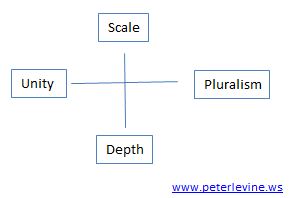
The model is SPUD (scale, pluralism, unity, and depth), which I discuss elsewhere on this blog.