On Tuesday, the Charles F. Kettering Foundation awarded an annual Democracy Prize to the people of the Twin Cities, saying:
The response of the people of the Twin Cities—Minneapolis and St. Paul, Minnesota, and the surrounding communities—to the immigration enforcement action nicknamed Operation Metro Surge in early 2026 was a rapid, sophisticated mobilization that reactivated the mutual aid and community defense networks first established after the 2020 murder of George Floyd and the protests that followed.
I totally agree with this. As a member of the Kettering board, I am proud that we made this award.
The Kettering Foundation and Gallup also conducted a national survey about democracy and civic engagement in April-June 2026. It asked a rich array of questions, including timely ones like: “Are you concerned about people being harmed by federal agents, military, or law enforcement during peaceful protests?”* Its 23,683 nationally representative respondents included 392 people from Minnesota, allowing comparisons between Minnesotans and other Americans.
I hypothesized that Minnesotans would show especially high levels of engagement. My premise was based not only on the headlines about events last winter and after George Floyd’s murder but also many previous studies that have found that the state has among the highest level of social capital: participation, membership, and trust. Robert Putnam (2001, p. 69) displays a map of civic engagement by state that resembles a weather map, observing a “high pressure” zone over the Mississippi’s headwaters and a “low pressure” zone over Louisiana and much of the former confederacy.
I found that after this winter’s intense resistance, Minnesotans were more likely to report protesting, volunteering in groups to improve local conditions, and following the news than other Americans. They reported spending less time on social media and attending religious services less often. These differences were statistically significant.
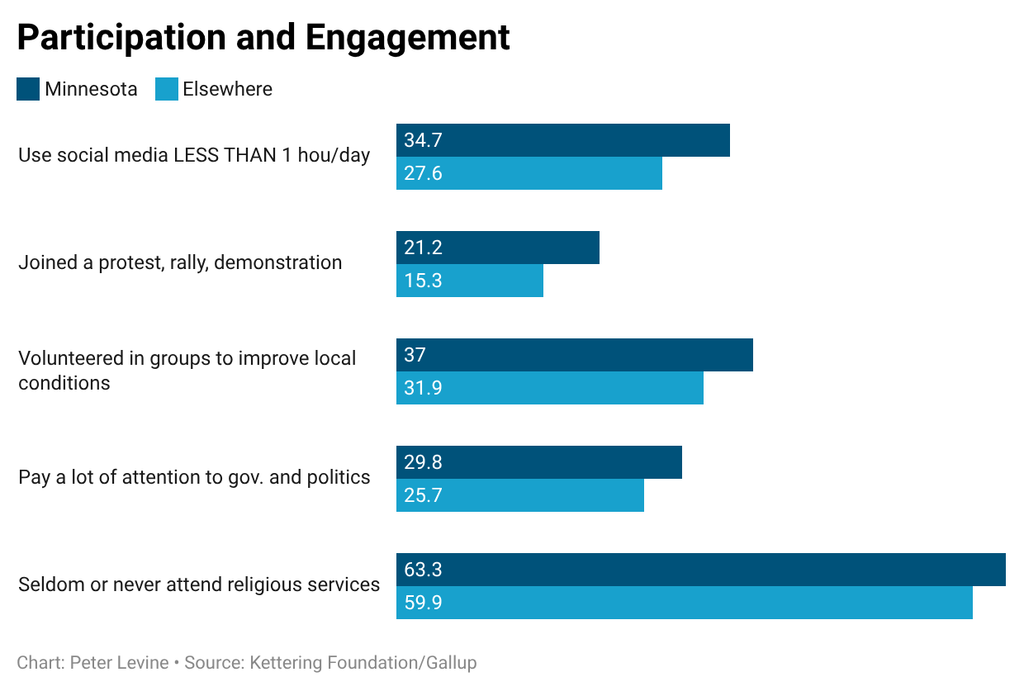
I also expected that Minnesotans would hold different opinions about relevant current events and issues. The following differences were statistically significant:
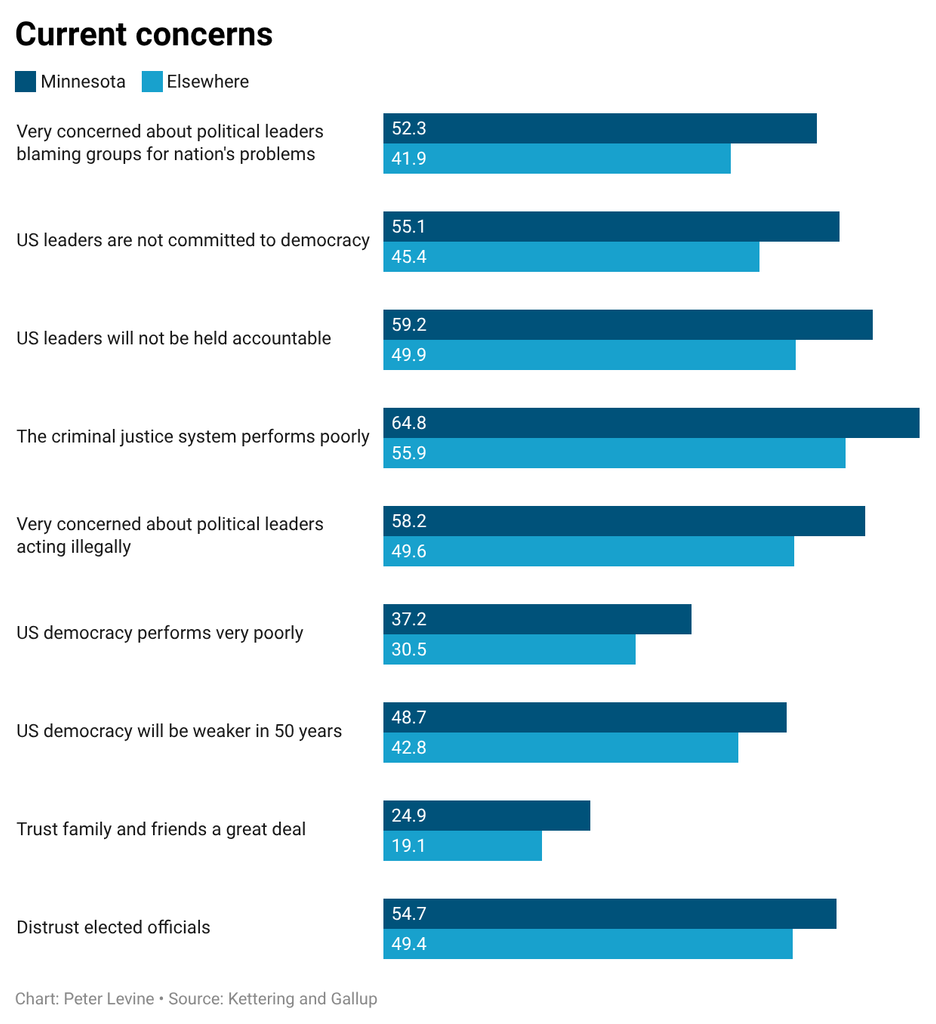
Overall, I would observe a higher level of concern about threats to democracy and more negative appraisals of our system in Minnesota. It is especially interesting that Minnesotans are less optimistic about democracy’s long-term future than other Americans are. But they do trust their own families and friends more.
These results generally met expectations, although I had wondered whether Minnesotans might have become more optimistic after what I regard as their partial victory on the streets of the Twin Cities. This does not seem to be true.
I did not expect them to report less time on social media, but that might be an important finding. They were on the streets, not on Instagram.
I would not have expected Minnesotans to attend religious services less than other Americans. Congregations can be important drivers of civic engagement, and some of the Minnesota resistance has been faith-based. However, this finding is consistent with my recent analysis of the national data, which showed that religious attendance was negatively related to pro-democratic values right now. I think this pattern is changeable, and some people are working inside Christianity to change it.
I would also note that the differences shown so far are not very large. They are detectable because of the large sample but not necessarily dramatic.
And I found no statistically significant differences on these questions:
- Are you concerned about people being harmed by federal agents during peaceful protests?
- How often do you attend events in your community, such as festivals, town halls, arts performances, etc.?
- Are the beliefs and experiences of people like you valued and respected by other people in the country?
- Are people in your community willing to help their neighbors?
- How much power do ordinary citizens have to create change in our nation?
- Do you identify as an American? As a member of your local community?
- How much do you trust religious leaders, business leaders, and education leaders?
- How well are the people playing their role in the democratic process?
- What word or phrase would you associate with the word “democracy” (Choices include free and fair elections, by the people, freedom, equality, etc.)
- Do you agree or disagree that democracy is the best form of government?
In many cases, Minnesotans gave more desirable responses (per my own values) than other Americans did, but not to a statistically significant extent.
As we would have expected, Minnesotans are somewhat more involved in democracy. They also display more critical, skeptical, or pessimistic views than other Americans.
If you had assumed that Minnesota is a beacon of civic life and that no other metro area could rise to the occasion as the Twin Cities did last winter, this post might make you more optimistic. I did not compare Minnesota to individual other states, but I could imagine that some might perform as well, and even the average is not so far behind.
Our democracy has much room to improve, but Minnesota is not a positive outlier. The whole US shows democratic potential.
*I have paraphrased this item and others. The original dataset is here. The reference is: R.D. Putnam (2001) “Community Based Social Capital and Educational Performance” in Making Good Citizens: Education and Civil Society, edited by Diane Ravitch and Joseph P. Viteritti (Yale University Press), pp. 58–95. See also: community engagement and concern for democratic values; church attendance, religious identity, and politics” [revisited]; the state of nonviolent grassroots resistance, etc.