Category Archives: elections

the next two years

Last spring, I noted that my own predictions for US politics had been badly wrong. I doubt that anyone was interested in the reliability of my crystal ball, but it can be useful to lay out one’s own expectations, test them against reality as events unfold, and then reflect on why you were right or wrong.

In that spirit, I currently expect Republicans to win the House–and quite likely the Senate–and to sweep more really extreme characters into state and federal office. I think the outlines of current federal policy will then remain basically unchanged, because Biden will be able to veto Republican bills, and the House GOP has a poor recent record of even mustering the votes on its own side. There may, however, be hair-raising showdowns over the debt limit and annual must-pass appropriations.

State policies will vary, with red states and blue states heading in opposite directions on abortion, policing, climate, education, and other key issues.

The Supreme Court will probably ban the use of race as a consideration in university admissions. That will not only have a major impact on who attends college (which is the main issue) but will also begin a deluge of litigation to investigate and alter pervasive practices within higher education. Documents will be subpoenaed; people will be deposed.

The Supreme may also gut the Clean Water Act and could decide Moore v. Harper in a way that allows legislatures to override the’ decisions in presidential elections, which would throw the 2024 election into grave question.

We are headed into a recession. That will cause social needs and dissatisfaction to rise and tax revenues to fall.

The probability of an international crisis is reasonably high, not only in Ukraine/Russia but also China/Taiwan and Iran. Justice may prevail in each of those cases, but the risks to the people of those regions and the world are serious.

At home, we will see more frequent acts of overt political violence and perhaps some really major politically motivated crimes.

Trump will be running for president, first unofficially and then as a declared candidate. He will easily dominate the GOP primary. Meanwhile, there is a substantial probability that he will face at least one criminal proceeding. He will use his prosecution as evidence of persecution by his political enemies.

Echoing the Clinton and Obama years, the new Republican majority will grow rapidly unpopular. Biden’s popularity will be suppressed by the recession but boosted by his opponents: Trump and the Hill GOP. Democrats will help to amplify the most extreme Republican voices. Biden will poll ahead of Trump through most of the 2024 election season, but there will be a real possibility that state legislatures and the US House will overrule the voters, especially if the Supreme Court exempts legislatures from judicial review regarding elections. Certainly, Trump will pre-announce that he cannot possibly lose, and a fair number of Republicans will echo that claim. I believe there would be resistance within the GOP, but that would be an intra-party struggle that would make everyone else into bystanders.

(By the way, if I did the math right, then according to the Social Security Administration’s actuarial tables, there’s a 73% chance that both Biden and Trump will still be alive in 2025, and a lower chance that both men will be healthy enough to serve.)

My predictions may be too pessimistic. Last time, I was overly positive. Regardless of how things play out, I’d offer two thoughts about addressing our situation.

First, a lot more Americans should be learning specific skills for organized nonviolent civil resistance. I am not arguing that nonviolence is morally superior or preferable in all situations. I do believe that only large-scale movements that are predominantly nonviolent will be relevant and plausibly effective in defense of democracy in the United States at this point. Here are few resources for learning. I am actually quite optimistic that the American people will prove hard to dominate and will resist effectively, but skills will help.

Second, we may have opportunities to build a better system, not merely preserve a flawed one. For instance, the Supreme Court has already played a problematic role in our government, and a crisis may be an opportunity for basic reform.

To take one example of a very bad-case scenario: Biden actually wins more Electoral College votes than Trump does in 2024, but several state legislatures award their votes to Trump, and the House certifies him as the president. That would be the beginning, not the end, of a chapter in American democracy. The end would depend on us.

See also: how I misjudged our moment; time again for civic courage; how to respond, revisited; reforms for a broken Supreme Court; etc.

Challenges Reported by Candidates for Local Office

Newly published: Peter Levine & David Abromowitz, “Challenges Reported by Candidates for Local Office,” State and Local Government Review (2022). Available behind a paywall: https://doi.org/10.1177/0160323X221130449 or in page proofs as open access here.

Abstract:

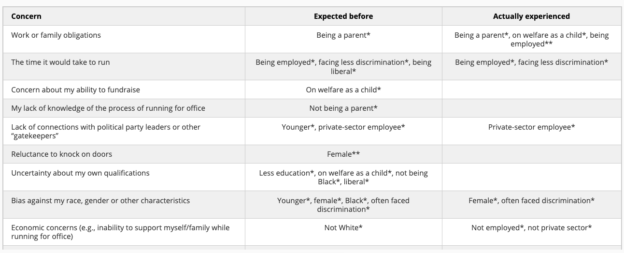
A survey of 711 candidates for local offices in the United States, conducted in December 2021, reveals that many were concerned before they began their campaigns about the impact of politics on their work and family, the time demands of campaigning, their ability to raise funds, and their knowledge of the process, among other obstacles. Many candidates who had anticipated each concern found it less onerous than they had expected. Those who were parents, those with full-time jobs, and those who had experienced poverty as children were especially likely to have difficulty meeting work and family obligations while campaigning. Being liberal, being young, having less education, and experiencing poverty in childhood were all associated with concerns about being qualified to run. The study offers additional details about which backgrounds and experiences are associated with specific challenges in local campaigns. The results may inform efforts to recruit and support underrepresented candidates.

Table 6 (“Predictors of Concerns”) summarizes some key findings. It is based on statistical models that account for other factors.

Our paper is an example of Civically Engaged Research (CER) in political science: “an approach to inquiry that involves political scientists collaborating in a mutually beneficial way with people and groups beyond the academy to co-produce, share, and apply knowledge related to power or politics, contributing to self-governance.”* David Abromowitz is a leader of the the New Power Project, which is “uniquely focused on recruiting and empowering values-driven individuals who have grown up in marginalized or underserved communities” to run for office. David approached me with the idea of conducting a survey of current candidates, drawing the sample from BallotReady. We designed the survey instrument together. I crunched the numbers, addressing David’s queries as well as my own. Our article illustrates that civically or community-engaged research is not always qualitative or hands-on. Although we statistically analyzed an anonymous survey, our collaboration was essential, and the results should help the New Power Project while contributing to the scholarly literature.

*Rasmussen, A., Levine, P., Lieberman, R., Sinclair-Chapman, V., & Smith, R. (2021). Preface. PS: Political Science & Politics, 54(4), 707-710. doi:10.1017/S1049096521000755. See also: civically engaged research in political science; engaged theory and the construction of community; how to keep political science in touch with politicsmethods for engaged research.

college student voting up 14 points in 2020

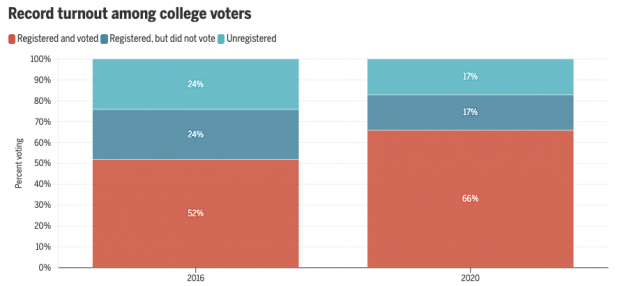
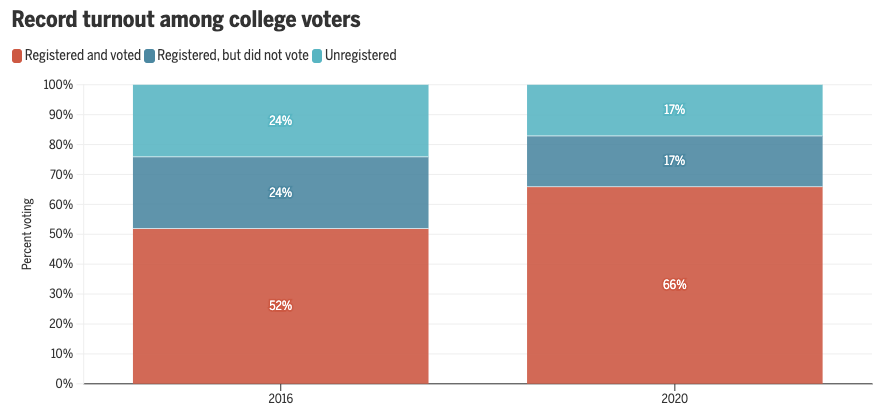
My colleagues at Tisch College’s Institute for Democracy and Higher Education have released their national report on the 2020 election, which is based on voting records of students enrolled at about 1,050 colleges and universities in the United States. As IDHE director Nancy Thomas says in the front-page Boston Globe feature, the turnout increase was “quite stunning.” It was also quite consistent across different types of institutions, fields of study, and demographic groups. For instance, white men, black men, social science or history majors, business majors, students at private liberal arts colleges, and students at public PhD-granting universities all showed increases of between 14 points and 17 points.

The whole report is here.

the youth vote in 2020

From CIRCLE’s latest release, based on voter files:

We estimate that 50% of young people, ages 18-29, voted in the 2020 presidential election, a remarkable 11-point increase from 2016 (39%) and likely one of the highest rates of youth electoral participation since the voting age was lowered to 18. …

However, as is the case in every election cycle, youth voter turnout rates varied widely across the country: New Jersey (67%), Minnesota (65%), Colorado (64%) and Maine (61%) had the highest statewide youth turnout rates, while South Dakota (32%), Oklahoma (34%), Arkansas (35%), and New Mexico (39%) had the lowest. ..

Numerous interconnected factors shape whether youth electoral participation is high or low. These include the competitiveness of elections, how much (or how little) campaigns and organizations reach out to young people, the state’s civic culture and civic education policies, the demographic composition of the youth population, and state voting laws … that can either facilitate voting or pose barriers for youth. ….

Understanding the effect of electoral policies on youth turnout is especially relevant at a time when the U.S. Congress is considering HR1: For the People Act of 2021. This bill would standardize some election laws across the country and nationally establish: automatic voter registration (AVR), online voter registration (OVR), same-day or Election-Day registration (SDR), early voting, no-excuse absentee voting, pre-registration, and requirements for voter registration programming in high schools. ….

We divided states into those with a majority of the electoral policies in HR1 and those with few of the policies, and we found that, on average, states with more of these policies had higher youth turnout. States with four or more of the HR1 policies had a combined youth turnout rate of 53%, compared to 43% turnout from states with less than four policies. It appears likely that a number of policies complement each other to create a system and culture of voting that is more conducive to youth participation, and the lack of them may have the opposite effect.

conservatism and identifying as white among Latinos

Latinos preferred Biden over Trump by 65%-32% according to the exit polls. There is some debate about that statistic, but it seems safe to say that Latinos tilt Democratic, yet somewhat less so than they did in the recent past.

We also know that people who consider their own whiteness important to their identity are more likely to support Trump. In the Tufts Equity study, whites who consider race important to their own identity favored Trump by 61.5%-31%, whereas Trump’s lead among other whites was just 5 points (47%-42%: less than a majority).

In this context, it seems significant that a majority of Hispanics identify as white, and a substantial proportion–one quarter in the 2012 American National Election Study (ANES)–say that being white is important to their identity.

I get that last statistic from Filindra and Kolbe 2020. These authors find that Latinos are more likely to identify as white if they have higher incomes, and less likely to identify as white if they have more education and if they report strong consciousness as Latinos. (Possibly, education increases social awareness.) Latinos are more likely to be Republicans and to support cuts in welfare if they identify as white.

These are not mere correlations but the results of models that control for numerous other variables. It is equally interesting that some variables do not seem to matter, e.g., religion, skin tone (albeit known for only some respondents), and whether one was born in the US or overseas. The degree of acculturation is related to views of welfare but not to other measures.

Filindra and Kolbe use 2012 ANES data, and I was interested in change since then. In a nutshell, I find no important shifts. My graphs below show rates of identifying as conservative and as liberal in the ANES since 2000. (Moderates are not shown, although they are the largest group.) Whites who are not Hispanic are the most conservative, and at a steady rate. However, they have also become the most likely to identify as liberal (at the expense of moderates). Hispanics who identify as white have been somewhat less conservative than other whites. And Hispanics who do not identify as white have not been statistically different from those who do.

Source: Filindra, Alexandra and Kolbe, Melanie, Are Latinos Becoming White? The Role of White Self-Categorization and White Identity in Shaping Contemporary Hispanic Political and Policy Preferences (May 16, 2020). Available at SSRN: https://ssrn.com/abstract=3602372 or http://dx.doi.org/10.2139/ssrn.3602372