Category Archives: elections

a new youth political poll

The first youth poll of the 2016 election is out, and it appears to be solid methodologically, with a phone sample and 1,000 respondents (up to age 34). It’s from Fusion. I am not interested in the young adults’ preference among the presidential candidates, because now is way too early to be forecasting the election. (For the record, young adults prefer Hillary right now.) But I am interested in these nuggets:

Party and ideology: The biggest group is composed of Independents (46%), but when you ask which way people “lean,” the results are 43% Democrats and 31% Republicans. (Most political science research finds that Independent leaners behave exactly like party members.) Fifty-seven percent say government is “helpful,” much higher than the national rate and a sign of a persistent Democratic tilt. About two thirds say they belong to the same party as their parents. It looks as if the remaining third has mostly shifted left of their older relatives.

Knowledge: Only 23% of respondents can name one of their US Senators. The rates are 20% for women, 18% for 18- to 24-year-olds, 16% for Latinos, and 10 percent for African-Americans. This is a form of political knowledge that I would really like to be higher. If you don’t know who represents you, you are not able to hold your representatives accountable. Note that this is a distinct problem from the scores on civics exams, because standardized tests never ask about current facts like the names of one’s elected officials. If we were guided by standardized test scores, we would spend less time on current events, not more time.

Issues: The top issue is the usual–“jobs and the economy”–at 19%. Health care follows at 10%, and education, at 7%. Police brutality is the top issue for 1%, as is racial harmony. Climate change is also at 1%. The most striking finding here is the wide dispersal of top issues. As I often note, young adults are not an interest group. They do not have one or a few defining issues. They face all the issues that confront us as human beings, from taxes (1%) to immigration (4%).

Age of candidates: We are often asked whether young voters prefer younger candidates. That question will come up again if Hilary Clinton is the Democratic nominee. For what it’s worth, this survey asked whether respondents would be more likely to vote “if there were more young candidates.” Seventy percent thought it would make no difference. Twenty-six percent saw it as a positive change, and 6% thought they would be less likely to vote if there were more young candidates.

Comedy: And if comedians ran for president, the leading candidate among young adults would be Colbert, followed pretty closely by Stewart and Fay.

do younger Americans think they lack the knowledge to vote responsibly?

voting_duty

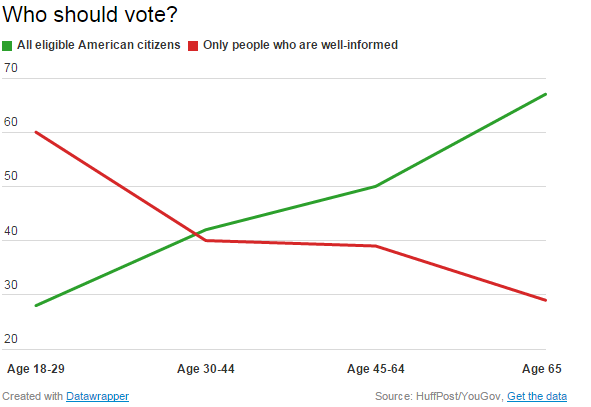
According to a HuffPost/YouGov survey reported by Ariel Edwards-Levy, younger Americans are the most likely to believe that you should only vote if you are well-informed. According to the same poll, younger Americans guess that a majority of their fellow citizens vote in midterm years. They overestimate national turnout far more than older people do. Yet many of these younger respondents do not vote themselves. (We know that actual youth turnout is only about 20-25% in midterm elections). They must see themselves as outliers–in a bad way. They are critical of their own political knowledge and believe that other people know more than they do.

The ones who do vote are quite well informed. According to the exit polls, 77% of 18-29s who voted this November claimed to have followed the midterm election at least “somewhat closely.” But many others may have told themselves that they don’t know enough to vote. As I said to Edwards-Levy, “If anything, they might be putting themselves through too stringent a test.”

Of course, you should inform yourself before you vote. But I don’t think our main problem is uninformed people casting ballots; it’s people staying home because they are actually uninformed or think they are. It is hard to collect political information all on your own just so that you can vote. The traditional solution is to enroll people in multi-purpose organizations that are also conduits for political information. But those organizations are shrinking. As I said in the article, “Twenty or thirty years ago, there were devices for getting information to working-class young people like labor unions, which they belonged to still, and also churches. … Those things have really weakened, so they’re kind of on their own. If you’re a high school dropout and you’re working at Walmart, there’s no way for you to get information except for you to actively seek it.”

top 8 takeaways about young voters and the 2014 election

In lieu of a post of my own, here are CIRCLE’s eight summary points about youth voting in 2014:

Each election year, the headlines about youth voters tend to be the same. The relatively low turnout rate is usually lamented, and sometimes there is some analysis of whether one party (usually the Democrats) benefited from youth support. But it is important to see complexities and derive subtler lessons. Here are our eight takeaways from the 2014 election, each of which suggests only the beginning of a story about young people and politics.

#8. Youth turnout in 2014 election was around 21.5%.

Our estimate of youth turnout in 2014 (based on the Exit Polls and the number of votes counted two days after the election) is 21.5% of youth. In other words, about one in five young adults who were eligible to vote did vote.

#7. Turnout of youth in 2014 was pretty standard, and comparable to previous midterms.

Voter turnout among all age groups is lower in midterm elections when compared to presidential election years. The drop has been consistently more pronounced among young people, so that midterm elections are best compared to previous midterm elections. By that standard, 2014 was highly typical, right near the average for the last 20 years. Note that some analysts are estimating that 2014 was the worst turnout year for the population as whole since 1940.

#6. Midterm exit polls don’t define a generation.

It is unwise to draw generation-wide conclusions based on 21.5% of youth. For example, as indicated in the graph below, while young people with a bachelor’s degree or higher make up 20% of the overall young citizen population, they made up 40% of voters in 2014. It is likely that the non-voters held somewhat different opinions of issues and candidates from the voters.

#5. Neither party has a lock on 18-to-24 year olds.

There has been some discussion of a possible shift to the right among the latest cohort of Millennials. The oldest Millennials were first-time voters during the 2004 election, so their formative experience was the George W. Bush Administration. People turning 18 in 2014 are fully ten years younger and have come of age under Barack Obama. It would stand to reason that their views would be different.

Small differences do emerge by age among the young voters who participated this year, but the differences indicate both more liberal and more conservative attitudes with slightly more of the latter. Comparing youth who voted in 2010 and 2014, there is no clear sign of a shift.

In the past few election cycles, people have been more likely to vote Democratic the younger they are. In 2010, there was a substantial gap in preferences for House candidates between voters under 30 and those 30 or older. In 2014, the gap seemed to fall around age 45. Compared to 2010, voters under 30 were one percentage point less likely to vote Democratic this year, but voters between 30 and 44 were four points more likely to vote Democratic. It could be the case that some of the youthful Democratic voters of 2004 and 2008 are still voting Democratic as they enter their 30s. There was no difference at all in partisan preference between the 18-24s and the 18-29s.

In some respects, the youngest cohort might be seen as somewhat more liberal than older Millennials, and considerably more so than voters 30 and older.

  • On abortion, the 18-24 and the 18-29s held similar views (59% and 60% favoring legal abortion), while to a lesser degree the older age groups were for legal abortion.
  • Asked whether they believed that immigrants should have a path to citizenship, the strongest support came from 18-24s (71%) followed by 18-29s (68%), compared to 57% of all voters.
  • On the general question of whether government should do more to solve problems, there was a steep age gradient. Fifty-three percent of 18-24s but only 35% of 60+ voters agreed. The 18-24s were slightly more favorable than the 18-29s.

Yet members of this younger cohort were less likely to report being enthusiastic or satisfied with the president and his administration than the overall youth voting bloc (42% vs 45%) and were more likely to cast their vote as a sign of opposition to the president (26% vs. 22%). Offered a choice between Hillary Clinton and an unnamed Republican presidential candidate in 2016, young people who voted in 2014 were more likely to answer “It depends” than other age groups. However, compared to 18-29s, 18-24s were also more likely to indicate that they would vote for the Republican candidate in 2016 (36% vs. 31%) and they were slightly more likely indicate a preference for a candidate like Rick Perry than Rand Paul in 2016 than the overall youth voting cohort.

#4. More differences emerge among youth by race and ethnicity.

While 54% of youth (18-29) nationally voted for Democratic House candidates, significant differences consistently emerge by race and ethnicity. In both 2010 and 2014, Black and Latino youth were considerably more likely to choose Democratic House candidates than White youth were. In 2014, White youth gave a majority to the Republicans in House races (54% to 43%).

Slightly more than a majority of young men and women of color who voted considered themselves to be Democrats. After Democrats, young Latinos who voted were next-most likely to identify as Independent/other, and 22% of Latinas who voted identified with the GOP.

#3. Gender also matters.

While White youth looked more conservative than people of color in 2014, White women approved of Congress and President Obama at a higher rate than White men. At the same time, White women were slightly more likely to see the Republican Party favorably than White men were (54% vs.49%), but largely split their vote between parties (50% for Republicans in House races, 47% for Democrats), while young white men overwhelmingly supported House Republican candidates (58% vs. 39%). Young White men were more likely to identify as Independents (40%) followed closely by GOP (36%), while young White women’s top choice was the GOP (41%), and 30% identified themselves as Independents.

Forty-six percent of young voters in 2014 felt that Secretary Clinton would make a good president, compared to 49% who did not. Thirty-two percent said they would vote for her in 2016, 31% for “the Republican candidate”, and 35% said “it depends.” Thirty-seven percent of White men who voted in 2014 said that Secretary Clinton would make a good president, compared to 48% of White women. (Unfortunately, sample sizes were too small to estimate responses to this question for people of color by gender.)

#2. Youth propensity for being independent poses a conundrum for political parties and democracy

While party identification among youth who voted in the 2010 or 2014 election has not changed dramatically, a larger issue for parties is how to draw in youth who are not already affiliated. Even among voters in 2014, 33% identified as Independents or “something else” (as compared to 37% who were Democrats and 31% who were Republicans). Young voters were split in their opinion of the Democratic Party and slightly more were unfavorable to the Republican Party. Gallup polling suggests that close to half of 18-29 year olds identify as Independent. The Pew Research political typology released earlier this year shows a considerable proportion of youth part of the independent, “Young Outsiders” group.

Since party affiliation is related to voter turnout, the lack of identification among youth poses problems for parties as well as future democratic participation.

#1. Missing Mobilization?

We know from previous research that outreach and mobilization of youth does have an impact on turnout. Yet, in 2014, young people were the age group least likely to be contacted, according to Pew Research data from October. The reason that youth turnout was comparable to previous midterm years may be that there was no more outreach this year. In 2010, 11.3 million youth were registered to vote but did not cast a ballot, and many of those were not contacted. To raise the level of youth electoral participation, we can give more attention to drastic gaps among youth.
fact-checking: vote three times for the same party and you’re hooked for life?

It is widely held that if a person votes three times in a row for a given party, she will always vote for that party. (For instance, a CNN “Election Night” segment in 2012 began with that explicit premise). The implication is causal: voting the same way three times makes the person a lifelong Democrat or Republican.

I have not been able to chase down the evidence for this claim in the form of quantitative social science. I admit that I have not searched intensively and may have missed the source. The seminal study by Campbell, Converse, Miller, and Stokes, The American Voter (1960), found a lot of stability in individuals’ partisan identification but devoted a whole section (pp. 149ff.) to “fluctuations in party identification,” which were pretty common. Nearly 40 years later, a sophisticated and well-annotated study like David O. Sears and Carolyn L. Funk, “Evidence of the Long-Term Persistence of Adults’ Political Predispositions” (Journal of Politics 61/1) neither mentions nor supports the “three-times-and-you’re hooked” thesis. These authors find a high degree of stability in partisan preference but much variation, and no magic number of three elections in a row. Both studies (and several others that I reviewed this morning) find that events can change people’s prior voting habits.

The claim has been made for many decades, at least by pundits and political consultants. Thus, if it has any validity at all, it must derive from an era when parties were very different from our parties today. Hence I am highly skeptical that the causal version of the theory will apply in the 21st century–even if it did in the 20th. It will be decades before we know for sure, but I doubt that partisan voting is now habitual.

Parties have changed in two fundamental and pertinent ways. First, until the 1970s, US political parties were ideologically incoherent coalitions of demographic groups. For instance, white Mississippians and Jewish-Americans from Brooklyn both voted solidly Democratic, even though they disagreed with each other on almost every contested issue. As long as a party’s positions were unpredictable and contested, but demographic groups had strong partisan loyalties, then it made sense that people would vote consistently for the party of their heritage. Casting three consecutive votes for the same party did not make people Democrats or Republicans or solidify their identities. It reflected their foreordained commitments.

Now that parties are ideologically coherent, people will still vote consistently if they are strong liberals or strong conservatives. But if they change their views, or hold mixed views, or fall near the ideological center, they may switch allegiances. We will still see a common pattern of consecutive votes for the same party, but it will not be causal. It will reflect relatively durable ideological positions.

The other important change is in the structure of parties. They used to be genuine associations, with ward leaders, county officers, and frequent face-to-face meetings. Now they are (mostly) designations that we select when we register. It seems plausible that joining an association would have influence. If you not only voted three times in a row for Republicans but also formed human connections to local Republican activists, that might indeed cause you to stick with the party. But if there are no local human connections within the party structure, that influence is gone.

what do the Democrats offer the working class?


According to the Exit Polls, 64% of white people without college educations, and also 64% of white men, voted Republican in this year’s House races. The Democrats performed better among white college graduates and much better among people of color. This is why so many progressives are fretting about the Republicans’ hold on the white working class.

Considering the 40-point difference in party choice between working-class white people and working-class people of color, race is obviously relevant. A partial explanation of the election results may be racial antipathy toward the president and toward government, seen as biased in favor of “minorities.”

Further, enormous amounts of money and effort have been spent to delegitimize government–to persuade citizens that it can do nothing good–whereas in fact programs like Medicare are strikingly efficient and beneficial.

But neither comes close to a complete explanation. The deeper problem (as authors like Harold Meyerson and Dean Baker argue), is that Democrats do not offer solutions to the actual problems of the working class. They have something to say to workers who face discrimination on the basis of race or gender: hence their stronger performance among women and people of color. They also favor somewhat stronger welfare policies and, indeed, won voters with family incomes below $30,000 by 20 points. But when it comes to the economic concerns of the working class, they’ve got nothing.

It used to be the case that a person without a college degree could find secure, remunerative, valued, and valuable work in a farm or a factory. But agricultural and manufacturing jobs have been disappearing–not cyclically in recessions but gradually and inexorably:

Those trends would be fine if former factory workers and farmers were now employed in secure, interesting, and well-paid service jobs, but we all know that is not the case, and the decline in real family incomes shows what has really happened:

Baker says, “There is no shortage of policies that the Democrats could be pushing which would help ordinary workers.” Maybe, but I see difficulties–not only with the policies but also with their political impact.

Keynesian macroeconomic policy would help in recessions (and we didn’t get much of it in 2008-10 because states cut their budgets), but expansionary fiscal and monetary policy cannot stop or reverse long-term de-industrialization. Baker writes, “No one in either party has any proposal that will make more than a marginal difference in the productivity of the U.S. economy any time in the near future.”

Better education (if we knew how to deliver it) would prepare the next generation for a competitive, global, post-industrial labor market, but it would offer nothing to today’s 50-year-old.

Taxing and spending does no good unless the spending buys something that benefits that 50-year-old, and what he wants is a sense of economic contribution and importance. Being on the receiving end of a social problem cannot address that need. I would defend smart welfare programs against critics who think they inevitably create “dependency.” If you are in poverty, money can help you. But if you are stuck in an unsatisfactory job, welfare is not what you want. On the contrary, the government takes at least some of your income and spends it on other people. Government doesn’t look like a real or potential solution to your problems.

Reporting from Maryland, Alec MacGillis writes, “The voters I spoke with all said their own economic situations were basically stable and better than they were a few years ago, but they nonetheless felt as if the state of affairs was not where it should be. Eline, the university pest-control worker, has a secure job and is close to retiring, but as someone whose ancestors worked at the shuttered Sparrows Point steel plant, he worries about the decline of industry in Maryland, and sees [Republican candidate Larry] Hogan as more likely to do something to address that.” [As I note in We are the Ones, Sparrow Point used to employ 30,000 men.]

In years with higher turnout, the Democrats are bailed out by groups such as environmentalists, secular social libertarians, and people who may need protection against discrimination. In 2012, Obama won 76% of voters who described themselves as gay, 55% of people with postgraduate educations, and 96% of Black women (for example). But he lost 61% of whites between the ages of 45 and 64, and 53% of adults who had only high school diplomas. When turnout fell in 2o14, Democrats were left high and dry.

Bill Clinton did somewhat better among working-class whites, but we were then 20 years earlier in the process of deindustrialization to which Democrats (including Clinton) have had no serious response. In 1996, a Democratic administration could still get away with delivering fairly decent macroeconomic performance. It’s too late for that now.

I’m certainly not suggesting that we give up on using policy to assist working people of all races. Assisting them is a question of justice as well as political expediency. But it won’t be easy, and we’re not seeing anything plausible yet. As Meyerson writes,

But the Democrats’ failure isn’t just the result of Republican negativity. It’s also intellectual and ideological. What, besides raising the minimum wage, do the Democrats propose to do about the shift in income from wages to profits, from labor to capital, from the 99 percent to the 1 percent? How do they deliver for an embattled middle class in a globalized, de-unionized, far-from-full-employment economy, where workers have lost the power they once wielded to ensure a more equitable distribution of income and wealth? What Democrat, besides Elizabeth Warren, campaigned this year to diminish the sway of the banks? Who proposed policies that would give workers the power to win more stable employment and higher incomes, not just at the level of the minimum wage but across the economic spectrum?