Category Archives: elections

civic education in the year of Trump: neutrality vs. civil courage

In the minds of many dedicated civic educators, two deep instincts are clashing as Donald Trump dominates the news media and the Republican presidential race.

One instinct is to try to be as neutral as possible about issues and candidates. It’s dangerous for an arm of the state, a public school, to take sides on political issues. Citizens are forced to pay for public education. Kids are especially impressionable and form a captive audience in the public school classroom. Teachers have great power since they can influence students’ educational progress and economic success. Arguably, the most ethical way for a public school teacher to treat students and their families is as bearers of authentic political views that should be respected in the classroom. Furthermore, students can learn a great deal by wrestling with genuine ideological diversity. Arguing from diverse perspectives is a challenging educational practice that teaches reasoning, interpretation, and perspective-taking. Finally, we suffer from a particular problem today: ideological polarization and a failure to interact productively across partisan lines. The social studies classroom–as Diana Hess and Paula McAvoy show–almost always harbors ideological diversity and can be a precious place to cultivate productive discussions.

The other instinct is to preserve the constitutional republic by teaching students to honor and protect its core principles when they are threatened from within or without. The ultimate test of civic education is the graduate’s readiness to resist assaults on human rights and the rule of law–if necessary, with her life. We must learn to be upstanders, not bystanders. In the Federal Republic of Germany, this outcome is called “civil courage.” A measure of successful civic education might arise if a new authoritarian ordered a particular minority group to wear the equivalent of the Nazis’ yellow star. In that case, every citizen who had learned Zivilcourage would put the star on. In the US, civil courage is a central goal of certain civic education programs, such as Facing History and Ourselves (whose roots were in Holocaust education), but it’s also consistent with provisions in many state standards documents.

This year, one of our major parties is likely to nominate a man who has been called, by leading figures in his own party, a threat to fundamental constitutional principles and human rights. Under such circumstances, the two agendas I’ve presented above come into conflict.

For instance, normally I’d recommend k-12 teachers to assign their students to debate the issues in the presidential campaign. I think they should often assign students to sides so that they don’t just argue from their own beliefs. But would you assign a student of Mexican heritage or a Muslim student to take the side of Donald Trump? If not, why would you assign any student to that role?

In 2012, according to a CIRCLE poll, 72% of high school government teachers required their students to watch a presidential debate. I endorse that idea. But when the debate was like last night’s fiasco, how should the assignment be presented and how should the experience be debriefed? More than one of the candidates behaved in ways that would be completely unacceptable in an 8th grade classroom. Should the teacher note that?

Andy Sabl wrote some years ago:

Professors worship at the altar of “maybe.” We prize the intellectual courage to say, “I’m not sure what’s right.” In the process, we slight what the Germans have learned — the hard way — to call civil courage: saying that you do know what’s right even when those around you are getting it backward. Training students in supple thought, do we undermine decent character?

I agree, especially during the year of Trump. But it’s not easy to decide precisely what counts as an assault on essential values rather than an expression of free speech in a rough-and-tumble competitive democracy. In Germany, the label “civil courage” gets used for people who stand up for immigrants–and also for people who criticize immigrants in the face of what they decry as political correctness.

Some criteria for deciding when to be neutral and when to stand up for principles won’t quite work. For instance, I wouldn’t distinguish an acceptable “mainstream” from radical alternatives that should be beyond consideration. Donald Trump’s opinions have broad and deep roots in American culture. As a factual matter, they are mainstream. Besides, our political debate is too narrow; radical voices can be salutary. Bernie Sanders is not actually very radical, but he’s arguably further from the empirical mainstream than Donald Trump is, and I think that (at worst) Sanders is improving the national debate. I would object if teachers presented Sanders as some kind of threat because he challenges the status quo.

Also, it’s not Trump alone who uses propaganda–however you define that–or who ignores constitutional limits, or who holds some lives cheap. I am a defender of the current administration, but this president routinely orders drone strikes that kill innocent civilians in foreign countries. So if teachers should drop their neutrality and demonstrate civil courage against Trump, why not also against the current, center-left administration?

In sum, I think this issue is genuinely hard. Valid principles conflict. It would be a mistake for public schools to abandon the quest for neutrality and enter the political fray against the presumptive nominee of the Republican Party. But they would also err if they taught students that it’s their responsibility to protect the republic and then presented a clear and present threat to the constitution as just another campaign. There are few sharp lines in politics, and good judgment usually requires deciding where on a continuum to make a stand. Teachers and schools should and will reach subtly different conclusions about the 2016 election, depending on their local communities’ norms and their students’ demographics and opinions, their personal commitments, and the way the campaign actually plays out. (Will the threat to constitutional rights become even more explicit, or much less so?) But I think everyone who has a role in educating the next generation of American citizens must at least think seriously about these tensions.

why political science dismissed Trump and political theory predicted him

Political scientists and data-crunchers were almost unanimous in their authoritative predictions all summer and fall that Donald Trump was going nowhere. (Daniel Drezner has a nice summary.) Meanwhile, several political theorists and political philosophers were alarmed by Trump from the start (e.g, Jason Stanley, and others whom I follow on social media). It seems they were right, so score a point for political theory. But this case actually reveals interesting strengths and weaknesses of two ways of thinking about politics.

Empirical social science is based on data, which is by definition from the past (although sometimes including the very recent past, like this morning’s polls). To the extent that it is predictive, it derives patterns or trends from what has already happened. That is a very broad definition that can encompass research at any geographical or historical scale. It can describe research that is meant to be descriptive or predictive of the existing regime and power structure or research that looks for openings for radical change. So it’s unfair to stereotype political science. However, there is a dominant style of research on American politics that has the following features:

  • It focuses on the US case, presumably because empirical generalizations are difficult across national lines. Trump strikes me as highly similar to current European right-wing leaders. Mainstream political science could explore this resemblance, but it would be very hard to incorporate data from Europe into a predictive model of US elections.
  • It restricts itself to recent political history, because models of election outcomes that include data from distant times are irrelevant. But, as often acknowledged, a study of presidential elections since 1960 or since 1972 is based on a problematically small number of cases. Just as elections have changed fundamentally at turning points in American history, so they can change again.
  • It discounts the significance of rhetoric and narrative, because empirical studies of the impact of discourse usually find small results. For instance, one can usually predict the results of a presidential election based on economic conditions a few months earlier. Likewise, the presidential bully pulpit is found almost never to affect public opinion. Such research suggests that rhetoric and ideological positioning are unimportant. Yet a broader look at the differences among regimes (and among eras in our own history) make ideas and ideologues look central again.
  • It discounts the impact of Margaret Mead’s “small groups of thoughtful and committed citizens,” because empirical research typically finds larger effects from demographic changes, market conditions, and other impersonal forces. Yet Nate Silver calculates that Trump won just 2.0% of the eligible adult population in Iowa, 9.7% in New Hampshire, 6.5% in South Carolina, and 1.8% in Nevada. That’s why he’s winning the nomination. Silver adds, “A few passionate supporters can go a LONG way.”
  • It takes the basic structure of the regime as a given. We have, for instance, a two-party system with privately funded elections and a certain ideological spectrum. But obviously, the regime could–and probably should–change.

Although you can study the current regime empirically with a critical intent, I think focusing tightly on the way things actually are creates a bias in favor of the status quo. It makes the discipline conservative. Theodore Lowi concludes his great book The End of Liberalism (1969, revised in 1979) by saying:

Realistic political science is a rationalization of the present. The political scientist is not necessarily a defender of the status quo, but the result is too often the same, because those who are trying to describe reality tend to reaffirm it. Focus on the group, for example, is a commitment to one of the more rigidified aspects of the social process. Stress upon the incremental is apologetic as well. The separation of facts from values is apologetic.

There is no denying that modern pluralistic political science brought science to politics. And that is a good thing. But it did not have to come at the cost of making political science an apologetic discipline. But that is exactly what happened. … In embracing facts alone about the process, modern political science embraced the ever-present. In so doing, political science took rigor over relevance.

Now, to be clear, political scientists are not apologists for the 2016 election, which most would depict as a nightmare. But, Lowi would argue, they were apologists for the fundamentally unstable and indefensible system that produced it.

Compared to empirical political scientists, theorists have been more attuned to the possibility of disruptive events, because:

  • They are interested in the regime, not just concrete behavior and events. They recognize contradictions within the regime that may presage radical change.
  • They have other regimes in mind–from ancient Greece to fascist Italy and beyond.
  • They are highly attuned to ideas and ideology, and therefore quick to see that Trump might have an unprecedented popular appeal.
  • They mostly don’t much like the status quo. Instead of being apologists for it, they are quick to expect and even celebrate its demise.

These predilections can mislead, though. It is very important to take into consideration the findings of empirical social science. Otherwise, what you want (or fear) can too strongly color your interpretation of events.

Indeed, I can imagine that the 2016 election will vindicate mainstream models of American politics. It seems highly likely that Hillary Clinton will beat Donald Trump, albeit with limited effects on down-ballot races because the country is so polarized along partisan lines. Clinton holds similar policy views to almost all the Democrats in Congress, so the election may reinforce their central place in US politics. Leftish critiques of the Sanders variety will then struggle for attention and traction. However, once the first Hillary Clinton administration nears its end, Democrats will have held the White House for 12 straight years, and voter fatigue may set in, perhaps compounded by a recession. Republicans will realize they can win with a more mainstream, Romney-type candidate. They will nominate such a person, and the parties will rotate as usual, restoring the system that we know.

That remains a plausible scenario. But so does a political realignment, or a constitutional crisis, or a meltdown. It’s to political theory that you must turn to assess not only the possibility of such events but their desirability.

In his most recent book, Public-Spirited Citizenship: Leadership and Good Government in the United States, Ralph Ketcham tells how leading American political scientists of the early 1900s decried education that took the form of “sermonizing and patriotic expostulation” (p. 105). The only alternative they recognized was a rigorous, detached, disenchanted study of politics as it was. In keeping with that goal, they advocated specialization and expertise. Political science meant training for professors and technocrats in basically the current system. Ketcham argues for a broad liberal education that is “profound,” “integrated,” and “radical.” But positivist social scientists tend to gravitate to education as specialized empirical training for the status quo. If you hope to navigate a time such as ours, you need do data and empirical models. But you also need a bit of profundity and radicalism.

the youth turnout story so far

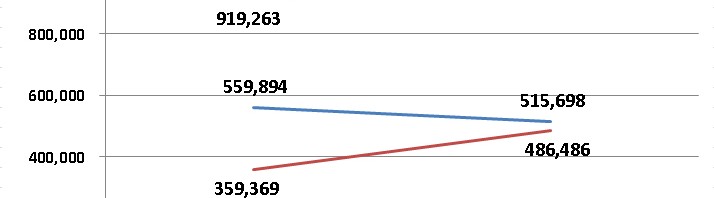
From CIRCLE’s release this morning: “An estimated 1.8 million young people participated in Super Tuesday’s primaries and caucuses, almost a million youth in the Democratic contests and around 900,000 in the Republican contests. With a number of strong showings across many states, young people continued this year’s trend of high participation that rivals the numbers from 2008, when youth turnout in some cases tripled that of previous years. Young Republican participation, especially, has increased compared to 2008, sometimes by dramatic amounts. And in both parties young people are still not rallying around the frontrunners.”

CIRCLE also has a nifty new interactive tool that allows you to compare recent presidential campaigns’ youth support. One takeaway for me: Sanders is mobilizing almost as many young voters as Obama did in ’08. (Sanders’ percentage is larger, but the actual number is a bit smaller.) The young Obama voters in ’08 were on a bus that drove all the way to the White House. The Sanders voters will not have such a smooth ride. What difference will that make to their development as citizens and activists?

the 10 places where youth voters will have the most impact

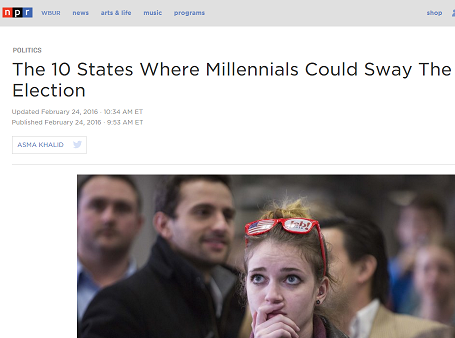
The current homepage of NPR news is a feature article by Asma Khalid about CIRCLE’s Youth Electoral Significance Index (YESI). My CIRCLE colleagues have identified the top 10 states and 10 congressional districts where the youth vote will matter most in Nov. 2016.

Politicians, campaigns, educators, and civic leaders should reach out to young people everywhere. But we recognize that political actors with limited resources will want to invest where they can have the biggest impact, and reporters may want to cover the youth vote where it counts for the most in electoral terms. Hence the YESI.

YESI

why don’t young people like parties?

Young Americans are not very loyal to parties. Many young people hold political beliefs that may make them almost guaranteed to vote for one party rather than the other–true “swing” voters are very rare–but they don’t identify with parties as organizations or devote their energy to parties as opposed to candidates and causes. I think that is partly why young people have so far been happy to vote for Bernie Sanders over Hillary Clinton by 4:1 margins. Remember that the primary election process was set up to allow party members to choose their party’s nominee, but young people who vote in the Democratic primaries don’t blink an eye to support a candidate who has chosen not to be a Democrat during his political career. I am not saying they should behave differently; I just think it’s interesting.

I have often heard cultural/generational explanations of this trend. Supposedly, Millennials are less favorable to organizations of all kinds. They prefer and expect looser and less hierarchical networks. There may be some truth to that, but I would suggest a different hypothesis. Young people are less loyal to parties than their predecessors were because parties don’t do anything any more.

Parties used to have functions, such as recruiting volunteers, paying workers, and organizing events (not to mention controlling patronage). Parties are now labels for clusters of entrepreneurial candidates and interest groups. The change occurred because the campaign finance reforms of the early 1970s defunded the parties, and then the deregulation of the 2000s allowed vast amounts of money to flow to entities other than parties. The Koch Brothers’ political network, for instance, employs 3.5 times as many people as the Republican National Committee does.

If parties do nothing for or with young people, it is easy to explain why youth don’t care about parties.

The General Social Survey asks about partisan ID at least every other year. The proportion of younger people who are Independents has grown, but most political scientists argue that that trend is misleading since the number of undecided or swing voters has actually shrunk. More to the point are questions that the GSS has asked only twice, about membership and active participation in parties. We know that parties didn’t do much to engage youth in 2004, because Dan Shea surveyed local party leaders that year, and “Only a handful of [county] party chairs mentioned what we might call significant activities, programs that require a significant amount of time or resources.” The parties were already hollow compared to decades earlier. He also asked an open-ended question: “Are there demographic groups of voters that are currently important to the long term success of your local party?” Just eight percent named young voters.

Nevertheless, the GSS indicates that the proportion of youth who actively participated in parties was 3.6 times higher in 2004 than it was in 2014. The hollowing-out continues.
partyID