Category Archives: elections

CIRCLE breaks down the youth vote

When CIRCLE’s Millennial survey was conducted (9/21-10/3), Clinton was beating Trump by 21 points (49% vs. 28%). Clinton may do better when the actual votes are cast, because there seems to be a trend in her favor among youth. That said, the CIRCLE poll allows detailed comparisons between young Americans who were favoring the two candidates at a moment when Trump was drawing one in four.

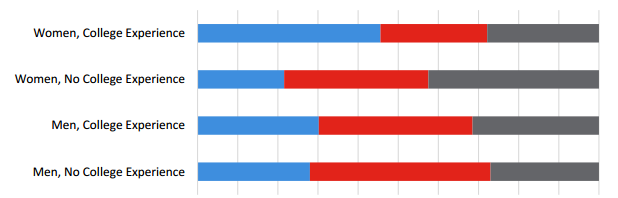
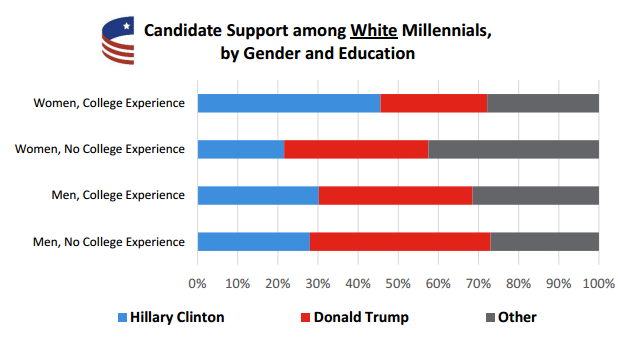
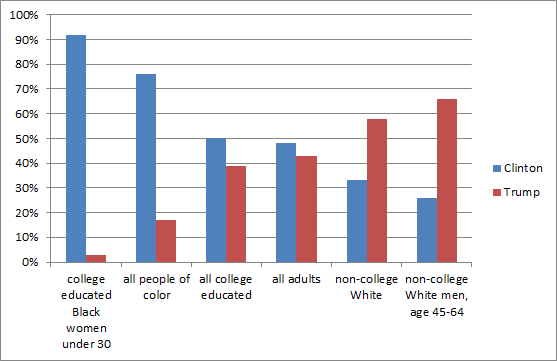
Young Trump and Clinton voters were starkly different people, and today CIRCLE has published an analysis that compares them by demographics and by opinions. For example, this graph shows Trump winning a plurality of non-college-educated men under 30 even as he was losing college-educated young women by almost 2-to-1.

circletrump

A couple of other illustrative findings from the report, which deserves to be read in full:

  • 85% of young Trump voters are dissatisfied with the way things are going for the country, and they are far more likely than Clinton supporters to believe that the country’s best days are behind us.
  • Trump supporters are less experienced with various types of political engagement, and more likely than Clinton supporters to say that they would “never, under any circumstances” do things like volunteer for a campaign or attend a political rally, suggesting that Trump supporters are overall less likely to be politically engaged.

social class does predict Trump support

Some say that Trump has captured the support of working-class Whites who are economically stressed or anxious. Others reply that Trump voters are relatively upscale but motivated by racial resentment alone. The former premise suggests that Democrats must do more to empower the working class, including Whites. The latter suggests that White nationalism is our fundamental problem today. Although I see truth in both positions, I’ve argued for addressing the economic and political vulnerability of the White working class. I present that as a strategy for countering Trumpism, but it’s a misguided strategy for that purpose if Trump voters are relatively affluent.

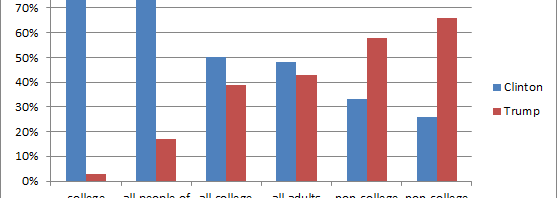
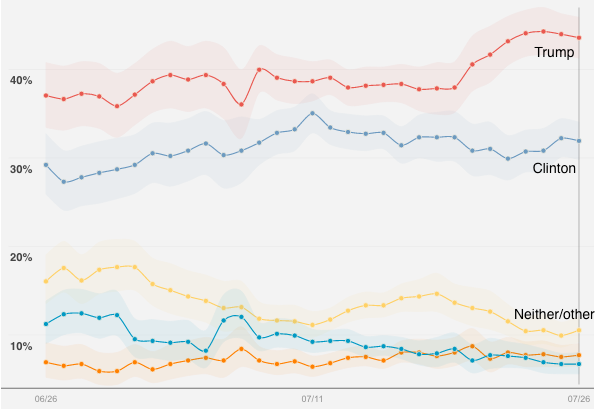
The raw story is that White people with lower incomes are Trump’s strongest backers.

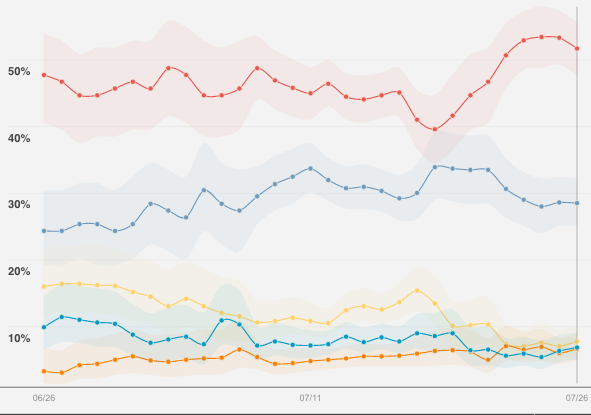
Presidential Candidate Preference for Whites with Family Income <75K (Reuters)

Presidential Candidate Preference for Whites with Family Income <$75K (Reuters)

But it’s not just about income and race. Education levels, age, and gender are also strongly related to voters’ preferences in this election, as I illustrate with data from YouGov:

yougov

The question is what to make of those middle-aged White men without college degrees, who are preferring Trump over Clinton by more than two-to-one in the YouGov polls (and by 59%-25% in Reuters). Is it economic anxiety, racial identity, or what?

One of the most widely cited pieces of evidence against the economic-anxiety explanation is Jonathan Rothwell’s paper, “Explaining nationalist political views: The case of Donald Trump.” Rothwell, who works for Gallup, conducted a regression analysis of almost 100,000 Gallup survey responses collected over the year that ended in July (i.e., mostly during the primary season). I have no quarrel with the paper, but I would note that it does not debunk a class analysis of the Trump vote.

Rothwell finds that holding a favorable view of Trump correlates with higher, not lower, income. Nate Silver is also widely cited for his finding that Trump voters during the primary season had higher median incomes than Clinton and Sanders voters (but the same as Cruz voters and lower than Kasich voters).

However, Rothwell also looks at whether household income remains a significant predictor of Trump support once you consider the fact that Trump voters are disproportionately White, male, and older. Using one measure of income, it remains a significant predictor; with a different measure, it ceases to predict Trump support.

At the same time, Rothwell’s model shows that you are more likely, to a statistically significant degree, to favor Trump if you: (1) hold a blue-collar job; (2) did not attend college; and (3) live in a community with high White mortality rates. Those relationships appear in the whole sample but are especially strong when the model is restricted to non-Hispanic Whites. Further, “more subtle measures at the commuting zone level provide evidence that social well-being, measured by longevity and intergenerational mobility, is significantly lower among in the communities of Trump supporters.”

If social class means income, then class is not a strong predictor of Trump support in Rothwell’s model. At least during the primary season, Trump voters were actually wealthier than the mean American voter. But if class means social status, and status involves occupation and education, then Trump voters tend to be downscale Whites in downscale White areas.

Rothwell’s paper uses a binary outcome of Trump support versus non-Trump support. The non-supporters include Republicans who were still favoring Cruz, Rubio, and others, plus Democrats for Sanders. That makes the analysis a bit dated now that we’re down to Clinton v. Trump. Reuters data suggests that Trump widened his lead among working class White men once he won the nomination.

Presidential Candidate Preference, White Men Without College Degrees (Reuters)

Presidential Candidate Preference, White Men Without College Degrees (Reuters)

Meanwhile, Clinton is now doing very well among the top 1 percent of the income distribution.

In sum, the relationship between working class status (measured by education) and Trump support seems strikingly strong for the White population. This doesn’t mean that class is the only issue. Race/ethnicity and gender are obviously very significant. But it means that there is some truth to the class analysis.

See also why the white working class must organize and it’s hard to talk about tough issues if no organization represents you.

state of the youth vote in 2016

CIRCLE has begun to release results from its survey of 1,605 Americans between the ages of 18 and 34. CIRCLE’s headlines are:

  • Most Millennials paying attention to presidential election, but far fewer to congressional elections
  • 30% of Clinton supporters contacted by campaigns, 28% of young Trump supporters contacted, 70% not contacted at all

Contact is important because it gives the recipients information and motivation to vote. These contact rates are disturbing low–and also uneven by region, gender, and party. Young men who live in battleground states have been contacted at nearly twice the rate of young women in “safe” states (38% vs. 20%).

Among likely young voters, Clinton beat Trump by 21 points (49% vs. 28%) in this poll, which was conducted between September 21 and October 3, 2016. USA Today/Rock the Vote released a youth poll yesterday that put the margin at 68%/20%. I’m not sure whether that difference results from methodological choices, such as the way the surveys define likely voters and present third-party candidates; but it is interesting that USA Today/RtV were in the field on October 11-13. The difference could therefore suggest a substantial improvement in Clinton’s margin since September.

The CIRCLE release presents additional information about young people’s attitudes, including this chart that compares the words that Trump supporters and Clinton supporters used to describe their own favored candidate.

to boost youth voting, teach civics and promote electoral competition

I have a short piece in the New York Times’ “Room for Debate” section this morning. It begins:

Once young adults start voting, the habit tends to persist for their whole lives. One way to boost young people’s voting — and their understanding of the political system and current issues — is to teach them civics while they are still in high school. Young adults are more likely to vote if they have experienced interactive civic education, if a teacher specifically taught them about voting, and if they discussed current events while they were teenagers.

After elaborating a bit on the importance of civics, I turn to political competition:

A wealth of experimental evidence also shows that young people respond well to personalized outreach: We have to ask them to vote. The organizations that have the greatest capacity to contact youth are parties and campaigns, and nothing would increase turnout as much as a robust competition for the youth vote.

Another contributor to the forum, Lisa Garcia Bedolla, also argues for personalized outreach, but Alan Gerber provides evidence that it is not hugely effective. I’d argue that outreach is particularly valuable for youth, who gain more than older adults do from information and encouragement, and who begin lasting habits of turnout. Finally, Jan E. Leighley and Jonathan Nagler make the case for being able to register on the same day you vote, which our research also finds beneficial for youth.

it’s hard to talk about tough issues if no organization represents you

I’m back from a great meeting in Chicago in which one theme was the need to have honest, productive conversations between people who might support Donald Trump and members or supporters of movements like Black Lives Matter. I’d note a major obstacle: the fact that working-class white people–the demographic core of Trump’s support–don’t have organizations that answer to them. As an illustration, consider that just 6 percent of adult Whites without college educations now belong to unions. That’s below the rate for college graduates, many of whom have other organizations behind them.

union

A lack of organization blocks or distorts difficult discussions, for these reasons:

  1. It’s literally hard to convene people who aren’t organized. Absent organizations, conversations tend to be online or draw highly atypical individuals who show up of their own accord.
  2. People who have no organizations behind them usually feel powerless. If that’s how they feel, they are unlikely to want to participate in difficult conversations. Especially when the topic is their own ostensible privilege, they are likely to resist talking. To be clear: I believe that everyone who is White in the US gains privilege from that. But if I felt politically powerless, I would not be in a mood to have that conversation, especially with people who were better organized than I was.
  3. People without organizations end up being represented by famous individuals–celebrities–who claim to speak for them and who claim mandates on the basis of their popularity. Celebrities have no incentives to address social problems; they gain their fame from their purely critical stance. And they owe no actual accountability to their fans, since no one (not even a passionate fan) expects a celebrity to deliver anything concrete. Donald Trump is unusual in that he has moved from a literal celebrity to a presidential nominee; but he still acts like a celebrity, and presumably he will return to being a pure mouthpiece once the election is over. Meanwhile, back at the grassroots level, a person who feels represented by celebrities is unlikely to talk productively with fellow citizens who disagree.
  4. People without organizations cannot negotiate. For instance, imagine that an individual Trump voter becomes convinced of the case for reparations, or at for least for race-conscious policies aimed at equity. That person cannot literally support such remedies, because he has no means to enact them. All he can do is assent to their theoretical merit. That also means that he can’t get anything tangible out of a deal. He’s just being asked to concede a point.

In 1959, A. Philip Randolph helped found and led the Negro American Labor Council as a voice for civil rights within the labor movement. As he pressed and negotiated with his fellow labor leaders on matters of civil rights, he was giving their millions of White rank-and-file members the opportunity to discuss segregation and racism productively. Crucially, not only were the Sleeping Car Porters organized; so were the predominantly White autoworkers, steelworkers, and mineworkers. Randolph also had–and used–substantial leverage over a Democratic Party that was still dependent on working-class voters, White and Black.

I’m certainly not implying that everything went smoothly in those days and reached satisfactory conclusions, but Randolph at least had a strategy that made sense. In an era of niche celebrities, candidate- and donor-driven political parties, and weak civic institutions, that strategy looks much harder.

Counterargument: The Fraternal Order of Police is an organization. Its members, although diverse demographically and ideologically, need to be at the table for any discussion of racial justice. But the FOP has endorsed Trump; and in many local contexts, its spokespeople seem particularly unwilling to deliberate and negotiate. Hence being organized is not a path to productive conversations. … To which I’d respond: Privilege yields to political power. Only effective political action will bring a group like this to the table. But the police can come to the table because they are organized, and that creates a strategic opening that is absent when people with similar views aren’t organized. It also enables pressure to come from within. For instance, the association that represents 2,500 Black police officers in Philadelphia has called Trump an “outrageous bigot” even as the Philly FoP has endorsed him.

See also: why the white working class must organize.