Category Archives: elections

social media and the youth vote

CIRCLE has released a highly substantive analysis of social media and the 2018 youth vote that is worth reading in full.

It probably won’t surprise you that many young adults heard about the election on social media. In fact, it might be worth pausing over the fact that only 47 percent saw something about it on Facebook, Instagram, Snapchat, and/or Twitter. It is possible to go through an election cycle without seeing much about politics on social media if your friend-networks are apolitical. We talk a lot about polarization into left and right, but an equally significant phenomenon is the division between political and apolitical Americans. That was less of a problem when people got their information from sources like broadcast TV and newspapers, which forced everyone to see political headlines.

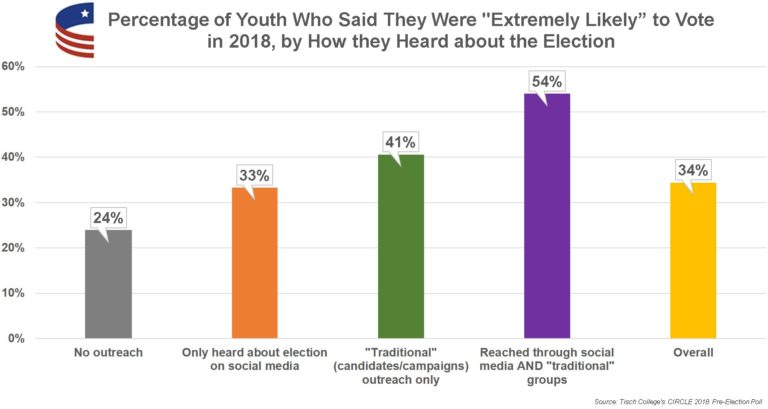
More than one quarter of young adults heard about the election only on social media, not from traditional outreach by campaigns, candidates, and parties. That probably means that social media is expanding the number of youth who are engaged in the election.

The more you hear about an election, the more likely you are to vote. Compared to young adults who had heard about the election both on social media and from campaigns or candidates, young adults who recalled no outreach were less than half as likely to say (in October) that they were extremely likely to vote.

Some selection is at play here. If you are already a likely voter or part of a community that is seen as active, campaigns are more likely to contact you. If you have friends who vote, you are more likely to see information about the election online, but you might have voted anyway. Maybe you even pick friends who are into politics. Still, evidence from randomized experiments shows that outreach boosts turnout, and at least some of these differences must be attributable to the effects of outreach.

the state versus petit-bourgeois white America

Citizens experience the state in the form of people–teachers, social workers, police officers, nurses and doctors. These may be public employees or just subsidized by public funds, as when doctors get reimbursed by Medicare or professors get some of their salary from federal financial aid and grants. They help, serve, and protect; they also advise, cajole, assess and select, and discipline.

If we expand distributive justice (taxing richer people and spending the money on “government”), then relatively needy people will be confronted with human representatives of the state. These interactions will be friction points, sites of cultural conflict and resistance.

This is a well-known problem that has been discussed for a century. Traditionally, it has a strong class dimension: the state sends mostly college-educated people to both help and discipline working-class people. The state represents norms and ways of life embraced by the dominant social class. (I think this was even the case in the USSR.) In the US, the friction also has a racial dimension, even though white people have always been recipients of government support and surveillance in the US.

I think four strategies have often been proposed to reduce the friction:

  1. Make the state more demographically representative of the people it relates to. For instance, work to enhance the racial diversity of public school teachers, especially when their students are people of color.
  2. Design programs and laws–also train the “street-level bureaucrats” who deliver services–to minimize unnecessary moral superiority, reduce patronizing attitudes, and shift the balance to helping people versus disciplining them. For instance, educators are taught to be sensitive to their students’ backgrounds; social workers have norms against being judgmental.
  3. Organize or train the recipients of government services to stand up for their own rights and values.
  4. Expand cash transfers and other detached forms of redistribution that don’t involve monitoring and changing behavior (as education, policing, public health, and social work do).

None of these strategies has ever been fully successful. But we now see a new dynamic. A significant segment of the population identifies strongly as middle class and culturally mainstream. These are white, Christian people who may have attended college (often without completing BA degrees) and who may own small businesses or work in white-collar settings. They live in smaller towns, exurbs, and rural settings that represent a vision of respectability.

Traditionally, they identified with the state, particularly since they were very well represented in Congress, the state legislatures, and the military. Their typical question was whether or not to spend money on the government, which might waste their tax dollars but might also protect their national security, might genuinely help them without a lot of lecturing (think of agricultural extension workers or locally-controlled public schools), and would discipline other people.

Now this class—white, non-urban, Christian, and petit-bourgeois rather than working class–is in trouble. Obesity, opioid abuse, and suicide are rising to the point that their life-expediencies are falling. In some cases, their communities are losing population. Their traditional economic roles are in peril, and they’re told that their children must live and learn differently to retain their class position.
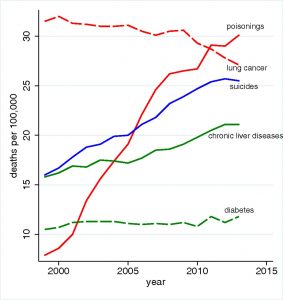
“Mortality by Cause for White Non-Hispanics Ages 45–54,” from Anne Case & Angus Deaton, PNAS December 8, 2015 112 (49)

The very bad trends depicted in this figure are concentrated among white people without college experience, but those with some college show increasing mortality. It’s only people with BAs or more who have escaped that pattern.

The state arrives to tell them to eat different foods, not to smoke, to raise their children differently. It may seem that the state disagrees with the messages that they hear in church, which they attend to live good lives. The state tells them to send their kids to the state university if they want to stay in the middle class. Their taxes and tuition dollars will pay for people who relate to them as the state has traditionally related to the poor and working class. Professors and student-affairs workers will steer their kids into a new culture that the coastal bourgeoisie has created. From the same universities come the k-12 teachers, nurses, and others who lecture them back in their own communities about food and exercise and carbon emissions. (Here I am indebted to Kathy Cramer, among others.)

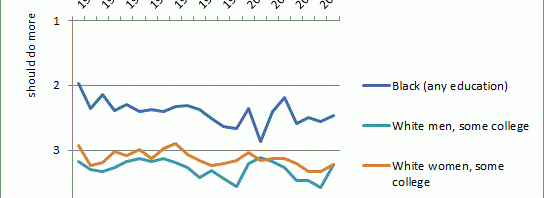
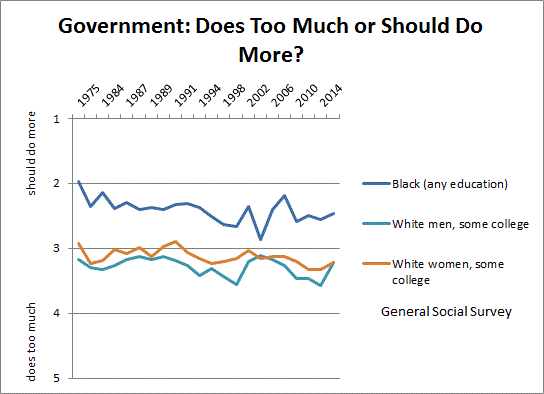
When asked whether the government should “do more” (1 on the scale below) or “is trying to do too many things that should be left to individuals and private business” (5 on the scale), white men have traditionally tilted against government. However, they caught up with white women in their support for government between 2014 and 2016, perhaps because they needed it more. We don’t have 2018 data yet, but we know they voted for Trump that year. This is consistent with needing government but not liking it.
The conflict between petit-bourgeois white people and the state is gendered, because many of the front-line representatives of the government are female, and many of the people with the most counter-normative behavior are men. The conflict is also racial in two respects. First, white, middle class people traditionally distinguished themselves from Americans who needed government aid and guidance, whom they viewed disproportionately as people of color; but that distinction is erased if the middle class also needs help. Second, representatives of the state–especially those who appear on TV–look at least somewhat more racially diverse than white communities do. At the very top of the state structure for eight years was a Black man.

I think these tensions are at the heart of current US politics. Focusing on them challenges both the “economic insecurity” and the “racial resentment” explanations of the 2016 election and its aftermath. A somewhat different premise is that lower-middle-class rural and exurban white Americans are now experiencing the state roughly as poor urban people are used to experiencing it. They need it but don’t like it, because it is always telling them they must change.

I’m not saying that most of them are responding appropriately or wisely, but we might want to dust off our tools for repairing the welfare state: make sure the government employs people who talk and look like those it affects, train them for sensitivity, organize those most affected by the state to push back, and try to shift to cash redistribution instead of invasive behavior-modification.

See also: why the white working class must organizeresponding to the deep story of Trump voterswhat do the Democrats offer the working class?
youth turnout up 10 points, youth opt for Democrats to an unprecedented degree

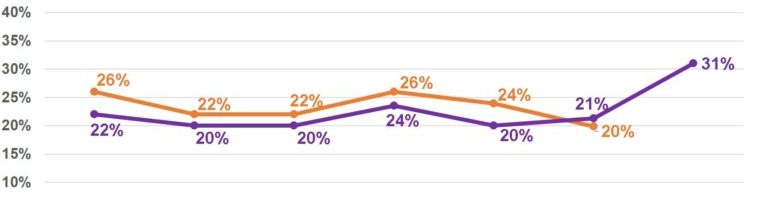
These two graphs from CIRCLE tell the story of youth in the 2018 election.

First, turnout rose dramatically. The blue line shows estimates of youth turnout using the only method that’s available immediately after an election. CIRCLE relies on the exit polls plus the number of ballots cast and demographic data to generate that line. As shown, this estimate has tracked a different method (the Census Bureau’s November surveys, which simply ask people whether they voted) pretty well historically. As CIRCLE acknowledges, their method could lead to errors if the exit polls’ age breakdown is wrong; but it’s the best available method, and it suggests a very strong year for youth.

Second, although young people do not always vote Democratic, they sure did this year. The partisan gap is unprecedented. I happen to think it’s folklore that once people have voted the same way three times, they keep voting that way for life. However, folklore sticks for a reason, and it’s certainly plausible that voting for the same party a few times in a row creates a habit that tends to persist. If that’s true, Republicans are taking a chance on long-term catastrophic damage.

Meanwhile, if you’re a Democrat in a mood to be a little chagrined by yesterday because your high expectations were not quite met (after all, you are a Democrat), just don’t blame youth. These trends are startlingly positive for Democrats. The problem lies further up the age pyramid.

2020 will also be tough for Senate Democrats

In 2016, everyone thinks the Senate “map” is terrible for Democrats. Forty-two Republican incumbents don’t face an election this year, whereas Democrats must defend 24 incumbents, 10 of them in states that Donald Trump won in 2016–sometimes by very large margins. Even a Blue Wave is expected to leave the Republicans in charge of the Senate.

You would think that 2020 would have to be better for Democrats. After all, Democratic voters outnumber Republicans in national votes for the president and the House. If, by the luck of the draw, the Democrats face a bad Senate map one year, the next time has to be better–right?

Actually, 2020 looks like another pretty hard year for the Dems. According to Nathaniel Rakich in FiveThirtyEight, 22 Republican Senators will face reelection. That sounds like fertile ground for Democrats, except that only two of those 22, Cory Gardner and Susan Collins, represent states that Hillary Clinton won in 2016. Based on that information, you might expect Republicans to lose just a seat or two. Meanwhile, 11 Democratic Senators will face reelection, and two of them represent states that Trump won in 2016: Jeanne Shaheen of New Hampshire (which was close) and Doug Jones of Alabama (which Trump won by 27 points). Based on that information, you might expect the Democrats to lose Jones and maybe one or two more.  If each party loses a seat or two to the other, it will be a wash, preserving the Republican majority.

How can this be? One reason is that a harder year will finally arrive for the Republicans in 2022. Twelve Democrats and 22 Republicans will have to defend seats that year, including several Republicans in swing states: Rubio in Florida, Grassley in Iowa (if he runs again at 89), Burr in North Carolina, Portman in Ohio, Toomey in Pennsylvania, and Johnson in Wisconsin. All the Dems who are up in 2022 are in either blue or purple states.

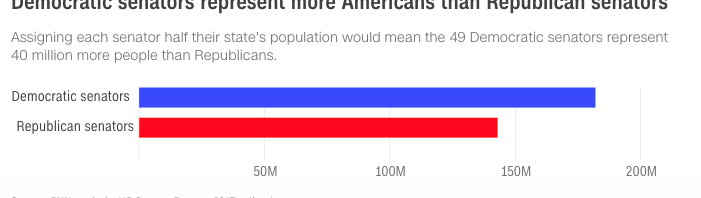
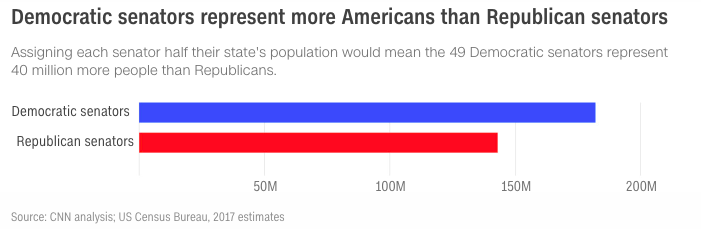
But the other reason is the extraordinary gap between the Senate and the American population. Even now, with the Senate controlled by Republicans, Democratic senators represent substantially more people:

The Constitution enshrines this imbalance. Anything in the whole document can be changed by amendment, “provided that… no state, without its consent, shall be deprived of its equal suffrage in the Senate.” This is is our only unamendable rule.

Long-term predictions are foolish, but I think you can imagine a pattern of Democratic presidents and House majorities being systematically stymied by Republican senates and the Supreme Court that the Senate has shaped. Then a significant majority of the public will be consistently blocked by an increasingly radicalized minority that is based in different parts of the country as we address climate crises, AI, and other truly profound challenges. Many people will not trace the failures of the government to specific provisions in our Constitution; they will perceive a government that’s inexplicably unresponsive and unrepresentative. And that, it seems to me, is a recipe for constitutional collapse.

See also: is our constitutional order doomed?two perspectives on our political paralysis; and are we seeing the fatal flaw of a presidential constitution?

youth vote 2018: what to expect and how to interpret the data

In The Washington Post, Amy Gardner reads some tea leaves that might foretell youth turnout in November.

On one hand, the good news: “In Pennsylvania, youth voters have made up nearly 60 percent of all new registrants, Target­Smart reported in September. The share of the electorate that is under age 30 has grown since 2017 in several key states, including Nevada, North Carolina and Florida, according to state voter registration data tracked by the firm L2. In Virginia, requests for student absentee ballots, at about 30,000, are about 50 percent higher than in last year’s gubernatorial election.”

We could add that CIRCLE’s youth polling finds much higher levels of intent to vote than we have seen recently. And these data from Texas look promising:

On the other hand, Gardner notes,

There are plenty of reasons for skepticism about an age group that typically performs dismally at the polls. In 2016, young Americans were expected to turn out heavily against Trump, but the actual share of voters under 30 who cast ballots was 43 percent of eligible voters — about the same as the previous presidential election in 2012 and lower than 2008. (Overall turnout in 2016 was 60 percent.)

Midterm performance is typically far worse: Just 16 percent of young Americans cast ballots in 2014. The highest midterm turnout among voters under 30 in the past three decades was a mere 21 percent in 1994.

And some of the tea leaves seem to foretell just a modest improvement:

In Nevada, young voters’ share of the electorate was 18.6 percent in August, up from 17.5 percent in September 2017, according to L2. In North Carolina, it was 18.3 percent in October, up from 16.7 percent in September 2017. And in Florida, it was 16.6 percent in September, up from 15.6 percent a year earlier.

Meanwhile, in Politico, Marc Caputo, Matt Dixon, and Isabel Dobrin write:

THE YOUNG PEOPLE WILL … STAY HOME? — Remember all that talk of how “the young people will win” and come out in force in Florida, especially after the Parkland massacre? So far, it’s not happening. Voters between the ages of 18-29 are 17 percent of the registered voters in Florida but have only cast 5 percent of the ballots so far. They tend to vote more Democratic. Meanwhile, voters 65 and older are 18.4 percent of the electorate but have cast 51.4 percent of the ballots. And older voters tend to vote more Republican.

Their analysis is based on Daniel Smith’s chart of the early votes so far in Florida, which shows all age groups rising but youth by the smallest amount:

A bunch of different statistics are being cited here: the number of voters or registrants in various age groups, the turnout (the percentage of eligible people in each category who actually voted), and the share of the electorate (what proportion of all voters fit in each category). These articles also cite statistics about registration, early voting, and total voting. It’s easy to get confused.

I expect turnout to rise for the population as a whole, in large part because of the actual and perceived high stakes of the 2018 election. I think youth turnout will also rise but youth will face a challenge keeping pace with the general increase. The difference between them and older voters will probably look better than in Dan Smith’s chart, because early voting seems to appeal especially to older people.

But we could still see various scenarios.

If youth turnout and share of the electorate both rise, it will be a great year for youth voting. Youth turnout could actually fall, but that would really surprise me. If youth turnout rises but no faster than–or not as fast as–the turnout of older people, then youth share will shrink. This will be reported by many news outlets as a decline. That interpretation will not be an outright error. If you want to exercise more influence on the outcome, you must increase your share of the vote. A flat or shrinking share means having no more influence. Also, if turnout rises but youth turnout rises less than average, it will pose questions about the impact of the nonpartisan and partisan efforts specifically to engage youth.

But it will also be true that more youth have voted, which will be worth celebrating if you care about youth engagement. And it will break a pattern, because historically youth turnout has been remarkably flat in midterm elections. Breaking that pattern might be a small positive step even if youth share shrinks slightly.