Category Archives: philosophy

everyone unique, all connected

Reading my sister Caroline Levine’s extraordinary new book Forms: Whole, Rhythm, Hierarchy, Network, I’ve been reflecting on similar ideas that I have come to quite independently.

In college, I was deeply struck by the argument that human beings (whatever we all share as members of the same evolved species) are also divided into large clusters whose members think alike in important respects but differ with outsiders. Those clusters can be called cultures, worldviews, Weltanschauungen, etc. That these groupings are internally consistent but different from one another is an essential premise of philosophers like Hegel and Herder, of founding anthropologists like Boas and Malinowski, of New Historicist critics like Catharine Gallagher and Stephen Greenblatt, and even of deconstructionists who seek to rupture such “bounded wholes” (see Caroline Levine, pp. 26, 115-16). I’ve found the same assumptions elsewhere, too. The influential psychologist Jonathan Haidt assumes that each person subscribes to a “moral matrix” that “provides a complete, unified, and emotionally compelling worldview, easily justified by observable evidence and nearly impregnable to arguments from outsiders.” And (although different from Haidt in most other respects) John Rawls called a “plurality of reasonable but incompatible comprehensive doctrines” a “fact” about the world.

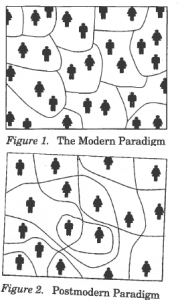
At one moment during the summer of 1989 (crossing the street in Rosslyn, VA), I thought: But each of us belongs to many of these clusters at once. The clusters overlap; their borders cross. In fact, even twin siblings would have somewhat different influences and assumptions. I drew this pair of diagrams, which appear in my Nietzsche and the Modern Crisis of the Humanities (1995, p. 188-9).

Nietzsche

I favored what I pretentiously called the “postmodern paradigm” of fig. 2 and claimed that it dispelled some of the dilemmas of value-relativism and skepticism that bedeviled modernity. This was before the large literature on “intersectionality” really got going. I agree with the argument that (for example) race, gender, and class can “intersect,” but I would push that to its limit. Our backgrounds intersect in so many ways that everyone stands at a unique intersection.

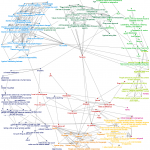
Now I am more likely to draw a different kind of map, one that treats each person’s mentality as a network of ideas, such that the nodes are typically shared by people who interact, but each person’s overall network is unique. (This is the map of the ideas identified by my students in a recent class. Each student is displayed in a different color, and their networks touch where they disclosed the same idea.)

class map 1.17

Caroline would describe figs. 1-2 as sets of bounded wholes, and the third diagram as a network map. Wholes and networks are two fundamental forms in her account–she also investigates rhythms and hierarchies. Indeed, the two forms I display above are limited in two respects. They are time-slices that fail to capture change. (Rhythm is missing.) And they are all about ideas and values, not about institutionalized forms, such as hierarchies. I think she is correct that all four types of form–and no doubt more as well–overlap and contend, creating the structures in which we live but also offering opportunities for emancipation if we figure out how to put them together in new ways.

the core of liberalism

Real ideological movements are under no one’s control. They shape-shift and amalgamate until it is both difficult and misleading to define them in terms of core principles. The  debate about their meaning not only reflects authentic intellectual inquiry but also a series of power-plays. If you can make conservatism mean what you want it to mean, for example, then you can line up support from people who identify as conservatives.

Michael Freeden studies the patterns of ideas that form political ideologies, which he calls their “morphologies.” He notes, “Morphology is not always consciously designed. Even when design enters the picture, it is partial, fragmented, and undergirded by layers of cultural meaning that are pre-assimilated into rational thinking.”*

Still, we can learn from ideologies, and not only from the relatively transparent and organized arguments that their theorists set down on paper. Political movements reflect accumulated experience. Although some movements are beyond the pale, all reasonably mainstream political ideologies invoke clusters of central ideas that deserve consideration.

In an earlier post, I argued that the valuable, core, animating impulse of conservatism is resistance to human arrogance. Conservatism can take different forms depending on the form of arrogance that is assumed to be most dangerous. If it’s the arrogance of central state planners, laissez-faire looks attractive. If it’s the arrogance of godless human beings, religious authority may look better. If it’s the arrogance of faceless corporations, small human communities may seem safer. Although these are disparate enemies, they are all charged with the same fundamental sin: blindness to human cognitive and ethical limitations.

What, then of liberalism? Empirically, it is at least as various as conservatism is. It would be appropriate to apply the word “liberal” to a New Deal social democrat or to a minimal-government libertarian, although they represent opposite poles in the US political debate.

Nevertheless, as with conservatism, we can undertake an appreciative reconstruction of liberalism as an ethical orientation. Its valuable, core, animating impulse is a high regard for the individual’s inner life–her ideas, passions, and commitments–and their expression in her personal behavior. That attitude can recommend a range of institutions, from a hyper-minimal state (to protect the individual against tyranny) to a strong social welfare state (to enable her to develop her individuality). That is why liberals span the US political spectrum. Yet not everyone is a liberal. If you see a community or a nation as having intrinsic value, you are (at least in that respect) distant from liberalism. If you see equality as an end, rather than as a potential means to individuals’ development, you diverge from liberalism. If you are confident that one or a few  ways of life embody the human good and should be encouraged or required, you are not fully liberal.

Although liberalism permits a wide range of political institutions, it has a fairly consistent cultural agenda. It favors the cultivation and appreciation of complex and diverse personalities. It is tolerant of the contemplative (rather than the active) life, of irony and ambiguity, of personal expressions against the crowd. Its most characteristic cultural form is the sensitive depiction of individuals in intimate relationships without the overlay of a strong authorial voice–as in the nineteenth-century novel or the Impressionist portrait. “Negative capability” (the ability not to take a position when describing the world) is the aesthetic analog of the liberal’s political principle of tolerance.

The poet Mark Strand gave a characteristic liberal’s response to the question, “What is your view of the function of poetry in today’s society?”:

Poetry delivers an inner life that is articulated to the reader. People have inner lives, but they are poorly expressed and rarely known. They have no language by which to bring it out into the open. … Poetry helps us imagine what it’s like to be human. I wish more politicians and heads of state would begin to imagine what it’s like to be human. They’ve forgotten, and it leads to bad things. If you can’t empathize, it’s hard to be decent; it’s hard to know what the other guy’s feeling. They talk from such a distance that they don’t see differences; they don’t see the little things that make up a life. They see numbers; they see generalities. They deal in sound bytes and vacuous speeches; when you read them again, they don’t mean anything.

These may be clichés (and Strand’s generalizations about politicians are just as empty as their alleged generalization about citizens). But in a poem like “The Way it Is,” Strand shows what he means. The narrator is beset by his jingoistic, gun-toting neighbor (“wearing the sleek / mask of a hawk with a large beak”) and by horsemen “riding around [the people], telling them why / they should die.” In other words, he fears the individual with no inner life and the faceless state. “I crouch / under the kitchen table, telling myself / I am a dog, who would kill a dog?” This is the liberal’s nightmare, but the poem is an act of freedom as self-expression.

Along similar lines, Lionel Trilling endorsed impersonal rules and institutions that enhanced freedom and happiness, yet he wished to “recall liberalism to its first essential imagination of variousness and possibility, which implies the awareness of complexity and difficulty.”** For Trilling, sensitive literary criticism was a characteristic liberal act because it involved the recovery of another individual’s thought.

On this definition, you can be a liberal and also a conservative, a socialist, and/or a majoritarian; those categories are not mutually exclusive. But liberalism points in certain directions and warns against certain dangers often forgotten in other ideologies.

*Michael Freeden, “The Morphological Analysis of Ideology,” in Freeden, Lyman Tower Sargent, and Marc Stears (eds.), The Oxford Handbook of Political Ideologies (Oxford, 2013), pp. 115-137 (quoting p. 122.)

**Trilling, The Liberal Imagination: Essays on Literature and Society (1950) (New York: New York Review of Books, 2008), p. xxi.

Foucault and neoliberalism

If you’re intellectually and ideologically eclectic, then you will find important ideas all over the map. It will not surprise you to learn that a person generally associated with the left has benefited from F.O. von Hayek or Gary Becker: leading libertarians. An excellent example is James C. Scott, who likes to call himself (I suspect partly for the frisson of it) “a crude Marxist,” but who has been deeply influenced by Hayek. Scott’s analysis of the high-modernist state is indispensable, however you choose to classify it.

On the other hand, if you’re a committed leftist intellectual, it may well come as a surprise to you that Michel Foucault read Hayek and Becker and said positive things about neoliberalism. That is the theme of Daniel Zamora’s forthcoming volume Critiquer Foucault: Les années 1980 et la tentation néolibérale. In the left magazine The Jacobin, Zamora presents it as puzzling and even potentially scandalous fact that Foucault should have showed “indulgence … toward neoliberalism.”

I do not know the relevant texts and statements by the late Foucault. But I think the affinity between Foucault’s style of critique and libertarianism is important although not very surprising, and I would understand it in the following contexts:

1. The “revolution” of May 1968 was led by activists and intellectuals who considered themselves Marxists and often especially favored Maoism. Yet their successful concrete demands were for greater individual freedom, especially vis-a-vis the state. They won a lower age of consent for sex (1974), abortion rights (1975), freedom of information (1978), and many other reforms traditionally recommended by classical liberals. They also reformed the state by reducing the power of the president, making elections more important, and strengthening NGOs. In Marxist terms, ’68 was a bourgeois revolution, not a proletarian one. So it shouldn’t be shocking that perhaps the greatest political thinker of ’68 was a bourgeois liberal (of a kind).

2. The most evident social issue of 19th century Europe was the oppression of the industrial working class. But economic growth made countries like France pervasively affluent by 1968. Industrial jobs had shrunk while social welfare programs and unions had improved the everyday life of those who still had such jobs–to the point where they could reasonably look like a kind of elite. As Zamora perceptively argues in the Jacobin article, the contrast between organized blue-collar workers and various “excluded” populations (new immigrants and disadvantaged racial minorities, the disabled, the very poor) became a central concern. But the “excluded” were not in a position to seize the commanding heights of the economy, or even to win elections, as the proletariat might have been in 1910. They were especially likely to suffer at the hands of the welfare state in poor schools, prisons, clinics, and conscripted armies. The neoliberal solution–reducing barriers to their market participation–might look more attractive than the traditional social-democratic solution of enrolling them in welfare programs that were sites of surveillance and discipline.

2. Many of the great disasters of the 20th century were attributable to high-modernist states that sought to count and measure society in order to control it–sometimes in the interest of laudable goals, like equality. One of the worst such states was Mao’s China, but French intellectuals of 1968 romanticized that regime as some kind of participatory democracy. Their misconception about China gradually faded, and in any case, China became capitalist. More to the point, the left intellectuals of Foucault’s generation were already able to see that other high modernist states were disastrous. It was appropriate and natural for the left to turn away from statism. But once they opposed the state, why should they not become libertarians? As Zamora asks in a follow-up article, “How could we seriously think that discrediting state action in the social domain and abandoning the very idea of social ‘rights’ constitutes progress toward thinking ‘beyond the welfare state’? All it has done is allow the welfare state’s destruction, not a glimpse of something ‘beyond.'” (An alternative could be anarchism, but anarchism in practice often looks like neoliberalism.)

3. Foucault and his generation emphasized a whole range of oppressions and invidious uses of power that might not arise between a capitalist and a worker but rather between a man and a woman, a parent and a child, a teacher and a student, a doctor and a patient, a white person and an immigrant, and other such pairings. They were correct to recognize these problems. But once oppression is seen as multifarious and omnipresent, we no longer want the working class to rule through the state or unions. Individual expressive freedom and various kinds of diversity become high priorities.

Zamora writes:

Foucault was highly attracted to economic liberalism: he saw in it the possibility of a form of governmentality that was much less normative and authoritarian than the socialist and communist left, which he saw as totally obsolete. He especially saw in neoliberalism a ‘much less bureaucratic’ and ‘much less disciplinarian’ form of politics than that offered by the postwar welfare state. He seemed to imagine a neoliberalism that wouldn’t project its anthropological models on the individual, that would offer individuals greater autonomy vis-à-vis the state.

Foucault “seemed to imagine” this because, indeed, a lightly regulated market economy in an affluent society is less bureaucratic than a social welfare state and does generate autonomy and diversity. Perhaps a market system also reshapes the human psyche in problematic ways. And certainly it generates unequal wealth. But for the reasons stated above, unequal wealth no longer seemed to be the primary domestic economic problem in a country like France ca. 1968. And if markets subtly shape the soul, states do so more blatantly and more uniformly.

To be clear, I am not a libertarian; I want states and other strongly organized bodies to promote equity as well as freedom. Also, I recognize that many people with egalitarian instincts have absorbed libertarian ideas without abandoning the state. They have read Hayek as well as Marx and Foucault. But I think the left still is still wrestling with the realities that led Foucault to say nice things about neoliberalism in his last years.

Bernard Williams on truth as a virtue of the humanities

Bernard Williams (1929-2003) published Truth and Truthfulness in 2002, when the humanities were still processing criticisms of truth, objectivity, science, the Enlightenment, and related ideals that had arisen with postmodernism. Williams held his own complex epistemology; he certainly wasn’t interested in defending naive positivism or scientism. But he saw that unless the humanities stood for truth as some kind of virtue, there wouldn’t be much of a case for those disciplines.

He recognized that the postmodern critique of truth might be waning. Epistemological radicalism had been more of an issue in 1990 (when I was at the same institution as Williams) than when he published Truth and Truthfulness. But he was prescient about the decade to come:

There is a danger that the decline of the more dramatic confrontations [about postmodernism] may do no more than register an inert cynicism, the kind of calm that in personal relations can follow a series of hysterical rows. If the passion for truthfulness is merely controlled and stilled without being satisfied, it will kill the activities it is supposed to support. This may be one of the reasons why, at the present time, the study of the humanities runs the risk of sliding from professional seriousness, through professionalization, to a finally disenchanted careerism.

(Anyone recognize evidence of the last three words today?)

Williams’ book is not really about truth but about “the ‘virtues’ of truth, qualities of people that are displayed in wanting to know the truth, in finding it out, and in telling it to other people.” Those virtues turn out to be two: Accuracy and Sincerity. Accuracy means trying to figure out what is true about the world and other people, as opposed to what one wishes, assumes, or is told to be true. It means making an “investment” in efforts to distinguish realities from wishes, for example. Sincerity means sharing what one believes with other people. The two virtues are distinct but related. It is, for example, not much good to be sincere about one’s beliefs if they are childish fantasies, nor to struggle to understand reality but keep what you find to yourself.

A third candidate for a virtue of truthfulness would be Authenticity–being true to who you really are. Williams criticizes the strong, Rousseauian version of this candidate virtue on interesting grounds. We don’t know who we really are. The self is not a unitary thing but a mix of values and other mental states that change rapidly, shift with context, and arise in relation to other people. Becoming someone is a “project” undertaken with other people. So the expectation of Authenticity is frustrating in ways that are worse than the quests for Accuracy and Sincerity.

Williams makes the case that any society needs Accuracy and Sincerity. But, as he argued more generally in Ethics and the Limits of Philosophy, the fact that a society needs X does not give an individual an adequate reason to supply X. One can free-ride instead. Also, there can be morally legitimate reasons to make exceptions. Kant was wrong to conclude that, because language and society depend on a general expectation of truthfulness, you may never lie. It only follows that most people should be truthful most of the time.

Instead of trying to derive grounds for principles of Accuracy and Sincerity, it is better to analyze and positively depict truthfulness as a virtue that gives credit to the person who displays it. We can also connect virtues together. Thus, for example, it takes courage to be Accurate, and compassion to be Sincere. (“Error is cowardice,” as Nietzsche wrote in a passage that Williams quotes.) Accuracy is also linked to freedom, because the struggle to understand nature is governed by one’s own will, in contrast to a struggle against other people’s wills, which limits freedom. I think Williams’ project is to defend truthfulness by linking several virtues into one attractive picture.

Note that virtues are not like Kantian principles; they can be exhibited to various degrees and even to excess. One can, for instance, make too much of an investment in determining the accuracy of a statement whose implications are not sufficiently important. (That is a sign of an obsession.) Or one can rightly withhold information that ought to be private.

Sincerity is a disposition, and it cannot be understood just as the disposition to follow a rule. Of course, there have to be some general considerations to which Sincerity attends, or the disposition would have no content. … But they do not add up to a rule, in the traditional sense of a requirement which is relatively simple and does not leave most of the work to judgement.

I read Truth and Truthfulness to explore a hypothesis that there are three different sets of virtues that are important to a good life, but they do not fit neatly together. One is truth, which Williams parses as Accuracy and Sincerity. A second concerns our relations to other people, which must be just, fair, compassionate, or some relative of those terms. (I deliberately mean this three-part model to allow for much debate about each part). And the third concerns our inner self, for we are entitled to worry about our own peace, equanimity, and/or happiness.

I found Williams helpful in two ways. First, he substantiates the premise that truthfulness is one set of virtues, honorable in themselves and generally useful to society, but sometimes in conflict with other worthy virtues. Again he quotes Nietzsche: “Fundamental Insight: There is no pre-established harmony between the furthering of truth and the well-being of humanity.” Second, Williams offers an impressive model for how to argue on behalf of a large abstract virtue, of which truthfulness is an example. He parses it closely. He shows by means of hypothetical cases that the virtue benefits a society. He shows by means of real history that the virtue has evolved in certain ways to take its current form. He shows that in the course of this history, certain efforts to change the virtue (e.g., Romantic proposals to turn it into Authenticity) have failed. And he links it to other virtues in ways that make it seem appealing.

The result is not the kind of knock-down argument that would convince a cheerful liar to start being Accurate and Sincere. It is, rather, an excavation of the kinds of reasons that lead reasonable people to try to be fairly truthful, even when inaccuracy and insincerity would be easier. I agree with Williams that unless the humanities exemplify that effort, they do not have much of a future.

See also: are we entering a post-truth era?; why we wish that goodness brought happiness, and why that is not so; unhappiness and injustice are different problems; all that matters is equanimity, community, and truth; does naturalism make room for the humanities? and building alternative intellectual establishments.

a method of mapping moral commitments as networks

I have been developing a method for representing moral beliefs as networks of ideas. Various friends have also been contributing to the development of this approach. So far, we have asked individuals to name their own beliefs, given them back their lists, asked them to note which pairs of beliefs seem connected, and generated network maps of their beliefs and connections. I’ve also asked individuals to share their maps with peers and to consider making changes in response to other people’s arguments. I have mapped the ideas of multiple people as one network. Instead of using surveys, one could interview people or groups about their moral thinking on a given topic and identify the beliefs and connections implied by their speech–or use a rich text, such as a poem, to discover an implicit network map. Major moral theories also have network shapes that can be diagrammed. Virtues, for instance, are important nodes in Aristotle’s conceptual network, and he says that the virtues are all connected by way of one central concept, practical wisdom.
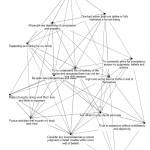
I do not see this network approach as a model of moral thought, an empirical theory about how we actually think, or a normative theory about how we should think. Instead, I see it as a technique of analysis that is relatively neutral with respect to models and theories, yet it does have certain substantive implications.

According to the Stanford Encyclopedia of Philosophy, there is little clarity or consensus about what defines a theory versus a model. But let me propose two analogies:

  1. A Lego car is a model of a real car. It can be used to develop and test theories about the performance of actual cars. These theories prove true or false when tested in real cars; the Lego model is reliable to the degree that the theories pan out. Making Lego models is a technique that is more or less helpful for engineering. Its value depends on the context and the available alternatives. For instance, Lego is almost certainly a better material than soap for making models of cars. It is a less precise medium than 3D printing, but it is also cheaper and easier. A good theory is true; a good model is valid and reliable; and a good technique is useful.
  2. In economics, I would call each equation a theory and use the word “model” to mean a whole set of equations, along with definitions and explanations of the hypothesized mathematical relationships. Working with equations is a technique. It is pretty obviously an essential technique for economics, but some have argued that it has been valued to the exclusion of other techniques, such as collecting better data, looking for natural experiments, or identifying important topics. Paul Krugman wrote recently: “It has been all too obvious that there are people with big reputations who can push equations around but don’t seem to have any sense of what the equations mean.” Like building with Legos, mathematics is a technique whose value varies with the context.

Likewise, I would propose that mapping moral networks is a technique with which one can build models and test hypotheses. It is fairly flexible and can accommodate a range of substantive views from both psychology and philosophy. But its relative value (compared to other techniques) varies depending on some assumptions about morality. I’ll compare it to two prevalent alternatives.

First, some moral philosophers construct systematic views. An example would be the sophisticated utilitarianism of Henry Sidgwick (which we could call “utilitarianism 3.0,” if Bentham’s was 1.0, was Mill’s was 2.0). Sidgwick held that there is just one ultimate moral principle: maximizing human happiness. But it generates a set of important moral rules, such as being kind and telling the truth. These precepts, in turn, imply many ordinary moral judgments, such as telling the truth to your mother.

Sidgwick’s structure was mainly philosophical, not empirical. He did not say that everyone is a utilitarian (in fact, he explicitly denied that), but that everyone’s judgments should be consistent with the results of utilitarian reasoning. There was, however, an element of empiricism is his view. He doubted that we can directly apply the utilitarian principle to real cases, which is why subsidiary rules are valuable.

Sidgwick’s structure can be diagrammed as a tree-like network, and that is somewhat illuminating. Individuals’ actual moral networks could also be mapped and compared to Sidgwick’s diagram, as a form of moral assessment. However, if Sidgwick was right, then network analysis has limited value. After all, his proposed network is quite simple, and some of the power of network modeling (e.g., detecting subtle clusters in large fields of data) would be wasted. Thus …

P1. Network techniques become more useful if we presume that real people hold many different structures of moral thought, that a theoretically driven structure like utilitarianism is not necessarily ideal, that some structures are much more complex than Sidgwick’s, and that comparing structures is illuminating.

Second, the moral psychologist Jonathan Haidt currently proposes six “moral foundations,” although his theory is subject to testing and improvement, and he is open to finding more than six foundations. One technique he uses is factor analysis. Many individuals are asked many questions about moral topics, and Haidt and colleagues look for unobserved variables (“factors”) that can explain a lot the variance in the answers. In developing statistical models that predict the actual results as a function of a few variables, they seek parsimony and fit. “Parsimony” means that fewer factors are better, but “fit” means that the unobserved variables should explain the actual survey answers without too much error.* Once the data yield statistical factors, Haidt and colleagues consider whether each one names a psychological instinct or emotion that 1) would have value for evolving homo sapiens, so that we would have developed an inborn tendency to embrace it, and 2) are found in many cultures around the world. Now bearing names like “care” and “liberty,” these factors become candidates for moral foundations.

Network analysis could represent Haidt’s model, just as it can represent Sidgwick’s very different conception. Each of Haidt’s foundations would be a central node connected to many concrete beliefs by one-way arrows. However, if Haidt is right, then network analysis is not as valuable a technique as the one he uses, factor analysis. First, network analysis is not nearly as parsimonious. A network map may show hundreds of beliefs clustered to varying degrees. Instead of generating six nameable foundations, a network map might yield fifty somewhat vaguely defined and partly overlapping clusters.

Second, the network method presumes that people’s explicit connections are meaningful. I diagram subjects’ networks using their assertions that their own beliefs are linked–for example, I link A to B when someone thinks that A gives her a reason to think B. But Haidt and colleagues argue that we do not know which beliefs are meaningfully connected. We reach conclusions because of unconscious biases and use reasons as mere rationalizations, gerrymandering our arguments to fit what we want to believe because of the underlying foundations. Sidgwick (like most philosophers) held that in morality, “as in other departments of thought, the primitive spontaneous processes of the mind are mixed with error, which is only to be removed gradually by comprehensive reflection upon the results of these processes.” But Haidt et al. believe that such reflection is basically ineffective, for only the primitive spontaneous processes of the mind really count. If that is the case, than the very items that matter most (the unobserved foundations) will be missing from a network map that is derived from people’s explicit connections. Thus …

P2 Network techniques become more useful if people have many clusters of moral ideas, if important information is lost by seeking parsimonious statistical models, and if reflection on explicit, conscious ideas and connections is valuable.

*Graham, Jesse et al. “Mapping the Moral Domain.” Journal of personality and social psychology 101.2 (2011): 366–385. PMC. Web. 1 Dec. 2014.