Category Archives: philosophy

Lifeworld and System: a primer

The great social theorist Jürgen Habermas has drawn attention–for more than half a century–to the problem that he calls the “colonization of the Lifeworld by System.” Here is my explanation, based mainly on a rare concrete example from his Theory of Communicative Action, vol. 2. 

The Lifeworld, for Habermas, is the background of ordinary life: mainly private, somewhat naive and biased, but also authentic and essential to our satisfaction as human beings. It is a “reservoir of taken-for-granteds, of unshaken convictions that participants in communication draw upon in cooperative processes of interpretation.” In the Lifeworld, we mostly communicate with people we know and who share our daily experience, so our communications tend to be opaque to outsiders and certainly not persuasive to people unlike us. But Habermas argues that we are incapable of thinking about everything at once. In order to reason and communicate, we must take most points as givens. Only then can “single elements, specific taken-for-granteds” be brought up for conversation and critical analysis.

Meanwhile, the “System” is composed of formal organizations, such as governments, corporations, parties, unions, and courts. People in a System have official roles and must pursue pre-defined goals (albeit sometimes with ethical constraints). For example, defense lawyers are required to defend their clients, corporate CEOs are supposed to maximize profit, and comptrollers are supposed to reduce waste in their own organizations. In the current period, there are fundamentally two Systems: markets (in which instrumental action leads to profit) and governments (in which instrumental action demonstrates power). Although the people who work in markets and governments are complex individuals with other commitments, their official work responsibilities are to maximize money or to administer power.

To illustrate the Lifeworld, Habermas invites us to envision an “older construction worker who sends a younger and newly arrived co-worker to fetch some beer, telling him to hurry up and be back in a few minutes.” The senior worker assumes that a whole set of beliefs and values are shared on the team: German construction workers enjoy and expect to drink beer at breaks during the workday, beer is for sale in the vicinity, the younger and/or most recently hired person is the one who does unpaid chores for the group, and so on. Each of these assumptions could be brought into doubt and subjected to debate. For instance, as Habermas suggests, the younger worker might say, “But I don’t have a car,” or “I’m not thirsty.” Other “elements of the situation” might generally pass unnoticed yet become relevant as circumstances change. If the younger worker is an immigrant without health coverage and he falls off the ladder as he goes to buy the beer, several relevant laws and controversies may suddenly occur to the workers, moving from their background knowledge to topics of explicit discussion. But at any given moment, simply by virtue of being human, the workers must assume most features of the situation as a shared and implicit background, a “vast and incalculable web of presuppositions.” This is their Lifeworld.

In order for the workers (or any other group of people) to be free and self-governing, they must be able to render any aspect of the Lifeworld problematic. It is a definitive feature of modernity that no assumptions are considered immune to critique; and it is a condition of democracy that no critique is blocked by law or other force. When the younger construction worker notes that no beer is available within walking distance and he doesn’t have a car, he is giving a reason for someone else to go. This turns his work group into a small Public Sphere. To the extent it is democratic and deliberative, his reasons will require responses.

Imagine (to go beyond Habermas’ presentation of this example) that the radio is playing as these men work. A news program includes an interview with a feminist activist who criticizes the construction industry for hiring very few women, followed by an immigrant leader who notes that alcohol is forbidden to Muslims (thus the assumption that everyone wants to drink beer is exclusionary), followed by a health expert who attributes disease to excessive daytime beer consumption. These people are making arguments that compel critical attention to specific aspects of the workers’ Lifeworld. They represent the larger Public Sphere of the Federal Republic or the European Union. It doesn’t matter whether the interviewees have self-interested motivations, such as selling copies of their books, or whether the radio station is a for-profit company trying to attract listeners. The format of any reasonably well-run news program will compel the speakers to give reasons that can be checked and assessed by reporters and listeners. This is a case of a democratic Public Sphere challenging citizens to reflect about aspects of their Lifeworld.

But although every particular point should be subject to discussion, the whole Lifeworld must be protected. One reason is that we need the Lifeworld to think at all, for we are capable of testing a specific assumption only while holding our other assumptions for granted. A second reason is that our Lifeworld is ours, a condition of living authentically. Any political program that tries to strip a group of people of their accumulated assumptions all at once would be totalitarian. A radio program that brings separate issues to the workers’ attention expands their thinking; but if a revolutionary government seizes all the radio stations and begins broadcasting propaganda against contemporary German working-class culture as a whole, that is a threat to their Lifeworld.

Meanwhile, the Lifeworld is vulnerable to manipulation by interested parties who act instrumentally. For example, suppose that on the radio, the workers hear men with similar accents to their own praising a particular brand of beer. Maybe women are also heard, enjoying these men’s company and appreciating their good taste. It sounds as if friends have entered the real Lifeworld of the construction site, but these supposed friends are really actors who are are paid to sell beer. Of course, the workers will understand the purpose of an advertisement, yet by skillfully imitating their authentic Lifeworld, the ad can affect their behavior. No reasons need be given; no rebuttal is invited. In this case, Habermas would say that the Lifeworld of the workers has been colonized by the System of markets. The System of government might similarly colonize their Lifeworld if a candidate for public office started talking on the radio as if he were their friend who shared their values and experiences.

In discussions of Systems colonizing Lifeworlds, common examples include commercial advertisements that masquerade as authentic communications. These are cases of “commodification”: firms mining the Lifeworld for economic advantage. Habermas also emphasizes the tendency of welfare state bureaucracies to “juridify” or “judicialize” the Lifeworld. For instance, when well-intentioned states seek to protect pupils and parents against unfairness in testing and discipline, fairness “is gained at the cost of a judicialization and bureaucratization that penetrates deep into the teaching and learning process,” depersonalizing the school, inhibiting innovation, and undermining relationships.

A neo-Marxist line of criticism faults Habermas for equating juridification with commodification and the state with the market. This critique hold that the underlying process is capitalist exploitation, and the welfare-state is only a threat to the Lifeworld because it is a tool of capital. Habermas disagrees. For him the underlying process is growing specialization, a feature of modernity. He insists that in socialist societies, the state colonizes the Lifeworld in a parallel way to the market’s colonization in capitalist societies; and in welfare states, both threats operate at once.

[It turns out that I have posted 58 times before on Habermas, collected here. My broadest posts are probably Habermas and critical theory (a primer)saving Habermas from the deliberative democrats; and Ostrom, Habermas, and Gandhi are all we need.]
my fall philosophy class on the question: How should I live?

This introductory course will emphasize one of the great philosophical questions: “How should I live?” The readings will specifically consider whether truthfulness, happiness, and justice are important aspects of a good life, and how each should be defined. …

Moral Mapping Exercise: With colleagues, I have been developing a method for moral introspection that involves making and revising a network diagram (or map) of your moral ideas and the connections among them. I will ask you to make a private map early on and to revise it regularly. I will ask you to bring a copy to class that you are comfortable sharing: it should omit any ideas that you prefer to keep private. At the end, I will collect your final map and a 2-page reflection on it. Instructions are here.

Syllabus: Subject to Change

Continue reading

libertarianism and democracy

In  the Washington Post, Michael Chwe argues that the “beliefs and values” of James M. Buchanan “conflict with basic democratic norms.” Buchanan (1919-2013) was a hugely influential public choice economist. Chwe is intervening in the debate about him that has been provoked by Nancy MacLean’s recent book Democracy in Chains. Although I haven’t read MacLean, I want to offer a theoretical point.

If freedom means non-interference, and if democracy means equitable decision-making in groups, then freedom and democracy are in tension.

“Non-interference” means not being told what to do or what not to do. “Equitable decision-making” means a process that yields a result binding on the whole group, based on everyone’s input. It need not mean majority-rule; democratic processes can be more complex and demanding than that. But democracy does yield binding outcomes, which may interfere with what individuals want to do. Therefore, democracy as equitable decision-making conflicts with freedom as non-interference.

This means that libertarians and classical liberals should own up to the fact that they are critics of democracy. Yes, they favor certain forms of liberty and equity, but those don’t equal democracy. Libertarians are leery of binding decisions by non-voluntary groups.

For their part, strong democrats–people who want to defend and expand the scope of democratic decision-making–should admit that they are critics of freedom as non-interference.

But one can compromise. I happen to think that non-interference is a real good. People rightly don’t like to be told what they may and may not do, except when it is strictly necessary. I also happen to think that democratic decision-making is a real good: people should deliberate and shape their common world. If the two goods trade off, then we can design institutions that offer elements of democracy along with strong constraints to protect individuals from unjust interference by the group. For those who favor a compromise, Buchanan’s work is full of important insights and cautions, but is not a satisfactory political theory all by itself.

Two important complications:

  1. Non-interference is a problematic concept. We tend to think of a person as free from interference insofar as she goes about her everyday life without anyone else making explicit commands or threats. But that person lives in a world shaped by institutions, norms, and powerful decisions by other people, starting with her parents and including her employer, competing companies in the marketplace, celebrities who shape the culture, etc. It’s not clear that she is more free if she faces fewer explicit, immediate rules.
  2. There are other kinds of freedom, besides non-interference. In a post that still draws daily traffic, I summarized six types. I actually omitted an important seventh type on which Philip Pettit is an expert: freedom as non-domination. This means freedom from any other person’s arbitrary will or discretionary choice. One can be highly limited by rules that are non-arbitrary, or one can be subject to arbitrary decisions that happen not to be very consequential. If you think that arbitrariness (rather than constraint) is the main threat to liberty, then you can favor strong democratic institutions. But they can’t be simply majoritarian. Instead, they must be aimed at producing non-arbitrary decisions: decisions that are justified by reasons, influenced by all opinions, and consistent with rules. I find this very promising, but I also believe that we must attend to the insights of Buchanan and others about how real institutions fail to honor such abstract principles.

science, law, and microagressions

We live and work in settings that are diverse but unequal. Opportunities and outcomes can often be predicted on the basis of race/ethnicity, culture and religion, gender and sexual orientation, and class background. In these settings, we communicate constantly. Some of our communications are blatantly inappropriate, threatening the recipients or intentionally and obviously making them feel unwelcome and inferior. Some are acceptable or even helpful. And in between, some are arguably problematic. They are being called “microaggressions“–“aggressions,” because they are wrong; and “micro-” because they are not blatantly or clearly objectionable when taken one at a time.

One problem with them is that they may combine with many similar statements to create an overall environment that prevents people from flourishing and succeeding. Another problem is that they are simply unethical. Even if a given aggression contributes no harm at all, it is not what a person should say to another person.

Our culture is uncomfortable with ethical distinctions. Even children are taught that ethical claims are opinions in contrast to facts. We are quick to see explicitly ethical claims as subjective and biased. To criticize another person’s expression on ethical grounds seems arrogant, judgmental, and a possible threat to liberty.

In contrast, two major forms of reasoning are confident and widely viewed as legitimate: science and law. So there is a constant temptation to convert an ethical discussion about what is right into a science-like or law-like analysis.

For instance, in Aeon recently, the psychology professor Scott O Lilienfeld wrote that all policies and programs that target microagressions

hinge on one overarching assumption: that the microaggression research programme aimed at documenting the phenomenon is sound, and that the concept itself has withstood rigorous scientific scrutiny. This is not the case. Microaggressions have not been defined with nearly enough clarity and consensus to allow rigorous scientific investigation. No one has shown that they are interpreted negatively by all or even most minority groups. No one has demonstrated that they reflect implicit prejudice or aggression. And no one has shown that microaggressions exert an adverse impact on mental health.

Lilienfeld concludes, “Until the evidence is in …, I recommend abandoning the term microaggression, which is potentially misleading. In addition, I call for a moratorium on microaggression training programmes and publicly distributed microaggression lists now widespread in the college and business worlds.”

I agree that it would be useful to know more about the consequences of definable categories of communication. The consequences of any form of speech will vary depending on the situation, the speaker, the recipient, etc. There won’t be one empirical finding about microagressions, but there may be many useful findings.

Still, note the assumptions that underlie this call for a scientific approach:

  1. A given act (in this case, a speech-act) should be criticized if, and only if, it causes a measurable harm. Moral philosophers would call this assumption “consequentialism.”
  2. Categories of behavior can be usefully abstracted from contexts and defined with necessary and sufficient conditions. This reasoning uses what Jonathan Dancy [in Moral Reasons, 1993, p. 65] calls “switching arguments”–arguments that isolate a given feature of a situation and assume that if it has a moral significance in its original context, it must have the same significance when the context is “switched” to another one. 

These are controversial positions. Kantians, virtue-ethicists, and others dispute consequentialism for various reasons, holding that an act can be right or wrong regardless of its causal impact. And particularists deny the validity of “switching arguments,” on the basis that a given feature can change its moral significance depending on the context. They criticize what Alfred North Whitehead called the “fallacy of misplaced concreteness.”

I don’t want to litigate those debates here, but merely to suggest that a scientific investigation of microaggressions makes strong assumptions about what should matter ethically. Those assumptions violate many ordinary people’s intuitions and ways of reasoning about what is right.

Meanwhile, legalistic reasoning influences the discourse of microaggressions. It’s not that critics want to make these acts literally illegal, but they introduce legal-sounding analysis. A microaggression deserves some kind of disciplinary intervention–perhaps not a punishment, but at least an authoritative statement that the speech is inappropriate in its context. A teacher or other authority figure who fails to intervene can be held responsible for creating a hostile environment.

But disciplinary responses threaten other values: freedom of speech, diversity of opinion, authentic expression of privately held views, and freedom from arbitrary judgments. Jesse Singal thinks that “microaggressions are being defined so broadly and so subjectively that students who are exposed to them are likely to come away very, very confused about what constitutes acceptable speech on campus — and campus disciplinary systems could get seriously gummed up in the years to come.” Thus we feel the pressure to introduce regular rules and policies that strike the appropriate balance and are predictable. Rule by people is to be replaced by rule of law.

Jürgen Habermas laments the tendency to “juridify” or “judicialize” what he calls the “Lifeworld.” For instance, when well-intentioned governments seek to protect pupils and parents against unfairness in testing and discipline, he writes, fairness “is gained at the cost of a judicialization and bureaucratization that penetrates deep into the teaching and learning process,” depersonalizing the school, inhibiting innovation, and undermining relationships [Theory of Communicative Action, vol. 2, p. 371.] Habermas reads the New Social Movements that have arisen since the 1970s–both on the right and the left–as efforts to protect the authenticity of the everyday Lifeworld from both the market and the intrusive welfare-state. It is an ironic outcome when these movements ultimately “juridify” such contexts as classrooms by turning ethical judgments into legalistic arguments. For example, some people cut their teeth in liberatory social movements but end up as diversity & inclusion specialists inside institutions, writing empirical papers (science) and establishing policies (law).

I am inclined to agree with Habermas that the underlying process is specialization. In large and technically complex modern societies, it pays to differentiate one’s expertise and authority. Constantly increasing specialization is thus a fundamental process of modernity. [Ibid. p. 374]. Science and law are two categories of specialization, each endlessly ramifying into sub-specialties. They seek legitimacy and often obtain it. Lilienfeld’s review of psychological research is an example of a scientist asserting authority on the basis of expertise.

Science and law are sometimes in tension. Behavioral scientists may argue that laws lack empirical basis; lawyers may block empirically justifiable rules on constitutional grounds. But these two systems also easily interlock. For instance, both disciplines need to categorize behavior and draw causal implications. 

Science and law offer important checks on the kinds of judgments that we may reach intuitively in ordinary life. When we assert that a given statement has (or does not have) effects on specific individuals, that is a causal claim that must stand up to scientific scrutiny. When we make a judgment about an individual’s speech, we should check it against general principles that would block favoritism and arbitrariness.

But these two limited forms of reasoning can distort or block ethical judgment–as when Lilienfeld uses the lack of scientific evidence to support a “moratorium” on the use of the word “microagression,” even though that is ultimately an ethical category. The imposition of law and science can overwhelm the following values:

  • Responsibility: We are obligated to make judgments about speech, our own and others’. We can’t offload responsibility onto bureaucratic or scientific systems.
  • Judgment and discretion: There is no algorithm that can settle subtle cases. It is up to the moral agent to decide, under circumstances of uncertainty and moral ambiguity. Discretion cuts two ways, sometimes requiring us to excuse behavior that violates policies or that has negative effects, and sometimes requiring us to condemn behavior that is allowable and inconsequential.
  • Holism: Good judgment requires concern for the whole individual, the whole situation, and the whole community.
  • Relationships: Ultimately, what matters are relationships among differently situated human beings. Relationships are affective as well as rational, embodied as well as communicative, implicit as well as explicit, and prolonged over time.

See also: morality in psychotherapy; insanity and evil: two paradigmsprotecting authentic human interaction;  is all truth scientific truth?free speech at a university; and don’t confuse bias and judgment.

psychoanalyzing presidents

There’s lots of conversation right now about Donald Trump’s mental condition. It includes claims that he demonstrates narcissistic personality disorder and that changes in his speech patterns reveal cognitive decline. I [analyzed] his speech pattern from a particular angle here.

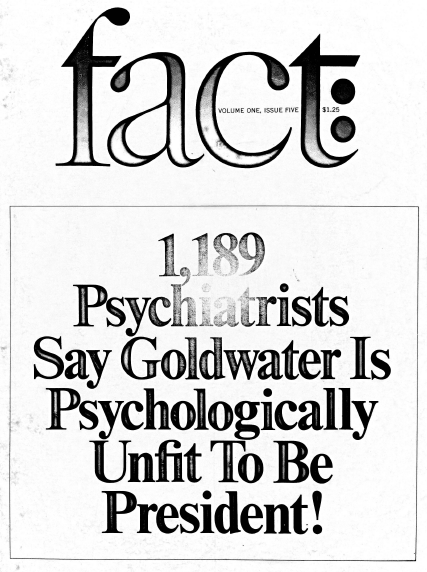
This discussion evokes the episode in 1964, when Fact magazine surveyed psychiatrists about then-candidate Barry Goldwater’s psychological fitness to be president.

Just under half (49.2%) of the 2,417 respondents thought he was unfit, with the rest split evenly between those who didn’t believe they could answer and those who considered him fit for office. Fact also gave respondents a chance to write comments and printed 40 pages of quotes from their answers. Goldwater sued and won over $1 million in damages (which bankrupted Fact magazine), leading to the American Psychiatric Association’s “Goldwater Rule,” which forbids members from making evaluative comments about public figures whom they have not examined as individual patients. A patient/physician relationship triggers ethical responsibilities that are absent when psychiatrists discuss public officials.

For me, the original Fact magazine issue is a fascinating example of professional authority encountering politics. It’s important to note that a considerable minority of the quoted statements either object to psychoanalyzing Goldwater without examining him in person or vouch for his mental health. Some of the surveyed psychiatrists even opine that he is the only sane candidate, surrounded by crazy socialists. But the majority of the quoted MDs make claims that now seem risibly dated and morally problematic. They do so under their professional titles, in a magazine entitled “Fact.” For example:

  • “Descriptions of his early life that I have read indicate to me that his mother assumed the masculine role in his family background. … The picture, therefore, is of a domineering, emasculating mother and a somewhat withdrawn, passive, narcissistic father. … This would provide a fertile background for sado-masochistic temperament, such as is seen in paranoid states.” — M.D., name withheld.
  • “From TV experiences, it is apparent that Goldwater hates and fears his wife. At the convention, she consistently appeared depressed and withdrawn. Certainly she was not like the typical enthusiastic candidate’s wife, e.g., Mary Scranton.” — M.D., name withheld.
  • “Barry Goldwater’s mental instability stems from the fact that his father was a Jew while his mother was a Protestant. This ethnic and cultural split accounts for his feelings of insecurity and spiritual loneliness. … ” — M.D., name withheld.
  • “In trying to analyze Mr. Goldwater’s behavior I am tempted to call him a ‘frustrated Jew.’ … He has never forgiven his father for being a Jew. … What the Senator from Arizona stands for is the antithesis of the traditional Jewish concepts of social justice, of humility, of moderation in speech and action, and of concern for the feelings of others, especially the vanquished. In eschewing these concepts, the Senator subconsciously expresses his hatred for his Jewish father.” — Max Dahl, M.D. Supervising Psychiatrist [etc.]
  • “In allowing you to quote me, which I do, I rely on the protection of Goldwater’s defeat at the polls in November; for if Goldwater wins the Presidency, both you and I will be among the first into the concentration camps.” – G. Templeton, M.D.,  Director, Community Hospital Mental Health [etc.]
  • “Characterologically, Goldwater is like many middle-class Americans. He is ‘formula’ oriented with a belief in the infallibility of his own rhetoric. … In short: Goldwater is an anal character who believes all’s well in his ‘tidy’ world.” — M.D., name withheld.
  • “From his published statements I get the impression that Goldwater is basically a paranoid schizophrenic who decompensates from time to time.” — M.D., name withheld.

I think we should talk about Donald J. Trump’s character and psychological fitness for office. It seems problematic to use the Goldwater Rule to keep the whole psychiatric profession out of this discussion. And yet these quotes from 1964 remind us how historically-relative, value-laden, and agenda-driven people can be, even when they present themselves as scientific specialists dealing only in Facts.