Category Archives: philosophy

two criticisms of Effective Altruism

In the week after Sam Bankman-Fried (known as “SBF”) lost his whole $16 billion fortune, I’m sure that everyone who was already skeptical about crypto, Silicon Valley, boy geniuses, billionaires of all ages, political donors, and Effective Altruists is now piling on. Schadenfreude flows palpably through the world’s social networks–flawed as they may be.

I don’t know whether personal attacks are merited. SBF had explicitly committed to making high-risk bets with relatively low odds of success, because he thought that was his moral duty. Even if he deserves to be denounced, I’m not interested in celebrating anyone’s failure or reinforcing my prior assumptions.

But Adam Fisher’s beautifully written pre-collapse profile of SBF supplies quotations that illustrate why I have always resisted Effective Altruism, as a matter of principle.

I believe:

  1. The world gets better when people have the capacity to define, analyze, and address their own problems.
  2. Being happy, in a worthy sense of that word (“eudaimonic,” if you prefer), is hard and rare. Most of us live lives of quiet desperation. Material conditions help but are insufficient. We must accomplish worthwhile happiness ourselves. To the extent that we can help others to flourish, it’s by sharing insights and developing relationships.

These two points are distinct, but they intersect because working with others to shape our world is a path to inner happiness. It is not the only path, and it’s often a fraught one, but it must be kept open. By exchanging proposals and then acting together with people whom we view as equals, we can broaden our thinking and enrich our inner lives.

In contrast, utilitarianism “in its purest—Benthamite—form” (Fisher’s description of SBF’s philosophy) presumes that we can and must make other people happy by acting on or for them at a distance. We can calculate the best decision privately and then just do it.

SBF asks Fisher to imagine a world in which many people resemble his description of himself. They take risks to make money that they then give away to assist the world’s poorest. Some succeed and some fail, but whether you are one of the successful shouldn’t matter much to you, because you are just one person among billions. “The starving child doesn’t give a shit about which person it is who does that good. So why are you concerned about this little term in the equation?”

“This little term” is a way of expressing altruism: each of us counts for almost nothing. But note that SBF’s mind goes to a child who is starving. Children only gradually develop agency. Babies cannot analyze or affect the larger social world. They cannot do better than receiving benevolence, although they need loving relationships as well as nutrients.

To treat adults like needy infants is paternalism, in the root sense of that word. If you recognize adults as fellow human beings, then you must not affect them without asking them what they think, making yourself accountable to them, and allowing them to affect you back.

Unless they are at death’s door, adults typically do care about who is claiming to help them, and why. That is because we want to choose and shape our relationships. We do not want someone else to have a purely discretionary choice about whether and how to affect us, even if that person happens to be benign. Discretionary power is domination, and domination is a basic evil.

Frank Lovett summarizes the classical republican argument (which is as old as Cicero): “to have a master with an exceptionally benevolent disposition is to be reasonably secure in one’s expectation that one will not often be adversely interfered with—but it is to have a master nonetheless. The republican idea of freedom specifically instructs us not to make our master a better person (the goal of the old ‘mirror for princes’ literature), but to render him less of a master.”

Can a financial donor dominate people? I would say absolutely, if the money affects people and the choice of whether and how to give is the donor’s alone. Effective Altruism seeks to make rich people better, much like renaissance books with titles like A Mirror for Princes that aimed to improve monarchs. The point, however, should be to do without masters.

My second concern involves the difficulty of achieving happiness. SBF devotes no evident attention to his inner life. Fisher reports, “SBF spends nothing, it would seem, pursuing his own pleasure. It’s not just that great books aren’t worthwhile. The great movies aren’t worth watching. Food gets the same treatment. … SBF’s rejection of pleasure is so profound it got me wondering if that absence of pleasure—as opposed to his philosophy—was the key to understanding him. Is he so deep in his head that he’s incapable of feeling pleasure?”

SBF says, “I would never read a book. … I’m very skeptical of books.” Although he is entitled to his preference in media, there’s one book that he should definitely read now that he has some time on his hands: The Autobiography of John Stewart Mill.

SBF would recognize the author’s situation. Mill was a famous young prodigy raised by utilitarians. His father arranged a powerful position for him as an administrator of British India. Thus Mill had “what might truly be called an object in life; to be a reformer of the world. My conception of my own happiness was entirely identified with this object.” Likewise, SBF was raised by utilitarian law professors and accumulated billions with which to affect countries like India.

I don’t know SBF’s current mental state, but in the India Office, Mill fell into a deep depression. He asked himself :

“Suppose that all your objects in life were realized; that all the changes in institutions and opinions which you are looking forward to, could be completely effected at this very instant: would this be a great joy and happiness to you?” And an irrepressible self-consciousness distinctly answered, “No!” At this my heart sank within me: the whole foundation on which my life was constructed fell down. All my happiness was to have been found in the continual pursuit of this end. The end had ceased to charm, and how could there ever again be any interest in the means? I seemed to have nothing left to live for.

SBF presents himself, like the young Mill, as someone who ignored his personal well-being to enhance others’. That verdict may be complicated by SBF’s 1,500 square-foot condo in the Bahamas, “with six bedrooms and spectacular views out every window,” and the possibility that he diverted his investors’ money. But even if SBF was sincere, he was making a fundamental mistake if happiness depends on wisdom, because then we must each learn to be wise. Mill wrote:

the important change which my opinions at this time underwent, was that I, for the first time, gave its proper place, among the prime necessities of human well-being, to the internal culture of the individual. I ceased to attach almost exclusive importance to the ordering of outward circumstances. …

Mill became a great proponent of the arts, of liberty as a personal accomplishment as well as a lack of censorship, and of representative government. He continued to make utilitarian arguments, but now refracted through an understanding that people must have power over their own lives, individually and collectively.

See also Mill’s question: If you achieved justice, would you be happy?; qualms about Effective Altruism; how we use Kant today; wicked problems, and excuses; how to think about other people’s interests: Rawls, Buddhism, and empathy; introducing republicanism; citizens against domination; etc.
Mapping Ideologies as Networks of Ideas

Newly published (behind a firewall): Peter Levine (2022) Mapping ideologies as networks of ideas, Journal of Political Ideologies, DOI: 10.1080/13569317.2022.2138293.

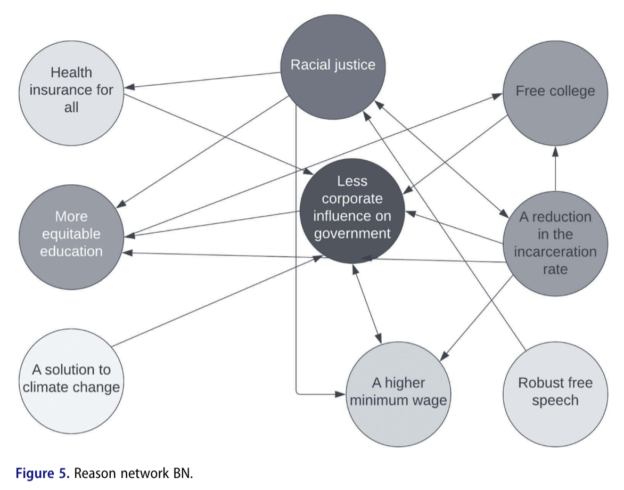
This is an early publication from my main current scholarly project. I am concerned that several streams of research and intellectual conversations are converging on the same conclusion: people just aren’t very thoughtful or rational about politics. This stance discourages efforts to enhance democracy and the public sphere. However, the most prevalent measurement tools–standard opinion surveys–are systematically biased against detecting the complexity and individuality of individuals’ political views. Various colleagues and I are experimenting with alternative quantitative methods that involve directly asking people about the connections among their distinct beliefs and analyzing the results as networks. This sole-authored article is a pilot study aimed at validating the method.

Abstract:

Individuals in a non-representative sample of 93 US progressives were asked which social outcomes they valued and then asked about the relationships among these opinions. Did each outcome provide a reason for a different one? Would each outcome cause a different one? If each outcome came to pass, would it make them more likely to support another outcome? Network diagrams derived from these responses represent portions of these individuals’ ideologies, understood as structures of political thought. Scrutiny of the network diagrams and analysis of the aggregate data suggest that most respondents carefully and reasonably identified relationships among their own ideas. Features of their networks predicted their assessments of five prominent politicians. This exploratory study paints a strikingly different picture of the sample than what would emerge from more conventional methods, such as factor analysis. Instead of a group that looks ideologically homogeneous on a unidimensional scale or that exhibits a low level of ideological coherence (because very few of their ideas are correlated), this method displays a collection of people who hold diverse and complex structures of thought. The method should be replicated with representative samples to explore the variation and significance of such structures.

See also: what if people’s political opinions are very heterogeneous?;  individuals in cultures: the concept of an idiodictuonideologies and complex systemsdon’t let the behavioral revolution make you fatalistic, etc.

who are today’s republicans (in the classic sense of the word)?

In our Introduction to Civic Studies course, we are briefly discussing both the classical tradition of republican thought (from Cicero to John Adams) and the contributions of Black American republican thinkers of the 19th century, as described by Melvin Rogers (2020). In this brief introductory video, I identify the following components of traditional republicanism:

  • Opposition to domination (which republicanism defines as the basic problem)
  • Rule of law
  • Separation of powers
  • Deliberation
  • The common good
  • Popular participation (going beyond voting, which by itself can allow domination by the majority)
  • Anti-elitism
  • Civic virtues and an expectation of sacrifice for the common good

One of our US political parties happens to be called “Republican,” and I think that is not merely coincidental. The GOP has roots in antebellum abolitionist movements that, in turn, explicitly invoked republican ideas.

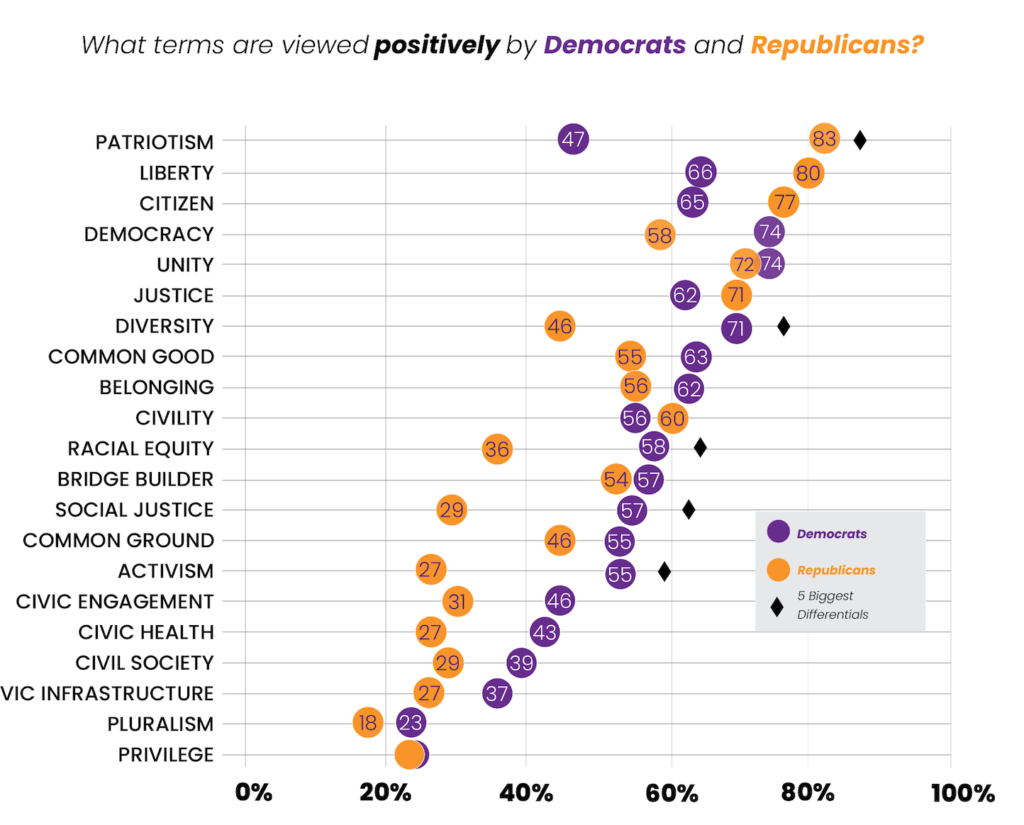
But that doesn’t mean that either of our major parties today is necessarily more republican (in the classical sense) than the other. The recent Civic Language Perceptions Project from Philanthropy for Active Civic Engagement (PACE) offers a chance to see how partisanship–as well as demographics–relate to classical republican ideals. Not all of the components of republicanism are tested, but some are. The data come from a nationally representative random sample of 5,000 registered voters conducted in 2021.

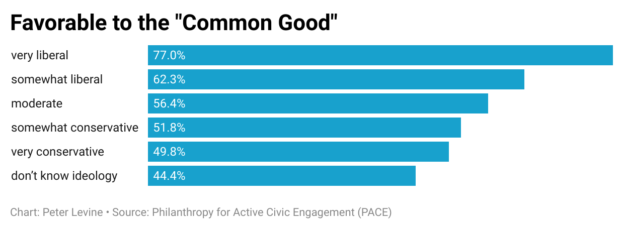
One component of traditional republicanism was an orientation to the common good. That phrase might seem like empty rhetoric, but classical republican authors placed the common good ahead of individual negative freedom, material prosperity, and pluralism, which they often decried as “factionalism.”

PACE asked respondents to react to the phrase “common good,” and it performed best among people who identified as “very liberal.” (See the graph above.)

Patriotism is not on my list of components of republicanism, but often the civic virtues have been defined in patriotic terms. Although some today may see patriotic rhetoric as conservative, it was fundamental to left-wing revolutionary republican movements, from France in 1789 to Mexico in 1910 to Russia in 1917. According to the PACE data, patriotism polls far better among Republicans than among Democrats: a 36-point gap. (See below.)

“Liberty” was the great principle for classical republicanism, and it polls better among Republicans than Democrats. However, some Americans may think of liberty as non-interference (simply being left alone), whereas for classical republicans, it meant non-domination (freedom from arbitrary will). This semantic ambiguity makes the result hard to interpret.

Both parties like “unity,” which was a classical republican value, but Democrats like “diversity” much more than Republicans do. Classical republicans tended to be skeptical of diversity. Therefore, either Democrats dissent from classical republicanism on this issue, or else the word “diversity” is being used in a new way–basically to mean racial equity, which Democrats like much more than Republican do: a 22-point gap. Classical republicans should have embraced racial equity, even though few actually did.

Republics require participation, also known as civic engagement, and that phrase is more popular among Democrats than Republicans.

Democracy is compatible with republicanism, although proponents of democracy tend to emphasize majority rule and responsiveness to mass opinion, whereas republicans want voting to play the limited role of checking elite domination. Madison writes, “If a faction consists of less than a majority, relief is supplied by the republican principle, which enables the majority to defeat its sinister views, by regular vote” (Federalist 10). In this passage and many others, he’s defining “republican” as majoritarian, but his own overall view is more complex. Democrats are more favorable to the word “democracy” than Republicans are, according to the PACE data, although a majority of Republicans do support it.

On balance, one might conclude that today’s Democrats are more republican than Republicans are; but perhaps it’s more accurate to regard the classical republican tradition as marginal all across our spectrum.

PACE infographic

Source: Melvin Rogers, “Race, Domination, and Republicanism,” in Difference without Domination: Pursuing Justice in Diverse Democracies, edited by Danielle Allen and Rohini Somanathan (University of Chicago Press 2020). See also introducing republicanism; James Madison in favor of majority rule; every Republican president [until Trump] insisted that the US is a democracy; a Democratic Republican Federalist; what defines conservatism?; liberals, conservatives, and love of the Constitution etc.

introducing republicanism

This is a 12.5-minute video in which I introduce the republican tradition (or just “republicanism”) as it is typically discussed in political theory these days. I’m drawing on authors like G.J.A. Pocock, Quentin Skinner, Philip Pettit, and Ian Shapiro. I also refer to Melvin Rogers’ important recent work on Black American republican thought and some ideas of Brooke Ackerly about how domination (which is the main concern of republican theorists) may relate to oppression. In our Introduction to Civic Studies course, we will be reading and discussing Rogers, so an immediate purpose of my video is to give our students some definitions that they can use to understand his work. But I hope that the video may be useful for others as well.

See also citizens against domination; what republic means, revisited; civility as equality; what to do about the guy behind the desk; civic republicanism in medieval Italy: the Lucignano council frescoes (etc.)

artificial intelligence and problems of collective action

Although I have not studied the serious scholarship on AI, I often see grandiose claims made about its impact in the near future. Intelligent machines will solve our deepest problems, such as poverty and climate change, or they will put us all out of work and become our robot overlords. I wonder whether these predictions ignore the problems of collective action that already bedevil us as human beings.

After all, there are already about 7.5 billion human brains on earth, about 10 times more than there were in 1800. Arguably, we are better off than we were then–but not clearly and straightforwardly so. If we ask why a tenfold increase in the total cognitive capacity of the species has not improved our condition enormously, the explanations are pretty obvious.

Even when people agree on goals, it is challenging to coordinate their behavior so that they pursue those ends efficiently. And even when some people manage to work together toward a shared goal, they have physical needs and limitations. (Using brains requires food and water; implementing any brain’s ideas by taking physical action requires additional resources.) To make matters worse, human beings often have legitimate but conflicting interests, like the need to gain sustenance from the same land. And some human beings have downright harmful goals, like dominating or spiting others.

One can see how artificial intelligence might mitigate some of these drawbacks. Imagine a single computer with computational power equivalent to one million human beings. It will be much more coordinated than those people. It will be able to aggregate and apply information more efficiently. It can also be programmed to have consistent and, indeed, desirable goals–and it will plug away at its goals for as long as it receives the physical inputs it needs. For instance, it could clean up pollution 24/7 instead of stopping for self-interested purposes, like sleeping.

However, it still has physical needs and limitations. It might use fuel and other inputs more efficiently than a human being does, but that depends on how good the human’s tools are. A person with a bulldozer can move more garbage than a clever little robot that works 24/7–and both of them need a place to put the garbage. (Intelligence cannot negate physical limits.)

Besides, a computer is designed by people–and probably by individuals arrayed as corporations or states. As such, AI is likely to be designed for conflicting and sometimes discreditable goals, including killing other people. At best, it will be hard to coordinate the activities of many different artificially intelligent systems.

Meanwhile, people already coordinate their behavior in quite impressive ways. A city receives roughly the amount of bread it needs every day because thousands of producers and vendors coordinate their behavior through prices. An international scientific discipline makes cumulative progress because thousands of scientists coordinate their behavior through peer-review and citation networks. And the English language develops new vocabulary for describing new phenomena as millions of people communicate. Thus the coordination attained by a machine with a lot of computational power should be compared to the coordination accomplished by human beings in a market, a discipline, or a language–which is impressive.

One claim made about AI is that machines will start to refine and improve their own hardware and software, thus achieving geometric growth in computational power. But human beings already do this. Although we cannot substantially redesign our individual brains, we can individually learn. More than that, we can redesign our systems for coordinating cognition. Many people are busy making markets, disciplines, languages, and other emergent human systems work better. That is already the kind of continuous self-engineering that some people expect AI to accomplish for the first time.

It is of course possible to imagine that an incredibly intelligent machine will identify solutions that simply elude us as human beings. For instance, it will negate the physical limitations of the carbon cycle by discovering whole new processes. But that is an empty supposition, like imagining that regular old science will one day discover solutions that we cannot envision today. That is probably true–it has happened many times before–but it is unhelpful in the present. Besides, both people and AI may create more problems than they solve.

See also: the progress of science; John Searle explains why computers will not become our overlords;