Category Archives: philosophy

Beliefs and connections among beliefs in a club

An Association as a Belief Network and Social Network

I will present a paper entitled “An Association as a Belief Network and Social Network” at next week’s Midwestern Political Science Association meeting (remotely). This is the paper.

Abstract:

A social network is composed of individuals who may have various relationships with one another. Each member of such a network may hold relevant beliefs and may connect each belief to other beliefs. A connection between two beliefs is a reason. Each member’s beliefs and reasons form a more-or-less connected network. As members of a group interact, they share some of their respective beliefs and reasons with peers and form a belief-network that represents their common view. However, either the social network or the belief network can be disconnected if the group is divided.

This study mapped both the social network and the belief-network of a Rotary Club in the US Midwest. The Club’s leadership found the results useful for diagnostic and planning purposes. This study also piloted a methodology that may be useful for social scientists who analyze organizations and associations of various kinds.

Two illustrative graphs …

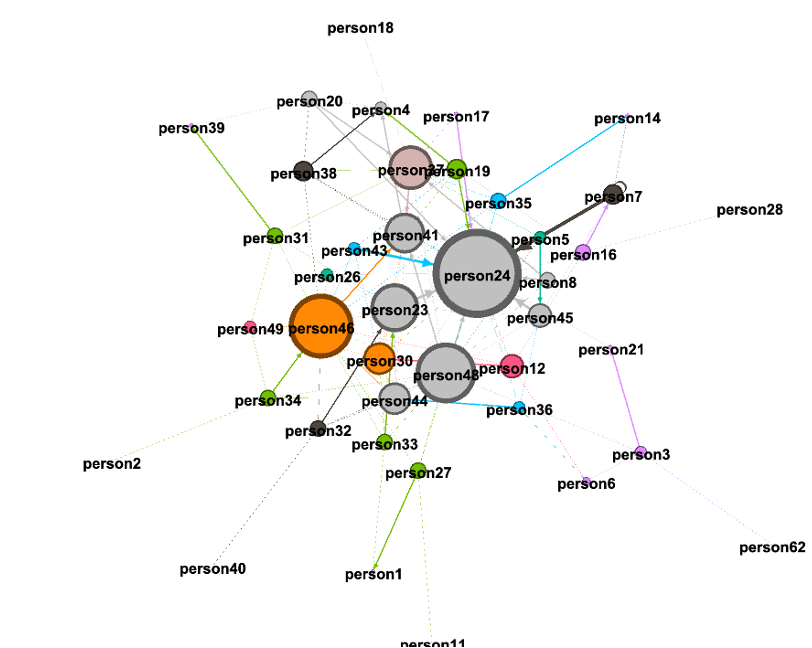
Below is the social network of the organization. A link indicates that someone named another person as a significant influence. The size of each dot reflects the number of people who named that individual. The network is connected, not balkanized. However, there are definitely some insiders, who have lots of connections, and a periphery.

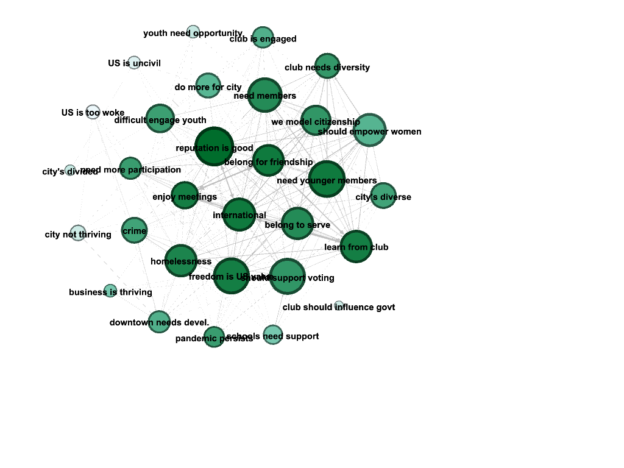
The belief-network is shown above this post. The nodes are beliefs held by members of the group. A link indicates that some members connect one belief to another as a reason, e.g., “I appreciate friendships in the club” and therefore, “I enjoy the meetings” (or vice-versa). Nodes with more connections are larger and placed nearer the center.

One takeaway is that members disagree about certain matters, such as the state of the local economy, but those contested beliefs do not serve as reasons for other beliefs, which prevents the group from fragmenting.

I would be interested in replicating this method with other organizations. I can share practical takeaways with a group while learning more from the additional case.

See also: a method for analyzing organizations

Cephalus

I am so lucky: near the finish line
With no tragedies. My three sons are fine.
I may never have to open the door
To wrenching news or the grim stench of war.

I sleep all right these days, now that lust is less
A master, and guilt, that dogged hunter,
Lets me burrow in a secret shelter
Where I tell myself I deserve success.

When I heard Socrates had come down here,
I sent a boy to stop him. My knees are such
I cannot walk uphill to Athens much.
I hate to miss the clever talk, and I fear
The wise and famous will forget Cephalus.

It was like old times; we quoted lovely lines.
But I knew he'd start to press: “What do you mean,
Cephalus? Doesn't that come in different kinds?”
The more we examine hope, the more hope declines.
I left Socrates to my son, exited the scene,
And, wearing my silly wreath, resumed my place,
Performing prayers in the marketplace.

Cf. Plato, Republic 331d: “‘Very well,’ said Cephalus, ‘I will turn the whole argument over to you. For now is the time when I must take charge of the sacrifices.’ ‘Well,’ he said, ‘Aren’t I, Polemarchus, the heir to everything you have?’ ‘Certainly,’ he laughed, and he went at once to the sacrifices.” See also: Pindar on hope; philosophy and self-help; shelter

The Vuslat Foundation and Generous Listening

The Vuslat Foundation has opened a public website as generouslistening.org. At the Tisch College of Civic Life, we are one of their partners, as you can tell from the description of a conference that we co-organized and held at Tufts last year (a symposium on “Generous Listening in Organizations“); a blog post by my colleague James Fisher about Quaker dialogues in West Africa; and other references on their site.

The Foundation also does much work on their own or with other partners, including remarkable support-groups for women displaced by the earthquakes in Southeast Turkey in 2023.

I come to this partnership as someone who has studied political deliberation–for instance, as a co-editor (with John Gastil) of the Deliberative Democracy Handbook. SInce the late 1900s, public deliberation has been a movement of theorists and practitioners, but it is rooted in much older ideas about politics that have typically emphasized speech, communication, persuasion, and rhetoric–as both virtues and threats.

The Vuslat Foundation has helped me to shift my focus from one side of the exchange to the other–from speaking to listening. Of course, these acts always go together (even when they are metaphors for written speech, signs, or gestures). It is hardly a novel insight that communication requires at least two people. But I have benefitted from thinking more about the listening side.

First, there’s an ethical imperative. Listening well (“generously,” in the language that the Vuslat Foundation has developed) is an important virtue. Using one’s voice well is also virtuous, and sometimes even obligatory, but the need to be a good listener seems especially compelling.

Second, we can think about listening holistically. One aspect is listening to other people in deliberations, but we also listen to ourselves, to animals, waves, or the wind, to human soundscapes, to near-silence, perhaps to the divine, and to those who are long dead. I have found it useful to think of civic listening as just one kind of listening.

Third, I am taken by the “interactionist” theory of Hugo Mercier and Dan Sperber, which has helped me make sense of some of my own data–in forthcoming articles. To summarize their model crudely, imagine two or more people discussing what to do. When individuals speak, they tend to use motivated reasoning: inventing justifications for what they already want to believe, sometimes for bad reasons, such as self-interested bias. But when they listen to other people offer reasons, they are relatively good at assessing whether these points are valid, and they may change their minds. Mercier and Sperber offer an evolutionary explanation that suggests that highly social and verbal primates would develop the ability to make arguments to advance their own interests, but also the ability to assess others’ arguments in order to make good collective judgments.

Mercier and Sperber never suggest that listening always goes well. We can certainly listen selectively and exhibit bad motives when we select whom and what to listen to. But their theory suggests that we can improve individual skills and conditions for listening–perhaps more easily than we can improve speaking.

Finally, listening has spiritual (or at least psychotherapeutic) benefits that have been recognized and developed in many traditions. Although we can also gain spiritually from communicating well, the listening side is especially relevant to meditative practices of all kinds.

See also: how intuitions relate to reasons: a social approach; an agenda for R&D for democracy; “you should be the pupil of everyone all the time”; ‘every thing that lives is holy’: Blake’s radical relativism; “The Listeners“; “Midlife“.

philosophy and self-help

I recommend Kieran Setiya’s article “Is Philosophy Self-Help?” in The Point. Setiya has written serious philosophy that I have found helpful psychologically, and he has looked at the self-help business, starting with Samuel Smiles’ 1859 bestseller, Self-Help: With Illustrations of Character and Conduct.

Based partly on his article, I would emphasize these differences:

  1. Self-help tries to meet the desires of the reader–usually but not invariably for happiness. In contrast, philosophy asks what the reader should desire. Personal happiness is one possible answer, but that is debatable in philosophy.
  2. Self-help tries to serve the reader, addressing that person’s specific needs, values, and tastes. Philosophy asks whether human beings in general should pursue certain values. Some philosophers have given pluralist responses, emphasizing that individuals or cultures may or should hold different values. But such pluralism is, again, controversial in philosophy and would require a defense. As Setiya notes, “For Aristotle, the nature you should perfect is not your individual potential, but an objective human nature whose ideal expression lies in theoretical contemplation of the cosmos.”
  3. Self-help influences individuals’ thoughts and choices. For some philosophers (e.g., Emerson) one’s self is the best topic, but for others, it’s essential to think about society and institutions, and possibly even to sacrifice oneself for them.

I’m in a reading group on Plato’s Republic, and all three differences between self-help and philosophy are already evident in the very first pages. Cephalus is presented as an old man who is happy. He has taken advice from Pindar and Simonides, whom he treats as self-help gurus. He has learned from them that he’s better off now that his appetites for sex and other desires have diminished. He derives serenity from reflecting on his own virtue.

Socrates is a threat to Cephalus’ happiness (and I am open to the possibility that Plato sees him as a menace). Socrates will not take Cephalus’ subjective beliefs for granted; he challenges the definition of justice that Cephalus has found in Simonides. He thereby demonstrates that Cephalus has drawn serenity from an unfounded belief in his own rightness.

Further, we know that Cephalus’ sons Polemarchus and Lysias (who are present in the dialogue) will later be selected to be two of the first ten victims of the Thirty Tyrants– Lysias narrowly escaping; Polemarchus suffering death. They will be singled out because, like Cephalus, they are wealthy resident aliens, not citizens. So we can see that Cephalus’ happiness is contingent on the accident that the city has chosen to treat him well. He should be thinking about how to secure justice for the community.

On the other hand, one might think that Cephalus is lucky not to get a full dose of Socrates. He leaves just before Socrates begins to critically analyze his beliefs, heading off to watch a civic/religious festival instead. I can read the portrait of Cephalus as elegiac: he fortunately lived a happy life to its conclusion before his happiness could be wrecked by either philosophy or politics.

See also: Pindar on hope; Cuttings version 2.0: a book about happiness; analytical moral philosophy as a way of life; Kieran Setiya on midlife: reviving philosophy as a way of life; etc.

Pindar on hope

Cephalus says: “For if, looking at his own life, [an old man] identifies many wrong acts, then he often awakens from his sleep, as children do, in fear and bad hopes, but if he observes no injustice in himself, then pleasant hope is always nearby as a good caregiver, as Pindar says–for he puts it gracefully, Socrates, when he says of a person who gets through life justly and piously:

Sweetness in the heart,
Fosterer and elder-carer:
Hope, the best pilot of the thought
Of oft-twisted mortals

Cephalus adds: “Oh, how wonderfully well he says that …”

But then Socrates breaks the mood by asking what justice is, making Cephalus–a contented old man–wonder whether he has ever really known it.

If I read the Pindar verses correctly, the two main words in the second line refer to the care (respectively) of children and the elderly. Indeed, the course of a human life is a prevalent theme at the beginning of The Republic, from which I have taken this passage (331a). At the very outset, Socrates, an older adult, is physically stopped on the road by a “child,”* who has been sent by an old man, Cephalus. One of the attractions that Socrates is promised, if he agrees to stay, is an opportunity for dialogue with “young men” (328a). But Socrates asks Cephalus to report on what it’s like to be old.

Although The Republic is about justice, the entree to that discussion is the question of how to age well. A major question is why one should have to think about justice at all, and an answer suggested here is that knowing justice allows one to have hope in old age. One irony is that Cephalus is happy because he only thinks he knows justice; a second irony is that Cephalus’ sons will later be cruelly treated by the unjust. In both respects, his hope may be misplaced.

*I drafted this post while preparing for a reading group discussion, and a colleague with infinitely better Greek than mine said that this use of the word pais is unspecific about age. Here, it’s a patronizing word for slave. Cf. Bernard Williams, Ethics and the Limits of Philosophy, p. 54. (The quoted verse is denoted Pindar Frag. 214, Loeb. Translations are mine.)