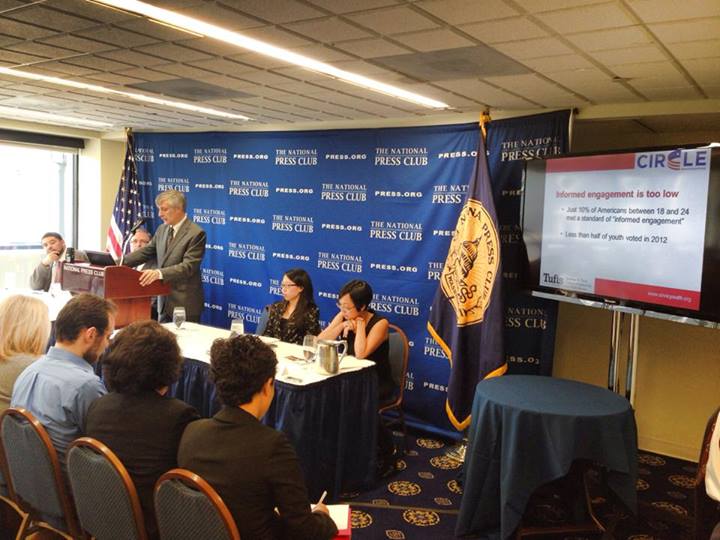
 (Washington, DC) Here I am at the National Press Club, releasing the report of the Commission on Youth Voting and Civic Knowledge, entitled “All Together Now: Collaboration and Innovation for Youth Engagement.”
Here is the text of our press release:
While the federal government is shut down, young people across America are required to study our system of government and how a bill becomes a law. Successful civic education is both more difficult and more important when Congress and other elected officials set such poor examples. Today, the Center for Information and Research on Civic Learning & Engagement (CIRCLE)—the nationally recognized research center based at Tufts University’s Tisch College of Citizenship and Public Service—released a groundbreaking report on how to educate young Americans for political participation in a time of deep polarization.
The new report, released this morning at a Newsmaker event hosted by the National Press Club in Washington, D.C., was written by the Commission on Youth Voting and Civic Knowledge and is entitled, “All Together Now: Collaboration and Innovation for Youth Engagement.” The report provides recommendations for educators, parents, and national, state and local policymakers on how to engage American youth.
The Commission on Youth Voting and Civic Knowledge is a distinguished, bipartisan group of scholars convened by CIRCLE to investigate exclusive data collected during and after the 2012 elections on issues such as civic knowledge, voting behavior, and the educational experiences of Americans ages 25 and under—a crucial constituency in electoral politics. The report is based, in part, on data collected for the Commission from more than 6,000 young adults and 720 high school civics or government teachers, and an analysis of all states’ voting and education laws. The research was funded by the S.D. Bechtel, Jr. Foundation, Robert R. McCormick Foundation, W.T. Grant Foundation, Spencer Foundation, and Youth Engagement Fund.
“Teachers face an inhospitable climate for civics: tests and standards that do not reward discussing current events, considerable resistance from parents to anything touching politics, and a national political climate that alienates young people from public life,” said Peter Levine, director of CIRCLE. “The research for this new report demonstrates the urgency of better civic education in schools and community-based organizations that include youth.”
Some highlights of the report’s findings released today include:
- Current levels of knowledgeable engagement by America’s youth remain too low. Less than half of young Americans vote, even in presidential elections, and just 10 percent of Americans between 18 and 24 met a standard of “informed engagement” in the 2012 presidential election cycle.
- Opportunities for civic learning and engagement are highly unequal. White, wealthy students are four to six times as likely as Hispanic or Black students from low-income households to exceed the “proficient” level on the National Assessment of Educational Progress (NAEP) in civics. Only 7 percent of students whose parents didn’t graduate from high school and who are eligible for free or reduced-price lunch reached “proficient.”
- Civic education is increasingly viewed as controversial by the public. A quarter (24.8 percent) of the teachers surveyed by the Commission thought that parents or other adults in their community would object if politics was discussed in their course—even though they were asked about a course on government or civics taught during a presidential election year.
- Although highly controversial, voting laws have only small effects. Photo ID laws seemed to lower voting for young people who have not attended college. Same Day Voter Registration modestly, but reliably, boosts youth turnout. The overall effects of these laws are small compared to the larger challenges to engaging youth in democracy.
“Research shows that civics education works. Discussing controversial issues, engaging in service learning if it involves discussion of “root causes,” being contacted by parties and campaigns, and participating in extracurricular groups all predict good civic outcomes for students,” said Trey Grayson, former Kentucky Secretary of State (R-KY), Director of the Harvard Institute of Politics and member of CIRCLE’s Commission on Youth Voting and Civic Knowledge. “As a teacher we surveyed stated, civic education ‘is essential if we are to continue as a free democratic society’.”
“All young Americans should be informed and responsibly involved in politics and civic life. And engaging the next generation is the best long-term solution to problems of polarization, incivility, and dysfunction in national politics,” said Levine.
To break current patterns, the report recommends policymakers must embrace innovative and collaborative approaches to civic education. Examples of recommendations from the report include:
- Lowering the voting age to 17 in municipal or state elections so that students can be encouraged to vote while they are taking a required civics class.
- Policies that support teachers’ obligation to include discussions of current, controversial political issues in the curriculum. Assigning students to read and debate news in class and encouraging them to discuss with their parents and other adults who are important in their lives.
- State standards for civics that focus on developing advanced civic skills, such as deliberation and collaboration, rather than memorizing facts.
- Badges for excellence in civics. These portable, online certificates would demonstrate advanced civic skills, knowledge, and actual contributions.
Both a full list of the commission’s members and additional, detailed information about the commission, its mission and focus can be found here.
###
CIRCLE (http://www.civicyouth.org) is a nonpartisan, independent, academic research center that studies young people in politics and presents detailed data on young voters in all 50 states. CIRCLE is part of the Jonathan M. Tisch College of Citizenship and Public Service at Tufts University.
The Jonathan M. Tisch College of Citizenship and Public Service (http://activecitizen.tufts.edu/) is a national leader whose model and research are setting the standard for higher education’s role in civic engagement education. Serving every school of Tufts University, Tisch College creates an enduring culture that prepares students to be lifelong active citizens.
Tufts University (http://www.tufts.edu/), located on three Massachusetts campuses in Boston, Medford/Somerville and Grafton, and in Talloires, France, is recognized as one of the premier research universities in the United States. Tufts enjoys a global reputation for academic excellence and for the preparation of students as leaders in a wide range of professions. A growing number of innovative teaching and research initiatives span all Tufts campuses, and collaboration among the faculty and students in the undergraduate, graduate, and professional programs across the university’s schools is widely encouraged.