Category Archives: pandemic

some highlights from the new CIRCLE survey

CIRCLE’s new survey of 2,232 young citizens (ages 18-29) is out. Among the findings:

  • “83% say they believe young people have the power to change the country, 60% feel like they’re part of a movement that will vote to express its views, and 79% of young people say the COVID-19 pandemic has helped them realize that politics impact their everyday lives.”
  • They support Biden over Trump by 58%-24%, “a staggering 34-point margin. But 18% of youth say they would like to vote for another candidate. Asian youth (78%) and Black youth (73%) are the most likely to support Biden. Meanwhile, almost three quarters of youth who support Trump (72%) are White.”
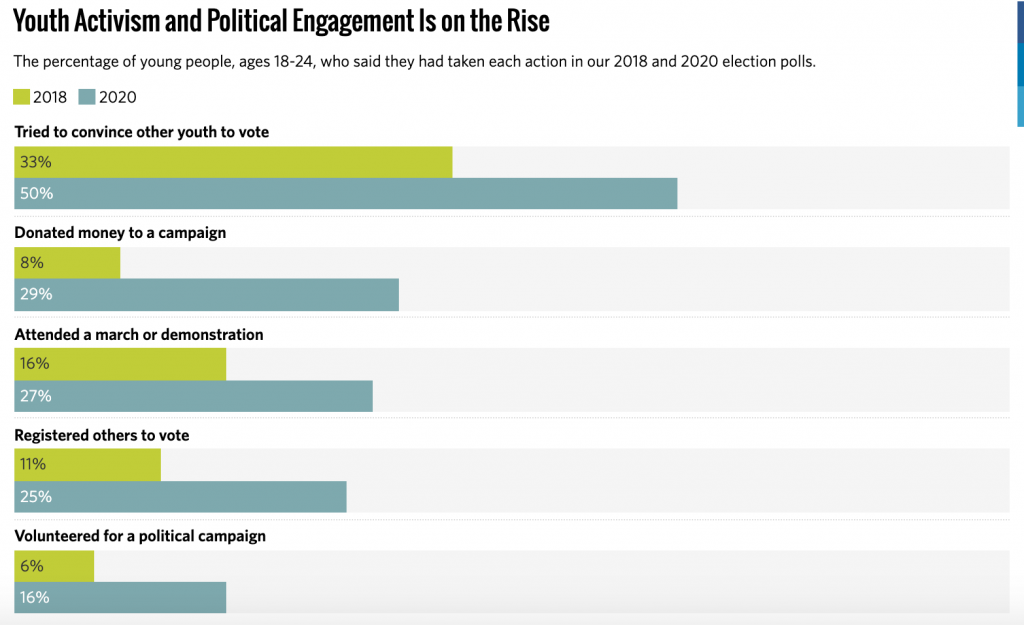
  • 27% of young people (ages 18-24) say they have attended a march or demonstration, a remarkable increase from when we asked the question [of] the same age group before the 2016 and 2018 elections (5% and 16%, respectively).”
  • For all youth, the top issues are environment and climate change (13%), racism (12%) and healthcare (12%). For Black youth, the priorities are racism (22%), policing of communities of color (15%), and healthcare (11%).
  • All measured forms of political engagement are up compared to 2018 (admittedly, not a presidential year). For instance, half say that they have tried to convince someone else to vote–which is a lot of viral marketing for the election.

Much more information is on the CIRCLE page.

Navigating the Pandemic: Inclusiveness, Addressing Bias, and Bridging Differences

This is the video from today’s session of a series for the Tufts Community (but open to the public.) The guests were Eboo Patel from Interfaith Youth Corps, Prof. Keith Maddox (Director of the Tufts University Social Cognition Lab, Prof. Sam Sommers (Director of the Tufts University Diversity and Intergroup Relations Lab) and Jessica Somogie with a meditation exercise. Deborah Donahue-Keegan and I moderated.

beauty worn of promise

Consider these points, made in the last 48 hours by scholars of color:

In the last weeks, there have been unprecedentedly large protests against police violence and systemic racism. The grievances are familiar. … But this time seems different. The costs of protesting are higher, and grievances are more intense, as I’ll explain below. Partly as a result, policymakers appear to be doing more to address protesters’ concerns. …

I find that legislators are 44 percent more likely to vote in favor of black protesters’ demands than white protesters’ demands. They are 39 percent more likely to vote in support of Latino protesters’ demands than white protesters’ demands. Legislators are 32 percent more likely to vote in favor of low-income protesters than more affluent protesters. And they are 10 percent more likely to vote in support of in-person protests, like marches or rallies, versus online protests, like online petitions or social media posts.

[She explains that protest by disadvantaged people is more costly, and costly protests have more political impact.] Legislators’ greater support of costly protest exists even when evaluating protests of equal size, disruptiveness and media attention. …

To be sure, the costliness of the protests is not the only factor in these rapid actions. Black Lives Matter has been shifting public opinion for several years now, and the Floyd protests have dramatically increased that shift, so that a majority of Americans now say they support the protesters’ claims. But given the dangers — the costs — of protesting during a pandemic, massive unemployment, widely circulated stories of brutality, and an election year, officials realize that the grievances are intense — and that black people and their allies are likely to punish officials at the polls if they don’t take action now.

LaGina Gause, “Black people have protested police killings for years. Here’s why officials are finally responding

The change is coming “at a speed that I don’t think we’ve seen before in American politics,” said Dorian Warren, president of Community Change, a nonprofit that works with grassroots groups in low-income communities around the county. …

“You can’t argue with the facts that you’re seeing, or wish them away, or make up an alternative story, because it’s 8 minutes, 46 seconds.”

Moreover, the Floyd video came on the heels of years of organizing by Black Lives Matter activists, as well as movements like the Women’s March and, further back, Occupy Wall Street, Warren said. It also came after the killings of Ahmaud Arbery and Breonna Taylor, young black Americans whose deaths also sparked outrage. Activists have been drawing attention to issues of police violence and race, gender, and class inequality for years, and those issues have only grown more urgent in recent months.

“One way to think about this metaphorically is like an earthquake,” he explained. Organizing by Black Lives Matter and other groups moves slowly, like tectonic plates: “and then all of a sudden they collide.”

Warren is quoted by Anna North in “White Americans are finally talking about racism. Will it translate into action?

The massive, multiracial coalitions that have taken to the streets to raise their voices against police brutality are replenishing springs of solidarity, nourishing the roots of a future social compact that we must now all get on with the business of making. We will do that most effectively with a common purpose in mind.

A common purpose is not some airy-fairy thing. It is a practical tool that allows people to achieve something together. It is a map marked with a destination, a guide that permits collaborative navigation. A common purpose is perhaps the most powerful tool in the democratic tool kit, particularly in a crisis, because it can yield the solidarity that induces people to do hard things voluntarily rather than through authoritarian compulsion. Yet the tool has been disintegrating from disuse.

Our common purpose is liberty and justice for all. We have rediscovered it. It’s time to build on that discovery.

Danielle Allen, “We seek reforms to policing. But something even deeper needs repair

Anger, shame, and fear are appropriate emotions right now, but the emotional palette should be richer than that. And it is richer for many scholars of color (and others) who were already deeply aware of injustice, but for whom the news is the power of the popular response.

History unfolds gradually, painfully, without evident purpose–until suddenly people break it open, allowing a better future to appear like a flash of light. Many such ruptures close again, but some do not. Pessimism (a habit ingrained by ordinary history) blocks the light. An inward turn, even if it is meant to be self-critical, can turn you away from solidarity. To take advantage of an opening, you must be receptive to hope, boldness, and even joy in the opportunity for solidarity and collective purpose.

See also: the kind of sacrifice required in nonviolence; taking satisfaction from politics in the face of injustice; notes on Hannah Arendt’s On Revolution; the prophetic mode in the Civil Rights Movement and in everyday politics; on the phrase: Abolish the police!; Martin Luther King as a philosopher.

a civic silver lining?

Thanks to the Former Members of Congress Association, I joined Former Member Dennis Ross (R-FL) and mayors Nan Whaley (D-Dayton), Francis Suarez (R-Miami) and Marty Walsh (D-Boston), for a discussion of civic engagement during the pandemic.

I particularly appreciated Mayor Walsh’s eloquence about respecting poorly-paid work. His point expanded into a broader discussion of how to get everyone involved in the “public work” of rebuilding our community and country. On that topic, see “War Is a Poor Metaphor for This Pandemic” by Harry Boyte and Trygve Throntveit in Yes!.

I learned a lot from the mayors. I ended up thinking that the attitudinal effects of the pandemic may well be positive. We may care more about each other and feel more motivated to work together on public goals. The fact that the crisis is widely (although inequitably) shared will provide an opportunity to bring Americans together. However, the economic impact on civic life is very worrying.

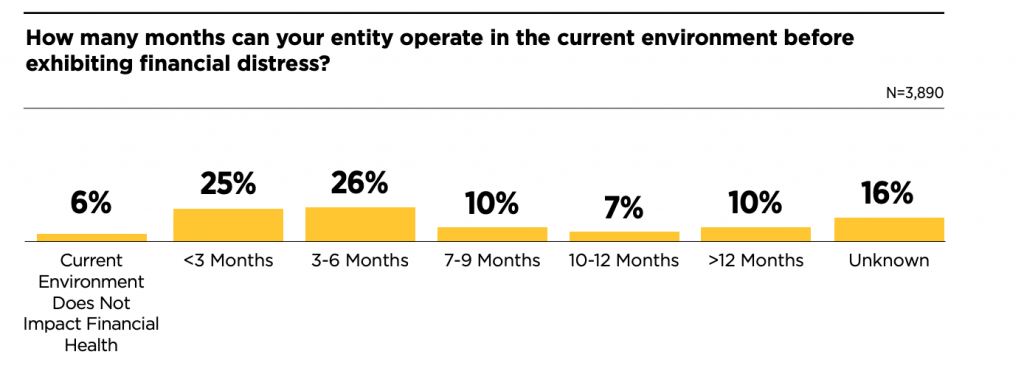
To that last point, the Federal Reserve system recently surveyed a mix of local organizational leaders (two thirds of them from nonprofits) about the impact of the pandemic. “Nearly 2 out of 3 respondents (66%) indicated demand for their services has increased or is anticipated to increase, and more than half of the respondents (55%) noted a corresponding decrease or anticipated decrease in their ability to provide services.”

This chart from the Fed. paper is particularly significant:

See also: the Coronavirus information commons; a Green recovery;Educational Equity During a Pandemic“; trends to watch in civil society; why the relatively good US numbers for COVID-19 mortality?; effects on civil society will be mediated by the economy; and COVID-19 is not a metaphor.

the Coronavirus information commons

In Wired, Natalie Chyi offers an excellent list of ways that people are fighting misinformation–and promoting reliable and useful information–during the pandemic:

Neighborhoods are creating Slack groups and communities are coming up with mutual aid spreadsheets to coordinate aid and support each other. … Local geographies have been reconstructed in online spaces, most notably as students are rebuilding their universities within Minecraft. … . Volunteers on Wikipedia have been working tirelessly to ensure that the site serves reliable and up-to-date information, especially surrounding the virus. Students are compiling master lists of summer internship updates, cancellations, and opportunities across various industries. Groups are creating crowdsourced libraries of resources tailored to the unique needs of everyone from mourners to remote workers to policymakers. New online platforms have been created for specialists like doctors, engineers, and scientists to find and contribute their expertise to ongoing relief projects. Thousands of Covid-19 related open-source projects are popping up, with the source code and documentation freely available to enable their use. Some focus on software, like code for a hospital impact model developed by the University of Pennsylvania; others on hardware, like instructions for 3D printing medically-approved masks and other critical supplies.

Finally, knowledge previously locked behind paywalls or intellectual property protections has been made available to the public for the purposes of fighting the pandemic.

Chyi credits Elinor Ostrom and Charlotte Hess for the idea of an information commons (itself an application of Lin Ostrom’s ideas to the special case of information), and she cites me to the effect that “this form of collective action and participation of place-based knowledge strengthens communities by giving them a shared sense of identity, understanding, and trust.” Incidentally, the whole book by Ostrom and Hess, Understanding Knowledge as a Commons (2007) in which my chapter appears is–fittingly–online and free.

See also my new chapter on Elinor Ostrom and Civic Studies; the legacy of Elinor Ostrom and the Bloomington School; Elinor Ostrom, 1933-2012; understanding knowledge as a commons.