Category Archives: Trump

what activist movements will look like in the Trump era

Dave Karpf has a great piece entitled, “Cyclical patterns in activist politics: what do we know about the politics of opposition”? Karpf argues that opposing a government looks very different from the “politics of articulation” (trying to develop and promote an agenda). These are some key differences:

  1. Opposition unites. As Karpf notes, the Tea Party formed to oppose Obama before he had made any policy decisions. Its original rhetoric–and its very name–implied opposition to tax increases. But Obama mainly cut taxes. That was no problem for the Tea Party, which shifted to opposing the Affordable Care Act. It was nimble about policies because its raison d’etre was opposition to a person, his core values, and the institution he controlled.
  2. Rapid response becomes more valuable. Especially in the age of social media, activist networks are good at getting people out quickly. They are much worse at sustaining pressure, negotiating, and achieving new policies. When your side shares formal power, rapid response is relatively unimportant. But when the main goal is to block policies coming from the other side, rapid response pays.
  3. By the same token, it becomes harder to advance a positive agenda when a movement must spend all its time blocking new initiatives from the government.

I would add two hypotheses:

  1. I think activists on the left will shift from soft, proximate targets to confront their main ideological opponents. The global justice movement of the Clinton era criticized transnational corporations and the governments that supported them, yet it gained attention for protests outside the World Bank, which funds development projects. Occupy Wall Street claimed to target Wall Street, yet it got the most traction in conflicts with Democratic big city mayors and state universities that were simultaneously facing budget cuts from conservative legislatures. The environmental movement focuses on massive destruction caused by fossil fuels but achieved a notable victory by pressuring a Democratic president to block a specific pipeline that could be easily bypassed. The left tends to confront near-allies for showing hypocrisy or weakness, but that impulse fades when explicit opponents take control. (See Bayard Rustin’s absolutely indispensable and totally timely 1965 article “From Protest to Politics” for a similar point.)
  2. Maintaining political discipline will be an enormous challenge. As Rustin reminded his fellow Civil Rights leaders in 1965, the point is to win. That requires mobilizing and inspiring a majority of Americans, not just fellow travelers. National Review’s Jim Geraghty tweeted earlier today, “Anti-Trump protesters are gonna take the bait, aren’t they? They’re gonna burn flags, thinking they’re irking him, but alienating majority.” It’s very hard for any large, loose network to remember what the majority of people value, let alone maintain message-discipline. Whether anti-Trump movements can manage that task is enormously important.

See also: we need SPUD (scale, pluralism, unity, depth)to beat Trump, invest in organizingbuilding grassroots power in and beyond the election; and democracy in the digital age.

pluralist populism

The leaders of ChinaIndia, Russia, Turkey, Venezuela, and Hungary–plus the President Elect of the USA and major political actors in Britain, France, and Austria (among other countries)–are called “populists.” A populist in this sense is one who views The People as homogeneous on important dimensions–for instance, race, culture, occupation, or ancestry–and as distinct from both foreigners and elites. Indeed, foreigners and elites are often seen as collaborating against The People. A populist leader represents The People, speaking for them and serving their interests. Therefore, it is wise to entrust power in the leader, who talks directly to and for each citizen. Majority rule is an attractive process, but majority votes that do not support the populist leader are suspect. Obstacles to populist government–rule of law, checks and balances, an independent press and civic society–are problematic at best.

There is, however, another sense of the word “populist” that deserves attention. In this conception, The People are not only heterogeneous; they are defined by being more pluralistic than the straight-laced elites, who promote one way of life as best for all. Furthermore, The People are not interested in surrendering their power to any leader. Their populist activity is all about building direct, grassroots, horizontal, participatory power. They are proud of their democratic innovations, whether those are letters of correspondence, Grange halls, sit-ins, salt marches, or flashmobs.

Eli Rosenberg, Jennifer Medina, and John Eligon began a recent New York Times article about anti-Trump protests:

They came in the thousands — the children of immigrants, transgender individuals, women and men of all different ages and races — to demonstrate against President-elect Donald J. Trump on Saturday in New York.

Some held handwritten signs like, “Show the world what the popular vote looks like.” The throng chanted, “Not our president!”

Showing the world that the popular vote looks heterogeneous is a traditional populist gambit, familiar from social movements and popular uprisings since time immemorial. It’s a way of demonstrating SPUD (scale, pluralism, unity, depth). I emphasize it because I fear we face three unsatisfactory alternatives:

  1. Trump-style populism, which defines The People as homogeneous, excludes everyone who doesn’t fit, and disempowers the actual people by centralizing political authority in a leader.
  2. Technocratic progressivism, which defers to a highly educated global elite whose norms and range of experiences are actually quite exclusive and narrow.
  3. Thin versions of diversity politics, which celebrate heterogeneity within existing institutions (e.g., racial diversity within a university) but which lack a political vision that can unify broad coalitions in favor of new institutional arrangements.

We need a dose of populism that neither delivers power to a leader nor merely promises fair economic outcomes to citizens as beneficiaries. In this form of populism, diverse people create actual power that they use to change the world together.

See also: two kinds of populism, with some comments on Jan-Werner Müller and Laura Grattan, and why the white working class must organize.

Trump’s rhetorical style and deliberation

Donald Trump’s speaking style is extraordinarily paratactic. That is, he utters declarative sentences without any of the explicit transitional words that can explain why sentences fit together. No “therefore’s,” “on the other hand’s,” or even “well, I think’s.” He just plunges in. Many listeners perceive the content of his various sentences to be logically unrelated. However, he is remarkably repetitive when he speaks at any length, so the unity of his speech derives from his returning to the same phrases. Finally, he uses “I” sentences overwhelmingly, plus “you” when he’s talking to someone in particular. He makes relatively rare use of the third person. We could name his style “paratactic/egocentric.”

I’ve been arguing that the way we organize our thoughts affects our ability to deliberate with others (to listen responsively to what they say). As I note in this video, some people hold such scattered thoughts that you can’t grab onto their argument in order to understand and engage it. Others have such centralized networks of ideas that all you can do is assess their one core principle (which might be individual freedom, equity, or God). If you happen to disagree with it, there’s no way to route around it. A better structure is connected, complex, and not overly centralized.

By this standard, Trump’s rhetoric is disastrous for deliberation. The network formed by his sentences manages to be disconnected except insofar as he repeats a few nodes and connects all his ideas to Donald Trump (which one cannot take as one’s own idea without becoming personally subservient to him).

My notion of what counts as good talk could be biased by class. After all, one of the things you learn as you accumulate years of education and pile on degrees is parataxis: connecting ideas by using explicit transitional words. That is either a sign of superior reasoning or a way for a white-collar elite to identify its own superiority. (Paging doctors Habermas and Bourdieu for a consult on that question.) Likewise, talking in the third person about ideas and institutions is either essential to deliberation or an evasion of personal authenticity. Some read Trump as honest and view more objective speakers as evasive.

I’ve been developing this view of deliberative rhetoric since long before I cared about Donald Trump. It’s in We Are the Ones We Have Been Waiting For, pp. 50-2. I oppose and reject Trump for many reasons other than his rhetorical style. Therefore, I don’t think I’m just criticizing his style to score political points against him. But it’s worth thinking about whether the rhetorical standards suggested by my theory are class-biased.

See also: tracking change in a group that discusses issuesassessing a discussion10 theses about ethics, in network termsstructured moral pluralism (a proposal).

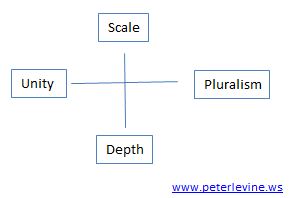
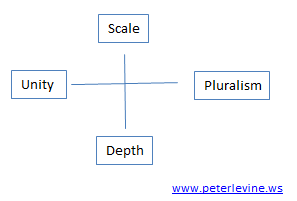
we need SPUD (scale, pluralism, unity, depth)

Whether you’re building a social movement, organization, network, or media platform, you should strive for SPUD:

Scale: You need a lot of people. For instance, if your social movement is anti-Trump, it must include 55% of all voting Americans in 2018 to have a chance of capturing the House. (Note that this is entirely possible. Joshua Spivak cites 1894 and 1994 as “among the two most important midterm elections in American history.” Both “came two years after one party won a seemingly sweeping mandate for power. Both saw historic reversals. And, perhaps more importantly, both completely reshaped the political landscape for decades to come.” Trump’s 2016 victory could be monumentally Pyrrhic–but only if the opposition attains sufficient scale to reverse it).

Pluralism: Your organization, movement, or platform must incorporate a plurality of perspectives. The criterion is not whether it represents the opinions of the American people as a whole. We are entitled to build groups that tilt one way or another; that’s what politics is about. But ideologically homogeneous groups make stupid choices. They also limit their own scale because they forget how many people disagree with their premises. Ideological homogeneity and narrowness are dangers on the left as well as on the right.

Unity: Groups are more effective when they can present a united front. We march together, sing the same anthem, or use the same hashtag to display unity. Standing together compels respect. Groups also need actual unity so that they can develop agendas and coordinate their resources and actions to accomplish their goals. Compromise is an inevitable aspect of politics, but groups that lack unity can’t negotiate effectively when it comes time to compromise.

Depth: Valuable political organizations change their participants. Truly engaged members learn skills and information, gain agency and purpose, develop allies, and (in the best cases) make their own goals more responsible and ethical by participating in groups. Both political outcomes and the quality of our civic life depend on who develops in these ways.

The SPUD values conflict. Groups with larger scale struggle to provide depth: transformative experiences for their members. But groups that really change lives struggle to reach large scale. Even more obviously, pluralism conflicts with unity. Supporters of Hillary Clinton, Bernie Sanders, Black Lives Matter, and #NeverTrump disagree about fundamental matters right now, and that is causing a lot of angst. A cheap consensus would reduce pluralism, but deep and continuous disagreements will block unity.

spud

Despite these tradeoffs and tensions, groups and movements achieve more or less SPUD. There is such a thing as populist pluralism the treats the people as highly diverse and yet united in the common interest. This is an essential antidote to Trumpian populism, which depicts the people as homogeneous and represented by a single leader. It takes work to grow large and go deep, to encourage pluralism and build unity. It would sound utopian except that it’s exactly what our best organizations and movements accomplish. And it suggests a diagnostic checklist for any group, institution, or network you’re part of. How are you doing on each dimension of SPUD?

For these distinctions, see also: Peter Levine, “Democracy in the Digital Age,” The Civic Media Reader, edited by Eric Gordon and Paul Mihailidis (Cambridge, MA: MIT Press, 2016), pp. 29-47; and Peter Levine and Eric Liu, “America’s Civic Renewal Movement: The View from Organizational Leaders” (Medford, MA: Jonathan M. Tisch College of Citizenship & Public Service, 2015).

to beat Trump, invest in organizing

To respond to Trump’s election, we must address who is organized, and how.

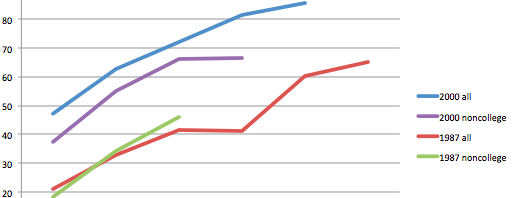
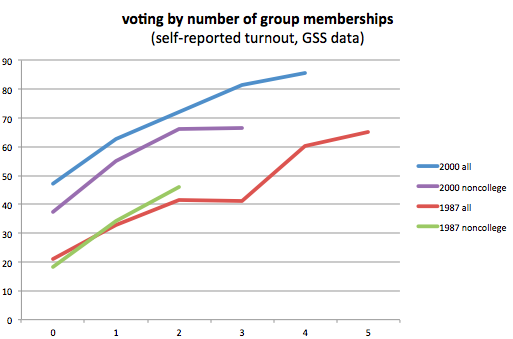
Members of organizations are more likely to vote and to take the more costly actions that will be vital during the Trump years, such as protest and resistance. As a quick-and-dirty illustration, consider the correlation between the number of groups that people belong to and the proportion who say they vote.*
screen-shot-2016-11-13-at-10-00-25-am

This graph combines all kinds of groups. When people belong to organizations that offer them voice and accountability, that address social or political issues, and that encompass at least some diversity, they are not only more likely to vote; they are also more likely to act and choose responsibly. Members of such groups learn to negotiate, to set appropriate expectations for their leaders, and to feel ownership for results.

Before the election, I proposed that Trump mainly appealed to people who lacked accountable organizations, and that’s one reason that they opted for a totally irresponsible (as well as a cruel) celebrity candidate. They behaved as alienated spectators rather than as political agents. I also expected turnout to be relatively weak among people leaning toward Trump.

Theda Skocpol finds that the rural and exurban areas where Trump performed best did have “organized networks – NRA, Christian Right, some RNC and Koch network/AFP presence – that amplified the right media attacks on HRC nonstop and persuaded many non-college women and some college women in those areas to go for Trump because of the Supreme Court.” Skocpol acknowledges that Trump himself “had no organization,” but, she says, he “made deals to get the NRA, Christian right and GOP federated operations on his side. They have real, extensive reach into nonmetro areas.” I’ve also estimated, based on Exit Poll data, that 56% of Trump voters attend church at least monthly. His turnout wasn’t great, but it was sufficient to win the Electoral College.

I was wrong in part. Trump did well because of the traditional mechanism: outreach by groups. However, I would still propose that the groups that reached Trump voters were unaccountable to them. The Koch Network, for instance, is centralized, fueled by two brothers’ money, and undemocratic and opaque in its internal organization. The relationship between such an organization and its target population is transactional and instrumental: it spends money to persuade them to vote. That is consistent with my view that Trump’s voters aren’t authentically organized. Being mobilized is not the same thing.

Meanwhile, Skocpol is definitely right about the other side:

HRC had the typical well-funded presidential-moment machine, an excellent one. We on the center left seem to treat these presidential machines as organization[s], and they are, but they are not as effective as longstanding natural organized networks. … [Off] the coasts, Democrats no longer have such reach beyond what a presidential campaign does on its own. Public sector and private sector unions have been decimated. And most of the rest of the Democratic-aligned infrastructure is metro based and focused. That infrastructure is also fragmented into hundreds of little issue and identity organizations run by professionals. HRC’s narrow loss was grounded in this absent non-metro infrastructure – and Dem Party losses in elections overall even more so.

In areas where progressive voters predominate, we need a much more authentic, democratic, and integrated base of organizations. Instead of parachuting presidential machines into diverse urban areas every four years in search of votes, the left must invest in younger and more diverse local leaders who have real authority and voice and who can work continuously. American democracy has always functioned best when organizations offer a range of goods, of which political power is just one. For instance, churches offer spirituality; unions raise salaries. Their members ultimately vote, but that’s not the main service these organizations advertise. Right now, resources should flow to multipurpose organizations and movements that will turn out voters in 2018 and 2012, but that will do much before then–starting with protecting safety and civil rights against both hateful individuals and government agencies.

The decline in votes in Wayne County (Detroit) between 2012 and 2016 (37,364) will almost certainly be larger than the final margin of victory for Michigan. Milwaukee saw a 41,000-vote decline that was bigger than the state’s margin. I suspect that scarce investment in organizing was as important in Wisconsin as voter-suppression. These statistics should ring loud alarms, if they haven’t already. How many young African American and Arab American organizers can count on paid activist jobs in Detroit in 2017 and 2018?

Meanwhile, we also need organizations in red states and red counties, in rural areas and exurbs. The point of organizing there is not to show empathy to Trump voters or to honor their concerns. The point is to win. Particularly in 2018, anti-Trump votes will be very poorly distributed–far too concentrated in the great cities to win the House and Senate back. Every extra vote in a white non-urban county will matter, and that requires organizations to change minds, to empower the disenfranchised, and to offer real benefits. By the way, although I think the Democratic Party is a necessary component of the opposition, it is not sufficient. Electing or reelecting responsible and caring Republicans in red districts is also essential.

In our October poll of Millennials, we found that just 30% of Clinton supporters had been contacted by a campaign or organization that had urged them to vote; 28% of young Trump supporters had been contacted; and 70% had not been contacted at all.  Young people who had received multiple contacts were 19 points more likely to say they’d vote than those who’d received none. That poll was a warning that young Americans across the spectrum were not being reached by organizations. Young Trump voters were almost as likely to receive outreach as Clinton voters were: another indictment of the left’s investments. The time to change this is now.

*I’m showing General Social Survey data from 1987 about whether people “always vote” and from 2000 about whether they voted in the last presidential election. Unfortunately, I can’t find more recent comparable data, but I hope the graph illustrates an important pattern. Note that the correlation applies to people who have no college experience (the working class) as well as the population as a whole.