Category Archives: Trump

a plea to conservatives

The new president derides almost everything you claim to defend. You say you are for limited government and the rule of law over men; he denies all limitations. You say you are patriots; he praises a foreign kleptocrat while abusing his domestic critics and public servants. You speak of an independent free market; he intervenes daily with threats and blandishments. You remind us of the importance of norms and moral constraints, grounded in traditions. He seeks public attention by violating interpersonal, institutional, even sexual norms. You honor faith; he demonstrates ignorance of his own religion and contempt for others. You stand for cultural excellence and depth–he is a shallow vulgarian.

It will be tempting, nevertheless, to embrace this man because he aligns with you on certain matters that you are entitled to hold dear: taxes, Supreme Court nominations. Besides, liberals and progressives with whom you have a long and bitter feud hate him, and that inclines you to sympathy. His critics sometimes go beyond principled judgment to demonstrate bias against him. That makes you want to take his side. Your fellow travelers who have never struggled to understand or honor the hard principles of your movement–opportunistic politicians and performers who don’t know Hamilton from Madison or Burke from Hayek–are already jumping aboard. They have cast their lots and sold themselves that they might drink.

Liberalism will be fine. Liberals will lose favored policies, and as a result people will suffer, even die. But as a movement, liberalism will emerge unscathed, indeed, more unified, determined, and popular. It is conservatism that it’s at risk. And that is a problem for the country, which needs a conservative counterweight.

If you don’t stand explicitly against him, he will define what you stand for. Conservatism will mean Trumpism for generations to come. If you are very lucky, his administration will perform well enough that you will survive to continue your battle with the left and center-left. But if he leads the nation into a crisis or ruin, you will own that, too. And deservedly, because his mistakes will flow from his arrogant abuse of state power, which you, as champions of limited government, should have blocked.

“For the day of the Lord is near in the valley of decision” (Joel 3:14). Even in a century or more, it will be remembered where you chose to stand. Blow ye the trumpet, sound the alarm.

the hollowing out of US democracy

How could a celebrity with no governing experience and no grassroots infrastructure alienate and offend an outright majority of Americans, adopt positions far from the mainstream, and yet become our president?* I argue that the underlying reason is a hollowed-out democracy in which many citizens no longer expect to be represented by accountable organizations and are no longer invited to share in governing. A celebrity who offers symbolic politics has the number of followers and the level of attention that professional politicians strive to buy with their cash. In an environment of isolated citizens, he wins.

We still have plenty of voluntary associations and networks concerned with politics. But politics is a minority taste, so these groups draw a small proportion of the population. And because most of them attract members by offering a political message or agenda, they produce ideologically homogeneous groups.

We also still have very large numbers of professional advocacy organizations, but many of them are accountable to donors rather than members, and their capacity and vision come from their highly-skilled professional staff, not from citizens.

We also have some large movements that look accountable but aren’t. The Koch Brothers network, for example, employs 1,200 full-time, year-round staffers in 107 offices nationwide, more than the Republican Party. The Koch Brothers own it.

What we lack now are the kinds of organizations that I believe have been core to US civil society since the era of de Tocqueville. They offer benefits other than politics to attract members. They draw a range of people–not representative samples of the US population, but diverse groups. They give their members reasons to think politically and aggregate their political power. They create pathways to political leadership for those who become most interested. And they depend on their members’ support for survival.

In short, they offer what I’d call SPUD–Scale, Pluralism, Unity, Depth–which is the magic recipe for civic engagement.

Four traditional types of organizations that offered SPUD were unions, political parties dependent on local voluntary labor, religious congregations, and metropolitan daily newspapers. All four were imperfect, but each was much better than nothing. And they are all in bad shape today.

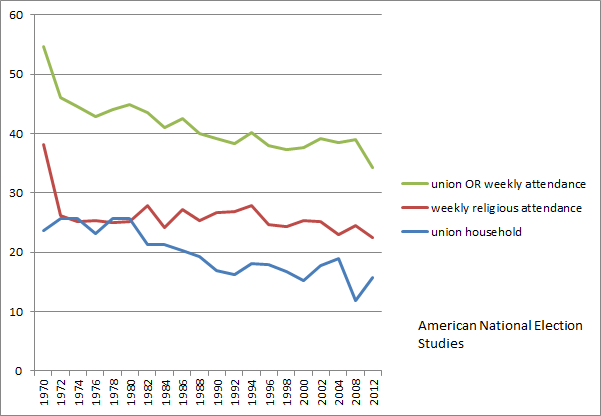
I’ve previously shown that newspapers have lost readership precipitously and parties have become loose networks of entrepreneurial politicians and donors instead of actual organizations. Unions and religious congregations have also shrunk. To illustrate those two trends, here is a new graph that shows the rates of union membership and weekly religious attendance. The top line is the proportion of adult Americans who either attend weekly services or belong to a union, or both. That proportion has dropped by twenty points, from a majority of 54.6 percent in 1970 to a minority of 34.3 percent in 2012. (By the way, I am skeptical that union membership really rose in 2012; I suspect that’s random noise.) I would look no further than this 20-point drop for the underlying conditions that yielded The Donald.

*The echo of Hamilton was inadvertent but seemed apt once I noticed it.

why the global turn to authoritarian ethnonationalism?

It seems impossible to explain why Donald Trump won the 2016 election. For one thing, he lost the popular vote. Besides, a single election is an “n” of one with numerous contingent circumstances, in this case including the FBI’s last-minute intervention, Hillary Clinton’s gender, and the behavior of cable news. We often think of a cause as something that would yield a different result if it were changed. In this case, changing any of a dozen or more factors might have put Clinton in the White House.

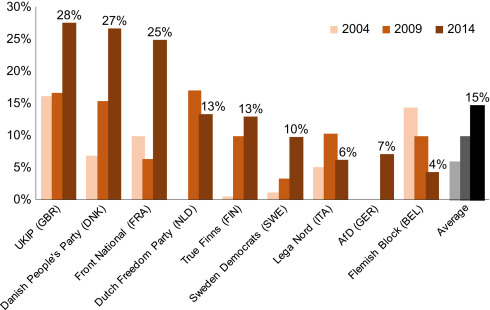
More valuable is to consider why authoritarian, illiberal nationalists either dominate or (like Trump) have narrowly missed winning majorities in many countries: at least in Austria, China, Hungary, India, Israel, the Philippines, Poland, Russia, South Africa, Turkey, and the United States–with England and France also looking at risk. Across the 34 OECD countries, true right-wing parties still capture only about 8 percent of total popular support, but that’s steadily up from five percent in the 1970s. This graph from Funke, Moritz & Schularick shows the recent shift in nine major European nations.

Vote Share for the Far Right Since 2004

At the global level, the “n” is much greater than one, and we can rule out certain explanations for the trends. For instance, in other counties, an authoritarian leader hasn’t replaced a person of color or defeated a female opponent.

I cannot estimate the relative impact of the following factors, but they seem plausible to me across the whole range of cases:

Oligarchy: Many of the authoritarian leaders are billionaires or closely associated with billionaires. Their supporters are personally wealthy individuals rather than multinational public companies, which are more comfortable with predictable centrists like Hillary Clinton. A billionaire can know political leaders personally, can trade wealth for influence, and can profit from disruptions in the larger economy. Several of the key billionaires are media personalities. I think some of them develop authoritarian expectations by being the barons of large private enterprises, within which their word is law. Billionaires have almost tripled their share of global GDP since 1996, and their inflation-adjusted total assets have risen by 7.5% annually over those two decades. They represent a global force that was absent in 1996.

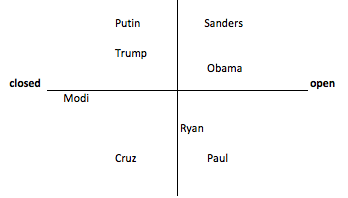
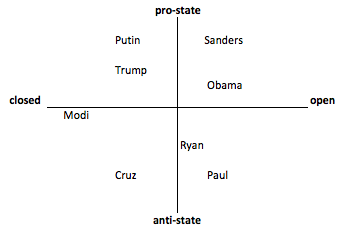
A gap in the ideological landscape: For this purpose, let’s categorize ideologies along two dimensions. They are either pro-state or anti-state/pro-market. And they either favor a narrowly defined ethnocultural group or they support diversity and globalism. I’ll call the latter spectrum closed versus open.

Since the 1950s, the dominant parties and movements in the wealthy democracies were all fairly open, at least in principle; the debate was about how much the state should intervene. We often thought of the US ideological spectrum as one-dimensional, from pro-state to pro-market, with everyone giving lip-service to openness. Some conservatives claimed to be pro-market and nationalist, but it’s not clear that that was a coherent position. The whole structure ignored the possibility of a pro-state, explicitly closed position. Like entrepreneurs who have discovered a market niche, authoritarian nationalists have filled the corner previously occupied by fascism. To be sure, Trump may govern like a market libertarian if he turns things over to Paul Ryan and contents himself with symbolic nationalism, but that’s not what he promised to do.

You would think that nationalist authoritarians wouldn’t cooperate much across international borders, because they are xenophobic. But there was a short-lived Fascist International in the 1930s, and we definitely see some coordination today.

Al Qaeda/ISIS: Before explaining why I think these terrorist organizations share causal responsibility for the global turn to authoritarianism, I want to stipulate that we are morally responsible for how we have responded to them. We did not have to invade Iraq, pass the Patriot Act, or turn Guantanamo into a prison. Those stupid and harmful acts are our responsibility as American citizens. Still, it seems both naive and misleading to omit the intentional acts of Al Qaeda and ISIS from our causal theory. They sought to provoke antidemocratic reactions, and they succeeded. An admired friend of mine recently summarized her qualitative research with Muslim teenagers in suburban New Jersey over the past decade, explaining that they have moved from a comfortable feeling of being Americans to a sense of vulnerability and alienation. This is an injustice that is up to remedy. But it struck me as a mistake not even to mention Al Qaeda as a major cause of the change. Osama bin Laden got what he wanted when he sent those planes into the Trade Towers. Although the US leadership of 2001 (including H. Clinton) proved monumentally stupid, Al Qaeda found a vulnerability that would have been hard to defend.

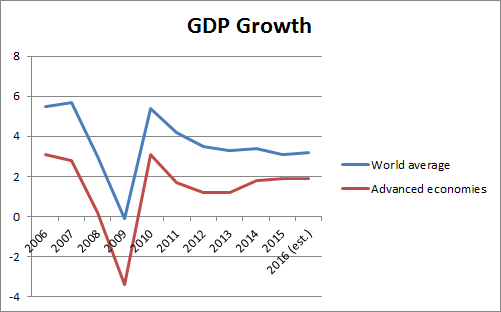
The 2007-8 financial crisis: Funke, Moritz & Schularick show pretty compellingly that voters shift to the far right after financial crises. This has been a pattern across many nations for at least a century. The 2007-8 collapse was an especially terrible one. It hit the advanced economies particularly hard, thus giving their voters a sense that they were losing comparative advantage as well as absolute wealth. It was followed by fiscal austerity that punished ordinary people, while no elites were held accountable for the trillions of dollars of waste and disruption. My sense is that Barack Obama got a pass from a majority of Americans because he wasn’t responsible at the time of the crisis, and he has been seen as laboring to repair the damage. But Hillary Clinton was part of the governing elite that was on duty when the fateful decisions were made.

Cultural backlash: Pippa Norris proposes that cultural liberalization (marriage equality, improving sexual equality, growing racial diversity, etc.). have produced a backlash rooted in the White working class of OECD countries. She clearly favors the trend of cultural liberalization and abhors the backlash, but a different take is Nancy Fraser‘s: people are rightly rejecting a form of “progressive neoliberalism” that unites “new social movements (feminism, anti-racism, multiculturalism, and LGBTQ rights)” with the cultural agendas of “high-end ‘symbolic’ and service-based business sectors (Wall Street, Silicon Valley, and Hollywood).” That is the coalition that delivers diversity in schools and workplaces along with “the weakening of unions, the decline of real wages, the increasing precarity of work, and the rise of the two–earner family in place of the defunct family wage.”

A hollowing out of democracy: People have died or placed themselves in terrible danger in the name of democracy and liberal values, whether on Omaha Beach or the Edmund Pettus Bridge. But an inspiring vision of democracy means more than the right to choose among professional politicians every few years. Even a call for equality isn’t inspiring enough, because how much should each of us care whether our share of power is as great as everyone else’s? Democracy must mean working together to create a better world.

Instead, the US rightwing has abandoned the sometimes inspiring pro-democratic rhetoric of Ronald Reagan to claim that we are not a democracy at all, but a republic. Similar rhetorical shifts away from democracy are evident in other countries as well. Meanwhile, the technocratic center presents democracy as a system of regular elections along with transparent information. Even defenders of the EU admit that it demonstrates a severe “democracy deficit.” Democratically governed associations, such as unions and congregationalist churches, are in decline. And several strands of the left are reflexively critical of any pro-democratic project that emerges in the US or elsewhere in the wealthy global North. People seem increasingly sophisticated about democracy’s drawbacks (misinformation, majority tyranny, cultural bias, etc.) and decreasingly inspired by its promise. That leaves the field open for explicitly illiberal and antidemocratic movements.

the bright side of one-party government: accountability

Here’s an excerpt of Sarah Kliff’s interview with Debbie Mills, a Trump voter:

Are you surprised how much Republicans are talking about repeal [of Obamacare]?

No.

Did you expect do you think they’ll do it, or do you think it’ll be too hard?

I’m hoping that they don’t, ’cause, I mean, what would they do then? Would this go away?

Yes, possibly.

The insurance?

It will go, if they repeal it. I mean, that’s what they promised to do in so many elections.

Right … so … I don’t know. … [snip]

Our interview began to make her a bit nervous.

You’re scaring me now on the insurance part … I’m afraid now that the insurance is going to go away and we’re going to be up a creek.

How could this happen? Why would vulnerable people vote against their own essential interests when they are aware of the stakes and have no altruistic or principled objections to the policy that’s at risk?

Kliff proposes that it was reasonable to doubt that Obamacare really would be repealed, since many political experts also predicted that it would become untouchable, like Social Security. Even to this day, there is a chance that Republicans will leave it alone. But, if we assume that Debbie Mills should have voted for Clinton over Trump to preserve Obamacare, then here are two familiar explanations for her choice:

  1. Trust. Nobody really knows that political leaders will do in the future. Nobody even knows what any given policy will accomplish. We all rely on information, interpretation, predictions, and promises from sources that we trust. I think many Trump voters did not trust Trump to do anything specific that he said, but they did trust his general competence and alignment with their interests. Meanwhile, they distrusted Clinton’s motivations. I believe they were wrong in these judgments, but the difference is not my superior rationality. Rather, we made different assessments of trustworthiness.
  2. Salience: Joseph Schumpeter observed in 1942 that “the typical citizen drops down to a lower level of mental performance as soon as he enters the political field. He argues and analyzes in a way which he would readily recognize as infantile within the sphere of his real interests. He becomes a primitive again. His thinking becomes associative and affective.” This was true, Schumpeter said, of “educated people and of people who are successfully active in non-political walks of life.” The reason was basically that each vote hardly counted, so it was irrational to spend a lot of time sorting through the “masses of information” that were already available in 1942–not to mention the vast masses today–to make careful judgments. In the absence of “immediate responsibility, ignorance will persist.” And voting, although a responsibility, is too small to compel much attention. Schumpeter originated this way of thinking about politics, but much subsequent psychological research has reinforced it.

I would add a third explanation, and this one is significant because it is likely to change.

  1. Divided government. For 28 of the past 36 years, the elected branches of the federal government have been divided between Democrats and Republicans. Even during the remaining eight years (two each under Clinton and Obama and four under G.W. Bush), Senate filibusters, opposing state governments, and courts have checked the majority’s power. This is one reason that net government spending–federal plus state plus local–rose by nearly 50% under a conservative-sounding president (Bush) and leveled off under under a liberal-sounding president (Obama). As long as the ideology of our most prominent leader is largely unrelated to the actual policies in place, voters get poor feedback from their choices at the ballot box. That makes them unlikely to learn.

I am not saying that it’s a Good Thing that we now face unified Republican government in most of the country. Mills will probably lose her health insurance, which could shorten or wreck her life. Many others will pay a severe price as well. It’s relatively easy for me to see the bright side, since I am not nearly as vulnerable.

But there is a bright side. If you believe in electoral democracy at all, you must acknowledge that voters will make mistakes severe enough to cost lives. The argument for electoral democracy is that voters will learn from such mistakes. But we have frustrated such learning for more than a generation. The political system has performed very poorly at times–killing half a million Iraqis, incarcerating 2 million Americans, allowing our industrial cities to whither wither away–but few citizens have had to rethink their prior assumptions about which ideology is better for them. The signal has been lost in the noise.

The signal is now about to be heard pretty clearly. Democrats and other progressives should amplify it by constantly drawing connections between the reigning ideology and its outcomes, and by refusing to mitigate the short-term damage. Then Trump’s 2016 victory will be Pyrrhic.

separating populism from anti-intellectualism

I’m a populist, yet I advocate the life of the mind. I’d like to see less elitism (of certain kinds) along with more intense and widespread intellectual inquiry. Unfortunately, the most prominent varieties of populism today are anti-intellectual. This is a problem rooted in social structures. Some of the solutions involve changing the way formal educational institutions work. Others involve enhancing intellectual life in informal contexts.

Let’s define “anti-intellectualism” as a rejection of advanced, specialized, complicated thought, which is viewed as antithetical to common sense. According to Mark Fisher (The Washington Post 7/17), Donald Trump is an explicit anti-intellectual:

He said in a series of interviews that he does not need to read extensively because he reaches the right decisions “with very little knowledge other than the knowledge I [already] had, plus the words ‘common sense,’ because I have a lot of common sense and I have a lot of business ability.” Trump said he is skeptical of experts because “they can’t see the forest for the trees.” He believes that when he makes decisions, people see that he instinctively knows the right thing to do: “A lot of people said, ‘Man, he was more accurate than guys who have studied it all the time.'” … Trump said reading long documents is a waste of time because he absorbs the gist of an issue very quickly. “I’m a very efficient guy,” he said. “Now, I could also do it verbally, which is fine. I’d always rather have — I want it short. There’s no reason to do hundreds of pages because I know exactly what it is.”

Presumably, Trump’s anti-intellectualism was more of a political asset than a liability in the campaign, and that tells us something about our culture. (On the other hand, one of the most curious and thoughtful political leaders in modern America–and a very fine writer–won the two previous presidential elections, so politics is not a vast wasteland.)

Let’s define “anti-elitism” as a rejection of the superior position, entitlement, and power of some privileged group. This is different from anti-intellectualism because an elite needn’t be defined by knowledge or expertise: the business class, for instance, usually is not. However, the two ideas often come together, not only in Trump’s rhetoric but in many other examples from American history. For instance, in Anti-Intellectualism in American Life (1963), Richard Hofstadter wrote:

The kind of anti-intellectualism expressed in official circles during the 1950’s was mainly the traditional businessman’s suspicion of experts working in any area outside his control, whether in scientific laboratories, universities, or diplomatic corps. Far more acute and sweeping was the hostility to intellectuals expressed on the far-right wing, a categorical folkish dislike of the educated classes and of any thing respectable, established, pedigreed, or cultivated. The right-wing crusade of the 1950’s was full of heated rhetoric about “Harvard professors, twisted-thinking intellectuals … in the State Department; those who are “burdened with Phi Beta Kappa keys and academic honors” but not “equally loaded with honesty and common sense”; “the American respectables, the socially pedigreed, the culturally acceptable, the certified gentlemen and scholars of the day, dripping with college degrees .. . the “best people” who were for Alger Hiss”; “the pompous diplomat in striped pants with phony British accent”; those who try to fight Communism “with kid gloves in perfumed drawing rooms “; Easterners who “insult the people of the great Midwest and West, the heart of America; those who can “trace their ancestry back to the eighteenth century or even further” but whose loyalty is still not above suspicion; those who understand “the Groton vocabulary of the Hiss-Achcson group.”

The businessmen who distrusted independent intellectuals represented one elite quarreling with a different one–Wall Street and Detroit struggled for influence with the Ivy League and the State Department. But the “far right-wing” rejected elites that they defined in terms of social privilege rather than intellectualism. For these people, the problem with Groton School alumni was not their sophisticated ways of thought but their social pedigree and arrogance. These right populists were against Wall Street and Harvard. Although Hafstadter is writing here about the right wing, some left populists share the same targets.

I think anti-elitism and anti-intellectualism come together because educational institutions serve two functions simultaneously.

On one hand, schools and colleges are spaces for intellectual inquiry. They are the most prominent and best supported places where people address unanswered questions of public importance, conduct deep and sustained conversations about unresolved topics, and model and teach the skills and values required for those pursuits.

At the same time, schools and colleges confer social status. A college degree is a prerequisite for occupying many of the advantaged slots in our social order. Educational institutions at all levels teach not only intellectual skills, but also manners, modes of social interaction, and ways of writing and speaking that mark out the advantaged class. And despite their protestations that they admit students fairly, they are dominated by children of privileged groups. For reasons that I’ve explored in some length, I don’t think this situation is likely to change markedly.

To make matters even more fraught, the genuine search for knowledge can be conducted arrogantly or else responsively. One can pursue the truth by studying other people and their problems in order to change those people (for good or ill), or one can listen and create knowledge together. Finally, claims to advanced knowledge can be trustworthy or not. After all, highly credentialed experts are the ones who told us to blast highways through inner cities, minimize fat consumption, and invade Iraq.

I think several trends worsen the conflation of populism with anti-intellectualism today.

First, although advanced intellectual inquiry occurs in some spaces that aren’t educational institutions–community organizing groups, online magazines, some religious communities, and hip hop–the state of “informal” intellectual life does not seem to be strong today compared to the past. Most of the people who can spend a lot of their time reading, writing, and talking about complex issues work as teachers or professors.

Second, tools for data collection, analysis, and influence are giving frightening amounts of power to people who possess and deploy information.

Third, in a post-industrial economy, the workforce is increasingly divided between people who work with their hands in low-status roles, and others who work with symbols and data. The former understandably wonder why they must pay for the latter, whether directly or via taxation. University of Wisconsin professor Kathy Cramer describes how she would visit small towns in her state and introduce herself “as a public opinion scholar from the state’s flagship university.” When she asked citizens what concerned them most, they often “expressed a deeply felt sense of not getting their ‘fair share’ …. They felt that they didn’t get a reasonable proportion of decision-making power, believing that the key decisions were made in the major metro areas of Madison [where Kathy works] and Milwaukee, then decreed out to the rest of the state, with little listening being done to people like them.” It became clear to Cramer that when they complained about people who didn’t work hard enough, they were “talking about the laziness of desk-job white professionals like me.” Why did their tax dollars have to pay for someone to drive around the state asking people political questions so she could write her books?

Finally, today seems like a time of growing deference to high-status people. As I wrote last fall:

We live at a time when billionaires, celebrities, and CEOs are given extraordinary deference, especially in comparison to run-of-the-mill elected officials, civil servants, union leaders, and grassroots organizers. Politicians, for instance, are constantly in contact with their wealthiest constituents. First-year Democratic Members of the House are advised to spend four hours per day of every day calling donors. Meanwhile, many advocacy groups are funded by rich individuals, not sustained by membership dues, so their leaders are also constantly on the phone or at conferences and meetings with wealthy people.

One solution is to identify, strengthen, and lift up informal spaces where people who haven’t attended college–at least, not recently–engage in intense intellectual work. When I interviewed the great community organizer Ernesto Cortés, Jr. (Industrial Areas Foundation (IAF) co-chair and executive director of the West / Southwest IAF regional network), he told me this was his organization’s strategy:

Building talented, committed, enterprising relational organizers through recruitment, training, and mentoring. We develop their capacity to be reciprocal, relational organizers. Ask–what do Aristotle and Aquinas say? Explore the different traditions. Offer all kinds of seminars with a wide range of scholars from left, right, center. Develop their intellectual capacity, which is the capacity to be deliberative. Help them to understand labor, capitalism, the various faith traditions, strategic thinking. We offer what amount to postgraduate-level seminars in how to create effective leaders in an institutional context–not lone celebrity activists–people who build institutions that can then be networked together. …

Another example is the impressive array of liberal arts programs now being taught in prisons on a pro bono basis by professors. For instance, the Jessup Correctional Institution Scholars Program explains:

Our Program is dedicated to a simple concept: no one in society should be deprived of access to ideas. This has led all of us, through different paths, to seek opportunities to teach and learn outside the walls of the academy, built to keep people out on the basis of their social standing and financial means. And it has ultimately led us to bring intellectual discussion inside the walls of the prison, a space that too many people consider radically separate from society. We see society as a whole riddled with locked doors and those of the prison are just one more set that we hope to open.

Everyone in the program is a scholar, and we think of ourselves as on equal moral and intellectual footing – we strive to create course content as a collaboration between teachers and students, and to make classes free-ranging discussions and workshops more than lectures.

Another solution is to do the intellectual work of the university in ways that better engage laypeople. Guided in part by Albert Dzur, I argue that the way to accomplish this is not to teach graduate students and PhD researchers to be more modest and humble. That message never sticks with an ambitious group, and it’s not really the ideal, anyway. We actually need more courageous and enterprising research. Instead, we can recognize that engaging members of the public in creating and using knowledge requires highly advanced skills–it’s a form of democratic professionalism. We should teach, evaluate, and reward excellent democratic professionalism in the academy.

A third solution is for the academy to take more responsibility–at the institutional level–for communicating research and intellectual life. It used to make some sense to assume that academics conducted research and professional reporters selected and translated the most relevant findings for their readers or listeners via mass media. If that model ever worked, it doesn’t work now that 30% fewer people are employed as professional reporters. Just as institutions of higher education created public broadcasting, so they must now launch new forms of communication.

None of these three strategies will solve the underlying problem completely. The social underpinnings are problematic and require reform. Meanwhile, there are tempting political payoffs for politicians who demonize intellectual life. But these are three ways of fighting back.