Category Archives: Trump

new research on “civic deserts”

(Washington, DC) My colleagues Kei Kawashima-Ginsberg and Felicia Sullivan coined the phrase “civic deserts” to name places where there are few or no opportunities to be active and constructive participants in civic life. The analogy is to “food deserts”–geographical communities where there is little or no nutritious food for sale. You can still be an active citizen in a civic desert, just as you can grow vegetables in your back yard; it’s just that the whole burden falls on you.

Today at the National Conference on Citizenship, we are releasing Civic Deserts: America’s Civic Health Challenge by Matthew N. Atwell, John Bridgeland, and me. It’s a 36-page report that documents the declining opportunities for civic engagement in America. John Bridgeland and Robert Putnam also write about it today in a PBS opinion piece.

This is an example of a table from the report:
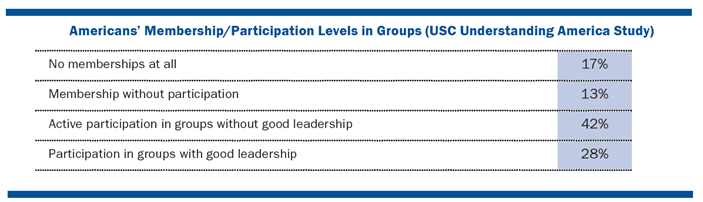
Thanks to friends at USC’s Center for Economic and Social Research, we were able to ask a  large, representative sample of Americans whether they belonged to various kinds of groups; if so, whether they participated actively in any of them; and if so, whether they thought that the group’s leaders (a) usually did what they promised and (b) usually tried to serve and include all the members. It turns out that only 28% of adult Americans actively belong to groups whose leaders are accountable and inclusive. That statistic does not tell us how much geographical space is taken up by civic deserts, but it suggests that they are common. And the historical data implies that civic engagement used to be much more widespread.

I separately formed a hypothesis that lacking direct, personal experience with good leadership would make a person more tolerant of the leadership style of Donald J. Trump, controlling for one’s political ideology. In other words, given two people who agree with Trump on issues, the one without experience of good local leadership would be more supportive of Trump as a leader. This was testable with the USC data, which includes a whole battery of questions about ideology, issues, and Trump. My hypothesis turned out not to be true: partisanship and media choice seem to explain opinions of the current president almost completely, and experience in groups adds no explanatory power. Still, I think there may be a more circuitous story about civic deserts as a cause of Trump’s victory: the decline of civic associations increases the power of partisan heuristics and ideological media. Even if that hypothesis is also false, civic deserts are still a problem, because civic engagement benefits health, economic development, safety, education, and good government.

See also: The Hollowing Out of US Democracy (my blog post for USC); Mitigating the Negative Consequences of Living in Civic Deserts – What Digital Media Can (and have yet to) Do (a new CIRCLE article); America needs big ideas to heal our divides. Here are three by Bridgeland and Putnam; and the power of the NRA in an age of civic deserts.
Arendt, freedom, Trump

This passage, from a previously unpublished 1966 or 1967 lecture by Hannah Arendt, is a rich text for the week of Independence Day while Donald Trump is president:

The first elements of a political philosophy corresponding to this notion of public freedom are spelled out in John Adams’s writings. His point of departure is the observation that “Wherever men, women, or children are to be found, whether they be old or young, rich or poor, high or low . . . ignorant or learned, every individual is seen to be strongly actuated by a desire to be seen, heard, talked of, approved and respected by the people about him and within his knowledge.” The virtue of this “desire” Adams saw in “the desire to excel another,” and its vice he called “ambition,” which “aims at power as a means of distinction.” And these two indeed are among the chief virtues and vices of political man. For the will to power as such, regardless of any passion for distinction (in which power is not a means but an end), is characteristic of the tyrant and is no longer even a political vice. It is rather the quality that tends to destroy all political life, its vices no less than its virtues. It is precisely because the tyrant has no desire to excel and lacks all passion for distinction that he finds it so pleasant to dominate, thereby excluding himself from the company of others; conversely, it is the desire to excel which makes men love the company of their peers and spurs them on into the public realm. This public freedom is a tangible worldly reality, created by men to enjoy together in public—to be seen, heard, known, and remembered by others. And this kind of freedom demands equality, it is possible only amongst peers. Institutionally speaking, it is possible only in a republic, which knows no subjects.

Note, first of all, that Arendt, like John Adams, views “the desire to excel another” in public life as a virtue. She could be thinking pragmatically: by encouraging people to excel in debates, we motivate them to enter public life and do their best. We give them a reason to “love the company of their peers and [spur] them on into the public realm.” But I read Arendt as making a second point as well. She sees political excellence as an intrinsic virtue, as constitutive of a good life. Her theory differs from views of democracy that emphasize humbleness, self-abnegating service, or the dispassionate pursuit of truth or consensus. She admires people who effectively advocate their own views and obtain recognition for their special eloquence.

Excellence of this sort “demands equality.” As a matter of logic, you cannot display the virtue of persuasiveness unless the people whom you seek to persuade are your equals, free to agree or disagree with you. Thus anyone who develops a love of political virtue will fight for political equality. Helping other people to be equal is not just good for them; it’s a necessary condition of one’s own “public freedom,” meaning the freedom “to be seen, heard, known, and remembered by others.”

The corresponding vice is “’ambition,’ which ‘aims at power as a means of distinction.’” For John Adams, virtuous citizens seek to distinguish themselves by demonstrating excellence and receiving the free respect of peers. This makes them fundamentally sociable; they seek company. In contrast, “the tyrant has no desire to excel and lacks all passion for distinction.” He tries to “dominate” or exclude others, seen as threats rather than peers. That leaves him alone, “exclud[ed] from the company of others,” with only his power over them as a connection to his fellow human beings.

Examples of civic virtue in Arendt’s sense are not terribly rare, but as a well-known case, I will cite our last president. Barack Obama is not self-abnegating. He demonstrates confidence and strives for excellence. He attempts to win arguments. But he never denies his fellow citizens’ standing in the public sphere or claims arbitrary power over others. On the contrary, almost every significant speech by the former president explicitly invites opponents into the conversation. Although President Obama is sometimes described as reserved or even mildly introverted, he “loves the company of peers” in the sense that he evidently appreciates the give-and-take of ideas in public forums.

In contrast, our current president understands speech as the mere display of power. Criticism is by nature a threat. A successful statement is one that demonstrates greater power. Trump doesn’t strive for eloquence–he doesn’t even spell-check his tweets. He demands loyalty to his person and shows no interest in differences of principle. He “thereby [excludes] himself from the company of others” and is fundamentally lonely in a way I don’t think we have seen in the White House since the last days of Richard M. Nixon.

I do not mean to imply that Donald Trump is a tyrant in Arendt’s sense. He lacks sufficient constitutional power for that; his incompetence provides an additional barrier. His efforts at domination tend to be more pathetic than terrifying. A tyrannical personality without tyrannical authority verges on a laughing-stock. Because the constitutional order creates independent peers for the president–members of Congress, judges, reporters, foreign leaders, and courageous citizens–a president who talks like a tyrant just loses friends and allies. Still, Arendt’s portrait fits, and if an extrinsic factor like a terrorist attack suddenly confers power on our national laughing-stock, the patterns she observed in 1789 and 1917 will become frighteningly relevant.

See also: Hannah Arendt and Lin-Manuel Miranda and notes on Hannah Arendt’s On Revolution.

psychoanalyzing presidents

There’s lots of conversation right now about Donald Trump’s mental condition. It includes claims that he demonstrates narcissistic personality disorder and that changes in his speech patterns reveal cognitive decline. I [analyzed] his speech pattern from a particular angle here.

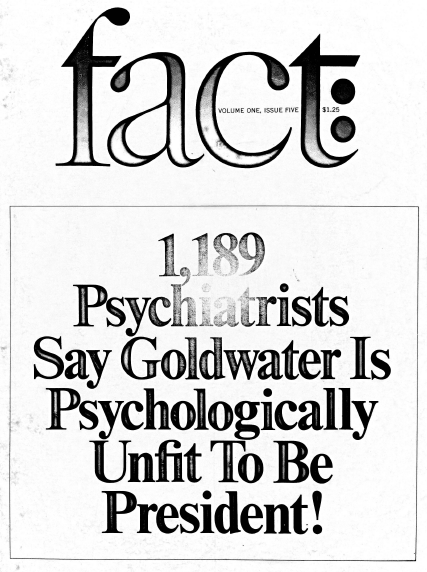
This discussion evokes the episode in 1964, when Fact magazine surveyed psychiatrists about then-candidate Barry Goldwater’s psychological fitness to be president.

Just under half (49.2%) of the 2,417 respondents thought he was unfit, with the rest split evenly between those who didn’t believe they could answer and those who considered him fit for office. Fact also gave respondents a chance to write comments and printed 40 pages of quotes from their answers. Goldwater sued and won over $1 million in damages (which bankrupted Fact magazine), leading to the American Psychiatric Association’s “Goldwater Rule,” which forbids members from making evaluative comments about public figures whom they have not examined as individual patients. A patient/physician relationship triggers ethical responsibilities that are absent when psychiatrists discuss public officials.

For me, the original Fact magazine issue is a fascinating example of professional authority encountering politics. It’s important to note that a considerable minority of the quoted statements either object to psychoanalyzing Goldwater without examining him in person or vouch for his mental health. Some of the surveyed psychiatrists even opine that he is the only sane candidate, surrounded by crazy socialists. But the majority of the quoted MDs make claims that now seem risibly dated and morally problematic. They do so under their professional titles, in a magazine entitled “Fact.” For example:

  • “Descriptions of his early life that I have read indicate to me that his mother assumed the masculine role in his family background. … The picture, therefore, is of a domineering, emasculating mother and a somewhat withdrawn, passive, narcissistic father. … This would provide a fertile background for sado-masochistic temperament, such as is seen in paranoid states.” — M.D., name withheld.
  • “From TV experiences, it is apparent that Goldwater hates and fears his wife. At the convention, she consistently appeared depressed and withdrawn. Certainly she was not like the typical enthusiastic candidate’s wife, e.g., Mary Scranton.” — M.D., name withheld.
  • “Barry Goldwater’s mental instability stems from the fact that his father was a Jew while his mother was a Protestant. This ethnic and cultural split accounts for his feelings of insecurity and spiritual loneliness. … ” — M.D., name withheld.
  • “In trying to analyze Mr. Goldwater’s behavior I am tempted to call him a ‘frustrated Jew.’ … He has never forgiven his father for being a Jew. … What the Senator from Arizona stands for is the antithesis of the traditional Jewish concepts of social justice, of humility, of moderation in speech and action, and of concern for the feelings of others, especially the vanquished. In eschewing these concepts, the Senator subconsciously expresses his hatred for his Jewish father.” — Max Dahl, M.D. Supervising Psychiatrist [etc.]
  • “In allowing you to quote me, which I do, I rely on the protection of Goldwater’s defeat at the polls in November; for if Goldwater wins the Presidency, both you and I will be among the first into the concentration camps.” – G. Templeton, M.D.,  Director, Community Hospital Mental Health [etc.]
  • “Characterologically, Goldwater is like many middle-class Americans. He is ‘formula’ oriented with a belief in the infallibility of his own rhetoric. … In short: Goldwater is an anal character who believes all’s well in his ‘tidy’ world.” — M.D., name withheld.
  • “From his published statements I get the impression that Goldwater is basically a paranoid schizophrenic who decompensates from time to time.” — M.D., name withheld.

I think we should talk about Donald J. Trump’s character and psychological fitness for office. It seems problematic to use the Goldwater Rule to keep the whole psychiatric profession out of this discussion. And yet these quotes from 1964 remind us how historically-relative, value-laden, and agenda-driven people can be, even when they present themselves as scientific specialists dealing only in Facts.

the Hollowing Out of US Democracy

In lieu of an original post here today, I’ll link to a new post of mine on The Evidence Base, a group blog from CESR, the Center for Economic and Social Research at University of Southern California.  I argue that the decline of certain types of associations has left many Americans, especially White working-class citizens, in what my colleagues at the Tisch College of Civic Life and I call “Civic Deserts.” This trend does not explain why a Republican president won in 2016 or why he has taken certain views of policy and ideology. But it does explain the appeal of his leadership style. Citizens who have never belonged to everyday local associations with responsible and accountable leaders do not expect such leadership from their president.

I also explain my SPUD framework, which stands for Scale, Pluralism, Unity, and Depth. SPUD, I propose, is the recipe for effective civic and political organizations, but it is difficult to achieve and is much scarcer today than decades ago.

two cheers for the West

The defeat of Marianne Le Pen is a victory for the European Union; and the EU is one of the structures built in the wake of World War II either directly or indirectly by the Western Allies in that war. In that sense, the EU is part of a project called “the West” that also includes at least the Marshall Plan and NATO–and arguably institutions that span the globe, like the IMF and the UN. These institutions are now beset by critics from Putin and Orban to Trump.

One reason to call these institutions “Western” is that Washington, New York, and Brussels lie to the west of, say, Moscow and Beijing. But at least some people believe that these institutions reflect a perspective, value-system, or set of ideals that can be usefully named “the West.” When I took a “Western civilization” course in the 1980s, it was colloquially called “Plato to NATO.”

One of the deepest ideological fault-lines of our time is how to assess this thing called “the West.” Imperialistic? Reactionary? Liberatory? Ethnocentric? Universalist? Inclusive? Greedy? Humane? A threat to US (or French) sovereignty, or an imposition of US (or French) power on others?

This debate seems intractable because institutions like the EU and NATO (not to mention the UN) have been involved in so many episodes and policies and have had so many effects on nations around the world. And if the West means a perspective or value-system, it is fatally vague. Anything we could define as “the West” in that sense encompasses too much diversity and overlaps too much with other cultural traditions to be meaningful.* For instance, Plato actually has almost nothing in common with NATO, but was an explicit influence on the Islamic Republic of Iran.

On the other hand, most large, co-constructed projects offer resources and inspirations for the present. Even if the first thing that comes to mind when you think of the EU or NATO is the exploitation of the Global South, these institutions also reflect other traditions. They were built on FDR’s Four Freedoms, the UN Declaration, and the promise of economic and social integration to prevent war. A set of states whose domestic arrangements range from democratic socialism to untrammeled capitalism have cooperated to advance international law, human rights, democratic institutions, and robust and interconnected cultures. I don’t deny that these states have done other things as well, but their achievements have been remarkable. Just compare continental Europe in 1945 and 2017.

I’m not sure we have conveyed the grandeur of this achievement–or its vulnerability. The EU is not just an economic zone with high GDP and a lot of bureaucrats in Brussels. It is part of a project that reflects high ideals for humanity. Stopping Le Pen has saved the EU to fight another day, but it doesn’t automatically convey the institution’s ideals. To make the European project inspiring again will require not only beating off its explicit enemies but also reforming “Western” institutions so that they again advance their best values.

*See my posts on the West and the restavoiding the labels of East and Westwhen East and West were one; and on modernity and the distinction between East and West.