Category Archives: notes on poems

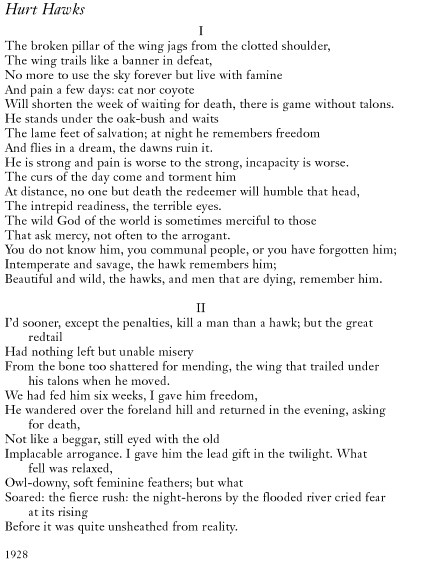
Robinson Jeffers, Hurt Hawks

Screen Shot 2013-05-19 at 4.46.51 PM

Robinson Jeffers’ son kept a wounded hawk as a pet for a few weeks in the 1920s. Jeffers wrote part 1 of this poem as a complete work before he killed the bird, adding part 2 later. It is famous for the line, “I’d sooner, except the penalties, kill a man than a hawk.” Since he did shoot the hawk, Jeffers is either very sorry about what he did or he doesn’t much care for human life.

Part 1 is descriptive and relatively impersonal. There is no first-person verb and no report of the narrator’s relationship to the bird. We are addressed (as “you communal people” who have forgotten “the wild God of the world”). We have access to the hawk’s inner life, knowing what he dreams of and what god he follows. The hawk does not understand us. I think “game without talons” refers to the food that the hawk is offered by his human captors, without his having to hunt it. The bird doesn’t grasp the meaning of the gift or the people’s intentions; he knows the meat by its bare description. “There is game without talons” is free indirect discourse, the hawk’s perspective taking over the narration.

Part 2 introduces the narrator’s voice and relates how he acted, in three steps: “We fed him for six weeks. … I gave him freedom. … I gave him the lead gift. …” Now the relationship between man and bird is central. The man tries to liberate the hawk, but you can’t give  freedom to another creature. The bird returns asking for death. The man does what he is asked. At the end, he holds the dead bird, reduced to a soft object.

This poem has been criticized as didactic. In verse, you are supposed to show, not tell–or so the modernists insisted–but this poem makes general points in the voice of Robinson Jeffers. But is the author serious about the views he expresses here? For instance, did the hawk really ask for death? (Does a bird understand the concept of death as applied to itself, and can it know that a human being might put it out of its misery?) Is there actually a wild God that is merciful to the weak but not to the arrogant?

If the answer to any of these questions is negative, the poem starts to look much more complicated. We do not know what the bird thinks, only how it behaves. We have the testimony of the man about what he has seen and done, but we cannot take any of that for granted. The man has imputed ideas to the hawk and become the god of the bird’s small world. He is in complete control of what we know, just as he controls the animal’s life.

I read the poem not as a didactic statement about nature and life, but as as the unreliable report of a narrator who is unsure whether he should have killed his son’s pet hawk. That narrator is not necessarily Robinson Jeffers. We know that the poet really shot a hawk, but he might have done so without much emotion and derived the idea for a fictional story from the event. All we have is the story with its shifting, partial perspectives and ambiguities.

(By the way: why “Hurt Hawks” instead of “Hurt Hawk”? Why is the wild God capitalized?)

a translation for spring

Dante sought his last refuge in Ravenna at the invitation of Count Guido Novello da Polenta (?-1320). According to Boccaccio, Guido was a person “well tutored in liberal studies” who honored “worthy men and especially those who exceeded others in knowledge.” Dante served Guido in various important capacities, including possibly as professor of rhetoric. He died as a member of the count’s household, having just completed a crucial diplomatic mission to Venice on Ravenna’s behalf. Guido organized a solemn funeral for Dante and had the poet buried in a classical sarcophagus in the local monastery of San Francesco.

Dante chose Guido’s own aunt, Francesca da Rimini, as a major character in the Inferno. Romantic-era critics saw Francesca as a doomed heroine, suffering because her love had violated arbitrary conventions and oppressive rules. I argue (along with several modern critics) that she is supposed to be a real sinner. Dante has placed her in hell because she deserves her punishment for adultery, and besides, she doesn’t really love Paolo, whom she describes with a pastiche of slight misquotations taken from love poetry. She is a 14th-century Madame Bovary, in love with the literary concept of love, not with the individual man.

But back to Guido: Intriguingly, he wrote a minor poem that contains a striking phrase that Francesca also utters (almost verbatim) in her last lines to Dante in hell. Either Guido borrowed the phrase that was spoken by his own dead-and-damned aunt in Dante’s already-famous poem, or else Dante read Guido’s poem before he wrote the Inferno and had Francesca quote it. Since almost everything else Francesca says in the Divine Comedy is a slight misquotation, I am inclined to think the latter is true: Dante took a line from his friend’s naive ingenuous sonnet and assigned it to a sinner in hell.

I make no great claims for Guido’s poem, and less for my translation, but I offer it today because the Boston weather reminded me of it. It’s in my Dante book, pp. 17-18:

The air was serene and the sky was clear
And the birds by the river sang.
That day was the first that felt like spring
When I saw you, my joy, so fair.
Your face wore an unaccustomed blush
That never leaves my thoughts today
And whenever I travel far away
Your pleasing smile seems to rush,
Gently launched toward my heart
By the look that comes to your pretty eyes,
And the smile that so sweetly flies
To blend with mine and never part.
Now she can never be torn away;
Joy shall spare me from misery.

Era l’aer sereno e lo bel tempo
et cantavan gli augei per la rivera
et in quel giorno apparve primavera
qand’io te vidi prima, bella gioia.
Ben fosti gioia, chè tal m’apparisti
e col novo color nel tuo bel viso
che già da la mia mente non se parte.
E quando sono in più lontana parte
più mi sovvien del tuo piacente riso.
Sì dolcemente nel mio cor venisti
per un soave sguardo che facesti
dal tuoi begli occhi, che mi mirar fiso
sì che già mai da te non fia diviso,
tanta allegrezza mi dà fuor di noia.

(cf. “che non mai da me no fia diviso”: Inferno v, 133-5).

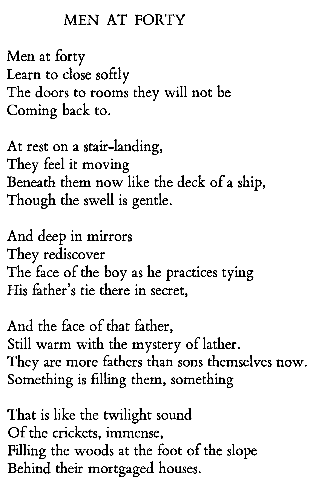
Donald Justice, Men at Forty

I don’t read to see myself reflected on the page. I read primarily to learn how someone else thinks and to analyze and appreciate the formal characteristics of a carefully constructed work. But if I were going to cite a poem that simply speaks to me and my condition, it would be this one, from Poetry magazine, 1966.

I’ve written more detailed notes on two other poems about mortality written by middle-aged men: Gerard Manley Hopkins’ “Spring and Fall,” and Philip Larkin’s “Aubade.” They strike me as more complicated and richer than this work–although it’s worth noting the pattern created by the four-line stanzas, each of which introduces a central verb and a new setting:

1. Closing doors in rooms
2. Feeling motion on staircases
3. Rediscovering a face in a mirror
4. Aging (implied)
5. Sounds filling space

But what I admire is how Justice discovers wonder in the most terrifying intimations of middle age.

(See also Donald Justice, “About My Poems.”)

moral network mapping and literary criticism: a methodological proposal

A moral worldview is a set of beliefs or values connected by various kinds of relationships. For instance, one belief may imply another, or may subsume another, or may be in tension with another even though both are truths. If analyzed that way, a whole worldview can be mapped as a network, with the beliefs viewed as nodes, and the relationships as ties.

Using that method, we can map the moral network implied by a work of literature, such as a lyric poem. Previously, I wrote some notes on W.H. Auden’s poem “September 1, 1939” (notes here; full text here.) I then mapped the moral network of that work. I think my first effort was a bit off, so here is a revised map:
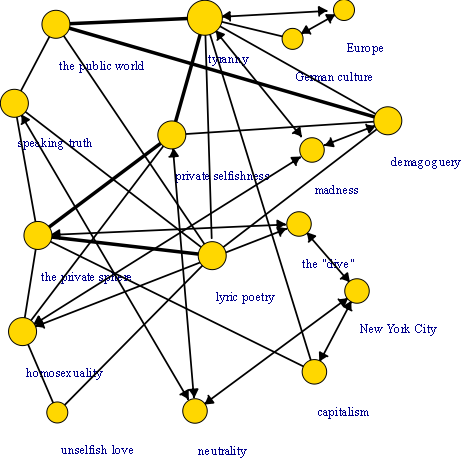
What assumptions underlie this method?

1. The moral evaluation of literature is a valid and useful mode of criticism. It is not just about judging the values of the text (pro or con), nor is it merely a matter of elucidating what the author meant or what the text implies about moral issues. It is rather a critical engagement with the moral perspective of the work, a kind of joint investigation into what is really good and right that is informed by both the text and the reader’s critical response. Although I think that remains a rare mode of literary criticism, it has prominent defenders.*

2. Formal network analysis, a branch of graph theory, offers insights about the structure of any system that is composed of objects and relationships. Tools from network analysis, such as calculating the centrality of nodes or the density of relationships, can help to elucidate and assess the moral worldview of a work of literature.

Underlying this premise is a deeper assumption that moral worldviews should not be assessed only (or mainly?) by evaluating the correspondence between their separate ideas and truths about the world. It’s also (or more?) important to ask how the whole worldview hangs together. The question is not whether Auden should be against tyranny, but how that stance fits into his overall thinking. When people argue for assessing a whole worldview instead of individual principles, their next step is usually to look for internal consistency. But consistency is not the main virtue of a well-structured worldview. Better a mentality that incorporates valid and fruitful tensions than one that avoids all inconsistencies at the cost of narrowness or oversimplification.** Network analysis reveals density and other virtues that are more helpful than consistency. (See also “ethical reasoning as a scale-free network.”)

3. Abstract and general principles are overrated. I do not claim that they should be expunged from one’s moral thinking (that would be an over-radical form of “particularism”), but rather that there is no good reason to assume that a well-ordered moral mentality can be arranged like an organizational chart, with the abstract principles at the top and all one’s concrete beliefs and commitments as mere implications. That would be one kind of moral network map, and some people do think that way. Other people are much more concrete, or they mix concrete particularities with abstract generalities in interesting and complex networks. For instance, I think New York City and the “dive” bar where Auden sits in this poem are just as important to his moral vision as tyranny or selfishness.

One reason not to try to make the abstract principles fundamental to one’s whole network is that certain crucial ideas, such as love, will then be distorted. These ideas have the feature that they are sometimes good and sometimes bad, depending on the circumstances. If you try to organize your thinking around abstract and general principles, you will be compelled to divide love into the good and bad kinds, and that is false to the experience of what love is.***

Turning the map above back into a written analysis of “Sept 1, 1939” would take some space, but I think a few key points emerge:

  • Auden has a dense moral network, not dependent on just one or two ideas. It’s robust. For instance, he later came to hate the line, “We must love one another or die.” But the poem does not rest on that.
  • Love, art, and politics are densely interconnected.
  • Homosexuality is not mentioned in the poem but is alluded to at least twice. It is hard to know whether Auden would connect it to “unselfish love.” I would. So I am either in disagreement with the poem or sympathetic with Auden (a gay man in the 1930s) because he could not draw that connection openly.
  • Much depends on a polarity between public and private, but poetry occupies an uneasy space between. Consider declamatory statements like this: “There is no such thing as the State /  And no one exists alone.” Are they incursions of public demagoguery into a poem, which should be private? Or should the poem speak truth to power?

*See David Parker, Ethics, Theory and the Novel (Cambridge: Cambridge University Press, 1994); Todd F. Davis and Kenneth Womack, Mapping the Ethical Turn: A Reader in Ethics, Culture, and Literary Theory (Charlottesville, University Press of Virginia, 2001), Amanda Anderson, The Way We Argue Now: A Study in the Cultures of Theory (Princeton, 2006)

** Simon Blackburn, “Securing the Nots,” in W. Sinnott-Armstrong and M Timmons, eds., Moral Knowledge (New York, Oxford University Press, 1996), p. 95

*** This is basically my thesis in Reforming the Humanities: Literature and Ethics from Dante through Modern Times (Palgrave Macmillan, December 2009).
Donald Justice, About My Poems

Donald Justice, “About My Poems,” from Poetry magazine, March 1965:

The poet appears as a critic of his own “early” (immature) verse that is “fashionably sad” and whose regular rhymes and meters “paralyze.” Nonetheless, he offers a rhymed, rhythmically regular poem composed of nothing but sad metaphors. They are so sad, in fact, that they overwhelm the wryness of the opening. This poem is the opposite of a shaggy-dog joke: not a humorless story that ends with a funny twist, but a punchline that introduces a moving story.

“Fashionable” has at least three senses. It can mean faddish, of temporary appeal. Nothing depicted in the poem is fashionable in that way, and some of the objects are precisely the opposite. For instance, a naked mannequin is a human figure without anything temporary and new to clothe it. A second meaning is “popular.” Moths swarming under streetlamps represent fashion, in that sense. A third meaning is contrived, artificial, or fashioned. The aesthetic of a small town is fashionable, by that third definition. Justice asks in what sense his own poem is “fashionable.” Is it artificial (with its heightened poetic forms)? Does it manipulate its readers into predictable emotions, like moths by a streetlamp? Is it modish in some way?

To what, exactly, does Justice compare his “early poems”? They have clipped lawns, porches, and streets. Under their porches, children sprawl; in their streets at night, mannequins wait. No single thing has both lawns and display windows. The poems are not analogous to one object, but all resemble small-town, bourgeois, American life in a mode of stillness and languor.

It is not so bad to be a bored child on a rainy Sunday morning: that might evoke nostalgia. It is worse to be a naked mannequin waiting to be desired. But either way, one is paralyzed and inactive, caught in a “long silence.”

The poem, however, is not silent. It speaks of these things. And people walk the poem’s streets–we do, when we read it. The poem is not like the mannequins; it absorbs the attention. Just when we are fully absorbed (perhaps “paralyzed” by the mood), the poet says, “Now the beginning again.” We’re sent back to his opening line about his own “fashionably sad” poems. We have been reading modern lyric verse in a conventional way. But then it is hard not to keep reading and become nostalgically sad again.