Category Archives: civic theory

why the deliberative democracy framework doesn’t quite work for me

In some ways, I came of age in the field of deliberative democracy. I had an internship at the Kettering Foundation when I was a college sophomore (when the foundation defined itself more purely in deliberative terms than it does today). By that time, I had already taken a philosophy seminar on the great deliberative theorist Jürgen Habermas. In the three decades since then, I’ve served on the boards of Kettering, Everyday Democracy, and AmericaSPEAKS. I wrote a book with “deliberative democracy” in its subtitle and co-edited The Deliberative Democracy Handbook with John Gastil. I was one of many co-founders of the Deliberative Democracy Consortium and have served on its steering committee since the last century.

None of these groups is committed to deliberation in a narrow sense (although opinions differ within the field). For me, these are the main limitations of focusing on deliberation as the central topic or unit of analysis:

Deliberative values are worthy ones, but they are not the only worthy ones. My own values would also include personal liberties and nonnegotiable rights, concerns for nature, and virtues of the inner life, such as equanimity and personal development. Stating my values doesn’t substitute for an argument, but it may suffice to make the point that deliberation is not the only good thing, and it’s in tension with other goods. A deliberative democrat will reply that I should discuss my values with other people. And so I should–but that doesn’t mean that the norms intrinsic to deliberation trump all other norms. Nor are fellow citizens the only sources of guidance; introspecting, reading ancient texts, consulting legal precedents, and conducting scientific experiments are helpful, too.

By the same token, deliberative virtues are not the only civic virtues. Deliberation is about discourse–talking and listening–so its virtues are discursive ones: humility and openness, empathy, sincerity, and perhaps eloquence. (The list is contested.) But a good citizen may be hard-working, physically courageous, or aesthetically creative instead of especially good at deliberating. The people who physically built the Athenian agora were as important as the people who exchanged ideas in it.

Deliberation depends on social organization. In order for people to have something that’s worth discussing, they must already make, control, or influence things of value together. That requires social organization, whether in the form of a market, a commons, a voluntary association, a functional network, or a political institution. Discussion rarely precedes these forms, because people can’t and won’t come together in completely amorphous groupings. Discussion is more typically a moment in an ongoing process of governance. Often a small group of founders chooses the rules-in-use that create a group in which deliberation can occur.

Thus we should ask about leadership and rules, not just about deliberation. Another way to put that point is that deliberation is often a good rule for a group to follow, but it is only one of the rules that they need. Indeed, some functional groups wisely choose rules that limit deliberation or that keep excessively divisive topics off the agenda.

A good argument for deliberation is that people gain practical wisdom and make better judgments by exchanging ideas and information. I see enough potential in that process to disagree with Austrian School economists who think that there is no way to make informed decisions without the data provided by prices in an unregulated market. But the ideas that arise in a deliberation (just like the prices that emerge in a market) are highly fallible. We ought to consider as much information as we can, including market signals and scientific findings as well as other people’s ideas and values. This is an argument for deliberation, but only as one source of guidance. In an ideal deliberative democracy, where “the people” governed through discourse alone, there would be no price signals, and so groups would make poor decisions.

The logic of deliberative democracy suggests that every institution should be a mini-public in which equal members exchange reasons. Moreover, there should be no rigid barriers among institutions: One Big Deliberation is the implicit goal. That goal has been challenged by “difference democrats” like Nancy Fraser, who writes, “public life in egalitarian, multicultural societies cannot consist exclusively in a single, comprehensive public sphere.” Fraser favors “a multiplicity of publics” over a “single public”; and she particularly celebrates “subaltern counterpublics,” meaning “parallel discursive arenas where members of subordinated social groups invent and circulate counterdiscourses to formulate oppositional interpretations of their identities, interests, and needs” (“Rethinking the Public Sphere,” 1994). I’m for that, but I would go further. We need not only “subaltern counterpublics” in which minority groups hold their own deliberative conversations. We also need non-deliberative institutions: hierarchical churches, efficient markets, massive social networks, and laboratories. That is because a plurality of power-centers–polycentricity—is essential to maintain liberty. 

Finally, deliberation by itself has limited power, and especially limited power to challenge dedicated opponents, such as authoritarian states and metastasizing markets. Authoritarian states can be persuaded to organize deliberative fora: see Baogan He & Mark E. Warren, “Authoritarian Deliberation in China,” Deadalus (summer 2017). Deliberative processes help the Party manage complex problems that would undermine its authority if left unaddressed. But deliberative fora don’t challenge illiberal regimes or powerful companies unless they are “free spaces” (Evans and Boyte) within social movements that can deploy power.

Because deliberative values are genuine values, it is absolutely worth giving them attention–in both theory and practice. But because deliberation depends upon so many other values, virtues, institutional forms, and political configurations, it is best not analyzed or pursued on its own.
The truth in Hayek

(Washington, DC) You are reading English; I am writing it. English has elaborate rules and conventions. You can break the rules, but that has consequences beyond your control. Mess up your grammar in a job interview and you may not get the position. On the other hand, talk very formally in a dorm hallway and you may come across as a geek.

English also has many limitations. There are things for which we lack words. There are words without rhymes. There are words that sound awkward together. Using the language can be a struggle for people at any level of proficiency. It was a struggle for Shakespeare, as you can sense when you see him trying to convey ideas that had never been said before in his language.

Yet hardly anyone experiences the rules and limitations of English as an infringement on liberty. Why not?

  1. No individual or committee designed the language. Its limitations, therefore, are not the result of anyone’s will. Not being able to express something in English is like not being able to run at 60 miles/hour: a constraint, but not an example of coercion, because no one is coercing you.
  2. No one can change the language wholesale. We can work to change it, one piece at a time. In my lifetime, “man” has ceased to mean “human being.” That change is a result of deliberate argument and advocacy. But it’s a change of one word, and it required lots of voluntary agreement to become a new norm.
  3. Language is predicable. Within any linguistic context, the rules-in-use (not necessarily the official rules written down in grammar books) are quite stable. Change is gradual. Therefore, we can usually predict how a listener will understand a given phrase. Its predictability makes language a tool for intentional agents, something that we can plan to use for our own ends.

Friedrich von Hayek admires emergent systems. They are “complex and orderly and, in a very definite sense, purposive institutions [that] owe very little to design” (Constitution of Liberty, p. 58). Each system is a “self -maintaining whole which is kept going by forces which we cannot replace.” (p. 70). It is “not invented but arose from the actions of many men who did not know what they are doing.” (pp. 58-9). It demonstrates “organic, slow, half-conscious growth” versus “intelligent men coming together for deliberation about how to make the world anew” (pp. 56-7).

Hayek sees an intrinsic link between emergent systems and liberty, for the three reasons numbered above. Another advantage of emergent systems is that they avoid human cognitive limitations. They create complexity without relying on anyone’s brainpower to design the whole system well.

Hayek thinks of markets as emergent systems, and that is why he is associated with the political right. He opposes the idea of “social justice” (p. 65), arguing that to assess a complex system according to your own idea of justice is actually antisocial. You are substituting your opinion for what a whole society has created through emergent processes, such as market exchange.

I disagree with this important strand in Hayek. I view markets as substantially the products of political power and intentional design, in the form of laws that create and structure economic activity. I also view modern markets as the domain of large corporations that are run by (more or less) “intelligent men coming together for deliberation.” For instance, the online marketplace is not just an emergent system but an archipelago of designed islands (Amazon, Google, Facebook, the App Store). Finally, I don’t think that liberty, in Hayek’s sense, is the only important good. So even when markets do meet Hayek’s criteria of emergence and thus generate liberty (in his sense), I’m not satisfied if they are also deeply unequal, destructive, or inhumane. Note that Hayek may agree on this point (p. 18).

Having noted my disagreement with Hayek on the question of markets, I would like to underline the value of his overall view. Even with respect to economics, it is important to recognize the link between markets and liberty in the specifically Hayekian sense. His argument is not that markets offer negative liberty (freedom to do what you want), nor that they guarantee happiness or prosperity. His argument is that markets allow you to form and implement your own plans, which is a form of liberty. There is considerable truth to this position.

Besides, markets are not the only examples of emergent systems, and not the purest or best ones. Consider indigenous human cultures that are deeply embedded in natural ecosystems. The people who admire such examples and want to conserve them against the imperialistic forces of science and the state are typically on the left. Here I am not only talking about hunter-gatherer societies in distant rainforests. Plenty of leftish Americans will regard an elaborate but fragile community, like Boston’s Chinatown, as a valuable emergent system and will strongly oppose planning that disrupts it. So you can be a left-Hayekian.

Another example is the Internet. Today it is dominated by such large designed platforms as Amazon. But I remember when it emerged with very simple, very stable protocols that allowed maximum scope for creativity. The result was beautifully Hayekian, in contrast to the planned network of the telephone company. The fact that it has evolved to be dominated by multi-billion-dollar companies with centrally planned algorithms is an argument against Hayek’s pro-market complacency. The market has undermined Hayekian values. Still, the best response is to make the Internet more of an emergent system through rules like net-neutrality—not to try to design the content of the World Wide Web.

Finally, I tend to agree with Hayek’s view of ethics. Moral rules are, “next to language … the most important instance of an undesigned growth.” We observe them because of their consequences even though we do not know what their consequences will be (p. 67). That makes sense given human fallibility. Hayek rejects the Socratic ideal of questioning everything. “This givenness of the value framework implies that, although we must always strive to improve our institutions, we can never aim to remake them as a whole and that, in our efforts to improve them, we must take for granted much that we do not understand” (p. 63). Habermas uses the word “givenness” in exactly the same way when he also argues for criticizing values one at a time, never wholesale. Here the Austrian School and the Frankfurt School coincide.

[See also:  Lifeworld and System: a primerit’s not just what you think, but how your thoughts are organizedFoucault and neoliberalism]

new research on “civic deserts”

(Washington, DC) My colleagues Kei Kawashima-Ginsberg and Felicia Sullivan coined the phrase “civic deserts” to name places where there are few or no opportunities to be active and constructive participants in civic life. The analogy is to “food deserts”–geographical communities where there is little or no nutritious food for sale. You can still be an active citizen in a civic desert, just as you can grow vegetables in your back yard; it’s just that the whole burden falls on you.

Today at the National Conference on Citizenship, we are releasing Civic Deserts: America’s Civic Health Challenge by Matthew N. Atwell, John Bridgeland, and me. It’s a 36-page report that documents the declining opportunities for civic engagement in America. John Bridgeland and Robert Putnam also write about it today in a PBS opinion piece.

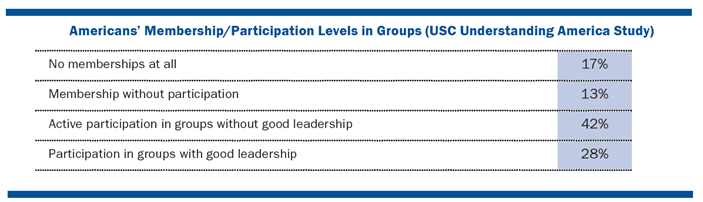
This is an example of a table from the report:

Thanks to friends at USC’s Center for Economic and Social Research, we were able to ask a  large, representative sample of Americans whether they belonged to various kinds of groups; if so, whether they participated actively in any of them; and if so, whether they thought that the group’s leaders (a) usually did what they promised and (b) usually tried to serve and include all the members. It turns out that only 28% of adult Americans actively belong to groups whose leaders are accountable and inclusive. That statistic does not tell us how much geographical space is taken up by civic deserts, but it suggests that they are common. And the historical data implies that civic engagement used to be much more widespread.

I separately formed a hypothesis that lacking direct, personal experience with good leadership would make a person more tolerant of the leadership style of Donald J. Trump, controlling for one’s political ideology. In other words, given two people who agree with Trump on issues, the one without experience of good local leadership would be more supportive of Trump as a leader. This was testable with the USC data, which includes a whole battery of questions about ideology, issues, and Trump. My hypothesis turned out not to be true: partisanship and media choice seem to explain opinions of the current president almost completely, and experience in groups adds no explanatory power. Still, I think there may be a more circuitous story about civic deserts as a cause of Trump’s victory: the decline of civic associations increases the power of partisan heuristics and ideological media. Even if that hypothesis is also false, civic deserts are still a problem, because civic engagement benefits health, economic development, safety, education, and good government.

See also: The Hollowing Out of US Democracy (my blog post for USC); Mitigating the Negative Consequences of Living in Civic Deserts – What Digital Media Can (and have yet to) Do (a new CIRCLE article); America needs big ideas to heal our divides. Here are three by Bridgeland and Putnam; and the power of the NRA in an age of civic deserts.

the legacy of Elinor Ostrom and the Bloomington School

Many years ago, I met Vincent and Elinor Ostrom in the seminar room of what is now the Ostrom Workshop at Indiana University in Bloomington. I then had several personal interactions with Lin Ostrom, and I’ve been back a few times to Bloomington. (I even wrote a poem about a B&B there once.) I have taught and studied her work and am writing a book in which the tradition that she and Vincent founded–the Bloomington School–is one of three essential components of a theory of citizenship. (The other two are the post-War Frankfurt School and the tradition of political nonviolence: Gandhi/King.) She is, for me, the model scholar.

Today, I was able to speak about Lin Ostrom’s legacy in that same seminar room. I tried to place the Bloomington School in the context of major currents of political theory and civic renewal. A video of my talk is already up on the Workshop’s website. The title is “Elinor Ostrom and the Citizen’s Basic Question: What Should We Do?”

See also: Elinor Ostrom wins the Nobel!Elinor Ostrom speaking at TuftsElinor Ostrom, 1933-2012Ostrom, Habermas, and Gandhi are all we need, and Habermas, Ostrom, Gandhi (II),

against state-centric political theory

What do all these statements have in common?

  1. “Republicanism is a consequentialist doctrine which assigns to government, in particular to governmental authorities, the task of promoting freedom as n0n-domination.” — Philip Pettit, Republicanism: A Theory of Freedom and Government
  2. “Of course governments may delegate … to private entities, but in the end it is government, meaning the society’s basic political structure, that bears the ultimate responsibilities for securing capabilities …. . The Capabilities Approach … insists that all entitlements involve an affirmative task for government: it must actively support people’s capabilities, not just fail to set up obstacles. … Fundamental rights are only words unless and until they are made real by government action.” — Martha Nussbaum, Creating Capabilities: The Human Development Approach
  3. “Justice is the first virtue of social institutions, as truth is of systems of thought. A theory however elegant and economical must be rejected or revised if it is untrue; likewise laws and institutions no matter how efficient and well-arranged must be reformed or abolished if they are unjust.” — John Rawls, A Theory of Justice
  4. “The free man will ask neither what his country can do for him nor what he can do for his country. He will ask rather ‘What can I and my compatriots do through government’ to help us discharge our individual responsibilities, to achieve our several goals and purposes, and above all, to protect our freedom? And he will accompany this question with another: How can we keep the government we create from becoming a Frankenstein that will destroy the very freedom we establish it to protect?” — Milton Friedman, Capitalism as Freedom

These authors disagree about what the government should do and what powers it should have. Friedman wants as little government as necessary to protect a certain kind of freedom. Nussbaum and Rawls would assign the state the powers it needs to guarantee a range of social outcomes. Pettit starts with a particular conception of freedom and concludes with an argument for an assertive state.

But all agree that justice means getting the role of the government right.

One objection to this shared premise is that no government alone can determine whether people experience justice or injustice. Amartya Sen begins his book The Idea of Justice with a quote from Great Expectations (“In the little world in which children have their existence, nothing is so finely felt and perceived as injustice”) to support the point that non-state actors–in Pip’s case, an older sister–can be just or unjust in ways that no state would be able to determine.

I agree, but my objection is different and (I think) more radical. All the books quoted above are about justice, but their authors and readers are not governments. Instead, these books are written by people for people. People can adopt views of what governments should do, and sometimes people influence governments. But individual people–even dictators–cannot directly make governments either just or unjust. The question for these authors and their readers should be: What must we do?

From that perspective, governments do enter the picture, as do families, markets, customs, religions, ecosystems, laws of nature, and many other tools and constraints. The question for us is not how each of these things should ideally work (if so, I’d favor laws of nature that guarantee us all perfect happiness forever), but rather how we should deal with the constraints and opportunities that confront us.

In particular, the governments that we deal with differ greatly. Some of us live in Denmark; others in North Korea or Bukina Faso. All the authors cited above would agree that Denmark’s government is better than North Korea’s, but that conclusion has limited value for residents of either country. Further, citizens of Denmark can fine-tune the justice of their government’s policies by supporting the political parties that best reflect their views. In North Korea (because of tyranny) and in Burkina Faso (because of poverty), that approach to improving the world isn’t really available.

My objection is not that governments should play a more limited role than they play today or than some theorists recommend. As an individual voter, it happens that I would support more assertive government. My objection is to treating the question, “What is a good government?” as an answer to the existential question, “What should I do as a citizen?” Apart from voting for the party that recommends my favorite size and type of government, what am I to do?

I’d venture an analogy to a family of theological views. For many theists, God is the Unmoved Mover, ultimately responsible for everything but not subject to being changed. Our stance toward God should involve such virtues as hope and faith. We can pray for certain outcomes, and we can be confident that divine choices will be just. We can ask what God is likely to do, given that God is just. We cannot, however, choose how God will act.

Likewise, in all the political philosophies cited above, the state is the unmoved mover of a system of justice. Unlike God, a state can either be good or bad; it can merit admiration or criticism. And we can debate whether the state should be more or less powerful (in contrast to God, Who is all-powerful). But these theories all suppose that the question of justice is: What is the ideal state? This question resembles the theological question, What are the attributes of God? It is a matter for analysis and inquiry, but not a choice.

Of course, everyone realizes that people make and change governments. The modern Danish state didn’t arise spontaneously; Danes made it and sustain it. They have also made the Danish language and economy and the physical layout of Danish towns and the countryside. But the strategies and ethics of citizens’ action are sidelined in all these political philosophies–even in Friedman’s libertarianism. He wants the state to do little, and private actors to do what they want; but that’s still not a theory of how we can accomplish justice. Again, if we are Danes who agree with Friedman, we can vote for classical-liberal candidates; but if we are North Koreans, Friedman’s ideals are empty.

How did a strategy for influencing the world become available in Denmark that is absent in North Korea? Because of the past behavior of people, both inside these countries and beyond.

Perhaps political philosophers focus on the state because they believe that blueprints of just political orders influence history. Without Locke, no American Revolution; without Rousseau, no French Revolution; without Marx, no Russian Revolution. The social impact of abstract philosophy is a large question on which I claim no special expertise. However, my general premise is that the Owl of Minerva flies at dusk and doesn’t see all that well. Locke writes after the actual English Revolution of 1688 and tries to make theoretical sense of it. He has some influence on the American framers, but they have many other influences as well, including their hands-on experiences in colonial government. Likewise, Robespierre may have carried his copy of Rousseau around with him–and Lenin, his Marx–but the actual revolutions that they led didn’t resemble these blueprints all that well. Not to mention that most sustainable change doesn’t occur during revolutions at all. It reflects slow, cumulative, experimental adjustments that are theorized after the fact.

Another reason that most political philosophers focus on the state rather than people may be that the actions of citizens appear to be theoretically uninteresting. Action is a matter of praxis, and the only question is empirical: Given the actual circumstances, what will work to move the society toward justice? That’s a question for strategists and empirical students of activism, lobbying, elections, social movements, revolutions, and so on, but not for political philosophers.

This is where I dissent. When we set out to change the world, we must decide what is right for us to do under the circumstances. The main way to test our answers to that question is to discuss them with other people. We must also coordinate our actions to increase our odds of changing the world. Unless we have already coordinated with some other people, we probably lack a venue in which to deliberate, because a deliberation is itself a shared activity, and it almost always takes place within an organization of some kind that we must sustain.

Deliberating and coordinating action generate relatively consistent classes of problems. They are hard problems, yet some groups of people have solved them. These problems are just as conceptually and ethically complex as the problem of designing a good state. But they are more pressing for us, because we can deliberate and coordinate, but we cannot implement our ideas of a good state. The only way that states will get better is if people (including those who work in and for states) deliberate and coordinate better. And–while we are at it–we can also change cultures, markets, religions, and even ecosystems. Theorizing that work is the task of Civic Studies.

See also: Ostrom, Habermas, and Gandhi are all we need; Habermas, Ostrom, Gandhi (II)new book–Civic Studies: Approaches to the Emerging Field; and The Good Society symposium on Civic Studies