Category Archives: civic theory

media literacy and the social discovery of reality

If you’re concerned about media education in the current fraught moment, you should read danah boyd’s “You Think You Want Media Literacy… Do You?” and Renee Hobbs’ response in Medium.

In my crude summary: danah boyd surveys some media literacy programs and sees a simplistic set of assumptions about the way media does–and should–work in our world. Hobbs replies that the actual field of media literacy education, which she has labored skillfully to build, welcomes complexity and diversity of views and nurtures sophisticated programs that boyd has overlooked. Hobbs also wonders why boyd selects media literacy education as her target instead of big media companies that are making money by degrading the public sphere.

I’m no danah boyd, and I’m no Renee Hobbs, but I recognize the appeal of both perspectives from my own work in different fields, such as service-learning, civic education, and deliberative democracy. There’s a role for the relatively detached critic who raises basic questions, but also for the field-builder who tries to create networks that enable experimentation and debate.

In the case of media literacy, I can offer my own view of the philosophical issues at stake, for what that’s worth. I don’t know to what extent people working in the field agree or disagree with the following ten theses. As I present them, I’ll use climate change as an example. Climate scientists make strong claims about truth, professional reporters must decide how to cover their claims, educators must decide whether climate change is a fact or rather a topic for debate, and the public is deeply polarized about all of the above.

  1. Truth claims are social. At least, that is true of claims like “human beings are causing the globe to warm by burning carbon.” No individual can have a justified true belief about the global climate, all by herself. No one can read all the secondary literature, let alone check all the analyses in that literature, let alone reanalyze all the data, let alone collect all the data, let alone create the methods and instruments needed to collect the data, let alone train all the scientists, let alone pay for all of that. We can each check some other people’s work, abstracting it from the rest of science. But we must leave most of the edifice unchecked. When people tell you they have “looked into” climate science and found it either true or false, they are exaggerating their personal expertise.
  2. Institutions require trust. An individual must trust the scientific enterprise as a whole in order to believe its specific results or even to take them seriously. Trust is directed at people, institutions, or social processes, not at facts. Many institutions do not merit trust.
  3. Social institutions represent power. For example, scientific labs, universities, and newspapers are funded, staffed, and managed. The human beings who manage them are exercising power. Most other people do not have the same power or equivalent degrees, titles, educational pedigrees, access to information, etc. Thus we are asked to trust people who have power over us. That is easier for someone like me–a colleague of climate scientists who works in a Boston-area research university–than for someone far away and in a different cultural setting.
  4. Truth is deeply intertwined with values. We really are warming the globe by burning carbon. But if that implies that we must regulate economic activity–even at the expense of liberty–it becomes a value-claim. Also, we know that we are warming the climate because we have invested in certain kinds of research. Motivating those investments are concerns about the globe as a whole and about the long-term aggregate welfare of people plus other species. If your concerns were different, you wouldn’t spend the money to collect the data that has produced these facts.
  5. Politics is about values and power. When we disagree about values or about who has power (or both) we are engaged in politics. Thus politics is necessarily involved in topics like climate change.
  6. Ideology is an unavoidable tool for managing complexity and uncertainty. The word “ideology” has different meanings in different circles, but if we mean fairly general heuristics that allow individuals to make sense of the world, then we all depend on it. Ideology is unavoidable. And it tends to merge causal theories, value-claims, and identities.
  7. Some values are better than others. I’ve said (see #4) that climate science depends on values. But the underlying values of climate science are good ones. We should be concerned about all human beings, about other species, about natural systems as intrinsic goods, and about the long-term. If we were only interested in the short-term wealth of US citizens, we wouldn’t care about climate change, but that would be a worse moral stance. Values are contestable, but our responsibility is to choose the best values.
  8. Truth can be socially discovered, not just socially constructed. Knowledge emerges from human institutions, like laboratories and newspapers. Change the people and the way they work together, and you will probably get different results. That is a causal claim. For some, it implies skepticism. But people do obtain justified true beliefs–for example, that we are heating the globe by burning carbon. This is not socially constructed knowledge; it is socially discovered. The discovery requires cooperation, just as it takes a bunch of sailors to reach a destination by sea. But their ship can actually find a new place, not merely “construct” one.
  9. Institutions for discovering truth are scarce and fragile. Behavioral science has uncovered an immense number of human cognitive and motivational limitations, many rooted in our biological origins as hunter-gatherers. We are ill-equipped to make sense of large-scale phenomena and are unlikely to care about issues that affect other people far away. Yet we have built institutions like universities and newspapers. These are highly problematic and fallible entities, with long records of errors and abuse. They are also miraculous achievements that defy the prediction that homo sapiens will never want to discover truths or succeed in that effort.
  10. Media literacy thus means exhibiting the right mixture of trust, support, skepticism, and critique. It’s possible for people to trust a given institution, such as a newspaper, too much. And it’s possible for them to trust it too little. Trust is an emotion that is related to personal identity, but it ought to be informed by good values and rigorous knowledge as well.

See also: the Pew climate change survey and the state of sciencemini-conference on Facts, Values, and Strategies (which led to a special issue of The Good Society, now in production); why we miseducate children to think of values as opinions; a media literacy education articlethe history of civics and news literacy educationis all truth scientific truth?don’t let the behavioral revolution make you fatalisticCivic Science; pseudoscience and the No True Scotsman fallacythe press loses its leverage; and generational change and the state of the press.
notes on the metaphysics of Gandhi and King

Gandhi offers a fully developed metaphysics and epistemology–original even though it is grounded in classical Indian thought. For Martin Luther King, Protestant theology provides a core theory of human nature, but King navigates his way through debates in modern Protestantism and offers his own synthesis and draws political implications. Even for non-Hindus and non-Protestants, some premises that both of these authors share may be persuasive.

For Gandhi, there are truths–for example, about the good life and the just society–but they exceed any individual’s comprehension. Almost everyone (perhaps literally everyone[1]) contributes valuable insights by observing the world from her own limited and fallible perspective.

The golden rule of conduct, therefore, is mutual toleration, seeing that we will never all think alike and we  shall see Truth in fragment and from different angles of vision. Conscience is not the same thing for all. Whilst, therefore, it is a good guide for individual conduct, imposition of that conduct upon all will be an insufferable interference with everybody’s freedom of conscience.
Q. With regard to your Satyagraha doctrine, so far as I understand it, it involves the pursuit of Truth and in  that pursuit you invite suffering on yourself and do not cause violence to anybody else.
A. Yes, sir.
Q. However honestly a man may strive in his search for Truth, his notions of Truth may be different from the notions of others. Who then is to determine the Truth?
A. The individual himself would determine that.
Q. Different individuals would have different views as to Truth. Would that not lead to confusion? …
A. That is why the non-violence part was a necessary corollary. Without that there would be confusion and  worse.[2]

According to Bhikhu Parek, Gandhi believes that “rational discussion and persuasion” are the “best way to resolve conflict.”[3] However, these methods depend on well-motivated reasoners who are able to overcome our species’ deep cognitive and ethical limitations. Under ordinary circumstances, reasoning is likely to fail, because we are mired in our own interests and not rational enough to be persuaded by arguments. Violence is therefore tempting but intrinsically problematic. The violent actor assumes that she is right, even though we are all inevitably wrong. Violence also threatens to erase the insights of the target by silencing or even eliminating her, or it may force her to do something without being sincere. On the other hand, voluntary sacrifice can touch the other person’s heart without negating her freedom.

Gandhi also believes that we ought to perform actions that are intrinsically meritorious without being concerned about their outcomes, which lie beyond our control. As Krishna teaches in the Baghavad Gita, “Motive should never be in the fruits of action.” Actions must be sincere in order to have value, and sincerity requires commitment by the heart and mind together. Unlike a typical action that is taken to achieve an end beyond the direct control of the actor, sacrifice remains connected to the person who sacrifices. For example, if I choose not to eat, that remains my will until the end of my fast. If my refusal to eat causes you to change your behavior, that may be good (assuming that my cause was right), but I am responsible only for forgoing the food, not for your behavior. I thus escape the pitfall of attaching my happiness and meaning to an end beyond my control.

Like Gandhi, King holds that violence “is immoral because it seeks to humiliate the opponent rather than win his understanding; it seeks to annihilate rather than convert. … It leaves society in monologue rather than dialogue.” Nonviolence is “the ultimate form of persuasion,” where the word “ultimate” means both the most powerful form and the one to try last, after arguments have failed.[4] King also shares with Gandhi a theory of the human soul as both rational and affective, a recognition of the limitations of human understanding, and the ideal of a transcendent truth that we can only approach together. He says that he found in Hegel the idea that “truth is the whole,” which is roughly analogous to Gandhi’s remarks about Brahman, the universal soul.[5]

However, King’s framework is Protestant rather than classically Indian, so his metaphysics is somewhat different. Human beings are made in God’s image and are granted freedom, but we are also fallen. God is personal, an actual character who loves us and can work with us. King says that personalism “is my basic philosophy,” the foundation of his faith in an active personal God and “the metaphysical basis for the dignity and worth of all human personality.” People have dignity and worth not because they are good but because of divine grace. King says that he agrees with Reinhold Niebuhr about “the reality of sin on every level of man’s existence,” contrary to a “great segment of Protestant liberalism” that is too optimistic about human nature. “While I still believed in man’s potential for good, Niebuhr made me realize his potential for evil as well.” King ultimately came to believe that Niebuhr had “overemphasized the corruption of human nature” because he had “overlooked” the power of divine grace to work with communities of people; yet King retained a sharp awareness of sin and evil.[6]

Agape–disinterested love–is the answer for King. It serves to explain the nature and will of God, our relationship to God, and our obligation to other people. It is not “sentimental” and it does not ignore sin. Instead, King defines nonviolent resistance as “a very stern love that would organize itself into collective action to right a wrong by taking on suffering.”[7] The combination of organization and collective action, love, and nonviolent sacrifice is essential.

These philosophical and theological positions cannot both be completely right, because they conflict at points. For instance, King’s God is personal whereas Gandhi’s divine is abstract. Gandhi acknowledges that God is love but attributes that view to Christianity and endorses it in the context of saying that “the human mind is a limited thing and you have to labour under limitations when you think of a being or entity who is beyond the power of man to grasp.”[8] Christians contribute the partial insight that God is love; for Gandhi himself, God is Truth.

Nevertheless, the overlapping premises of these two philosophies seem plausible even in secular contexts and are compatible with behavioral science.[9] People really are cognitively and ethically limited when we think and act alone, but we are capable of reasoning better when we come together in groups that are organized to bring out the best in us. We really do make better decisions when we preserve alternative views instead of violently suppressing them. Yet we cannot expect the best conclusions to emerge from deliberation alone; change aso requires organized sacrifice.

[1] That is Parek’s reading.  Gandhi: A Very Short Introduction (Oxford University Press, 2001), p. 54.
[2] These quotations come from several articles in the newspaper Young India, but they were combined by Nirmal Kumar Bose in his Selections from Gandhi (Ahmedabad: Navajivan Publishing House, 1948), pp, 66-67, which carries a very strong endorsement from Gandhi. Thus I treat them as a coherent argument that Gandhi approved.
[3] Parek, p. 51
[4] King, Stride Toward Freedom, Kindle locations 2850 and 2892.
[5] King, location 1355; cf. Nicholas F. Gier, The Virtue of Nonviolence: From Gautama to Gandhi (Albany: SUNY Press, 2004), pp. 40-1
[6] King, Stride Toward Freedom, 1355, 1327
[7] King, “My Trip to the Land of Gandhi,” originally published in Ebony magazine,1959, in Martin Luther King Jr., I Have a Dream: Writing and Speeches that Changed the World, edited by James M. Washington, (Glenview, IL, Harper Collins, 1992), p. 44.
[8] Bose, 4.
[9] Christopher Beem relates Niebuhr’s theological commitment to human limitations to the findings of modern psychology and draws political implications in Democratic Humility: Reinhold Niebuhr, Neuroscience, and America’s Political Crisis (Lanham, MD: Lexington Books, 2015).

See also the relationship between justice and peace; the central role of sacrifice in social movements; how the Montgomery Bus Boycott used and created social capital; prophesy as a form of political rhetoric; and the need to consider evil in politics.

new Civic Studies major at Tufts

Yesterday, the Tufts Faculty of Arts & Sciences approved our proposal for a new major in Civic Studies, the first in the world. It will begin next fall, and I’ll co-teach the new introductory course with my colleagues Erin Kelly (Philosophy) and Yannis Evrigenis (Political Science). Here are the relevant portions of the proposal that passed yesterday:

Curriculum Proposal: Civic Studies

“We see before us an emerging civic politics, along with an emerging intellectual community, a field, and a discipline. Its work is to understand and strengthen civic politics, civic initiatives, civic capacity, civic society and civic culture.…and to contribute to an emerging global movement of civic renewal.” — Harry Boyte, Stephen Elkin, Peter Levine, Jane Mansbridge, Elinor Ostrom, Karol So?tan, and Rogers Smith, “Framing Statement for Civic Studies,” 2007

Civic Studies is an interdisciplinary field of study that focuses on critical reflection, ethical thinking, and action for social change, within and between societies. People who think and act together to improve society must address problems of collective action (how to get members to work together) and deliberation (how to reason together about contested values). They must understand how power is organized and how it operates within and between societies. They must grapple with social conflict, violence, and other obstacles to peaceful cooperation. They will consider questions of justice and fairness when social tensions arise, and they must confront questions about appropriate relationships to outsiders of all types. This includes examining alternative ethical, political, and theological frameworks to encourage comparative reflection about different ways in which people live together in society.

The focus on civil society contrasts with state-centric approaches. It includes the study of collective action in social spheres that, while organized, may not be institutionalized or otherwise sanctioned by the state, and it highlights the perspective of individual and group agents.  Thus civic studies considers phenomena that are central to other disciplines—governments, law, markets, societies, cultures, and networks—but from the distinctive perspective of civic agents, that is, individuals and groups who think together and act cooperatively. It includes principles and vantage points civic agents may use to evaluate existing social norms, institutions, governments, and ideologies. In these and other ways, Civic Studies brings critical scrutiny to status quo norms of social order.

Civic Studies is more than citizenship studies. Civic agents include citizens, disenfranchised or colonized groups, temporary residents, undocumented migrants, refugees, and members of other societies acting across borders. Civic Studies engages with the importance of a society’s criteria of membership, as well as the logic and dynamics of inclusion and exclusion, hierarchy and subordination, across social groups. It subjects social dynamics to empirical study and normative evaluation, with the aim of understanding how to challenge unjust inequalities and to enhance just forms of social inclusion.

Normative reflection, ethical analysis, empirical understanding, historical perspective, and the development of practical skills are all important to the study of social and political conflict, and for developing cooperative strategies to enable positive social change. Civic Studies brings those modes of learning together to deepen our understanding of social criticism and action for social change as well as the circumstances that give rise to a need for it. The major’s classroom and experiential learning requirements would enable students to explore the theory and practice of critical reflection and just social change.

A Peace and Justice Studies track within the Civic Studies major provides a special focus within Civic Studies for learning about the causes and effects of violence, and for developing nonviolent strategies for conflict resolution and just social transformation. A minor in Peace and Justice Studies is also available to students who are particularly interested in studying violence and alternatives to it.

In sum, a major in Civic Studies [will] continue from the Tufts Peace and Justice Studies major the following core commitments: a combination of classroom-based and experiential learning; normative analysis and critical scrutiny of claims about justice; an explicit focus on conflict and possibilities for resolving it, and the development of skills useful in nonprofits, governments, community groups, and social movements. We believe the intellectual content of Civic Studies is exciting and the curriculum distinctive, highlighting strengths of Tufts University.

The proposed requirements for the Civic Studies major are 11 courses distributed as follows:

  1. CVS 0010—Introduction to Civic Studies
  2. Thinking about Justice: two courses in political theory, philosophy, or social theory devoted to normative questions about the nature and content of justice. Courses must be selected from an approved list. [Examples are listed in the proposal. E.g., PS 41: Western Political Thought I and II; REL 43: Asian Religions; HIST 129: Black Political Thought in the 20th century]
  3. Social Conflict and Violence: Two courses to enhance an empirical understanding of the historical, political, and social origins of conflict and violence. Courses must be selected from an approved list. [Among others: SOC 94: Sociology of Violence; PS 138-01: Political Violence in State and Society; PSY 136: Stereotypes, Prejudice, and Discrimination]
  4. Civic Action and Social Movements: Two courses dealing with the historical, ethical, and social origins of organized movements for social change. Courses must be selected from an approved list. [Among others: CH 109: Community Action and Social Movements in Public Health; ANTH 0146: Global Feminisms]
  5. Civic Skills: two courses that focus on civic skills or civic practices, e.g., dialogue and deliberation, ethical reasoning, emotional intelligence, conflict-mediation and peacemaking, community-based research, communication and media-making, public art, community organizing, evaluating nonprofits, or financing social enterprises. [Among others: UEP 194: Technology, Media, and the City; ELS 193: Social Entrepreneurship, Policy, and Systems Change; VISC 145/AMER 94, which is a course taught in state prison]
  6. CVS 099: A required internship. This includes a weekly 2.5 hour class with graded assignments and a final project. (3 SHUs)
  7. CVS 190: A capstone seminar taught by a CVS affiliated faculty member.(3 SHUs)

Total: 11 courses

what does it mean to say democracy is in retreat?

According to Freedom House, “Democracy faced its most serious crisis in decades in 2017 as its basic tenets—including guarantees of free and fair elections, the rights of minorities, freedom of the press, and the rule of law—came under attack around the world.”

This statement deserves unpacking if we want to understand in what ways democracy (or “freedom”) is declining worldwide. The statement combines several ideals that may not fit neatly together in practice. It’s not obvious why Freedom House mentions some rights instead of others. For example, if the key concept is “democracy,” we might look for equality of voice, power, and status. Finally, the statement never defines the alternative to democracy: what is gaining at the expense of the basket of values that Freedom House endorses.

I think what’s gaining is authoritarianism, meaning a system that relies on the arbitrary will of leaders. It is a government by rulers without (many) rules. An authoritarian leader can say “Do this” and can evade any explanation other than, “Because I said so.” Authoritarian leaders typically undermine precisely the values that Freedom House lists: fair elections, minority rights, a free press, and rule of law.

The opposite of authoritarianism is “non-domination,” in Philip Pettit’s influential sense. A system without domination is one in which, although citizens must follow rules and face restrictions, nobody can simply tell anyone else what to do. Pettit argues that non-domination was the core value in the long tradition of civic republicanism that began in antiquity and flourished in the Italian city states, the English Revolution, and the American founding. His framework suggests a spectrum that runs from an absence of domination (republicanism) to pervasive domination (authoritarianism).

Evidence like the material I collected recently shows that republican institutions are in decline in many countries. Republicanism is in retreat.

Within the republican tradition, there is room for debate about democratic processes. Do democratic institutions (such as popular voting) prevent domination or create opportunities for majorities to dominate? There is also room for debate about liberal rights. For example, do property rights prevent or enable domination?

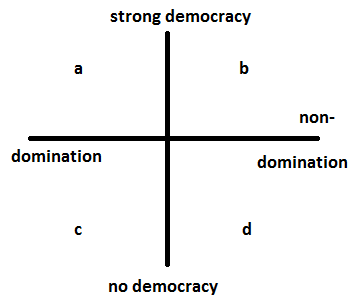
I’ll leave liberal rights aside for this post, although they are important. If we focus on democratic participation (lively debate, mobilized citizens, and a strong scope for elections), then we can view it as theoretically distinct from republicanism. Below, republicanism is on the horizontal axis; democracy on the vertical. Quadrant A stands for a system in which the people rule, yet majorities or popularly elected leaders dictate results without having to justify themselves. B is a society with equal voice and power, where everything is open to debate and no one can dominate anyone else. C is classic authoritarianism: no rules, no voice. And D is a system in which the government is limited and rule-guided and obligated to explain itself, but the people don’t have much of a voice. (Austria-Hungary in 1890?)

It is then an empirical question whether democratic processes tend to accompany republican safeguards. Is B common? Is it even possible?

In the V-Dem database, in 2016, for nations that held elections at all, there was a correlation of 0.4 between the degree to which the executive branch honors constitutional constraints and the degree to which free elections were held without intimidation.

There was a stronger correlation between respect for the constitution and robust public discussion (.53). (This means that that “large numbers of non-elite groups as well as ordinary people … discuss major policies among themselves, in the media, in associations or neighborhoods, or in the streets”).

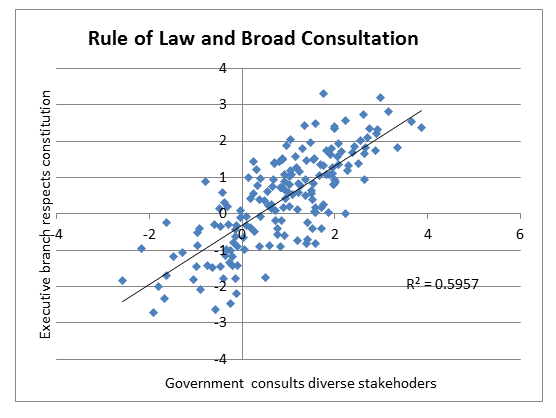
I show here the correlation between respect for the constitution and whether the government consults with a broad range of stakeholders before making decisions (0.6).

These results are consistent with the hypothesis that elections and a strong public sphere help to check arbitrary power. Perhaps limited governments are forced to permit elections, to consult with stakeholders, and to accept robust deliberation.

There are no examples in the world today of strongly rule-guided governments that don’t deliberate at all, nor are there any governments that consult and deliberate widely but pay no attention to constitutional safeguards.

However, the correlations are far from lockstep. Countries do fall in all of the four quadrants, albeit not deeply into A or D. If your values are strongly republican, democratic methods seem to be helpful–but they won’t get you all the way to non-domination. And if your values are strictly democratic, republicanism may get somewhat in your way.

insights on police reform from Elinor Ostrom and social choice theory

Elinor Ostrom was my favorite scholar. Her research was empirically rigorous and methodologically innovative. After working with Vincent Ostrom on water management, she turned to a series of studies of police. Her findings are pertinent today, when crime has fallen but we are (and should be) deeply concerned about racial bias in the criminal justice system.

The topic of policing scrambles ideological lines. Progressives who are otherwise favorable toward governments and unions get leery of police forces and police unions, for good reasons. Some conservatives who are normally concerned about limiting the state suddenly get enthusiastic about the police.

Placing Elinor Ostrom on an ideological map is also tricky. She was deeply influenced by works like James M. Buchanan’s and Gordon Tullock’s The Calculus of Consent: Logical Foundations of Constitutional Democracy, a foundational text of neoliberalism. She opposed centralized control and could be skeptical about redistribution, thus aligning with libertarians. At the same time, she was a committed environmentalist, a defender of indigenous cultures (many of which are not individualist or freedom-loving), and a theorist interested in moving “beyond markets and states”–the title of her Nobel lecture. She was a great proponent of commons and common-pool resources, which are popular on the left. To bring her ideas into the debate about policing offers insights that both sides may be prone to overlook.

Ostrom saw police as consumers and providers of a whole set of “services” (training, forensics, traffic control, patrol, arrests, pretrial detention, investigation, and more). Each unit within the world of policing–whether a forensic lab, a police station, or a specialized investigative team–negotiated with many other units to do its work. Some negotiations were formal, e.g., a town’s police department paying a different city’s forensic lab for services. More often, the negotiations within and among police systems were informal. Citizens were also organized in numerous overlapping ways–towns, counties, states, voluntary associations, juries–that influenced the police.

Ostrom analyzed all this complexity from the perspective of individuals, some of whom might happen to be police officers or other kinds of “professionals.” Citizens–meaning all individuals concerned with solving problems–would generally benefit if: 1) there were many potential providers of services, so that they had some choice, 2) the scale and boundaries of problems matched the scale and mandate of organizations, and 3) they could influence the goals and priorities of the police.

Her main empirical finding was that consolidating police departments reduced the quality of policing–as defined by citizens. Consolidation limited the choice available for services like training and forensics. It reduced the leverage that local police had over larger entities. It kept front-line professionals from being able to define goals and priorities, because they got slotted into larger systems. It kept them from addressing local problems (e.g., dangerous streets) because they had to meet targets, such as numbers of arrests, that came down from bureaucracies. And it blocked citizens in diverse communities from defining what “good policing” should mean.

Public safety (with a dimension of fairness to all) is a common-pool resource. Everyone benefits when it’s provided, but anyone can degrade it by illegally harming others; and lots of people must actively contribute to make it available. Lin Ostrom and her colleagues developed eight design principles that help with the management of common-pool resources, writ large. I  list them below (from this summary) and offer some thoughts about how each applies to policing in the USA.

1. Define clear boundaries. Most police forces and organizations do have clearly defined jurisdictions. The fact that the geographical boundaries around police departments,  sheriffs’ departments, state police, federal agencies, etc. form a complex pattern is probably an advantage, not a source of inefficiency or damaging conflict, according to the Ostroms’ “polycentric” theory. Thus our police systems do OK on this first design principle.

However, if we move beyond “clarity” and use other criteria to assess the boundaries, we see problems. For example, at the time of Michael Brown’s killing, the government and police force of Ferguson, MO were dominated by Whites even though the majority of the city was Black, and the metro area as a whole was better aligned with the Black population than the city was. To put it another way, the borders around Ferguson were unrelated to real patterns of settlement.

2. Match rules governing use of common goods to local needs and conditions. In the US, criminal justice works poorly by this standard. The laws governing citizens–and policies for the police–are set by state legislatures and Congress. Their decisions are not helpful in many specific contexts. For example, criminalizing drugs might have some benefits for reducing drug abuse, but it is harmful in the neighborhoods where drugs are sold.

3. Ensure that those affected by the rules can participate in modifying the rules. Most Americans have a vote and free speech. But we exercise those forms of influence at inappropriate scales and within unhelpful boundaries. A citizen of Baltimore gets a vote in Maryland statewide elections but is outvoted by suburbanites. The police are more accountable to the city and the state than to the specific communities where they work.

4. Make sure the rule-making rights of community members are respected by outside authorities. Here again, mandates by state and federal authorities clearly interfere. In fact, community members are hardly involved at all in making rules in the domain of criminal justice. Common-pool resources rarely survive when this principle is violated.

5. Develop a system, carried out by community members, for monitoring members’ behavior. We have police review boards and other tools for monitoring police. There are some interesting and valuable examples, like Community Policing in Chicago Beat Meetings. Still, my sense is that monitoring is underdeveloped.

6. Use graduated sanctions for rule violators. The general principle is that violations of rules should carry highly predictable costs, but the costs should start low. If punishment begins at a draconian level, not only may the perpetrator be unduly harmed, but the community is likely to excuse some violators entirely. A first-time offender should be able to pay the price and then be completely embraced by the community. Although penalties should start low, they should rise steadily with repeated infractions. For both law-breakers and police, this principle is almost uniformly ignored in American criminal justice.

7. Provide accessible, low-cost means for dispute resolution. In the context of criminal justice, that would mean helping citizens to resolve disputes without necessarily involving the police. It would also mean allowing citizens to resolve their disputes with the police without filing federal lawsuits. Both opportunities seem sorely lacking, despite important exceptions.

8. Build responsibility for governing the common resource in nested tiers from the lowest level up to the entire interconnected system. We do the opposite. Mandates flow down from states to cities to neighborhoods; and Congress influences the whole system without much accountability.

In short, criminal justice in the United States is a commons problem that we manage in ways that violate almost every principle for the management of common resources.

Because my concern is with racial injustice, I have no interest in marginalizing racial analysis of policing. However, it is important to structure institutions well. If we assume that the majority population is prone to treat minorities unfairly, that is an extra reason to design the rules right. We should also work on reducing racial bias, but we’d have to be awfully optimistic on that front not to give primary attention to institutions. The design principles are particularly important when we have good reason to mistrust some key actors.

I think restructuring criminal justice in line with common-pool management principles is a promising alternative to “abolition.” To be sure, we should ask the critical question, Why do we employ armed and uniformed paramilitary organizations to keep the domestic peace? The idea of abolishing police is worthy of debate. However, wholesale social transformation has a pretty poor record of success. Restructuring is a better place to start.

By the way, this approach is compatible with recognizing that American police serve many people in many communities very well. We needn’t reorganize everywhere, and we may be able to learn from the better examples.

Finally, this approach has the great advantage of viewing public safety as the job of many actors, of which the police are only one. There is growing evidence that voluntary citizens’ efforts are important for reducing crime. In an American Sociological Review article, Sharkey, Torrats-Espinosa, and Takyar find that “every 10 additional organizations focusing on crime and community life in a city with 100,000 residents leads to a 9 percent reduction in the murder rate, a 6 percent reduction in the violent crime rate, and a 4 percent reduction in the property crime rate.” That finding fits very nicely with the Ostroms’ theory. Vincent Ostrom told my friend Paul Aligica:

We do not think of ‘government’ or ‘governance’ as something provided by states alone. Families, voluntary associations, villages, and other forms of human association all involve some form of self-government. Rather than looking only to states, we need to give much more attention to building the kinds of basic institutional structures that enable people to find ways of relating constructively to one another and of resolving problems in their daily lives.*

The problem with policing is that we have not built structures that allow people to relate constructively across lines of race (and class) in order to resolve the problems that they define as important.

*V. Ostrom to P. Aligica, 2003, in Vlad Tarko, Elinor Ostrom: An Intellectual Biography, p. 49. See also: Ostrom, Habermas, and Gandhi are all we needHabermas, Ostrom, Gandhi (II) or this video that explores Ostrom along with other “Civic Studies” thinkers.