Category Archives: fine arts

history and fiction in Hilary Mantel’s A Place of Greater Safety

A passerby hesitated, stared. “Excuse me–” he said. “Good citizen–are you Robespierre?
Robespierre didn’t look at the man. “Do you understand what I say about heroes? There is no place for them. Resistance to tyrants means oblivion. I will embrace that oblivion. My name will vanish from the page.”
“Good citizen, forgive me,” the patriot said doggedly.
Eyes rested on him briefly. “Yes, I’m Robespierre,” he said. He put his hand on Citizen Desmoulin’s arm, “Camille, history is fiction.”
Hilary Mantel, A Place of Greater Safety

Like her Booker-Prize-winning books Wolf Hall and Bring up the Bodies, A Place of Greater Safety is a historical novel in which lawyers best known for beheading tragic heroines (Anne Boleyn, Marie Antoinette) are among the protagonists. In its form, its topic, and even its quality, A Place of Greater Safety also bears comparison to War and Peace, although Mantel does not advocate an elaborate conceptual scheme comparable to Tolstoy’s. In the afterword, she writes, “I am not trying to persuade my reader to view events in a particular way, or to draw any particular lessons from them. I have tried to write a novel that gives the reader scope to change opinions: a book that one can think and live inside.” Until I finished the novel on Saturday, I was so deeply inside it that now I mourn the characters, even Robespierre.

As the quotation cited above suggests, Mantel is interested in the relationship between history and fiction. The most obvious difference is that history is true and fiction is false. But even if one insists on facts (as I do), the distinction is more complicated than that. Robespierre really walked down the streets of Paris. The passage above is fiction because Mantel has imagined the scene. (However, Mantel frequently has the characters state real quotations from their works, on the theory that “what goes onto the record is often tried out earlier, off the record.”) Within the fiction of the book, it really is Robespierre whom the patriot recognizes: that is a fact, not a mistake.

But what does it mean to say “Robespierre”? Does one mean The Incorruptible, the great civic republican moralist and statesman? Does one mean the villainous author of the Terror? Historians still debate who Robespierre was, even given the vast evidence that survives. And, according to Mantel, Robespierre wasn’t sure himself. Not only is the truth perspectival in the sense that each of us observes from a distant and limited vantage-point, but we are not even sure how to view ourselves. The meaning of the word “Robespierre” changes for Robespierre from minute to minute. His name did not vanish from the page, as he predicts above, but the fullness of his experience did.

It’s worth comparing the actual French Revolution to the contents of this novel. One difference is scale. Twenty-eight million people were alive in France in 1792. Each lived a continuous stream of consciousness and formed passionate, complex, incomplete, and often invalid views of scores of other people, for a total of billions of relationships. The scale of a novel is necessarily much smaller. I count roughly 136 named characters in A Place of Greater Safety, not counting crowds and generic figures like “the patriot” (above).

In real life, the action was continuous and simultaneous, all those millions acting and thinking at once. In contrast, Mantel writes almost entirely in set-pieces. Each scene takes place at a geographical location and involves between one and a dozen named people. Each scene is set after the previous one in chronological order, but usually after a gap of hours, days, or even months. So, whereas history flowed smoothly and simultaneously, the novel jumps from set-piece to set-piece.

Reality has no narrator. Mantel narrates in a supple, subtle, deliberate style. For instance, consider this sentence: “He put his hand on Citizen Desmoulin’s arm, ‘Camille, history is fiction.'” Since Robespierre was a boyhood friend of Demoulin’s, he never addresses him as “Citizen Desmoulin.” The title “Citizen” enters the narration here because “the patriot” has been addressing strangers that way, and Robespierre sees his friend from the patriot’s perspective at that moment. But he begins is sentence with the name “Camille …,” and within three words, we are back to a more intimate view. The title “Citizen” evokes layers of irony as we read Mantel’s narration of Robespierre’s thoughts in reaction to a nameless patriot who is using terminology invented by men like Robespierre.

As Mantel writes in the afterword, “I am very conscious that a novel is a cooperative effort, a joint venture between writer and reader. I purvey my own version of events, but facts change according to your viewpoint. Of course, my characters did not have the blessing of hindsight; they lived from day to day, as best they could.” To imagine their experience sympathetically (when the characters in question include Danton, Demoulins, and Robespierre) is a great achievement of sympathy. But the book is not devoid of judgment, on the false theory that “tout comprendre, c’est tout pardonner.” Like Cromwell at the end of Bring up the Bodies, Robespierre in the last chapter of A Place of Greater Safety is a chilling figure, all the more frightening because Mantel has made him so human until then.
Seamus Heaney, 1939-2013

Many people are contributing memories of “Famous Seamus.” I will not claim any great insight, and certainly no important interactions with the poet, although he, his wife, and I did wait on a freezing pitch-black Oxford winter morning for the bus to Heathrow, ca. 1990. This is the wife to whom he texted his very last words: “Noli timere” from the Gospel of Matthew:

And when the disciples saw him walking on the sea, they were troubled, saying, It is a spirit; and they cried out for fear.

But straightway Jesus spake unto them, saying, Be of good cheer; it is I; be not afraid. (Mathew 14:26-7)

I don’t think Heaney was identifying himself with Jesus. He was just recalling the Latin for “be not afraid” from his childhood of school and church. But he was an insightful reader of the New Testament, pointing out, for example, that it was Jesus’ bare act of writing that saved the “Woman Taken in Adultery.”

And again he stooped down, and wrote on the ground.

And they which heard it, being convicted by their own conscience, went out one by one, beginning at the eldest, even unto the last: and Jesus was left alone, and the woman standing in the midst (John 8:8-9)

Heaney said that poetry, like Jesus’ mysterious and quiet writing, “holds attention for a space, functions not as distraction but as pure concentration, a focus where our power to concentrate is concentrated back on ourselves.” Poetry puts us in the “Republic of Conscience.”

People seem to like my discussion questions prompted by Heaney’s magnificent poem of that name. That post has had 1,300 unique visitors, including a burst of readers just lately. I first heard “The Republic of Conscience” in the soft Irish lilt of Mary Robinson, formerly president of Ireland and UN High Commissioner for Human Rights, who read it at a conference. It belongs to Amnesty International because Heaney gave AI the copyright. Looking back over my blog, I also find that I’ve reviewed Heaney’s translation of Beowulf, quoted his commentary on terrorism from his Nobel Lecture, quoted him on the liberating power of poetry, and ruminated on what it would really mean to live in a republic of conscience. That is a fair amount to have written about one poet on a civics blog, so I am satisfied I have done my bit to memorialize this great man.

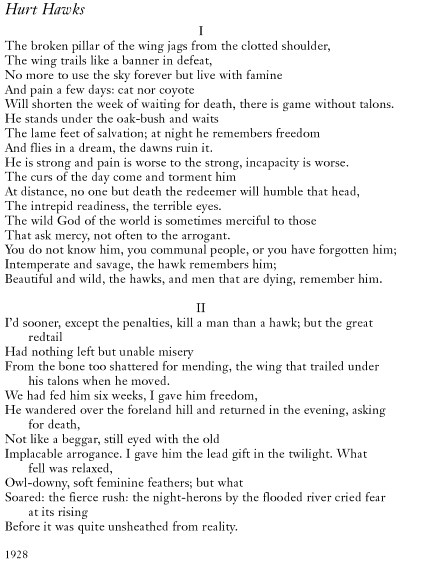
Robinson Jeffers, Hurt Hawks

Screen Shot 2013-05-19 at 4.46.51 PM

Robinson Jeffers’ son kept a wounded hawk as a pet for a few weeks in the 1920s. Jeffers wrote part 1 of this poem as a complete work before he killed the bird, adding part 2 later. It is famous for the line, “I’d sooner, except the penalties, kill a man than a hawk.” Since he did shoot the hawk, Jeffers is either very sorry about what he did or he doesn’t much care for human life.

Part 1 is descriptive and relatively impersonal. There is no first-person verb and no report of the narrator’s relationship to the bird. We are addressed (as “you communal people” who have forgotten “the wild God of the world”). We have access to the hawk’s inner life, knowing what he dreams of and what god he follows. The hawk does not understand us. I think “game without talons” refers to the food that the hawk is offered by his human captors, without his having to hunt it. The bird doesn’t grasp the meaning of the gift or the people’s intentions; he knows the meat by its bare description. “There is game without talons” is free indirect discourse, the hawk’s perspective taking over the narration.

Part 2 introduces the narrator’s voice and relates how he acted, in three steps: “We fed him for six weeks. … I gave him freedom. … I gave him the lead gift. …” Now the relationship between man and bird is central. The man tries to liberate the hawk, but you can’t give  freedom to another creature. The bird returns asking for death. The man does what he is asked. At the end, he holds the dead bird, reduced to a soft object.

This poem has been criticized as didactic. In verse, you are supposed to show, not tell–or so the modernists insisted–but this poem makes general points in the voice of Robinson Jeffers. But is the author serious about the views he expresses here? For instance, did the hawk really ask for death? (Does a bird understand the concept of death as applied to itself, and can it know that a human being might put it out of its misery?) Is there actually a wild God that is merciful to the weak but not to the arrogant?

If the answer to any of these questions is negative, the poem starts to look much more complicated. We do not know what the bird thinks, only how it behaves. We have the testimony of the man about what he has seen and done, but we cannot take any of that for granted. The man has imputed ideas to the hawk and become the god of the bird’s small world. He is in complete control of what we know, just as he controls the animal’s life.

I read the poem not as a didactic statement about nature and life, but as as the unreliable report of a narrator who is unsure whether he should have killed his son’s pet hawk. That narrator is not necessarily Robinson Jeffers. We know that the poet really shot a hawk, but he might have done so without much emotion and derived the idea for a fictional story from the event. All we have is the story with its shifting, partial perspectives and ambiguities.

(By the way: why “Hurt Hawks” instead of “Hurt Hawk”? Why is the wild God capitalized?)

the generational politics of Turgenev’s Fathers and Sons

Novels of multiple generations provide excellent vehicles for exploring changes in politics and culture. That is certainly true of Turgenev’s Fathers & Sons (more literally, “Fathers & Children”), published in 1862. Two friends return from college to the rural province where they were children and move together from one household to the other. That creates a set of about 10 relationships between the young friends and the older people in their two families. Nearby is a third country house that belongs to two lovely and available young women. A marriage plot–or even a dual marriage–seems likely, but I will not spoil the conclusion by revealing whether the novel turns into the comedy that the beginning promises.

Turgenev actually belonged to the parents’ generation in the novel. In his youth, the only opponents of the Czarist regime and critics of serfdom had been liberal aristocrats. The middle class had been too small and weak, and the peasants too oppressed, to resist. The liberal aristocrats of Turgenev’s generation were brutally suppressed and achieved little politically. But by the sixties, the regime was loosening and real reforms seemed attainable. Serfdom was actually abolished in 1861. Meanwhile, a new political class arose: commoner sons of priests and lawyers who could obtain university educations. They were angrier, more alienated, more drawn to radicalism, and more ambitious than members of Turgenev’s generation has been.

In Fathers & Sons, Yevgeny Vasil’evich Bazarov represents the new cohort. He is a self-described “nihilist,” having no elaborate positive vision but much resentment, irony, and anger. He is a scientist who believes–if he believes in anything–in facts. He comes from humble origins and likes to think he can relate to the peasants, although they laugh at him behind his back. He is attracted both to an heiress and to a servant girl. His admiring young friend Arkady Nikolaevich Kirsanov comes from the gentry and has no political views of his own. One question is whether he will follow Bazarov or return to the life that is expected of him: marrying a respectable lady and presiding over a country estate.

Fathers & Sons is unusual in depicting the passionate love of parents for their grown children. In romantic fiction, a suspenseful question is whether the protagonist’s love will be requited. In this novel, the same question arises for the fathers and the surviving mother. Will their sons give them attention and affection and choose to live in their homes, or will these young men disdain their old-fashioned beliefs and ride away? Perhaps Turgenev is asking the same question about the whole generation that follows his.

Turgenev was strongly criticized by both the moderates of his generation and the radicals of the next. Neither faction liked the way it was exemplified in Fathers & Sons. That is because all the characters escape simple stereotypes, positive or negative. Bazarov, for example, could be cursorily described as an angry young sophisticate who returns from college to mock the bourgeois old folks in his home town. Except that he really loves his parents and has as much contempt for himself as for them.

I see Fathers & Sons as “liberal” in the sense promoted by Lionel Trilling, Vladimir Nabokov, Isaiah Berlin, Richard Rorty, and others in their tradition. Depicting subtle and unpredictable characters is a political statement, because this is Turgenev’s view of a good society: one in which all people (including the peasants) are able to develop their individuality and in which each person appreciates the others for who they are. On one hand, that stance made Turgenev a bitter critic of Czarism and serfdom; he suffered imprisonment and exile for his politics. On the other hand, it prevented him from satirizing or stereotyping anyone in order to make a political point. The novel is suffused with the empathy and kindness that its author wants for his country.

a translation for spring

Dante sought his last refuge in Ravenna at the invitation of Count Guido Novello da Polenta (?-1320). According to Boccaccio, Guido was a person “well tutored in liberal studies” who honored “worthy men and especially those who exceeded others in knowledge.” Dante served Guido in various important capacities, including possibly as professor of rhetoric. He died as a member of the count’s household, having just completed a crucial diplomatic mission to Venice on Ravenna’s behalf. Guido organized a solemn funeral for Dante and had the poet buried in a classical sarcophagus in the local monastery of San Francesco.

Dante chose Guido’s own aunt, Francesca da Rimini, as a major character in the Inferno. Romantic-era critics saw Francesca as a doomed heroine, suffering because her love had violated arbitrary conventions and oppressive rules. I argue (along with several modern critics) that she is supposed to be a real sinner. Dante has placed her in hell because she deserves her punishment for adultery, and besides, she doesn’t really love Paolo, whom she describes with a pastiche of slight misquotations taken from love poetry. She is a 14th-century Madame Bovary, in love with the literary concept of love, not with the individual man.

But back to Guido: Intriguingly, he wrote a minor poem that contains a striking phrase that Francesca also utters (almost verbatim) in her last lines to Dante in hell. Either Guido borrowed the phrase that was spoken by his own dead-and-damned aunt in Dante’s already-famous poem, or else Dante read Guido’s poem before he wrote the Inferno and had Francesca quote it. Since almost everything else Francesca says in the Divine Comedy is a slight misquotation, I am inclined to think the latter is true: Dante took a line from his friend’s naive ingenuous sonnet and assigned it to a sinner in hell.

I make no great claims for Guido’s poem, and less for my translation, but I offer it today because the Boston weather reminded me of it. It’s in my Dante book, pp. 17-18:

The air was serene and the sky was clear
And the birds by the river sang.
That day was the first that felt like spring
When I saw you, my joy, so fair.
Your face wore an unaccustomed blush
That never leaves my thoughts today
And whenever I travel far away
Your pleasing smile seems to rush,
Gently launched toward my heart
By the look that comes to your pretty eyes,
And the smile that so sweetly flies
To blend with mine and never part.
Now she can never be torn away;
Joy shall spare me from misery.

Era l’aer sereno e lo bel tempo
et cantavan gli augei per la rivera
et in quel giorno apparve primavera
qand’io te vidi prima, bella gioia.
Ben fosti gioia, chè tal m’apparisti
e col novo color nel tuo bel viso
che già da la mia mente non se parte.
E quando sono in più lontana parte
più mi sovvien del tuo piacente riso.
Sì dolcemente nel mio cor venisti
per un soave sguardo che facesti
dal tuoi begli occhi, che mi mirar fiso
sì che già mai da te non fia diviso,
tanta allegrezza mi dà fuor di noia.

(cf. “che non mai da me no fia diviso”: Inferno v, 133-5).