Category Archives: Uncategorized

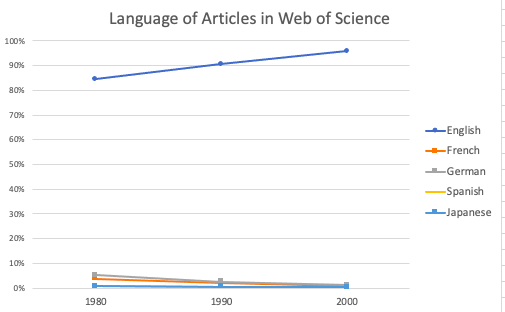
Graph: Web of Science citations by language, data from Bordon ans Gomez 2004

English dominance in academia

On a recent quick trip to a smallish European country (Czechia), I was reminded of the dominance of English in broad reaches of academic life.

We Anglophones have the privilege of being able to travel almost anywhere and enjoy rich discussions in our native tongue. This also means that English idioms and conceptual schemas are hugely influential, while specialized vocabulary can lag in other languages. And most of the world’s people face an additional burden when they try to use research: it’s mostly in English. As a Quebecois scholar writes (Lord 2023):

«Cette internationalisation de l’enseignement présente également quelques défis, importants notamment celui de préserver une culture nationale en recherche et un accès à la recherche scientifique dans les communautés locales.» (“This internationalization of education also presents some important challenges, notably preserving a national research culture and access to scientific research in local communities.”)

In many countries, citation counts are used to assess individual scholars and whole universities. That method is always problematic, but an additional problem in most of the world is that papers published in English–and in English-language journals–almost always have higher counts. In fact, controlling for other factors, English is statistically related to the number of times an article is cited (Di Bitetti & Ferreras 2017).

Two Spanish scholars (writing, not surprisingly, in English) calculate the trends captured by the Web of Science from 1980 to 2000. I present their data in the graph with this post. Overall, English represented 84.5% of all articles in 1980, rising very smoothly to 95.9% in 2000. Spanish–which has more than half a billion native speakers–is invisible on my graph, with 0.3% of all articles in 2000. (Bordons & Gomez 2004). The authors don’t calculate Chinese or Hindi.

In countries whose languages were never widely spoken, university life was always conducted in one or more foreign languages. Latin yielded to French or German, before shifting to English after WWII. But even languages that have hundreds of millions of speakers and/or international prestige seem endangered today in academia. Bordons and Gomez calculate that 59% of articles by French authors, and 62% by German authors, were written in English in 1980, rising to 89% and 90% (respectively) by 2000. I haven’t found more recent statistics, but that trend would lead to an English monopoly if it continued.

These data come from Web of Science. Although that database includes humanities, social sciences, and law, it tilts to the STEM fields, as do all citation counts. My own humanities and social science articles from the last few years are sole-authored publications that required many weeks of my work, and they will not receive any citations for quite a while. Being cited requires another scholar to read the piece, write an article that cites it, and then navigate a publication process that can take years. In contrast, I was part of two public health publications in 2022, along with co-authors. Each required hours of work from me. Just months after appearing, they already have 19 published citations between them. STEM simply involves a much higher volume and faster pace, basically swamping the humanities in numerical terms.

I mention this point about STEM because any data about publications will likely underestimate the humanities, where the written languages are probably more diverse. I find that when I want to know about specific works of art or literature, Google Scholar will often yield results in languages other than English. Nevertheless, English is dominant in academia as a whole, and its share appears to be growing.

References: Lord, F. R. (2023). La communauté universitaire sous tensions: analyse des dynamiques de communication et de gestion entourant la création d’une université (Doctoral dissertation, Université du Québec à Trois-Rivières); Di Bitetti, M. S., & Ferreras, J. A. (2017). Publish (in English) or perish: The effect on citation rate of using languages other than English in scientific publications. Ambio, 46, 121-127; Bordons M and Gomez I. 2004. Towards a single language in science? A Spanish view. Serials 17: 189–195
a clearinghouse to make political contributions anonymous

At the Institute H21 symposium last week in Prague, Stein Ringen described his proposal for a campaign finance clearinghouse. I gather Ringen also defends this idea in How Democracies Live: Power, Statecraft, and Freedom in Modern Societies (Chicago, 2022), which I have not yet read. My summary is based on his talk alone.

The idea is that you could give money (up to the legal limit) to candidates, but you would have to make your contributions through a clearinghouse that would transmit the funds to your chosen recipients without telling them who gave them the money.

Normatively, this proposal accepts that individuals have a right to support communications by their favored candidates. Like Ringen, I am unsure I agree with this premise, but it has been upheld by the US Supreme Court since 1971 (in Buckley v Valeo). Also, there are times when being able to support insurgent candidates with many smallish contributions increases competition and challenges incumbents.

At the same time, the proposal denies that candidates should be able to tell who gave them money, because contributions should never purchase access, goodwill, or influence.

Ringen said that he would allow contributors to inform candidates that they had given money. That’s a form of speech that would probably be protected by the US Supreme Court (and I am generally skeptical about banning speech and then policing the ban). However, the clearinghouse would make such communications quite noisy. Many donors would not take the trouble to inform candidates that they had given, and some would lie about having done so. They might even falsely tell both sides that they were financial supporters. As a result, candidates would have a much more ambiguous picture of who was supporting them financially. And that ambiguity would be good.

The secret ballot has a similar rationale. You can might want to bribe or coerce other voters, but you can never tell how they actually voted, because you cannot see their ballots. Privacy blocks the emergence of markets for votes. The same could happen to campaign finance if the money flowed through a clearinghouse.

sexual politics in Milan Kundera’s Laughter and Forgetting

While on a quick but lovely trip to Prague–and since Milan Kundera had died recently–I decided to read a book that I had not read before, Kundera’s The Book of Laughter and Forgetting (translated from French by Aaron Asher).

It is a set of linked stories with some essay-like passages, “a novel in the form of variations” (p. 227). The stories constantly recombine leitmotifs: the acts of laughter and forgetting that are named in the title plus dancing (especially in circles), caches of letters, literary writing, and sex. I think the novel as a whole avoids any theory–any consistent and organized way of combining its major themes that might reflect a truth about the world. Instead, it plays with them. Perhaps the resistance to theory and the embrace of free play is itself a theory of both literature and politics, a kind of liberalism that emphasizes the right to have and to express a complex and individual inner life.

The gender binary is very evident, and there is a lot of sex as well as some rape. The most admirable characters are women; most of the men are pretty bad. But the women are mostly defined by their relationships to male lovers.

For instance, exiled in France, Tamina is surrounded by privileged bourgeois citizens of a free republic who want to express themselves in writing (for the sake of being writers), bend her ear with their concerns, or have sex with her, and none of them is willing to assist her at any personal cost. The narrator says:

[This] is a novel about Tamina, and whenever Tamina goes offstage, it is a novel for Tamina. She is its principal character and its principal audience, and all the other stories are variations on her own story and meet with her life as in a mirror (p. 227).

One of Tamina’s admirable features is her steadfast love for her late husband, an exiled Czech dissident/writer–someone who sounds rather like Milan Kundera, albeit with a shorter lifespan.

Tamina doesn’t have much of an agenda: cultural, political, or otherwise. That’s fine; she’s just trying to live her life. But one gets that sense that this is not really “a novel about Tamina.” It’s a novel about someone like Kundera, as seen by his devoted wife. Indeed, as a deceased Czech dissident, Tamina’s husband is now purely good–a figure worthy of grief who cannot possibly do any harm. Tamina strives to preserve his memory.

The narrator writes:

The gaze of a man has often been described. It seems to fasten coldly on the woman, as if it were measuring, weighing, evaluating, choosing her, as if, in other words, it were turning her into a thing.

Less well known is that a woman is not entirely defenseless against that gaze. If she is turned into a thing, then she watches the man with the gaze of a thing. It is as if a hammer suddenly had eyes and watched the carpenter grip it to drive in a nail. Seeing the hammer’s malicious gaze, the carpenter loses his self-confidence and hits his thumb.

The carpenter is the hammer’s master, yet it is the hammer that has the advantage over the carpenter, because a tool knows exactly how it should be handled, while the one who handles it can only know approximately how (pp. 285-286).

Could this be reversed, to talk about a woman’s gaze at a man? Could the hammer think about anything other than the carpenter?

I cannot address the whole of Kundera’s oeuvre, let alone his peers and influences, but I did find this general thesis in Matonoha (2014):

The reduction of women to objects, which are observed or used by male subjects, is a conspicuous feature of Czech prose. By the same token, this classic feminist critical topos (man in the position of a subject, woman reduced to the position of an object) is further internally structured in Czech prose. Generally speaking, the following model is more or less repeated: at first glance — objectification, reification, fetishization, trivialization; on a second plane — proving that the male character is misunderstood, reduction of the female character, and the uncovering of his existential dependence on a loving female character; however, it is the next, higher, plane that uncovers the real, unreflected patriarchal and androcentric groundwork of the whole epistemological and ethical complex. Therefore, the model does not only include banal sexism and scopophilia (although they are plentiful) but also, on the second plane, paradoxically flattering and therefore even more treacherous identities …

Matonoha discusses Lucie from Kundera’s The Joke (1967) as the novelist’s first example of a recurrent type, the “idealized silent woman.” This also seems to be Tamina’s role in The Book of Laughter and Forgetting. And the narrator tells us that she is the center of that whole book.

Kundera is a political writer insofar as he sees state communism as hostile to individual flourishing. His female characters are among the victims of that system. But he seems to miss the possibility that they are also oppressed on account of their gender and that men like him can play a role analogous to the state’s.

Source: Matonoha, J., 2014. Dispositives of Silence: Gender, Feminism and Czech literature between 1948 and 1989. In The Politics of Gender Culture under State Socialism (pp. 162-187). Routledge. See also: Ivo Andric, Bosnian Chronicle, Or, The Days of the Consuls; The Dictionary of the Khazars, pro and con; Vaclav Havel

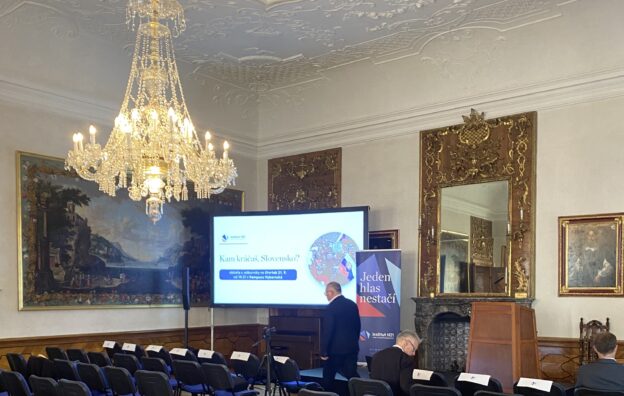
Meeting venue in Prague

visiting Prague

I’m briefly in Prague for a valuable symposium on “Democracy in the 21st Century: Challenges for an Open Society” organized by the Czech political research and reform group called Institute H21. I will share substantive ideas from the conversation when I’m home. In lieu of new comments about this beautiful city, I’ll share a link to an introduction I wrote during a longer visit here in 2008. Sometimes, I find my own writing from that long ago cringe-worthy, but I think this mini-essay about how to “read” the city of Prague holds up OK and may have some value for other visitors.

the progress of the king (note #4 from the Levine library)

Last week I wrote about my copy of the Rheims-Douai Bible, an English translation made by Catholics in 1582 and smuggled into Protestant England for Catholic laypeople to read. One of the translators, Edmund Campion, is now a saint, tortured to death for his secret work in England.

This Bible refutes the widespread myth that Catholics opposed translating and disseminating scripture. I think the myth sticks as a result of Protestant propaganda plus a desire to believe that religious bodies typically seek to control knowledge whereas technology (in this case, the printing press) liberates it.

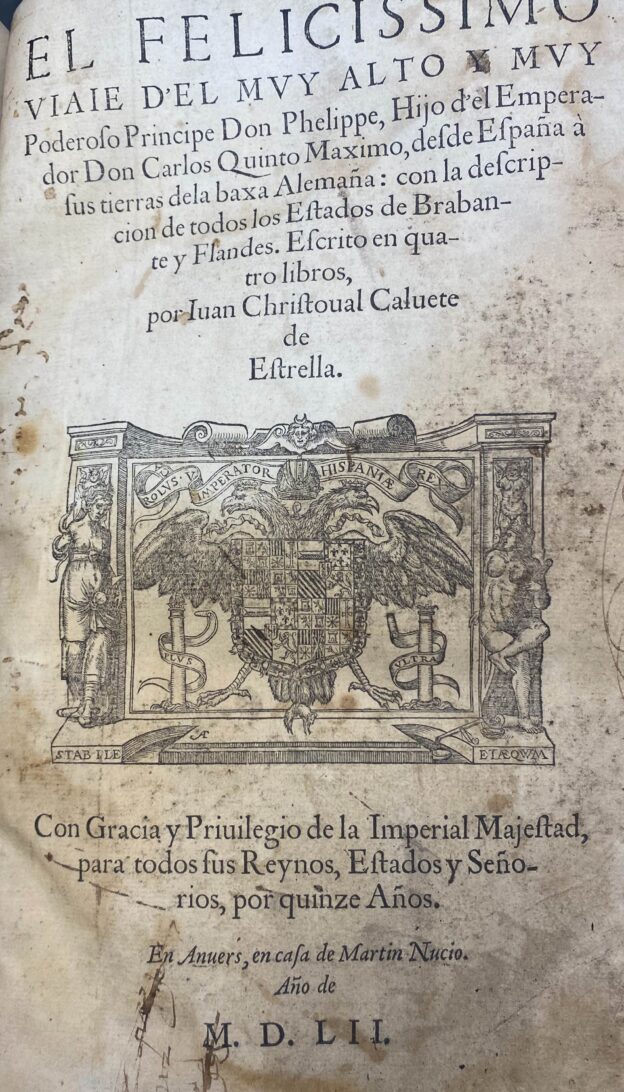
I mentioned in passing that this Bible was printed in Douai, now a city in France, which then belonged to Philip II. I also inherited from my father a 1552 volume that describes some possessions of that monarch, who later became King of Spain, King of Portugal, King of Naples and Sicily, officially the King of England and Ireland for a few years, Duke of Milan, Lord of the Seventeen Provinces of the Netherlands, and the colonial ruler of the Americas from New Mexico to Peru. In my translation from the Spanish, it’s entitled The Most Happy Journey of the Highest and Most Powerful Prince, Don Philip, Son of the Emperor Charles V the Great, Through Spain and His Lands in Lower Germany, With a Description of All the Estates of Brabant and Flanders.

Douay is presented on pp. 161-3. It is a “very good and well-favored [suerte] town of Gallic Flanders on the banks of the River Scarpe.” It is the site of a “good monastery” that has produced several saints. Its jurisdiction extends over many nearby villages. In mid-paragraph, the text then launches into a description of the visit by the young Philip with his father, Charles V, “who came to eat at Orchies [now in France], which was made very fresh and special with fruits and bouquets, strewn in the streets as a sign of welcome, and there the prince first ate before entering Douay. … Out of the town came the burgomasters, knights, and counselors, very well accompanied, and in the field beyond was a flag with [pisaros – ?] and drums, and there were three hundred soldiers very well ordered in colorful arms and clothing, yellow and white, and at the gate of the city the clergy processed …” — and so on for a couple more pages.

The aim is evidently propagandistic, which doesn’t imply that the authors were insincere. Perhaps they thought that Philip was a “most happy” prince of a happy empire. He did, however, face a massive uprising in his Low Country dominions.

This book was written three decades before the English Bible was printed in Douai/Rheims, but it gives a flavor of the times, which were still feudal and chivalric.

See also: A 1582 Catholic translation of the Bible into English (note #3 from the Levine library)