Category Archives: Uncategorized

the aspiration curve from youth to old age

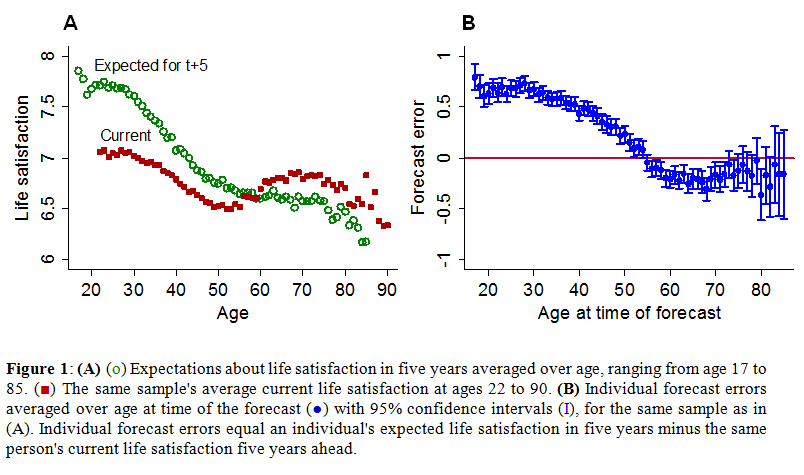
This is a interesting pair of graphs produced by an economist named Hannes Schwandt. Graph A shows people’s reported life satisfaction at each age (the square dots) and their expectations for how satisfied they will be five years later (open dots). Most young people expect to see dramatic improvements in the near future, whereas older people expect to be worse off after five years. But their actual (self-reported) satisfaction does not climb and then fall off in old age. Quite the contrary: it falls and then rises. Graph B shows the error in their predictions: they are substantially too optimistic until about age 50, and then too pessimistic from age 60+ (although life takes so many directions in the last decades that a few people err on the side of excessive optimism).

Schwandt thinks that the U-shaped curve in our subjective life-satisfaction results from errors in expectations. Although people of all ages hold diverse views, many young adults feel that they are not yet getting what they want from life (money, security, positive impact, love, sex, or whatever). Many expect to get all this in five years. In middle age, the same people are disappointed not to have seen their expectations met and rate themselves dissatisfied. This is the notorious Midlife Crisis. They also expect life to get worse–it won’t offer important new satisfactions or successes, but their health will decline as their years  run out. Instead, life does offer new rewards in the later decades, and so people are pleasantly surprised. Mean self-reported satisfaction is the same at age 70 as it was at age 30 (and much higher than it was at 50).

For those of us who work primarily on issues of youth, this is a challenging theory. It suggests that young people’s expectations are often so high as to cause distress later. This pattern certainly does not affect everyone. We found that before teenagers enter YouthBuild, just 30% expect even to live to old age. YouthBuild raises their hopes to the point that 90% of its graduates expect to live past 65. That is clearly a success. The U-curve may be a “first world problem,” affecting people whose teenage years have gone reasonably well. It is still a problem, however, and I have never seen an effort to address it. Maybe encourage young adults to read Stoic or classical Indian philosophy?

who is oppressed? a question for researchers

Let’s say you want to conduct research in a way that is “anti-oppressive.” Certain techniques and emphases will seem valuable. But a preliminary question arises: Who is oppressed? And that raises the deeper question: What is oppression?

In an article entitled “Anti-Oppressive Research in Social Work: A Preliminary Definition,” Roni Streier, an Israeli academic, offers a helpful summary of Anti-Oppressive Social Work Research (AOSWR), which turns out to be a well-established movement.* AOSWR emphasizes “the systemic study of oppression and the development of knowledge that supports people’s actions to achieve freedom from oppression.” It selects for investigation “the most oppressed populations that are largely excluded from main spheres of public and economic life and disconnected from social services.” It “reject[s] the dominant traditions of social science research” in favor of “more qualitative, ‘bottom-up’, interpretive methods.” It demands safe, reciprocal, mutually respectful partnerships between the researchers and the participants, working together to produce knowledge. And it yields research that will be owned by the communities being studied and that will lead to action.

I read all of this happily enough. Although I don’t want all research to be “community based” and participatory, I like the kind of work that Streier describes. But then she offers a case study: research on and with low-income Jewish women in Jerusalem.

I do not know this community. In fact, one limitation of my study trip to Israel and the West Bank last year is that I met secular middle-class Jewish Israelis, Arab Israelis, and West Bank Palestinians, but no ultra-orthodox. Thus I cannot be sure that poor Jewish women in Jerusalem are ultra-orthodox–although I suspect most are–nor do I understand their daily lives, values, and aspirations.

But I would not start by defining them as “the most oppressed population” in their geographical area. Perhaps biased by secular Israeli and Palestinian perspectives, I would view them as a community complicit in oppressing Arabs and strongly favored by Israeli state policies regarding welfare, education, and the draft. My instinct, if I were an anti-oppression scholar with an interest in this community, would be to stand apart from them and critically assess their privileges. To be sure, they are poor and they are women, but what jumps out at me is their political power.

On the other hand: I may be wrong in my diagnosis. And even if I am right, understanding how and why they think as they do might be helpful. Just because they have power, one should understand how to influence them and negotiate with them. That is a case for investigating this population with an open mind. But it doesn’t sound like “anti-oppression research.”

So the unavoidable question is: who’s oppressed? That breaks down into many subsidiary questions, of which a few are:

  • What is the relevant community? If one defines the community as Israel, then perhaps poor Jewish women are oppressed. If one defines it as Israel plus the Occupied Territories, then these women move far up the scale. Which geographical scope to use is highly controversial (but that does not mean that judgments of the matter are arbitrary opinions).
  • In what ways can people be oppressed? Individuals were chosen for this example on the basis of income or wealth and gender. But if they are really ultra-orthodox, then their families are foregoing income in favor of religious study and intense communalism. Are they “poor”? Does that matter?
  • What do they want? Self-interest is not self-evident; human beings want all kinds of things, including subservient positions within their own communities and limited freedoms. If a group of highly-religious women favor traditional gender roles, does that make their circumstances OK? Should our research about them be “bottom-up” and driven by their values? Or would anti-oppression research aim to broaden their options?

*British Journal of Social Work (2007) 37, 857–871

upcoming public talks

  • 11/20, 4pm, Hood College in Frederick, MD: book talk on We Are the Ones We Have Been Waiting For
  • 11/21, 9:30-10:45 am, Washington, DC: panel at the National Communication Association Conference on “Rethinking Foundations of Youth Engagement: Challenges and Possibilities of Young Citizen Engagement in Research and Practice”
  • 11/22, 9:00–9:55 am, St. Louis, MO, panel on “New and Exciting Research to Inform Civic Learning Classroom Practices” at the National Council for the Social Studies annual conference (with Diana Hess and Walter Parker)
  • 11/23, 10:30-11:30, St. Louis, MO, National Council for the Social Studies solo session on “Civics in the C3 Framework”
  • 12/4, 12:45-2:00pm, Boston, panel on “Measuring Civic Engagement,” at NEASC, the New England Association of Schools and Colleges.
  • 1/10, all day, New Orleans, mini-conference on civic studies, including an author-meets-critics session on my book.
  • 1/22, 6-30-8:30 pm, Washington, DC, Busboys & Poets book talk on We Are the Ones We Have Been Waiting For

what are the humanities? (basic points for non-humanists)

(Indianapolis) I am here for a meeting about the public purposes and social impact of the humanities. All the participants will be sophisticated about the humanities as practiced inside and beyond universities. But often I participate in conversations about the social purposes of academia in which I am the only humanist. I find that many professors in the social sciences, natural sciences, and professional disciplines fundamentally mistake what the humanities are about and cannot imagine a plausible public role for humanists. They may suggest, for example, that humanists should write stories that convey the importance of social issues. That is not what humanists do. Here are some very basic points about the humanities that I would want to convey:

First, the humanities are not aesthetic disciplines. Academics who create works of art and literature are not humanists. (Sometimes, creative writers are assigned to teach in English departments, but they are still not humanities professors unless they are also literary critics.) Humanists who study objects of high aesthetic value do not spend their time appreciating or teaching others to appreciate these things. They seek to understand how and why the objects or texts were made and used. A fuller understanding of a work of art can contribute to its enjoyment, but it can also undermine our pleasure by revealing its unsavory origins or purposes. Raising or lowering our appraisal of the object is not the point, except for the rare art historian who crosses over into attribution and connoisseurship.

By the same token, humanists do not write beautifully. Some write better than others, but very little credit is given for the style. I see both good and awful prose in the social sciences and the humanities alike.

It may be true that people tend to enter fields like literary criticism and art history because they enjoy works of beauty. But it is equally likely that people become biologists and mathematicians because they find nature and numbers beautiful. Neither scientists nor humanists get tenure for explaining why they admire the objects they study.

In any case, most humanists do not concern themselves with works that were meant to be beautiful. The humanities include social and political history, the philosophy of mind, religious studies, legal theory, and lots of other disciplines and sub-disciplines not related to the arts.

A great deal of humanistic scholarship is political. Humanists are not unconscious of political themes like power and oppression. Their views and interests vary widely, but if anything, they tend to adopt strongly critical political stances. I think one of the reasons that many humanists are disconnected from American public debates and institutions is that they are so critical they do not know how to engage fruitfully. That attitude may disempower them, but not because they are oblivious to politics.

Nevertheless, some humanists are deeply engaged with laypeople or in public debates. Imagining America is a network for engaged humanists. At Tufts, one of my favorite examples is Project Perseus, the vast compendium of free online classical texts in the original languages and translations. It is public scholarship not only because it serves the public but also because the founder, Gregory Crane, enlists laypeople from all over the world (for instance, Islamic clerical students from the Middle East) to contribute knowledge to the archive.

Humanists need certain kinds of support, but not the kinds familiar to scientists and engineers. In many parts of a university, grant money provides a pretty accurate proxy measure of excellence. For instance, you can’t do most kinds of biology without expensive equipment and staff, so good biologists win grants. But a humanist could produce stellar work for an entire career without getting a single cash award. Still, small amounts of money for travel or release time can buy excellent and influential humanistic work. Libraries and collections still have high value for humanists. And they need to be able to convene.

As a humanist and someone who has written three books in defense of the humanities, I worry that they have become marginal in public life. I could cite many reasons, but an important cause would be the profound positivism of our era. If you strictly separate facts from values and presume that values are matters of opinion, then (1) the disciplines directly concerned with moral argumentation—ethics, theology, jurisprudence—seem senseless, and (2) the best way to understand human beings seems to be to generalize about them statistically. But if you believe that value judgments can be defended rationally, then not only do the explicitly moral disciplines (such as ethics) seem essential, but so do history and literary criticism, because they often analyze cases selected for their unusual political, moral, intellectual, spiritual, or aesthetic importance.
radio interviews talking about my book

Here are six radio or podcast discussions on my book, We Are the Ones We Have Been Waiting For. Most are call-in shows:

  • This is the audio of me and John Dankosky talking about my book on “Where We Live” (WNPR-Connecticut) on Oct. 25. As a bonus: at min. 26:40, hear Ralph Nader call in and say that everyone should read it.
  • On Nov. 12, I spent 30 minutes on “Topical Currents” with Joseph Cooper, Bonnie Berman and Paul Leary on WLRN in Miami. We discussed why Miami ranks so low on civic engagement. A caller advocated for mandatory voting. My favorite part was when they played Sweet Honey in the Rock’s version of “We Are the Ones ….” They asked, “Professor, was that the inspiration for your book?” Yes, indeed.
  • Here is the audio of my hour-long conversation on Nov. 5 with Kathleen Dunn on Wisconsin Public Radio. This one got quite a few callers, but I thought the conversation got a little vague–my fault. One interesting question was about polarization, and the premise was that liberals are mainly responsible because they all rally around “their” president.
  • This is the audio of my conversation with John Gambling, a self-described moderate conservative radio host on WOR in New York City. His main topic was civic education, but he also asked about my book. He seemed to like the idea that civil discourse is an important aspect of civics in schools–he aims for civility on his radio show.
  • This is an audio podcast of me talking with Frank LoMonte, Executive Director of The Student Press Law Center. He asked me about my book while interviewing me about free speech in schools.
  • Jack Russell Weinstein interviews philosophers for Prairie Public Radio. Here I am on his show “Why? Philosophical Discussions About Everyday Life”–again, talking about the book. This is the most reflective conversation, and we talked about the flawed constitutional structure of the US as well as ordinary civic engagement. Jack told an interesting story about opposing a local development project that the city’s leaders favored–and they were right. That was an opportunity to discuss the value of expertise and also the need to update our methods for discussing issues with political leaders.