Category Archives: Uncategorized

what does it mean if Millennials are detached from religion?

The recent Pew survey of Millennials is aptly entitled, “Millennials in Adulthood: Detached from Institutions, Networked with Friends.” One form of detachment involves religion. Pew says, “This generation’s religious views and behaviors are quite different from [those of] older age groups. Not only are they less likely than older generations to be affiliated with any religion, they are also less likely to say they believe in God.”

That is a clearly Bad Thing if God exists; many Millennials have drifted away from their Maker. But from a secular (or religiously neutral) perspective, the trend is more ambiguous and debatable.

W. Bradford Wilcox argues that religious adherence and congregational membership are linked to various good outcomes, including personal happiness and trust. In that case, detaching from religious institutions could be harmful.

Wilcox is a conservative writer, but some on the left would offer a complementary argument. They might emphasize power more than happiness. For example, in Dry Bones Rattling: Community Building to Revitalize American Democracy, Mark R. Warren argues that the “rich and vibrant” networks of churches, along with small businesses and community organizations, “served as the basis for the social and political gains African Americans made in the civil rights movement of the fifties and sixties.” The Black Church provided the recruitment, leadership, budgets, moral underpinning, and prophetic voice of the Freedom Movement. And that is not a unique example: Warren’s own book is about Latino Catholics in San Antonio from 1970-1990.

We could develop functional equivalents or replacements for churches. After all, religious denominations have done harm as well as good in the world, and there might be other paths to worldly justice and happiness. But any functional equivalent would have to meet the following criteria, I think:

  1. Depth. Warren begins his book with a vignette of Father Al Jost reading from Ezekiel: “Them bones, them bones …” This is a biblical verse, written more than 20 centuries ago in Hebrew. It is fantastic poetry: a spooky story about bones reforming into living people and a fascinating dialog between the prophet and his God. It has had a long and complex history. Via Jerome, it entered Latin, the language that evolved into Spanish and colonized the New World. Via the King James Version, it entered Renaissance English. In that form, it was quoted from all kinds of pulpits, but most notably in the Black Church, where the idea of the bones reforming as a result of prophesy became a metaphor for the oppressed people’s rebirth in freedom. When a White Catholic liberal priest quotes Ezekiel to a group of predominantly Latina parishioners, they may hear a wide range of associations, but the effect is palpable. They are nervous before Father Jost speaks, but they respond “with a resounding ‘Amen’ and [stride] onto the stage to the sounds of a mariachi band … exuding confidence and collective determination.” I propose that the original quality and the subsequent reuses of Ezekiel’s poetry partly explain their power. A secular equivalent would have to match that depth.
  2. Mechanisms for recruitment. The old civil society of churches, unions, parties, and newspapers recruited people for very persuasive reasons (getting to heaven, getting a job, getting patronage, and reading the classifieds and comics) but then helped at least some of their members become politically and civically engaged. The new civil society of nonprofit groups and loose social networks asks people to join because they have political and civic motivations. Many do not. Therefore, the new civil society is badly biased in favor of the already-active. A functional equivalent of churches must solve that recruitment problem.
  3. Mechanisms for overcoming collective action problems. As Gerald Gamm shows, when Catholics were tempted to leave Boston (unfortunately, because of racial prejudice and tension), the Catholic Church was able to stem the tide by committing to fund and retain the parish churches and parochial schools. Individual choices would have produced mass flight. Coordinated action preserved the institutions and let them evolve so that some of the old Irish Catholic churches are now predominantly Latino or Haitian. That is in some ways an ugly example, but it is also a clear case of how institutional structures help people achieve shared ends. Institutions need not be churches, but they must work as well.
  4. Plurality and freedom of choice: America offers many religious faiths, denominations, congregations within each denomination, and small groups within each congregation. Also, every religious tradition is a rich and ancient array of ideas, many in tension or even conflict with each other. So a religious believer can (unless overly pressured by other people in her life) make her own path. If we had one religion and it was a fully ordered system of rules and principles, then religious adherence would conflict with freedom. But in a massively diverse and competitive arena, religion is compatible with freedom.
  5. Bridges as well as walls. It is true that Sunday morning is the most segregated time of the week; and religion reflects the ideological, cultural, linguistic, and class segregation of the US as a whole. On the other hand, religious adherents see that problem and build structures to connect congregations: interfaith dialogues and broad-based religious organizing efforts that are now impressive at the level of whole metropolitan areas. These connections also keep individual congregations from becoming too morally disconnected and intolerant. Does it work perfectly?–absolutely not. But when other efforts to bring diverse people together are so weak, the potential of interfaith organizing is relatively impressive.
  6. A long historic arc. It is hard to keep going with civic and political work. Failure and defeat are inescapable. Persistence is a lot easier if you see yourself connected to a permanent community with a prophetic vision of the future–if, for example, you believe that your people were sold into bondage but are walking slowly toward the Promised Land.
  7. Moral obligation. You do not have to be religious to be moral. I hope not, because I am not religious. Further, you can be religious and evil: that is common enough. But being good does require commitments to other people (and perhaps to nature) as intrinsically valuable. Those commitments do not come from science or reason. In fact, science would suggest that people are dramatically unequal and that nature is fully exploitable. So I think moral people have “faith-based” commitments even if those have nothing to do with the divine. And one source of challenging moral thought and language is religion. Functional equivalents must be at least as good.

Finally, a sociological point. Today’s young people are less religious (in terms of both belief and practice) than today’s older people. One reason is generational change, and that suggests that they will remain less involved for the rest of their lives. But another reason is the life cycle. According to a Pew study from 2010, Millennials are just three points less likely to attend religious services than Xers were at the same age. But we Xers have grown substantially more observant as we have moved into middle age, and we now resemble Baby Boomers. I would tentatively predict a similar pattern for the Millennials.



large-scale civic movements forming?

I don’t know much more about these efforts than what I read online, but they represent an interesting confluence:

  • From Idealist.org: “The big day is almost here! We’re just about ready to launch the Idealist network—a new online and on-the-ground platform that will help people everywhere take action on the issues they care about. More than 20,000 people are set to learn more and join us [on] March 11 …. We’ll start with a live online presentation, take your questions, and then start building this network with you. Here’s some background about why we’re doing this, and why we need your voice in the conversation.”
  • From Rich Harwood: “I’m glad to announce today [Feb. 19] The Harwood Institute’s plan to train 5,000 new Public Innovators by 2016. Public innovators are individuals with the mindset and skills to catalyze and drive productive change in communities and change how communities work together. We’ll also grow our Public Innovators Corps to 100,000 members – individuals who actively support this new direction and use our approach to better their communities, organizations and lives.”

Assuming no overlap, that would be 120,000 people. I admire the scale of these efforts. Of course, there are many more people already at work in civic networks–but additions are always welcome.

toward a technique for moral reflection

classmapmarch

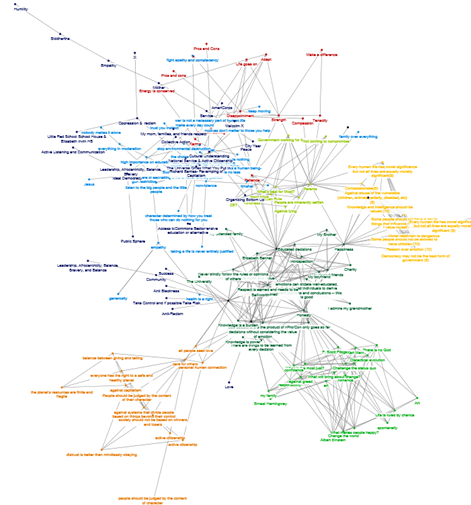
My undergraduate students have identified their own most significant moral ideas and commitments and the important connections among them. The image above shows the networks that have resulted so far–with each student colored differently, and each idea shown as shared if two or more students held it. Today, students are pairing up to explain their moral networks and will adjust their own maps if their partners propose persuasive ideas (or remind them of any ideas they forgot). I anticipate that the class map will become a tighter network as a result.

As I briefly explained in class, a network is a model that can be used to describe anyone’s moral thought. The nodes are ideas; the links are various kinds of connections. That people have moral networks is not a theory that could be found true or false. Rather, a network is a tool for visualizing how anyone thinks.

Often, when we try to improve our moral thought, we seek a systematic philosophy or theology. At any rate, systems (such as Kantianism, utilitarianism, or the classical Hinduism of the Bhagavad Gita) are what we most often teach in courses on philosophy and religion.

Any system organizes the whole network in some way. For instance, the system may assert that there is one highest good (very general and abstract) that should imply all the other ideas on our map. Or the system may offer an algorithm for determining which ideas belong and which ones trump other ones.

If a moral system is valid, then an individual can relate directly to it. You can adopt it as your network. You don’t need other people to help apply the system to your own life.

If you can make a moral system work, that’s fine. But I find that almost all reflective people are not systematic; they have lots of related ideas without a coherent structure. (The same has also been found by some psychologists and sociologists.) This is even true of very religious people. They may assert that God knows one organized structure or even the God holds just one idea. But we can’t know it. We humans must hold lots of different beliefs, values, stories, heroes, etc.–closely connected but not reducible to a system.

If we can’t adopt a system, the other way to improve is constantly to reflect on and revise our own networks. This is more like gardening than architecture. You start with what’s already growing, and you trim, weed, and plant one idea at a time. That process requires other people because we need their perspectives and experiences to provide ideas and to check our own biases. We can expect that our moral network will be dynamic and somewhat situational. (We’ll have different ideas in different contexts.)

At times in the history of thought, systematic moral theories have been dominant. But those moments have alternated with times when many of the leading thinkers just can’t assent to the available systems. They instead offer techniques for moral reflection and self-improvement (a.k.a. moral therapy, or moral hygiene). For instance, the systematic moment of Plato and Aristotle gave way to Stoicism, Epicureanism, and Skepticism, which are all about techniques of self-improvement. The high point of medieval Catholic systematic theology gave way to Renaissance essayists like Montaigne. The era of Kant and Hegel gave way to Emerson and Nietzsche. I think the same alternation has occurred in Eastern thought as well.

The thinkers who teach methods of continuous moral improvement vary a great deal, but I find a very frequent return to three fundamental criteria, each in tension with the other two: 1) truth, or at least the avoidance of error; 2) community or justice; and 3) happiness or inner peace. For instance, those are the three criteria in Greco-Roman thought after Aristotle. Rabbi Shimon ben Gamliel, a rabbi of about the same time, is supposed to have said: “On three things the world stands: justice, truth, and peace.” In Buddhism, the Three Jewels are Buddha (freedom from suffering), dharma (law—but in Buddhism, it often means truth), and sangha (community).

And that is why I am interested in putting people into dialogue with each other about their moral networks and asking them to reflect on whether their networks are compatible with truth, community, and happiness.

Ellen Miller on passing the baton

I am no Ellen Miller (and I am not going to retire any time soon), but when the time comes, I will consider it a mark of an outstanding career if I can write as she did today:

When I was a young congressional staffer, I thought changing the world was going to be a sprint. In the middle of my career, when I launched the Center for Responsive Politics and then started Public Campaign, I thought it was going to be a marathon and you just had to be a long distance runner; so I trained up for that. Now, after eight years building and running the Sunlight Foundation, I now see this process as a relay race — and one where I’m glad to say there are many other great people running alongside me, including the terrific team we have built here at Sunlight. It’s truly extraordinary. And it’s time to pass the baton.

Francis Bacon on confirmation bias

Nowadays, we call it “confirmation bias:” our deep-seated tendency to prefer information that confirms our existing positions. A political controversy erupted in 2010 when the libertarian blogger Julian Sanchez accused conservatives of falling prey to “epistemic closure,” which was his preferred term for the same problem:

Reality is defined by a multimedia array of interconnected and cross promoting conservative blogs, radio programs, magazines, and of course, Fox News. Whatever conflicts with that reality can be dismissed out of hand because it comes from the liberal media, and is therefore ipso facto not to be trusted.

Edward Glaesser and Cass Sunstein call this phenomenon “asymmetric Bayesianism” and give examples from the left as well as the right. I argued earlier this week that Amy Chua’s and Jed Rubenfeld’s book The Triple Package suffers from the same problem.

But–as is often the case–Francis Bacon got there first. In his remarkable compendium of human cognitive frailties (published in 1620), he included this problem:

The human understanding when it has once adopted an opinion (either as being the received opinion or as being agreeable to itself) draws all things else to support and agree with it. And though there be a greater number and weight of instances to be found on the other side, yet these it either neglects and despises, or else by some distinction sets aside and rejects, in order that by this great and pernicious predetermination the authority of its former conclusions may remain inviolate. And therefore it was a good answer that was made by one who, when they showed him hanging in a temple a picture of those who had paid their vows as having escaped shipwreck, and would have him say whether he did not now acknowledge the power of the gods — “Aye,” asked he again, “but where are they painted that were drowned after their vows?” And such is the way of all superstition, whether in astrology, dreams, omens, divine judgments, or the like; wherein men, having a delight in such vanities, mark the events where they are fulfilled, but where they fail, though this happen much oftener, neglect and pass them by. But with far more subtlety does this mischief insinuate itself into philosophy and the sciences; in which the first conclusion colors and brings into conformity with itself all that come after, though far sounder and better. Besides, independently of that delight and vanity which I have described, it is the peculiar and perpetual error of the human intellect to be more moved and excited by affirmatives than by negatives; whereas it ought properly to hold itself indifferently disposed toward both alike. Indeed, in the establishment of any true axiom, the negative instance is the more forcible of the two.

 (Novum Organon, XLVI) 

Of course, Bacon’s goal was not lament our tendency to err but to help us fix it. Evidence has accumulated to reinforce his concerns about our blinkers and biases. Yet, as the Yale psychologist Paul Bloom recently wrote in The Atlantic, even the accumulated evidence does not show that we are fundamentally irrational. We very often make wise and deliberate choices. It all depends on the context of choice and the methods we use to deliberate:

So, yes, if you want to see people at their worst, press them on the details of those complex political issues that correspond to political identity and that cleave the country almost perfectly in half. But if this sort of irrational dogmatism reflected how our minds generally work, we wouldn’t even make it out of bed each morning.

As the heirs of Bacon’s scientific revolution, we should relentlessly investigate all systematic forms of human error–not to shake our faith in reason but to help us to reason better.