Category Archives: Uncategorized

everyone unique, all connected

Reading my sister Caroline Levine’s extraordinary new book Forms: Whole, Rhythm, Hierarchy, Network, I’ve been reflecting on similar ideas that I have come to quite independently.

In college, I was deeply struck by the argument that human beings (whatever we all share as members of the same evolved species) are also divided into large clusters whose members think alike in important respects but differ with outsiders. Those clusters can be called cultures, worldviews, Weltanschauungen, etc. That these groupings are internally consistent but different from one another is an essential premise of philosophers like Hegel and Herder, of founding anthropologists like Boas and Malinowski, of New Historicist critics like Catharine Gallagher and Stephen Greenblatt, and even of deconstructionists who seek to rupture such “bounded wholes” (see Caroline Levine, pp. 26, 115-16). I’ve found the same assumptions elsewhere, too. The influential psychologist Jonathan Haidt assumes that each person subscribes to a “moral matrix” that “provides a complete, unified, and emotionally compelling worldview, easily justified by observable evidence and nearly impregnable to arguments from outsiders.” And (although different from Haidt in most other respects) John Rawls called a “plurality of reasonable but incompatible comprehensive doctrines” a “fact” about the world.

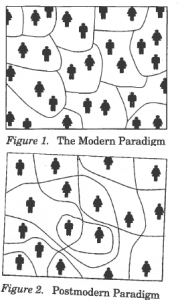
At one moment during the summer of 1989 (crossing the street in Rosslyn, VA), I thought: But each of us belongs to many of these clusters at once. The clusters overlap; their borders cross. In fact, even twin siblings would have somewhat different influences and assumptions. I drew this pair of diagrams, which appear in my Nietzsche and the Modern Crisis of the Humanities (1995, p. 188-9).
Nietzsche

I favored what I pretentiously called the “postmodern paradigm” of fig. 2 and claimed that it dispelled some of the dilemmas of value-relativism and skepticism that bedeviled modernity. This was before the large literature on “intersectionality” really got going. I agree with the argument that (for example) race, gender, and class can “intersect,” but I would push that to its limit. Our backgrounds intersect in so many ways that everyone stands at a unique intersection.

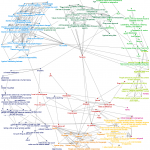
Now I am more likely to draw a different kind of map, one that treats each person’s mentality as a network of ideas, such that the nodes are typically shared by people who interact, but each person’s overall network is unique. (This is the map of the ideas identified by my students in a recent class. Each student is displayed in a different color, and their networks touch where they disclosed the same idea.)
class map 1.17

Caroline would describe figs. 1-2 as sets of bounded wholes, and the third diagram as a network map. Wholes and networks are two fundamental forms in her account–she also investigates rhythms and hierarchies. Indeed, the two forms I display above are limited in two respects. They are time-slices that fail to capture change. (Rhythm is missing.) And they are all about ideas and values, not about institutionalized forms, such as hierarchies. I think she is correct that all four types of form–and no doubt more as well–overlap and contend, creating the structures in which we live but also offering opportunities for emancipation if we figure out how to put them together in new ways.

why volunteering has gone up while other forms of civic engagement have declined

Because you get what you pay for. To elaborate. …

The Associated Press-GfK recently repeated survey questions that they had asked in 1984 about voting, volunteering, serving on a jury, reporting crime, knowing English, and keeping informed about news and public issues. Voting has been fairly flat, although turnout rates vary from year to year and from jurisdiction to jurisdiction depending on the competitiveness and importance of the election. Four of the measures have fallen since 1984. But volunteering is up, buoyed by a substantial increase in young people’s commitment to service.

As I said in the AP article, “That’s partly [because] we have built up our institutions for volunteering. … Something like 30 percent of high schools have service learning programs. They didn’t have that in the 1980s.” We could also cite a substantial investment in youth volunteering through AmeriCorps, Campus Compact’s member colleges, and so on. Proponents of service have won new funding and rewards for volunteering, positive media coverage, intensive research and evaluation, and favorable policies, including mandates in many school districts.

There has been no comparable investment in the other forms of civic engagement. That is why they have stagnated or fallen. If, for example, schools cease to emphasize news literacy education, and the news industry fails to encourage young readers, then “keeping informed about news and public issues” will fall. Measures of civic obligation are mostly proxies for the civic opportunities we offer people.

I’d also offer an observation about the obligation to know English, one of the variables in the AP survey that fell between 1984 and 2014. It’s unique among the items because everyone who took the survey did know English. (It was an English-language instrument.) Thus the decline is not attributable to falling levels of engagement among people in the sample. Instead, respondents essentially had to decide whether it was a civic obligation for others to know English. I can imagine that the decline is explained by a lessening belief that immigrants are obliged to learn English, although (importantly) young immigrants do learn the majority language. An alternative explanation is that people are less likely to see the purpose of learning English as civic because they see civic engagement as less salient than they did in 1984. That would be bad news–but again, more a symptom of declining opportunities for engagement than a moral slide.

Charlie Hebdo, American academia, and free speech

David Brooks begins today’s column: “The journalists at Charlie Hebdo are now rightly being celebrated as martyrs on behalf of freedom of expression, but let’s face it: If they had tried to publish their satirical newspaper on any American university campus over the last two decades it wouldn’t have lasted 30 seconds. Student and faculty groups would have accused them of hate speech. The administration would have cut financing and shut them down.”

It’s critical to distinguish between two questions: 1) How should I (or a small group) manage a forum of communication that is under my or our control? and 2) What rights do people have to run their own fora?

A forum might be a newspaper or a magazine, a course, a speaker series, a website, or the wall outside my office. If I (either alone or with colleagues) am responsible for that forum, then I must decide how it should be run. It can be an open forum in which anyone may post anything. But that is a choice, not an obligation, and often it’s a bad one. I much prefer the edited and curated homepage of the New York Times to an unmoderated chat. Assuming we choose to manage a space, we must make constant decisions about what and whom to include and exclude. It is appropriate to consider questions of relevance, quality, impact on various people, diversity, consistency, fairness, and more.

A society, however, should not be a forum with one set of rules and values. It should include an enormous array of quasi-autonomous fora under many different managers, rules, and value-systems. Individuals and voluntary groups should have very extensive rights to create and run their own fora in their own ways.

Thus there is no contradiction at all between saying (a) I would rather not post an anti-Islamic cartoon on my website or invite an anti-Islamic speaker to address my class, and (b) the cold-blooded murder of Charlie Hebdo’s staff was a fascistic assault on human rights and liberty. These are actually closely related ideas, because both stem from the fundamental principle that forums of communication must be plural and autonomous.

Thus I am not concerned or embarrassed that American academic institutions may be reluctant to invite inflammatory anti-Muslim speakers. That’s a reasonable judgment by the organizers of those particular fora.

One thing that does worry me is the gradual evolution of each American university from a plural array of fora into a singular forum. In some ideal world, a university would be a space in which tenured faculty and students can exercise a high degree of free speech, creating their own mini-fora: diverse classes, speaker series, associations, and publications. To be sure, certain aspects of the university–such as the annual commencement address–must be chosen by the institution and thus must be governed by uniform criteria and processes. But in a healthy university, those centralized fora do not crowd out all the diversity.

I see increased centralization of control over a university’s discourse and inquiry, due to: the influence of external donors, the severe shortage of tenured positions, the rising share of contingent faculty, IRB review, multiplying layers of administration (so writes an associate dean for research), increasingly sophisticated PR efforts, and the growing role of metrics and assessments. Campus speech codes and other explicit regulations of speech may also play a role–and I am skeptical of these interventions–but I don’t think they represent the main threat to pluralism.

the Civic Studies Institute spreads to Ukraine

Thanks to our colleague Dr. Tetyana Kloubert of the University of Augsburg and a grant from the German Academic Exchange Service (Deutscher Akademischer Austauschdienst), the Summer Institute of Civic Studies that we hold annually at Tufts is adding a parallel institute in Ukraine, which I will help to teach in 2015. Ukrainian scholars and practitioners are strongly encouraged to apply. We will also consider applications
from Germany, Belarus and Poland. Please feel free to circulate this announcement.

Summer Institute of Civic Studies and Civic Education
Call for Applications

We are happy to invite you to participate in the Summer Institute of Civic Studies and
Civic Education that will take place in Ukraine from 3-16 August 2015 (at the Chernivitsi National Yuriy Fedkovych University).

The Summer Institute of Civic Studies and Civic Education is organized by a team from Tufts University (Prof. Peter Levine), the University of Maryland (Prof. Karol Soltan) and the University of Augsburg (Dr. Tetyana Kloubert).

Objectives and topics

The Summer Institute of Civic Studies and Civic Education is an intensive, two-week, interdisciplinary seminar bringing together advanced graduate students, faculty, and practitioners from diverse fields of study.

The Summer Institute of Civic Studies and Civic Education deals with issues of development of civil society, the role of an individual/citizen in society, the role of education in promoting democracy, the role of institutions in the development of a civil society and questions related to the ethical foundation of civic issues in a (democratic)
society. These topics will be examined in international and comparative perspectives, considering European (especially German) and US-American civic traditions. International examples will be discussed in the context of consolidation of democracy in
Eastern Europe, particularly in Ukraine.

The Summer Institute of Civic Studies and Civic Education engages participants in challenging discussions such as:

  • What kinds of citizens (if any) do good regimes need?
  • What should such citizens know, believe, and do?
  • What practices and institutional structures promote the right kinds of citizenship?
  • What ought to be the relationships among empirical evidence, ethics, and strategy?

Summer Institutes of Civic Studies have been annually organized by Peter Levine and Karol Soltan at Tufts University since 2009.

How to apply

Continue reading

two perspectives on our political paralysis

Let’s define “governing” in a democracy (and I mean really governing, as opposed to administering or muddling through) as putting an agenda before the people, achieving a mandate, and enacting the agenda before the next election offers a verdict.

No one has governed the United States, in this sense, for at least a quarter century, except for transient and incomplete moments: Reagan cutting taxes in 1980-82, Clinton raising taxes to balance the budget in 1992-4, G.W. Bush cutting taxes and passing the Patriot Act after 9/11, and Obama passing the Affordable Care Act (ACA) in 2010. But those names also remind us of abandoned agendas. Under Reagan, taxes and spending rose as a percentage of GDP and the federal service added a net 230,000 jobs. In retrospect, it’s hard to say what the domestic policy agendas of Clinton or the two Bushes were. Obama stopped governing (in the sense I mean here) when he lost his House majority in 2010. No one expects anything except paralysis through at least 2016. Gallup reports that “2014 was … the first year since 2007 that the economy was not the top ranking issue, and it was the first year ever in Gallup records that dissatisfaction with government topped the list.”

Here are two ways of interpreting this situation.

First, political scientist Juan Linz would note that every presidential system other than the US has collapsed. Individual legislators are not held accountable for the performance of the country but do get credit for criticizing the president. Thus a legislature has every incentive to undermine the executive branch. When the two branches are separately elected, you are bound to see legislative obstructionism (on one side) and executive unilateralism (on the other) whenever power is split.

That is just what we have seen in the US since ca. 1986. Why not before? Because until the 1980s, Congress always had at least three effective political parties, the Democrats being composed of two radically different wings (the Southern conservatives and Northern liberals). Thus a president could normally put two of the three congressional blocs together to obtain a majority. He was basically in the position of a Prime Minister, assembling a majority in the legislature. That opportunity vanished when the parties sorted neatly into left and right, so now we face the Linzian nightmare. Presidents will rule by executive order and congresses will obstruct until the system fails.

Alternatively, political scientist James A. Morone has argued that the US system was designed to avoid governing (in the sense of this post.) That is not only true of the federal constitution, with its famous checks and balances, but also of new institutions that we have developed subsequently, such as the New Deal regulatory agencies and the ACA. They always incorporate numerous veto points because they cannot come into being unless their opponents are mollified by such barriers–and because Americans profoundly fear governing as a form of tyranny.

Morone argues that at several points in American history, the federal government (blocked by design from changing its policies) has become manifestly out of step with a changing country. To name one example, Washington could not recognize unions but was faced with a militant labor movement ca. 1932. In such cases, Americans typically denounce their hobbled government as corrupt and elitist and demand that power shift to “the people.” They are invoking a myth, because the population is not unified; in fact, one of the reasons that government is paralyzed is that it reflects citizens’ conflicting interests. Nevertheless, by invoking “the people,” the reformers win new political rights or procedures (white male suffrage in the Jacksonian Era, regulatory agencies in the Progressive Era, collective bargaining under the New Deal, community action agencies in the 1960s). These new rights and procedures change who is effectively enfranchised and thus shift policy outcomes. Once a new equilibrium is reached, the system returns to paralysis, but in better alignment with the underlying social/economic situation.

If Linz is right, our challenge is largely unprecedented, and we are in big trouble. If Morone is right, we have faced the same circumstance at least five times before and the time now looks ripe for a new set of populist institutional innovations. Based on the past waves of reform, we should expect “an exuberant mix of democratic images and contemporary organizational methods: open meetings, civic education, broad opportunities to participate, professional staff support” (The Democratic Myth, 1990, p. 28). Today that might mean Participatory Budgeting, online games for city planning, and service corps, among other examples. These reforms will adjust the political balance and policy outcomes before they ultimately disappoint by puncturing the myth of a unified people.

Neither argument is exactly rosy, but both should be taken seriously if we hope to find better ways forward.