Category Archives: Uncategorized

voices

(in St. Paul, Minn.)

Why does the owl, her nest turned into flames
By an errant fire balloon, shriek as she flees?
As the solo goose flaps his steady beat,
Sea-bound, whom does he think will hear his honk?
An eagle chick pecks to a slow death her
New-hatched twin so that the fitter one will last.
It’s clear why the weaker chick pecks back, but
Why have a voice and to whom does he bleat?

we are hiring!

Come work on my team. We actually have two new jobs posted, one for a graduate student. Click the links for considerably more information about both.

  1. Researcher – The Center for Information and Research on Civic Learning and Engagement (CIRCLE) – (15001652)

The Center for Information and Research on Civic Learning and Engagement (CIRCLE) is a leading research center that studies young Americans’ civic development and participation. CIRCLE is the premier source of information—facts, trends, evaluations, and best practices—related to youth civic learning and engagement. CIRCLE shares the results of its research with policy makers, practitioners, journalists, and scholars in various disciplines.

CIRCLE is seeking a full-time Researcher to conduct research and to help manage some of CIRCLE’s research and evaluation projects. Reporting to the Director of CIRCLE and based on the Medford/Somerville Tufts University Campus, the Researcher will work as part of the CIRCLE team on CIRCLE products and activities. The Researcher will also interact with a larger group of colleagues at Tisch College, and will be expected to participate in various college-wide initiatives such as college-wide events and assistance with student program evaluations. Specific responsibilities include:

  • Serving as an Researcher on a range of research projects that may include secondary data-analysis, literature reviews, field experiments, program evaluations and other original data collection (via survey or other methods);
  • Curating and preparing datasets of various sizes and formats for research use;
  • Producing reports, fact sheets and press releases on timely and relevant topics, often in close collaboration with CIRCLE colleagues;
  • Providing feedback, assistance, and support to colleagues at Tisch College and CIRCLE on research-related tasks, as needed;
  • Representing CIRCLE at a wide range of events including research conferences;
  • Answer queries from reporters about CIRCLE research;
  • Performing administrative duties as needed, as they pertain to CIRCLE operations; and
  • Participating in activities and meetings that involve Tisch College staff.

2. Quantitative Researcher for NSLVE (the National Study of Learning, Voting, and Engagement)

To join a team of researchers working on the National Study of Learning, Voting, and Engagement (NSLVE) at the Jonathan M. Tisch College of Citizenship and Public Service, Tufts University. NSLVE is a service to colleges and universities nationwide, providing colleges and universities with their students’ voter registration and voting rates, broken down by individual student characteristics (e.g., field of study). Currently, the database consists of nearly 700 colleges and universities and 6.7 million de-identified student records.

Responsibilities:

  • Support data analysis of a large national dataset: Calculate tailored campus-level data for participating institutions. Respond to internal data requests for data for presentations and resources
  • Resource development: Support the development of the resources and tools for colleges and universities. Support the development of publications, both peer reviewed and self-published, on college student political engagement

PhD candidate preferred; MA candidate will be considered based on quantitative research experience

two degrees of Christopher Marlowe

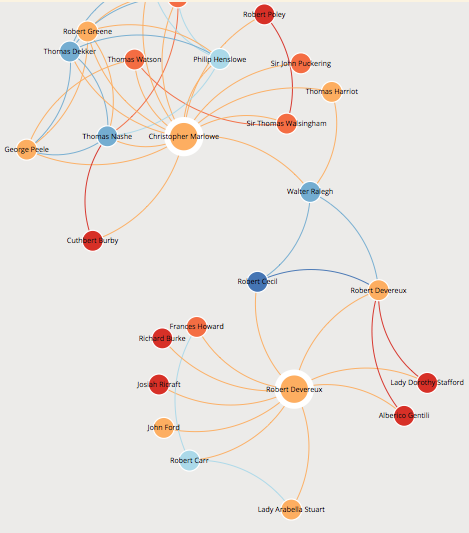
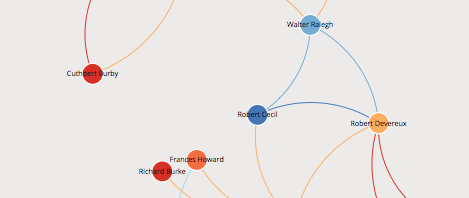
In The Reckoning (1994), Charles Nicholl carefully investigated the 1593 murder of Christopher Marlowe, arguing that it resulted from a struggle between the rival spy networks of Walter Raleigh and Robert Devereux (the 2nd Earl of Essex). It’s a compelling read and a brilliant use of scattered historical records to reveal hidden connections. But The Reckoning predated the current enthusiasm for actually mapping networks and crowd-sourcing the data. Now we have Six Degrees of Francis Bacon, a network map of documented figures from English history, 1500-1700. Using that tool, one can quickly create a map that shows the networks of Christopher Marlowe and Essex, with Raleigh appearing as an intermediary.

Screen Shot 2015-09-16 at 7.57.44 PM

The diagram is by no means complete. For instance, Thomas Kyd is in the database but not linked to his former housemate, Marlowe; and the man who probably stabbed Marlowe, Ingram Frizer, isn’t on the map at all. But that isn’t a criticism, for the organizers ask visitors to add data. How many more stories will come to light as the map grows and historians use it?

(See also the murder of Marlowe and my version of “come with me.”)

Q&A for Constitution Day

It’s Constitution Day. Thanks to an amendment included at the behest of the late Robert Byrd in 2004, every educational institution that receives federal money–from a kindergarten to a graduate school–must offer programs on this day that concern the Constitution. Eight years ago, I posed some gently subversive questions that could be the basis of a discussion on Constitution Day. Here are my questions again, with–for what they’re worth–my answers:

  • How, under our Constitution, can legislation be passed on the sole prerogative of one US Senator?

The Constitution leaves it up to each house of Congress to organize its own procedures. (Article 1, sec. 2: “Each House may determine the rules of its proceedings.”) The Senate can basically construct bills any way it wants.

There is no ideal way to legislate. Any parliamentary body faces a severe challenge in aggregating the opinions of its many members on the many topics that come before it. No legislature can discuss and separately vote on everything. Still, the Senate’s rules give an awful lot of power to individual members to insert provisions. I suspect the reason lies with the Senate’s filibuster rules, which make the passage of legislation extraordinarily difficult. To prevent even more filibusters than we actually have, Senators are allowed to slip in special provisions they especially care about.

Legislating this way is not “unconstitutional” in the sense of violating the text of the document. But we could say that in the broader meaning of the phrase “constitutional system,” our system includes the rules of the US Senate, which are very problematic.

  • How can Congress pass legislation without hearings or debate?

See above. But this second question underlines a particular disadvantage of the Senate’s rules: many decisions get no deliberation whatsoever. No teachers were asked to testify about the pros and cons of a Constitution Day mandate. Again, no process is prefect, but the Senate’s procedures seem to neglect the deliberative value that our constitutional order was meant to uphold: “the mild voice of reason, pleading the cause of an enlarged and permanent interest.”

  • Is it a constructive and appropriate use of federal power to determine the content and timing of educational instruction?

Strong conservative constitutionalists will say that Congress has no business in education at all, because education is not among the enumerated powers of Article 1, Section 8. Students should learn and consider that argument. For my part, I think we long ago rightly settled that the Congress may raise taxes and spend the money on education and may put certain conditions on the funding. I would especially argue for a federal role in supporting education for republican self-government, on the ground that this is “necessary and proper” for the survival of our system.

But that doesn’t mean that micromanagement from Washington is wise. To pick a day–right at the beginning of the conventional academic year–when every school (k-20) must teach the Constitution is a good example of meddling. It’s unlikely to yield positive results. Conservatives make a valid point that needn’t be rooted in an originalist reading of the Constitution: Congress should generally avoid micromanaging, especially in an ad hoc way, because it is too distant from local concerns, too likely to make one size fit all, and too remote from accountability. Characteristically, when the Senate passed a Constitution Day mandate, no one even dreamed of empirically evaluating the impact–whereas a school district that tried such an experiment might have to show that it was cost-effective and a “research-based best practice.” Congressional micromanagement violates the spirit of the Constitution, even when it passes legal muster.

Finally, I do think some good comes from the Constitution Day mandate. It gives an annual boost to the wonderful organizations that provide materials, lesson plans, and professional development for civics, and it yields an annual crop of articles and social media about civic education. Still, if I had to teach a lesson on Constitution Day, it might be about how the legislation that launched it is constitutional yet also problematic–so maybe we need some reform.

See also liberals, conservatives, and love of the Constitutionis our constitutional order doomed? and constitutional piety.
missing the civic empowerment messages of a Pope and a President

Michelle Boorstein compares the enthusiastic responses to Pope Francis in 2015 and Barack Obama in 2008 and collects several explanations for both:

  1. People have “an undeniable, sweeping affinity, a gut reaction to a new leader to whom we attach huge expectations …,  even though most Americans don’t know much about Francis.”
  2. “Does the pope’s all-embracing commentary, which seems to exclude no one, have particular resonance in an increasingly diverse country?”
  3. Does “Francis offer people hope of rescue with his confident proclamations about what needs to be done to fix the world? Cartoonists and graffiti artists have often drawn him as a caped superhero.”
  4. “Francis is an accessible father figure at the helm of one of the world’s largest organizations.”
  5. “People love the blank slate.”

Let me suggest an alternative. Both the president and the Pope talk explicitly about how we, active citizens, can and must address problems. These two men may have been caricatured as caped superheroes, but they are as clear as one can be that they are not the solutions to our problems; we are.

This was the main theme of Obama’s Springfield speech announcing his candidacy in 2007, an important note in his Grant Park speech on Election Night 2008, and a recurrent topic throughout the campaign. When he accepted the Democratic nomination in 2012, he put it concisely: “As citizens,” Obama said, “we understand that America is not about what can be done for us. It’s about what can be done by us, together through the hard and frustrating but necessary work of self-government.” I have collected many more similar quotes here.

As for the Holy Father, he said recently, “the future of humanity does not lie solely in the hands of great leaders, the great powers and the elites. It is fundamentally in the hands of peoples and in their ability to organize.”

I believe that people hear and are moved by these invocations of their power, agency, and responsibility. They do not treat Obama and the Pope as blank slates or as accessible personalities; they feel moved to take action.

Meanwhile, the press completely ignores these leaders’ talk of civic engagement. That theme was never covered in the 2008 presidential campaign, and no one mentions it when they cover the Pope. Obama’s critics especially misunderstand his civic appeal, thinking that it is narcissistic. (“We are the ones we have been waiting for” is literally misheard as “I am the one you have been waiting for”). And we see basically patronizing explanations of why these leaders strike a chord.

See also how to respond to a leader’s call for civic renewal; the encyclical Laudato Si and the power of peoples to organize; and Taking the President Seriously About Citizenship.