Category Archives: Uncategorized

a blogaversary flashback

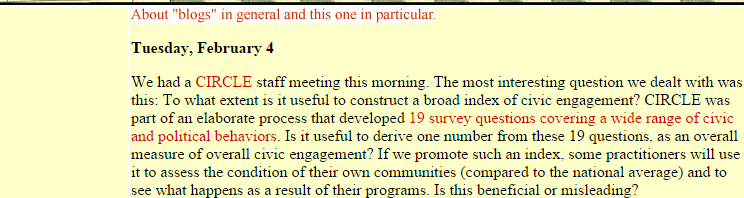
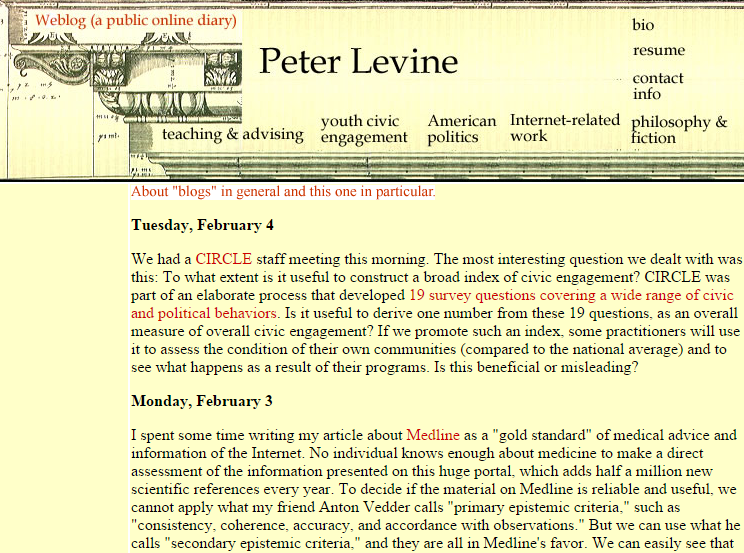
I’ve been blogging since January 2003–for 13 years. I usually note the anniversary with a post about the past year. This year I will illustrate the blogaversary with a screenshot (thanks to the Internet Archive) of the blog as it looked on February 4, 2003:

2003screenshot

The text in those days was simple HTML. In other words, this site was not a database of posts that automatically generated a “front end” view for the reader (as it is now). Back then, I just typed each new entry on top of the previous one. Because blogging was still fairly new, I felt the need to explain at the top of the page that a Weblog was a “public online diary” and I included a link to a statement about “‘blogs’ in general and this one in particular.” I put the word “blog” in quotation marks because it was unfamiliar. In keeping with my definition, I did in fact write a kind of diary. The intro to each of the posts you see above was about what I had done during that day, hooked to some kind of substantive point.

On Feb. 4, 2003, we seem to have talked about creating a “broad index of civic engagement.” The fruits of that discussion include the Civic Health Index, led by the National Conference on Citizenship, which was written into federal law as part of the Kennedy Serve America Act of 2009. We’ve been involved in countless other measurement efforts since then.

The Feb. 3 post is about a form of literacy (in this case, medical literacy) and whether to promote it with better free electronic resources or with public schooling–or both. Even now, in our world of social media, these issues remain important and difficult. I continue to resist piling all responsibilities for boosting every form of “literacy” onto our public schools. I also continue to think that sometimes we can lower the cognitive demands on citizens by simplifying systems, rather than trying to feed everyone ever more information. That strategy seems appealing for law and policy as for medicine and health.

Flashing forward to 2015 (3,119 posts later) … I think the past year was fairly typical, although I intentionally let slip my traditional obsession with posting every single workday. Nowadays, this is not a diary so much as a notebook of argumentative writing, a fair amount of which ends up in articles. For better or worse, the categories that interest me remain basically the same as they were more than a decade ago.

propose sessions for Frontiers of Democracy

The next Frontiers of Democracy conference will take place on June 23-25, 2016 at Tufts University’s downtown Boston campus. The conference schedule is taking shape, and we welcome proposals for concurrent sessions. We call the sessions “learning exchanges” because we do not accept papers or presentations. Instead, we are looking for moderated discussions, workshops, trainings, debates, or other interactive sessions that normally last 90 minutes each and involve up to 20 people. The special conference theme for this year is “Revolt Against the Mainstream?” (thinking not only about the US presidential election but many other examples of “revolts” from around the world.) Session ideas would be welcome that address that theme, but we are open to all kinds of topics related to civic engagement and democracy. Please use this form to submit ideas–for best consideration, by Feb. 29.

when is cultural appropriation good or bad?

The Oberlin College Cultural Appropriation Controversy is almost certainly getting more attention than it deserves because it reinforces critiques of political correctness in higher education. Nevertheless, it provides an interesting case to consider the general questions: What is cultural appropriation, and when is it bad?

Some Oberlin students criticized Oberlin’s dining hall’s bánh mì and General Tso’s chicken as cultural appropriations. These are wonderfully ironic cases. Bánh mì is a French baguette sandwich with ingredients popular in Vietnam. It is a direct result of French colonialism, a perfect example of a creole or hybrid cultural product. Without cultural appropriation, there could be no bánh mì in the first place. General Tso’s chicken has obscure origins but is most widely thought to have been invented in New York City by chefs of Chinese origin.

I start with the assumption that there is no such thing as cultural purity. We are all creoles, all the way down. We have been in contact with each other all along, naturally and inevitably borrowing, sharing, and stealing. Even supposedly “uncontacted” peoples deep in the rain forest have actually been in close contact with others for thousands of years. Claims of cultural purity and authenticity are almost always problematic, morally as well as factually.

And yet the critical students at Oberlin were making some valid points. To borrow a cultural product is to enter a relationship with someone else. That can be done respectfully and gratefully or rudely and exploitatively. In other words, it involves ethics. Also, it can be done skillfully–so as to produce an excellent product (possibly one never seen before)–or else poorly. In other words, it involves aesthetics. The Oberlin students are saying that their college dining hall’s Asian food has been borrowed disrespectfully and also poorly.

Those can be fair points, but we don’t often conduct such conversations well—for two large and important reasons. Because of positivism, we are not good at talking about ethics. And because we accept deep social inequality, we tend to overlook the material conditions of fine culture.

To the first point: We live at a time when science has enormous prestige, and science cannot address value judgments except to recognize that human beings form them for various reasons. Science suggests that there are two buckets: facts and evidence go in one; values, emotions, preferences and tastes, and personal identities go in the other. To say that Oberlin’s bánh mì are bad is not a factual claim, so it must involve emotion, preferences, and identities. That means that we cannot reason deliberatively with people who might hold different views of Oberlin’s bánh mì or of culture more generally. We can only express opinions that have strong emotional charges and that are linked to our identities. So to take a position on either side is to harm emotionally people who have different identities.

I would not dismiss the significance of emotion or identity. We must be sensitive of both. But we can also deliberate about relatively subtle, charged, and complex questions like food and culture. More than one perspective is valid, and each position can be supported with arguments and reasons. Opinions can change; the group can learn. Expressing a view is not necessarily a threat to other people; it can be an opportunity to reason.

In a positivist and relativist culture, scholars in the humanities and cultural disciplines are basically taught to suppress value judgments–yet certain strong values break through that screen because they are irrepressible and because political movements stand behind them. So even though value judgments are deemed to be culturally relative, it is wrong to be sexist, racist, or colonialist. I agree that those attitudes are wrong, but I see them as just the tip of a submarine mountain of ethical issues, all complex and all deserving of analysis.

When I was writing my book about Dante, I first encountered the view held by certain scholars that cultural appropriation is intrinsically bad. For instance, it was intrinsically problematic that Byron appropriated Dante’s medieval Italian culture for liberal nationalism. My response was: let’s think about when and why various forms of cultural borrowing are good or bad for various people. That is to reason about ethics, which is countercultural for many scholars. (Aaron R. Hanlon has a good response to the Oberlin controversy, calling for a distinction between “appropriation,” which should be value-neutral, and “expropriation,” which is bad and requires a critical argument.)

The second issue is inequality and the material conditions of successful borrowing. The dining hall staff of Oberlin College may not have been given the support they would need to do a good job providing Asian food–or original, “fusion” food. That would take experience, support, and time. Absent those supports, it’s possible that they should stick to what they know best (which will not be culturally pure or authentic, but simply a list of recipes of miscellaneous origin that are familiar to them). Or it’s possible that someone should help them try new things. But it definitely takes resources to engage well with any unfamiliar culture.

In many a Yuppie household (such as mine), people frequently dine in fine restaurants that serve foods from around the world, occasionally travel to distant lands, attempt to learn other languages, and have rows of cookbooks from many cuisines that they use to cook their own food. For instance, we were able to spend the winter break in Guadeloupe, and last night I cooked Chicken Colombo, which is a Guadelopean fusion dish strongly influenced by South Asian indentured workers. Meanwhile, in many families, the adults cook what they learned from their own parents. I remember chatting with a bunch of working-class immigrant high school students from Hyattsville, MD who were amused (more than offended) that Yuppies cook food other than “their own.”

The differences between these two kinds of households may depend in part on personal tastes and proclivities and on local cultural norms. For instance, Mexican/Asian fusion cuisines are famously widespread in San Bernardino County, California. But there is also certainly a socioeconomic aspect of this difference. I cooked Chicken Colombo last night because we could afford to visit Guadeloupe. One reason we visited that island is that we have had opportunities to learn French. And we were comfortable eating food unfamiliar to us because our neighborhoods have long been full of diverse restaurants. These are forms of material support.

I don’t know anyone at Oberlin, but I can imagine two kinds of hypothetical characters: a Yuppie student who despises the college’s bánh mì because she grew up with better ones, and a working-class immigrant student who is offended that the college serves “someone else’s” cuisine because she hasn’t had an opportunity–yet–to sample and cook foods from around the world. Material inequality is relevant to both perspectives. Without sufficient resources, it is simply harder to make something ethical and creative out of a cultural interaction.
to a well traveled hidalgo

This will be hard to explain, so please lie
Still and I’ll try to make it clear to you.
It may have been a normal day; perhaps
You were optimistic, out for a hunt.
Something happened, though–a fall from the saddle?
Boils, putrid breath, and fever? An axe?
Whatever it was, you were dead by day’s end.
(Every death comes before a day has ended.)
At least a few people were sorry enough
They had a huge monument made of you:
Sword in your hand, Pepe curled at your feet,
All in gilt and expensive blue tempera.
Come to think of it, they messed up the garments
A bit. Parts hang down as if you were standing;
Other parts lie flat as if you were prone.
Never mind; in all, it was resplendent.

Some of the rest is easy to relate.
Woodworms are responsible for all those holes.
There was a fire once. You would recognize
La Guerra Civil as a peasant revolt
With more than the typical body count.
Napoleon–he was sort of a Lombard
Who got himself crowned Emperor in Rome
And sent a Frankish army to sack Spain.
Columbus–well, let’s just say there’s another
Large country out west across the sea, yes,
Way west of Galicia, and a part
Of that is settled now by a kind of
Heretical Anglian peasant mob
Who like things like your monument. They bought it
Cheap, carted it over, and laid you out
To be labeled, walked around, and looked at.

Honestly, just one in ten look down, for
The pictures all around you are more vibrant
And hang conveniently at eye level.
Still, now and then a whole regiment
Will gather round, women in their midst, and point.
They know more of your time, Hidalgo, than
You did. They know the before and after
And the why of everything. You just inhaled
The loamy air, tasted salt from your lip,
Felt horsehair, and heard the crack of the whip.

Rome didn’t end because of barbarian invasions

(New York) This is a classic map of the “barbarian invasions,” taken from Wikipedia. I certainly grew up looking at maps like these. The story they illustrate goes like this. First, there was a Roman Empire with armed borders all around the periphery of the Mediterranean. Inside its borders, the people were Romans who spoke Latin and/or Greek and were ruled from Rome. Beyond were barbarian peoples who behaved very differently. At a certain point, the borders collapsed and various barbarian peoples swept in, taking up residence in portions of the former Empire. They brought new languages, myths, and cultures with them. Their descendants still constitute the majority populations of most parts of Europe, North Africa, and the Levant to this day. The newcomers ceased to be barbarians once they stopped moving, because then missionaries were able to radiate back out from Rome and Constantinople to teach them Christianity, Latin and/or Greek, and other elements of ancient civilization.

I had already begun to realize from various scraps of evidence (even including news reports of genetic data) that this model was quite wrong. Now reading Peter Brown’s brilliant book The Rise of Western Christendom, I understand the current synthesis. It denies that there were vast movements of peoples from one place to another around the time the Roman Empire ended. Rather, the population within and around the territory of the old official Empire went through a series of cultural, political, and economic changes until the Imperial system was gone. These changes often germinated within the borders rather than coming from outside. People who were, in some important sense, Romans turned (over the course of several generations) into people who thought of themselves as Franks or Bulgarians.

To elaborate a bit: The Roman Empire was always much more culturally and linguistically diverse than I was taught in grade school, and much more loosely governed. Local elites always ran things in their own ways. Brown notes that even though Egypt was a crucial province that encompassed one of the biggest cities in the world, Rome posted only one official there per 10,000 residents. Egyptians governed Egypt. The official borders made little difference, since the culture, economy, and political order on both sides was just about the same. However, the Empire was important economically because it taxed everyone within its borders and used the proceeds for armies and official building programs (both of which also enriched an upper class). When the Empire lost its taxing capacity, that changed the flow of goods and greatly reduced levels of construction and production.

The Empire was also important culturally because it offered a set of ideas that could be used by local elites. Among these ideas: Rome was the center of the world (urbs et orbis), the Emperor was the most powerful mortal of the day, Latin was the language of law, and there was a difference between Roman subjects/citizens and barbarians. Those ideas were never exactly true or false—they were closer to orienting value judgments. Over time, they lost their force, and then the same elites who had governed as Romans started to govern as, for instance, Franks. In place of stories about Rome, they started to tell mythical stories about their ancestors’ migrations from primordial homelands beyond the old borders, and those myths continue to influence Europeans to this day.

Meanwhile, profound changes in culture and behavior developed within the Empire. For instance, in the third and fourth centuries, civil wars were almost constant. They were fought by soldiers who pledged personal loyalty to leaders (claimants to the Imperial throne) and moved around regions like northern Italy and the Balkans, often pillaging. They dressed increasingly in ways that we associate with the “Dark Ages.” Brown says these soldiers wore “Embroidered trousers, great swinging cloaks, large gold brooches, and heavy belt-buckles.” They probably spoke various languages other than Latin. We might once have viewed them as barbarians who had somehow come inside the frontiers of the Empire and threatened its security. But a better theory is that they were Roman soldiers who were gradually developing the organization, behavior, and even dress that we associate with the post-Roman era. That is a great example of the new synthesis.