Category Archives: Uncategorized

civic responses to crime

(Fishkill, NY) In an American Sociological Review article, Patrick Sharkey, Gerard Torrats-Espinosa, and Delaram Takyar find that “every 10 additional organizations focusing on crime and community life in a city with 100,000 residents leads to a 9 percent reduction in the murder rate, a 6 percent reduction in the violent crime rate, and a 4 percent reduction in the property crime rate.” This is not an iron law or conclusive finding, but it’s an impressive piece of social science. The authors use several methodological approaches to triangulate on the same basic finding: civic associations cut crime.

Incidentally, crime rates fell in major US cities just as the number of anti-crime civic groups rose. That doesn’t prove causality, any more than the decline of the European stork population is responsible for declining birth rates in Europe. But along with the causal evidence assembled by Sharkey et al., there really is a plausible case that a bottom-up, voluntary movement to make cities safer worked in the 1990s.

The evidence also suggests that it wasn’t mainly the explicit anti-crime groups that had the biggest effect. Substance-abuse and workforce-training organizations seem to be more important, although that finding is less secure than the general relationship between voluntary groups and safety.

The question is how to get more citizens involved in the kinds of civic work that can make neighborhoods safer and otherwise better places to live. One opportunity is presented by all the citizens who step forward to give hours of service. Instead of being satisfied with low-impact volunteering efforts, we could help these citizens to organize themselves into powerful groups. And instead of letting them work in isolation, we could coordinate their efforts with those of city officials and agencies and local businesses to address common goals together.

That is the model of Cities of Service, about which Myung Lee and I wrote a Stanford Social Innovation Review article. One specific project of Cities of Service is Love Your Block, in which cities and neighborhood residents get resources to identify and work together to address local needs–the residents contributing free labor, and the city offering its support.
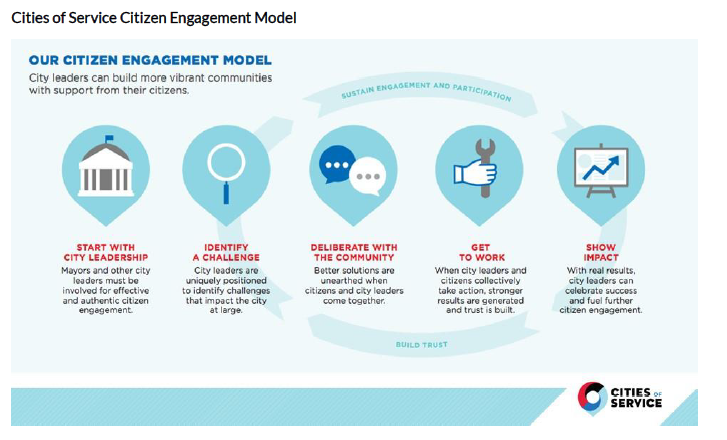
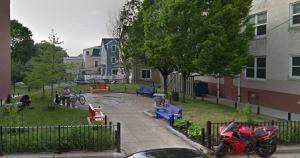
Last year, Mary Bogle, Leiha Edmonds, and Ruth Gourevitch of the Urban Institute wrote a qualitative evaluation of three Love Your Block projects–in Phoenix, Lansing, and Boston. Here are my Google Streetview pictures of the Phoenix and Boston projects, both of which are park renovations.

Bogle, Edmonds, and Gourevitch talked to active grassroots leaders involved in these projects and to other people in the same neighborhoods. They produced social network maps of old and new relationships among the people involved (as a way of measuring changes in social capital). They asked interviewees whether the projects had affected relationships, collective efficacy (the ability of a community to control its own environment), public ownership of public spaces, and safety.

Overall, the results were positive. Participants generally reported more and stronger working relationships. Everyone perceived that crime had declined, although they understandably cited many causes for that trend, not just Love Your Block. Relatively few of the interviewees who were not directly involved in the project saw evidence of stronger community ties, but they were more likely to see such value in Lansing than in the other two cities.

The contexts differ a lot. In Boston, the neighborhood is changing fast–pressures of gentrification are powerful. Some of the Boston participants are well connected to local elected officials and took advantage of that form of social capital. But horizontal ties in the Boston neighborhood are weaker. “A few participants thought community cohesion had gotten worse.” That would not be an effect of the park restoration but rather a consequence of rapid demographic shifts in the neighborhood.

In contrast, Lansing seems more stable, and more residents perceive more impact of Love Your Block on the community as a whole. Horizontal relationships are more important there.

In Boston and Phoenix, gentrification is a concern, and residents involved in improving their communities worry that their good work will displace residents. One Phoenix interviewee said, “I do have this anxiety about being so involved in the organizational side of things and also recognizing that any positive impact we have is veiled privilege.” That is not a problem in Lansing, where capital and population is at risk of flight. The Lansing team worked to restore a garden immediately adjacent to a public school that is vacant due to population-loss–not a problem in Boston.

Although local community work against a problem like crime is not likely to stop gentrification, it can mitigate some of its disruptive effects and empower residents so that they are able to negotiate somewhat better policies. In a 2016 report, HUD argued,

Although residential displacement is a primary concern of many changing neighborhoods, communities should also act to ensure that residents are not left alienated from neighborhood changes. … In order for low-income residents to garner the benefits of neighborhood change, communities should also pursue policy objectives further than affordable housing by supporting neighborhood organizations that foster greater connections between newcomers and long-time residents and that encourage civic engagement among all groups.

Similarly, my colleagues and I are studying the potential of an arts center in Boston’s Chinatown not to stop gentrification but to mitigate its damaging effects.

In the network diagrams of Love Your Block, local businesses emerge as important nodes, and “anchor institutions” (notably ASU in Phoenix and MSU in Lansing) are important assets. In Boston, these institutions are less important, and City Hall is more so. Interestingly, in Boston “the park is falling into modest disrepair already,” whereas Lansing’s park is “self-sustaining” thanks to active volunteer gardeners. That suggests that truly community-based networks are more valuable than ones that rely on official power. But it’s also easier to build horizontal networks in smaller places where the population is more stable and gentrification is much slower or nonexistent.

In July 2018, Cities of Service launched a new 10-city program focused on Legacy Cities (“older, industrial cities that have faced substantial population loss”). It will be evaluated by the Urban Institute.

Overall, the evidence seems strong that how communities organize themselves matters for reducing crime. Cities of Service Love Your Block program is one of the most ambitious and well-designed national efforts to engage communities. Early returns suggests that it may help cut crime. Although additional research and evaluation is appropriate (as always), the evidence already suggests that cities should use this approach to boosting public safety.

See also: can the arts mitigate the harms of gentrification? A project in Boston’s Chinatownorganizing is renewable energycivic responses to Newtown and “the rise of urban citizenship
the value of diversity and discussion within social movements

If you want a more deliberative society–one in which diverse people discuss and learn before (and while) they act politically–you’re not going to accomplish it simply by promoting deliberation. Too many people are understandably motivated by specific agendas, and too many resources are spent to promote specific goals, for a deliberative strategy to work on its own.

But we do have social movements, and they could fuel deliberation. At first glance, they don’t seem promising, because they tend to recruit people who share specific goals and then make demands on target authorities. They do not seem likely to encourage discussion among people who disagree. Charles Tilly, a major theorist of social movements, argued that movements need WUNC–worthiness, unity, numbers, and commitment–to succeed (Tilly 2004). A large group of people who demonstrate unity do not seem to be deliberating.

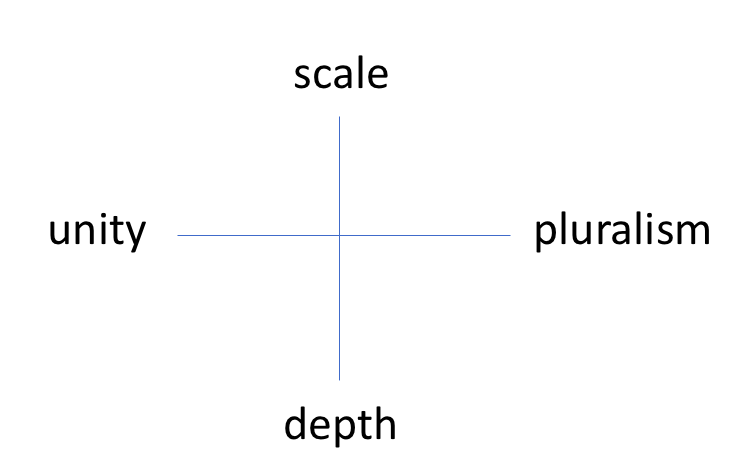
However, the research increasingly suggests that social movements are more likely to succeed if they are internally diverse and good at promoting a free and rich internal conversation. I have cited Erica Chenoweth & Maria Stephan (2011) and Marshall Ganz (2010) to this effect. My own model is SPUD: movements need scale (lots of people), pluralism (diversity of identities and views), unity (shared objectives and tactics), and depth (growth and learning for the participants). Deliberation is relevant because it takes talk to combine scale with depth and pluralism with unity.

New support comes from Wouters (2018). He has shown Belgian and American samples media clips of protests that demonstrate WUNC and that are experimentally altered to show either more or less diversity.

Diversity deals with the heterogeneity of a demonstration’s composition and thus with variation in descriptive characteristics of participants (participation of the young and the elderly; employers and employees; the rich and the poor). Whereas unity deals with the extent to which a group is on the same page and a solid bloc, diversity focuses on a march’s composition. Whereas numbers appeal through an increase in quantity, diversity boosts attractiveness through an increase in quality (various types of participants). Diversity breeds public support, I argue, because observers are presented with more opportunities to identify and because it signals observers that the movement and its grievance engage all citizens. Non-diverse crowds create the impression that the protest serves narrow self-interests, limiting potential identification. In sum, I expect more diverse protesters to facilitate identification and to trigger more supportive reactions.

His finding is that diversity improves audiences’ responses to the protests. He has coined the term dWUNC, “diverse WUNC,” and sees it as an ingredient of success.

Wouters argues that protests are more appealing when members of the audience can see individuals like them among the protesters. They are more likely to see people like themselves if the movement is diverse. He notes that Black Lives Matter protests became more appealing to white viewers if they included some white participants, but black viewers’ opinions did not change.

Wouters’ findings are troubling because demographically homogeneous groups also have value. Oppressed people have a right (and sometimes have good reasons) to act separately, without demonstrating that they have “diverse” support. However, if Wouters is correct, then it’s worth at least considering the cost of fielding a homogeneous group.

I would add that a movement that consistently puts diverse people onto the streets will have to promote internal deliberation to keep those people unified. If this is correct, then a strategy for making society more deliberative is to encourage social movements to maximize their internal diversity. They should do so to make themselves appealing, but as a major side effect, they will promote deliberation.

I make this argument in Levine 2018, but without citing Wouters 2018, which appeared too recently. Here is my PowerPoint on the topic:

Citations

  • Erica Chenoweth & Maria Stephan, Why Civil Resistance Works: The Strategic Logic of Nonviolent Conflict (Columbia Studies in Terrorism and Irregular Warfare, 2011)
  • Marshall Ganz, Why David Sometimes Wins: Leadership, Organization, and Strategy in the California Farm Worker Movement (New York: Oxford University Press, 2010), pp. 17-18.
  • Peter Levine, “Habermas with a Whiff of Tear Gas: Nonviolent Campaigns and Deliberation in an Era of Authoritarianism,” Journal of Public Deliberation, in press
  • Ruud Wouters; “The Persuasive Power of Protest. How Protest wins Public Support,” Social Forces, soy110, https://doi.org/10.1093/sf/soy110 (03 November 2018)
  • Charles Tilly, Social Movements: 1768-2004 (Boulder/London: Paradigm, 2004)
  • Support, Social Forces, 2018, https://doi.org/10.1093/sf/soy110

See also: we need SPUD (scale, pluralism, unity, depth)closing remarks at the Bridge Alliance summitWhy Civil Resistance Workstools for the #resistance; and so, you want to strengthen democracy?

working against gerrymandering

At Tisch College and Tufts, we are extremely proud of Moon Duchin and her team in the Metric Geometry and Gerrymandering group. This new video takes less than two minutes to play and introduces their work:

Moon and her colleagues are generating tools, participating in legal processes, and training people (from k-12 students to expert witnesses)–all in the interests of democratizing influence on the redistricting process.

As an example, they develop algorithms that start with the existing map and randomly generate enormous numbers of additional maps. Observing that set of possible maps allows one to see whether any given one is more partisan–or otherwise less fair–than the norm. Often, the real or proposed map is an outlier because it reflects a political agenda.

I am pleased to help promote this initiative on the eve of an election that will be deeply shaped by gerrymandering–and likely to affect the electoral map for the next decade.

See also Rebooting the Mathematics Behind Gerrymandering by Moon Duchin and me.

2020 will also be tough for Senate Democrats

In 2016, everyone thinks the Senate “map” is terrible for Democrats. Forty-two Republican incumbents don’t face an election this year, whereas Democrats must defend 24 incumbents, 10 of them in states that Donald Trump won in 2016–sometimes by very large margins. Even a Blue Wave is expected to leave the Republicans in charge of the Senate.

You would think that 2020 would have to be better for Democrats. After all, Democratic voters outnumber Republicans in national votes for the president and the House. If, by the luck of the draw, the Democrats face a bad Senate map one year, the next time has to be better–right?

Actually, 2020 looks like another pretty hard year for the Dems. According to Nathaniel Rakich in FiveThirtyEight, 22 Republican Senators will face reelection. That sounds like fertile ground for Democrats, except that only two of those 22, Cory Gardner and Susan Collins, represent states that Hillary Clinton won in 2016. Based on that information, you might expect Republicans to lose just a seat or two. Meanwhile, 11 Democratic Senators will face reelection, and two of them represent states that Trump won in 2016: Jeanne Shaheen of New Hampshire (which was close) and Doug Jones of Alabama (which Trump won by 27 points). Based on that information, you might expect the Democrats to lose Jones and maybe one or two more.  If each party loses a seat or two to the other, it will be a wash, preserving the Republican majority.

How can this be? One reason is that a harder year will finally arrive for the Republicans in 2022. Twelve Democrats and 22 Republicans will have to defend seats that year, including several Republicans in swing states: Rubio in Florida, Grassley in Iowa (if he runs again at 89), Burr in North Carolina, Portman in Ohio, Toomey in Pennsylvania, and Johnson in Wisconsin. All the Dems who are up in 2022 are in either blue or purple states.

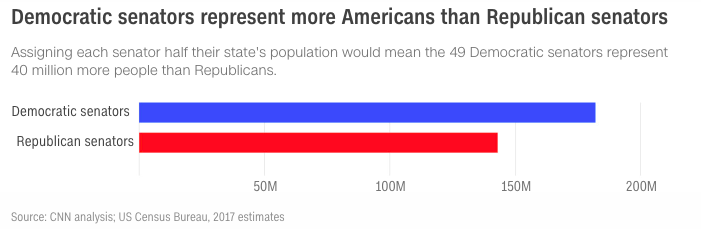
But the other reason is the extraordinary gap between the Senate and the American population. Even now, with the Senate controlled by Republicans, Democratic senators represent substantially more people:

The Constitution enshrines this imbalance. Anything in the whole document can be changed by amendment, “provided that… no state, without its consent, shall be deprived of its equal suffrage in the Senate.” This is is our only unamendable rule.

Long-term predictions are foolish, but I think you can imagine a pattern of Democratic presidents and House majorities being systematically stymied by Republican senates and the Supreme Court that the Senate has shaped. Then a significant majority of the public will be consistently blocked by an increasingly radicalized minority that is based in different parts of the country as we address climate crises, AI, and other truly profound challenges. Many people will not trace the failures of the government to specific provisions in our Constitution; they will perceive a government that’s inexplicably unresponsive and unrepresentative. And that, it seems to me, is a recipe for constitutional collapse.

See also: is our constitutional order doomed?two perspectives on our political paralysis; and are we seeing the fatal flaw of a presidential constitution?

courses that count for the Civic Studies major in spring 2019

More on the Civic Studies major at Tufts is here.

Required Introductory Course:

  • CVS 0020/PHIL 0020/PS 0020: Introduction to Civic Studies (Erin Kelly, Peter Levine) 

Thinking about Justice:

  • ANTH 140: Food Justice: Fair Food Activism and Social Movements (Alex Blanchette)
  • CVS 190/PHIL 192: Seminar: Political Philosophy of MLK, Jr
  • ECON 62: Economics of International Migration (Anna Hardman)
  • ENG 160 : Environmental Justice and World Literature (Ammons)
  • HIST 10: Colonialism in Global Perspective (Kris Manjapra)
  • MUSIC 132: Music and Ethics (Melinda Latour)
  • PHIL 195: Contemporary Political Philosophy (Lionel McPherson)
  • PHIL 25: Food Ethics (Sigrun Svavarsdottir)
  • PHIL 28: Feminist Philosophy (staff)
  • PS 151: Seminar: The Political Philosophy of Hobbes (Ioannis Evrigenis)
  • REL 08: Law, Religion and International Relations (Joseph Walser)
  • SOC 103-01: Sociological Theory (Freeden Blume Oeur)
  • SOC 94: Health, Policy, and Inequality (Brett Nava-Coulter) 

Social Conflict, Inequality, and Violence:

  • CH 0188: Health and Human Rights (Fernando Ona)
  • HIST 173: Black and Native New England (Kendra Field and Kerri Greenidge)
  • PS 108: Public Opinion and U.S. Democracy (Brian Schaffner)
  • PS 138: Democracy and Its Alternatives (David Art)
  • PSY 13: Social Psychology (Keith Maddox)
  • SOC 113: Urban Sociology: Global Perspectives on Space, Inequality and Resistance (Anjuli Fahlberg)
  • SOC 120 Sociology of War and Peace (Paul Joseph)
  • SOC 181 Seminar: War/Peace/State/Society (Paul Joseph)
  • SOC 188 Seminar: Intimate Violence (Anjuli Fahlberg) 

Civic Action and Social Movements:

  • CSHD 0034: Children, Nature, & the Ecology Movement (George Scarlett)
  • EC 117: Economics of Social Interactions and Social Networks (Yannis M. Ioannides)
  • FMS 22: Media Literacy (Julie Dobrow)
  • MUS 197: Social Justice, Advocacy and Music (Jeffrey A. Summit)
  • PS 108: Public Opinion and U.S. Democracy (Brian Schaffner)
  • PS 113: Nonprofits and Civil Society (Jeffrey Berry)
  • PS 118-02: Organizing for Social Change (Daniel LeBlanc & Ken Galdston)
  • PS 188-05: The Howard School of International Affairs (Pearl Robinson)
  • SOC 106: Political Sociology (Anjuli Fahlberg)
  • SOC 111: Making Social Change Happen (Margaret McGladrey)
  • SOC 113: Urban Sociology: Global Perspectives on Space, Inequality and Resistance (Anjuli Fahlberg)
  • UEP 278: Environmental Justice, Security, and Sustainability (Penn Loh)

Civic Skills:

  • ANTH 133: Anthropology of Journalism (Amahl Bishara)
  • CH 0188: Health and Human Rights (Fernando Ona)
  • CHEM 0094: Science and the Human Experience (Jonathan Garlick)
  • CSHD 004: Topics in Child Development: Identity, Community, and Voice (Jayanthi Mistry)
  • ED15: Social-Emotional & Civic Learning in Schools (Deborah Donahue-Keegan)
  • EE194 / ELS 109: Creating Children’s Media (Julie Dobrow)
  • ELS 109: Societal Aspects of Design: Integration, Innovation, and Impact (Ron Lasser)
  • ENG 311: Tufts 1+4 Foundation: Communicating for Change (Grace Talusan)
  • ENV 120: Introduction to Environmental Fieldwork (John de la Parra)
  • ENV 150: Environment, Communication, and Culture (Ninian Stein)
  • ENV 152: Seminar in Environmental Negotiations (Ninian Stein)
  • ExCollege: The President Has Tweeted: Official Government Communications in the Age of Trump (Nanda Chitre)
  • PHIL 24: Introduction to Ethics (Monica Link)
  • PS: Massachusetts State House Internships – Learning While Doing (State Sen. Ben Downing)
  • TBD: Project Citizen: Promoting Civic Engagement (Sherri Sklarwitz)
  • UEP 293-02: Community Practice Theory and Methods (Penn Loh)
  • UEP 294-02: Communications and Media for Policy and Planning (Penn Loh)
  • UEP 294: Teaching Democracy (Penn Loh)
  • WGSS 0185/AMER 0094: Mass Incarceration and the Literature of Confinement (Hilary Binda) 

Internship Seminar:

  • CVS 099: A required internship. This includes a weekly 2.5 hour class with graded assignments and a final project.


Capstone Seminar:

  • CVS 190/PHIL 192: Seminar: Political Philosophy of MLK, Jr.