For the sake of argument, let’s define “engaged scholarship” as …
The organized production of knowledge by groups that include some professional academic researchers and some people who are not academics and belong to the communities, populations, or organizations being studied.
I don’t have a representative sample of projects of engaged scholarship, but I would venture these generalizations:
Often the topics are issues that are priorities on the left or center-left, such as health disparities, access to government services, or environmental damage.
Often the communities that participate in the research lean left: low-income urban neighborhoods, migrant farmworkers, etc. (In 2004, I met with Penn State faculty interested in community-based research and observed that most did not work in their surrounding communities–conservative central Pennsylvania–but drove to Philadelphia to do their engaged research.)
Yet some of the underlying values of this approach can be seen as conservative: a preference for the local and the nonprofit/voluntary sector over Big Government, deep appreciation for local traditions, and a tendency to do something directly about problems rather than trying to win elections to change laws. I’ve even argued that the most authentically Burkean conservative field in the US today is the field that connects universities with communities through service, community-based research, and other partnerships.
Especially given the third point, you’d expect to see conservative engaged scholarship. The academic researchers might vote Republican instead of Democratic or Green, they would work in and with communities that preferred Trump over Clinton, and they would study issues like taxes, regulation, zoning, and abortion (as problems).
But I am hard pressed to find any examples. There are cases in which conservative adolescents conduct research on issues of their choice and scholars support them. But in those cases, the scholars’ focus is usually on the kids and their learning, not the issue that the students have chosen to address.
Why the dearth of conservative engaged scholarship? I can imagine five answers:
It’s not missing; I just haven’t found it. Here is one program at Ashland University that might qualify, and maybe there are more.
Conservatives are simply scarce in the social sciences and relevant humanities (especially in fields like public health and education, in which applied work is most common), and this scarcity explains why not many conservatives do engaged scholarship.
Conservatives have found other rich veins to mine: quantitative economic modeling, Austrian School economics (which is not at all quantitative but is favorable to libertarian principles), constitutional law, and some domains of intellectual history. They’re busy there.
Despite not liking government as much as (some) liberals do, conservatives are more aware of its power, including at the local level. Therefore, they are skeptical that working with a local nonprofit on a research study will make nearly as much difference as, say, running for office or advocating ideas that win elections.
Principled conservatives haven’t yet figured out that they should embrace engaged scholarship. They should develop experience and exemplary cases that strengthen conservative voices in engaged scholarship.
I hope that the last point is true, because it would be good for the gatherings and networks of engaged scholars if they included more conservative concerns, populations, and thinkers.
Garret Hardin’s 1968 Science article entitled “The Tragedy of the Commons” has been cited more than 40,000 times. It is appropriately influential, since the problem he analyzed is pervasive and profound. The example of global warming could kill us all, as could the example with which he began his article: the nuclear arms race.
Hardin saw ubiquitous “tragedies,” situations defined by the “solemnity of the relentless working of things,” “the inevitableness of destiny,” and “the futility of escape” (quoting Alfred North Whitehead). That stance provoked Elinor Ostrom and her colleagues to identify solutions. In place of the tragedy of the commons, Ostrom observed a drama that may end as either a comedy or a tragedy, depending on how we act. I find her response to Hardin extraordinarily important.
Several recent articles have explored Hardin’s apparent connection to radical anti-immigration campaigns. These articles have been prompted by the El Paso murderer’s writings (which have environmentalist echoes) plus the recent death of John Tanton, the founder of the Federation for American Immigration Reform (FAIR). Tanton was inspired by Hardin, who served on the FAIR board. See, for example, Matto Mildenberger, “The Tragedy of the Tragedy of the Commons“ (subtitled: “The man who wrote one of environmentalism’s most-cited essays was a racist, eugenicist, nativist and Islamaphobe—plus his argument was wrong”) and Alexander C. Kaufman, “The El Paso Manifesto: Where Racism and Eco-Facism Meet.”
I don’t have extra insights into Hardin and have not directly evaluated the charges in these articles. But I have long wondered about the strange normative claims in the “Tragedy of the Commons” article.
For instance, at one point, Hardin considers whether a system of private property plus legal inheritance is just. He answers that it is not, because “legal possession should be perfectly correlated with biological inheritance–that those who are biologically more fit to be the custodians of property and power should legally inherit more.” Instead, in our system, “an idiot can inherit millions,” which we “must admit” is unjust, although it does help to prevent a tragedy of the commons by protecting property rights (p. 1247).
Hardin says that this conclusion about justice follows from his training as a biologist. But biology cannot demonstrate that the biologically fittest deserve the most property. Biology should not yield normative conclusions at all. From the perspective of science–the study of nature–there is no justice, not even a reason to prefer environmental sustainability over a tragedy of the commons.
One reason that some people try to derive ethics from biology is naturalism: they posit that there can be no truths about right and wrong, only truths about nature that science uncovers. Therefore, we should replace any ethical claims with scientific ones. In my view, this is misguided, but it isn’t necessarily pernicious; plenty of people who hold decent values are naturalists, in this sense of the word.
A different reason is some kind of enthusiasm for Darwinian nature, understood as a realm of power and selection-of-the-fittest, in contrast to our debased societies that coddle the weak. This is not naturalism but evil. Reading “The Tragedy of the Commons” many times, I always assumed that Hardin was a naturalist, but now I wonder if he was at least tinged by evil.
CIRCLE has released its framework for “growing voters” (as an alternative to mobilizing people just in time to vote one way or the other in an election). This short slide deck is a summary; much more information is here.
Aeschylus, Prometheus Bound, lines 19-35, in my amateur translation:
Prometheus, you will always suffer under
One tyrant or another, uncomforted:
That’s the price of befriending people.
A god, you didn’t fear the rage of gods
When you gave mortals the forbidden gifts.
The penalty: you’ll always guard this rock,
This awful rock. No sleep, no rest; you can’t even
Move your leg. You just sing out your anguish
To no effect. Prometheus, it is a hard thing
To change the mind of the king of the gods.
For every new ruler is harsh and cruel.
And according to Google TranslateTM:
Arthovoulos Themidis absolutely,
Nearby of dissolvable copper
I use human ice cream
It is neither the voice nor the brute form
Light, constant flame retardant
you have to pay for flowers. Tied up
lei a variety of hidden hides,
thunderstorms if the sun again:
This is a bad thing
bury you: à à à ù ù ù

this is what I give to the philanthropic way.
God forbid, not even for the balloons
Honorable Mention I Am Out Of Trial.
There are no stone guards here
Arthostadin, Cleft, the knee flexor:
a lot of good people and good people.
Type: Two grams of unpleasant brakes.
You left me alone in the new hold.
Announcing his reelection campaign, Senator Ben Sasse (R-NE) made two claims about civic education:
1) “What’s at stake in 2020 is nothing less than a choice between American civics and socialism,” Sasse said. ‘”Those are the stakes.”
2) Sasse drew a direct connection between American teenagers not knowing civics and the fact that polling data today suggests that nearly 40% of Americans under 30 believe the First Amendment might be harmful.”
Sasse also quoted Reagan to the effect that “freedom is always one generation away from extinction. [It] is not passed along in the bloodstream—it has to be taught.” The main theme of his reelection launch was civics, at least according to his website.
The Post’s Jennifer Rubin thinks this is just another example of a Republican politician debased by Donald Trump. She calls Sasse’s speech a “pathetic spectacle” and thinks he should know better. Perhaps, but my style is to take people seriously, and Sasse is generally a serious thinker.
Besides, he is not alone in arguing that countering a socialist revival (presumably embodied by a few junior members of the House of Representatives and a presidential primary candidate) is a reason to restore civic education. Such arguments will affect those of us who work for civics, changing the political context for our efforts.
We also confront claims that what is at stake in 2020 is nothing less than a choice between American civics and Donald Trump. One (or conceivably both) of these arguments might be right, but both raise partisan sensitivities in their opponents and thereby complicate the politics in state legislatures and elsewhere.
We can all agree with Sen. Sasse that principles of freedom must be taught and that low support for the First Amendment is troubling. The most alarming evidence of decline comes from Yascha Mounk, although I raise some doubts about his study here.
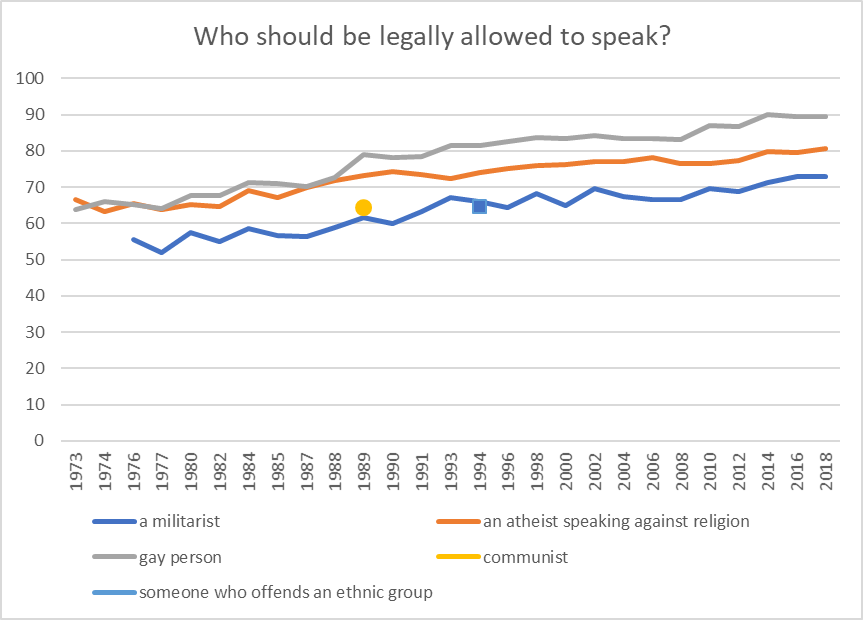
The General Social Survey has asked Americans whether various categories of people “should be allowed to speak.” The trends have generally risen over time. Americans have never been consistent supporters of the First Amendment, but they have generally become more willing to tolerate various categories of disfavored speakers. In 2019, Knight found that 58% of college students favored legally permitting “hate speech.” Perhaps this result reflects too little support for the First Amendment, but a similar proportion of adults in 1994 wanted to permit speech that (merely) offended another ethnic group. I think free speech requires constant attention, but I don’t see evidence of decline.
The controversial part of Sasse’s statement is not his support for the First Amendment or other civil liberties. It’s his contrast between “American civics” and “socialism.” That contrast raises the question of what those two categories mean. Sasse seems to suggest that support for the First Amendment and socialism are incompatible, but that is definitely not true; there is a long tradition of socialists who have also been strong supporters of free speech.
“Democratic socialism is committed both to a freedom of speech that does not recoil from dissent, and to the freedom to organize independent trade unions, women’s groups, political parties, and other social movements. We are committed to a freedom of religion and conscience that acknowledges the rights of those for whom spiritual concerns are central and the rights of those who reject organized religion.”
On one view, socialism is about economics, and it’s a matter of degree. Perhaps the metric is the proportion of GDP managed by the state (between 15% and 25% in the USA ever since 1955). The US is more socialistic than it was in 1900 and a bit less so than Germany is today. But then one must decide whether the political economy established by the New Deal and the Great Society–since it is somewhat socialist–is compatible or not with the ideas that we should impart in “American civics.”
James Ceasar has distinguished between “civic education,” which by definition supports a regime, and “political education,” which aims to change the regime. For him, the educational reforms of the Progressive Movement, multiculturalism, and global education are three examples of political, not civic, education, because they have aimed to change what he identifies as the American regime. (Here “regime” doesn’t have a negative connotation; it just means the core features of a political order.)
My question is why our regime must be defined by the dominant constitutional theory of 1900. I’d read our current regime as (more or less) a multicultural welfare state, in which case an education that promotes the American regime should favor those values. Education that aims to delegitimize the welfare state is political, not civic, in the 21st century. It is a form of politics with a reactionary intent. Maybe the education that John Dewey and other Progressives promoted was political in their own time, but because they won victories as political reformers, now their ideas have become the civic ones (in Ceasar’s sense)–the ideas that bolster the present system. And if the present system is partly socialist, then “American civics” is partly socialist.
On a different view, socialism is something that we have never seen in America. It refers to policies that are more radical than, say, Social Security or the Environmental Protection Act, because these laws have passed constitutional muster and have become part of the American tradition. Some socialists would concur that Social Security and the EPA are not socialistic to a satisfactory degree; they want a lot more. (But such people are scarce in the USA.)
Sometimes in this debate, people say that students should learn to prize “limited” government. I would only observe that governments that are avowedly socialist can be very careful about limits–constitutional, legal, and democratic. The Scandinavian democracies are excellent examples. They endorse the idea of the Rechtsstaat (a government under law) even as they tax and spend at relatively high rates.
Moreover, the limits set by the US Constitution can be compatible with much more socialism than we have today. No one disputes, for example, that Congress has the constitutional authority to raise income tax rates by a lot and to spend a lot more on social welfare programs. So limits per se aren’t really the issue; the question is what policies we should choose.
A third view might be that civic education, properly understood, encourages students to be less individualistic, less acquisitive, and more concerned with the common good than they would be otherwise. Therefore, it may strengthen support for the kinds of policies that strong conservatives like Sen. Sasse would call socialistic. In that case, civics and socialism are not opposed; they go together. To argue this point well, I think you would have to define “socialism” very broadly, so that it encompasses Great Society liberalism, Christian and other faith-based communitarianism, and mild social-democratic reforms as well as more radical proposals.
On yet a different view, students should not be taught any substantive political views in public schools. Schools should be committed to impartiality and should respect the individual rights of students to form their own opinions. (Impartiality is also a safeguard against the regime’s propagandizing in its own favor.) Students should learn about socialism, libertarianism, constitutional originalism, feminism, critical race theory, environmentalism, and other doctrines and should be equipped to make their own choices.
The problem here is that schools inevitably impart values, and probably should instill the values that create and sustain a fundamentally decent regime. Even studying a range of political ideologies reflects a political stance (some form of liberalism). So, if we must teach values, then are the values of democratic socialism opposed to the legitimate American regime, or part of it now, or better than the regime–or is this all a matter that students should debate?
My own view, for what it’s worth, is that socialism names a basket of policy options that have been part of the American political debate since the 188os and that students should critically assess as part of their civic educations. They may also reflect on the other traditions, apart from socialism, that have animated the American left. And certainly they should understand and asses various forms of conservative thought. The values that Donald Trump represents have equally deep (or deeper) historical roots in America, but some of his values are contrary to the fundamental aspirations of the regime and should be marginalized in “American civics” worthy of the name.