Category Archives: Uncategorized

teaching about institutions, in a prison

The Tufts University Prison Initiative of the Tisch College of Civic Life (TUPIT) is my institution’s contribution to the national movement for prison education. Colleges and universities are offering classes, degree programs, and special events for people in prisons or for incarcerated people along with students who come from “outside.” Sometimes, corrections staff and scholars of criminal justice also participate in these programs as learners, educators, or both.

In the era of mass incarceration–and in the wake of massive cuts to prison education programs–these efforts are far too small to fill the need, but they offer valuable opportunities and potential models for broader reform. Some of my favorite colleagues are deeply involved in prison education, and that includes the Founding Director of TUPIT, Prof. Hilary Binda, and her colleagues here at Tufts.

Thanks to TUPIT, I got to guest-teach a class at MCI-Concord last week. The class consisted of about 25 incarcerated men who are working on associates degrees. I presented my current working model for institutions, which I had also presented a few days earlier in the very different environment of a Tufts brown-bag series.
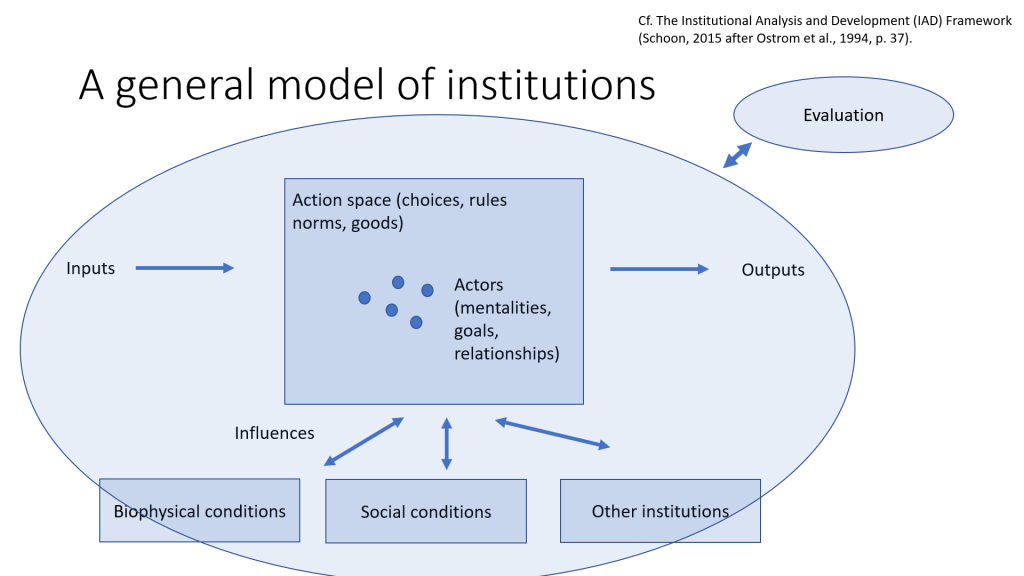
I told the students at MCI Concord that they should decide whether we’d focus on the prison as an institution, or spend more time on other examples. I’d say that we talked about prisons about half the time during the 2-hour conversation, but we also discussed families, gangs, schools, businesses, the foster-care system, and even biological systems such as forests. At least one student was interested in understanding the self as an “institution” that could fit the model. At Tufts, in contrast, the main institution that we’d discussed was “science”—mainly because that was the topic of the brown bag series in which I presented. Science and a prison make a pretty sharp contrast, but the model covers both.

For me, a goal was to test the validity of the model with this particular group. I think it largely passed muster, although many classes are too polite to share their reservations, and this was an exceptionally polite class, by any standard.

Certain aspects of the model seemed illuminating for at least some students. For example, the diagram shows a two-way arrow between biophysical conditions and the action space, which is composed of rules, norms, etc. Students at MCI-Concord generated the insight that the walls and barbed wire around the prison are biophysical conditions that both shape, and are shaped by, the rules and norms on the inside.

Among the interesting topics that arose was the distinction between a rule and a norm. Which is the right word for “Don’t snitch” within MCI-Concord? It is not an official rule; in fact, it violates the official rules. But it may be more than a norm, since it is enforced by the community, with clear consequences. Maybe it is a community-imposed rule.

I took one major challenge away from the conversation. The model that I presented is static or cross-sectional. It analyzes how an institution functions at a given time. The students wanted to know how people develop and change as they pass into, out of, and through multiple institutions. I suggested to them that they might be thinking that way because they’re taking a course that is all about personal transformation, but I also acknowledged that personal change is a concern for everyone, everywhere. So I came away feeling that the model of institutions should somehow connect to a model of personal development.

Finally, a word about the origins of this model. Where did I get this diagram, and why do I claim it might be valid? Essentially, it is my simplification of the Institutional Analysis and Design Model developed by Elinor Ostrom and her colleagues, which she presented in her Nobel Lecture. That is a pretty strong pedigree. I have simplified it in order to make it more general. The kinds of cases that Ostrom investigated are well modeled by game theory. They involve actors with fairly fixed goals who interact by bargaining. But human beings also interact in other kinds of situations, e.g., when we don’t know what we want and we are open to discussing it, or when our interests fuse due to very strong emotional attachments. My more general model is meant to cover bargaining situations, deliberative situations, loving relationships, and more. I am also interested in explicitly analyzing the role of power in institutions—not that Ostrom was blind to power, but I think she interpreted it too narrowly. I have claimed that power operates on every element of this model.

how to assess candidates in a presidential primary

Voters in a primary are a bit like members of a hiring committee. They have a batch of eager candidates and must choose one to represent their party and–they hope–hold the office.

I have served on dozens of hiring committees, including some for nonprofit CEOs and senior university administrators. Head-hunters give consistent advice about how to assess candidates. They advise committees not to ask how a candidate will or would address issues in the future. Candidates don’t really know, because their strategies will depend on the details of the issue and the other stakeholders’ actions. They almost inevitably give platitudinous responses: “I will bring people together, build consensus, and then move decisively.” “I will identify the ineffective programs and phase them out.” Such responses have zero informational and predictive value. Instead, committees should ask candidates how they actually addressed challenges in their previous work, and what they learned from that experience. This is more informative.

I don’t think that advice applies to voters in legislative elections. A legislator faces decisions about whether to vote yea or nay on bills. Newly elected legislators–back-benchers–do little else than vote yea or nay. It makes sense to ask legislative candidates (especially newcomers) how they would vote.

I realize that voters around the world are cynical about politicians’ promises. But I think cynicism should be reserved for their very general rhetoric about outcomes. “I will bring the country together” or “I will generate 5% growth” — these are promises waiting to be broken. (If they come to pass, it’s mostly good luck.) On the other hand, when candidates say, “I will support HR 1234,” that is quite predictive. It’s good to ask them how they will vote.

But presidents are more like CEOs than legislators. To be sure, they face decisions about whether to sign or veto bills, but those are rarely their decisive actions. Most of their impact results from hiring, firing, and guiding subordinates and jawboning all kinds of independent actors: 535 members of Congress, foreign heads of state, civil society actors and corporate leaders. (They also have the bully pulpit to address the nation, but the impact of that is somewhat overrated.)

We’d like to know how well they’ll do in those conversations and what their (precise) objectives will be. But what they say how they will deal with other people has limited value. It’s currently fashionable to place Democratic candidates on a scale from accommodating to tough, where the question is how they will handle their relationship with Republicans. I don’t think how they present themselves on the campaign trail predicts that very well at all.

Candidates should publish policy briefs, and we should read them. The main reason is that a campaign is a precious opportunity for a national debate about issues, influencing citizens’ knowledge and values. But policy briefs are not very informative about a candidate’s actual performance as president.

A brief may tell you something about the candidate’s goals and values. A Democratic candidate who says “Medicaid for all,” is conveying more progressive ideals that a candidate who asks, “How will we pay for that?” But an actual Democratic president will not choose between those two policy positions. She or he will: (1) choose one or two issues to emphasize at key moments, (2) deal with members of Congress across the spectrum about those issues and the many issues that arise for other reasons; and (3) decide whether to sign or veto the actual bills that emerge from Congress–if any do. Asking candidates how they will perform those tasks is not terribly informative, because the question yields platitudes of the form, “I will bring people together and move forward together” or “I will rally the troops and drive change through.” (Those sound different, but neither describes what they will actually do.)

The 2020 Democratic Primary has generated an especially large number of interesting policy proposals. The Warren campaign, in particular, has made a meta-issue of having detailed policy briefs. (“I have a plan for that.”) I like the message that Warren is detail-oriented and interested in policy, a major contrast to the incumbent and probably predictive of how she would govern. I like the ethic of presenting specific ideas to the voters: it takes people seriously as thinkers. I also think the policy debate among candidates may have some influence on other actors–Members of Congress, interest groups, and the public–which is beneficial. But I would still take the headhunters’ advice and focus more on how candidates have actually dealt with challenges than on what they say they would do if they were president.

Deliberative Democracy Consortium conference on whether deliberation is feasible

From this official registration page:

On October 30 and 31, the Deliberative Democracy Consortium is convening researchers, scholars, and deliberative democracy practitioners in Washington, D.C., to explore the intersection of deliberative democracy with human cognition, social and emotional intelligence, and moral decision making.

We will explore questions such as:

1) Given what we know about human cognition and moral development, is deliberative democracy feasible?

2) At what scale?

3) Under what conditions?

This meeting will give scholars, practitioners, funders, and others an opportunity to explore both the promise and the limitations of deliberative democracy in the context of human behavior and development. The meeting may result in an edited volume; future convenings; an action plan; a statement of shared values; promising partnerships; etc.

Agenda

Evening of Wednesday, October 30 – 5:00pm – Reception with no host bar and heavy hors d’oeuvres

Thursday, October 31 – 9:00am – 4:00pm – All day meeting – Continental breakfast (8:30am) and lunch included

I’ll be moderating a panel. Part of our session description (still under construction) says:

The traditional “civics class” description of democracy assumes that citizens reason independently about issues, listen to and learn from each other, and then select leaders or policies that represent their views. It is consistent with liberal democratic tenets of individual and minority rights, free speech and the rule of law. 

The Behavioral Revolution presents a very different premise: human beings are deeply biased, and the reasons we express are mainly justifications for opinions we already held without conscious choice. Meanwhile, New Institutionalism suggests that even when individuals reason well, the processes that yield decisions in groups add arbitrariness and bias. These are two of the most influential currents in the study of human beings, and both tend to support arguments for expertise and unregulated markets, technocracy, or authoritarianism. Specifically, right-wing authoritarian populism is on the rise.  …

How can deliberative democracy address these problems of citizen capacity and the consequent vulnerability of liberal democracy?

Please join us.

revisiting Against Deliberation in the age of Trump

In Introduction to Civic Studies, we recently discussed Lynn M. Sanders, “Against Deliberation,” Political Theory, June 1997 v.25 no. 3

Here are some illustrative arguments from her important piece:

“Appeals to deliberation, I will argue, have often been fraught with connotations of rationality, reserve, cautiousness, quietude, community, selflessness, and universalism, connotations which in fact probably undermine deliberation’s democratic claims.” (p. 2)

“Some citizens are better than others at articulating their arguments in rational, reasonable terms. Some citizens, then, appear already to be deliberating, and, given the tight link between democracy and deliberation, appear already to be acting democratically.” (p.2)

“Deliberation is a request for a certain kind of talk: rational, contained, and oriented to a shared problem” (p. 13). “Arguing that democratic discussion should be rational, moderate, and not selfish implicitly excludes public talk that is impassioned, extreme, and the product of particular interests. (p. 14)

“Prejudice and privilege do not emerge in deliberative settings as bad reasons, and they are not countered by good arguments. They are too sneaky, invisible, and pernicious for that reasonable process. So worrying about specifying what counts as a good argument, or trying to enhance reason-giving either via the formulation of better rules and procedures or by providing the time, money, and education necessary to become a responsible deliberative citizen, does not engage some of the most serious challenges to the possibility of achieving democratic deliberation. Some people might be ignored no matter how good their reasons are, no matter how skillfully they articulate them, and when this happens, democratic theory doesn’t have an answer, because one cannot counter a pernicious group dynamic with a good reason.” (p. 4)

I see these as serious concerns. Rose Marie Nierras and I found that many activists from the Global South felt them acutely. (Levine, Peter and Nierras, Rose Marie [2007] “Activists’ Views of Deliberation,” Journal of Public Deliberation: Vol. 3 : Iss. 1 , Article 4.)

But I also sense that the main problem has shifted, requiring a reevaluation of these arguments against deliberation.

It’s true that reason-giving can favor the privileged because they are good at it (or they can hire professional reason-givers, such as lawyers), and because they are basically OK with the social system in which reasons are exchanged.

But it is also a characteristic of privilege not to feel any compulsion to give reasons. It is the autocrat who says, “Because I said so.” Donald Trump is completely unwilling to give or hear reasons, and he may have developed that attitude as a result of extreme socio-economic privilege. His opponents and critics want reasons from him and are willing to give reasons for their demands.

Indeed, there is a long tradition of the people demanding reasons, and authoritarian elites trying to evade reason-giving. When we have that tradition in mind, it’s natural to equate deliberation with political equity. On the other hand, when we think about formal deliberative bodies within a stable but imperfect state–American juries, for example–we worry that deliberation and equity can conflict, because those with advantage prevail in such discussions.

As with many issues, Donald Trump reminds us of the positive case.

See also Habermas with a Whiff of Tear Gas: Nonviolent Campaigns and Deliberation in an Era of Authoritarianism; postmodernism and Trump;

Gandhi: The Years That Changed the World, 1914-1948 by Ramachandra Guha

Guha’s biography is the essential work on Gandhi: much more detailed, better researched, and more persuasive than the earlier biographies that I know of. Volume Two, focusing on India, is 1,104 pages long but moves at a brisk pace. It’s detailed but never ponderous. The story is often suspenseful, even if you know how it will turn out in broad outlines. For example, just when all seems lost, Gandhi suddenly pulls off the Salt March. And the end of his life has the inexorability of a classical tragedy.

Guha generally proceeds chronologically, but now and then he pauses for an essay on a special topic, such as “Gandhi’s personal faith, his personal morality, as expressed in his words and actions in this decade of the 1920s.” The narrative is enlivened by numerous quotations from original documents, many never printed before. Along with Gandhi’s voice, we hear an amazing range of human beings who interacted with him or commented on him in one way or another, from Black American pastors to anarchists to the advertisers who used his silhouette as a brand.

One of the larger themes that emerged for me was Gandhi as polemicist. The Mahatma relished arguments, even though some of his opponents alienated and infuriated him. You could summarize his thought by capturing his long-lived debates with a few key rivals, especially B.R. Ambedkar and Muhammad Ali Jinnah. But he also sparred with many others.

For instance, I love to think of Margaret Sanger, the sex educator and popularizer of the phrase “birth control,” staying in Gandhi’s ashram and arguing with the celibate old man about first-wave feminism:

‘both seemed to be agreed that woman should be emancipated, that woman should be the arbiter of her destiny’. But whereas Mrs Sanger believed that contraceptives were the safest route to emancipation, Gandhi argued that women should resist their husbands, while men for their part should seek to curb ‘animal passion’. (p. 585)

Sanger was just one of scores of such visitors.

Guha is even-handed, judicious, and open-minded. Only at the end, in an epilogue on contemporary interpretations of Gandhi, does he emerge as a defender of his subject. By then, Guha has explored many flaws, errors, and vices, but he insists that Gandhi was far more complex and responsive than some of his critics have been. For instance:

[Arundhati Roy] presented Gandhi as a thoroughgoing apologist for caste, further arguing that this was in line with his views on race. Gandhi, she suggested, was casteist in India because he had been racist in South Africa. Roy claimed that Gandhi ‘feared and despised Africans’; this he certainly did in his twenties, but just as certainly did not in his forties and fifties. Reading Roy, one would not know that Gandhi decisively outgrew the racism of his youth, a fact that people of colour themselves acknowledged, and appreciated. … Roy has all of Ambedkar’s polemical zeal but none of his scholarship or sociological insight. … [She seeks] —by the technique of suppressio veri, suggestio falsi so beloved of ideologues down the ages—to prove a verdict they have arrived at beforehand.” (p. 876)

In contrast, Guha situates Gandhi in his time and cultural context, appreciates the Mahatma’s critics and opponents, explores his flaws and limitations (and occasional weirdness) at length, and paints a real-life portrait–which thereby emerges as a portrait of greatness.

Guha, Ramachandra. Gandhi: The Years That Changed the World, 1914-1948. Knopf Doubleday Publishing Group. See also: the question of sacrifice in politics (on Gandhi and Ambedkar); Gandhi versus Jinnah on means and ends; Gandhi on the primacy of means over ends; and notes on the metaphysics of Gandhi and King