Category Archives: Uncategorized

survey of Ukrainians’ motivation to fight

Pippa Norris and Kseniya Kizlova have crunched some numbers from the European Social Survey’s Ukraine sample (2,901 people) to investigate “what mobilises the Ukrainian resistance?

In autumn 2020, Europeans were asked: “Of course, we all hope that there will not be another war, but if it were to come to that, would you be willing to fight for your country?” About 70% of Ukrainians said yes.

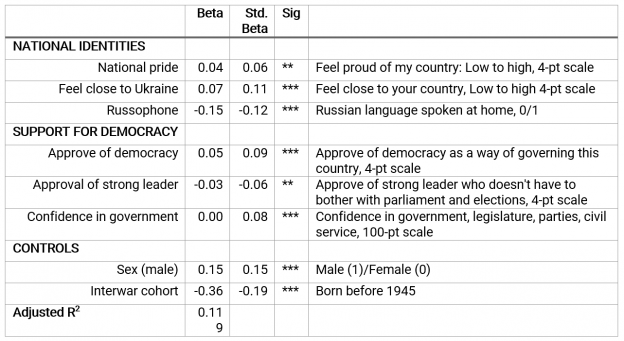
That number isn’t especially meaningful on its own, since it is hypothetical. However, the correlates of the responses are interesting. As the table from Norris and Kizlova shows, Ukrainians were more likely to say they would fight if they felt patriotic, if they spoke Ukrainian rather than Russian at home, if they were confident in their government, and if they supported democratic values. Those are outputs of a statistical model, so they imply that each of these factors matters by itself. For instance, democratic values correlate with a willingness to fight when holding patriotism/nationalism constant. Also note that although speaking Ukrainian was a correlate of willingness to fight, 51% of those who spoke Russian at home said yes.

Since this was a question about personally taking up arms, it is not surprising that being male and younger correlated with positive responses. In general, the literature on nonviolent resistance suggests that it mobilizes people who are not young men.

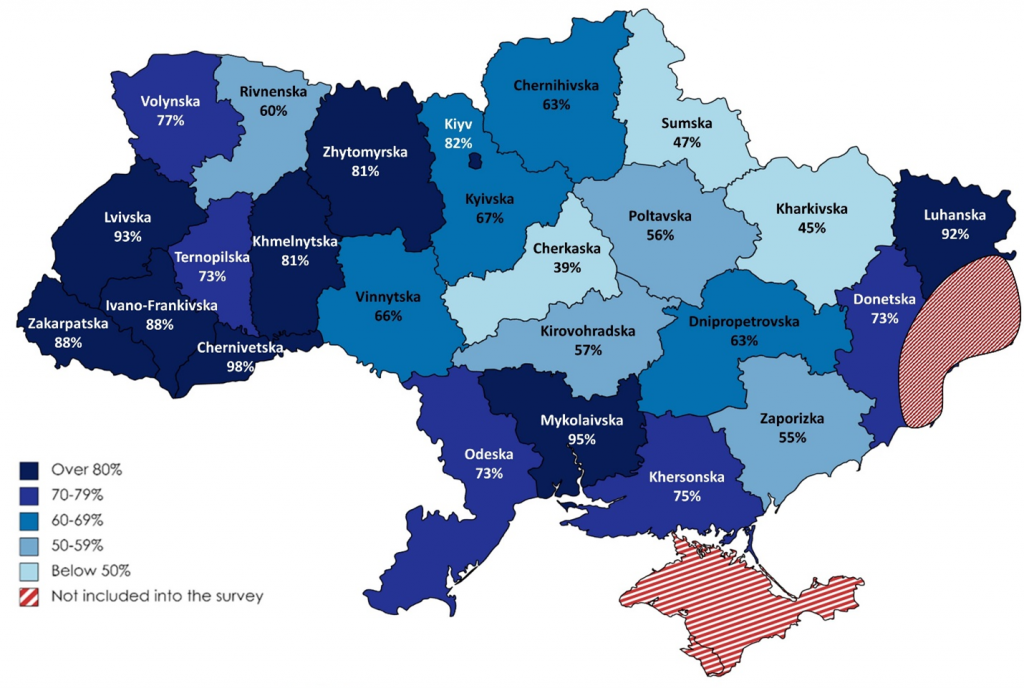
Norris & Kizlova find regional differences, but not in a simple way. Indeed, the highest rate of willingness to fight was immediately adjacent to the Russian proxy “republics” in the east, followed by the Lviv area far to the west.

See also: civilian resistance in Ukraine, Russia, and Belarus; when a university is committed to democracy (about the Ukrainian Catholic University in Lviv); and why I stand with Ukraine (from 2015)

civilian resistance in Ukraine, Russia, and Belarus

Yesterday, I posted about prospects for nonviolent resistance in Ukraine and in Russia. Perhaps “civilian resistance” is a better heading. That category would include throwing a Molotov cocktail or firing grandpa’s hunting rifle as well as classic nonviolent acts like marches and occupations. My point is not that civilian resistance is better than military defense, or that refraining from violence is–or isn’t–morally superior. I hope for every possible Ukrainian success on the battlefield. But I believe that civilian resistance also has real potential, and indeed, that resistance by Russian civilians offers the best hope in this dire situation.

So I will try to track relevant developments, although with no hope of being comprehensive.

  • This is Rob Lee’s thread of videos showing Ukrainian civilians successfully blocking Russian troops–evidence of courage and of Russian soldiers’ reluctance to kill.
  • This a thread by my Tufts colleague Oxana Shevel arguing that Ukrainian civilians will make the country ungovernable by Russian occupiers.
  • Alexei Navalny’s group is officially calling for civil disobedience against the war. OVD-Info is reporting that 6,494 Russians have been detained in “anti-war actions” since Feb 24.
  • Despite the incredible difficulty of organizing resistance in Belarus, there have been antiwar protests in several Belarusian cities.
  • When Ukrainian government officials express deep sadness about the deaths of Russian soldiers, they reframe the conflict as Putin versus the peoples of both countries. This framing invites Russian civilians to help end the war and creates the basis for reconciliation. It reminds me of the way Lincoln describes Confederate deaths in the Second Inaugural Address. He bears responsibility for these deaths as the leader of the North’s military effort, “upon which all else chiefly depends.” Yet he presents both sides’ losses as a shared sacrifice to end slavery and build a better society. Similarly, in honoring the Union dead at Gettysburg, Lincoln never mentions their bloody military victory (or the Confederates’ loss) but describes the soldiers’ sacrifice almost as if it had been nonviolent. In both cases–Lincoln and Ukraine–I presume the sorrow is genuine, but it is also a brilliant strategy.

I have no way of estimating the chances of success in any of these three countries, but guessing the odds is not our task. We should do everything we can to increase the probability of successful civilian (and military) resistance by contributing money, upholding the best examples, and advocating for support in our own countries and institutions.

On Ukraine, see also: prospects for nonviolent resistance in Ukraine and in Russia; why I stand with Ukraine (from 2015); working on civic education in Ukraine (2017); and Ukraine means borderland (2017)

On civilian resistance, see also: the case for (and against) nonviolence; self-limiting popular politics; Why Civil Resistance Works; the kind of sacrifice required in nonviolence.

prospects for nonviolent resistance in Ukraine and in Russia

It is not inevitable that Russia will gain control of large portions of Ukraine, but that outcome is certainly possible, even if the invaders must resort to sustained shelling and bombing to capture cities. If an occupation does come to pass, I would anticipate (and support) an armed insurgency. My topic, however, is the possibility of nonviolent resistance–in Ukraine, in Russia, and even in Belarus.

I make no assumption that nonviolence is morally superior to war. An insurgency will be fully justified in the event of an occupation. However, I believe:

  • Nonviolence has powerful potential.
  • A nonviolent movement can complement a violent insurrection, as was the case in British India, South Africa under apartheid, or Palestine 1987-93 (notwithstanding major differences among these examples).
  • A nonviolent movement permits a whole population to participate in forging a democratic future together, whereas a military effort is intrinsically hierarchical and selective; and
  • The circumstances for nonviolence could be propitious. Here I will make a cautious case for optimism.

Already, we see effective moments of nonviolent resistance in Ukraine. This is the widely-viewed video of a Russian tank turning around and driving away when confronted by civilians (apparently near Zaporizhzhia). Although many such cases will have tragic results, the example is powerful. Presumably, most Russian soldiers do not want to run over or shoot Ukrainian civilians. Their reluctance will be a serious challenge to the Putin regime.

Restraint by ordinary Russian soldiers is one reason for tentative optimism. I do not share the view that Russians will be restrained because of their cultural, linguistic, and other similarities to Ukrainians. During this period of very strongly justified concern about racism, we sometimes forget that people can eagerly slaughter others who look just like them. Ukraine from 1932 to 1945 (or even from 1914 to 1945) provides catastrophic examples. Putin’s problem is different. He has failed to legitimate the invasion in any way; and human beings rarely like killing other people unless a war has been legitimized (or they are scared of being killed first).

A second favorable circumstance: Ukraine may have the largest number of highly experienced nonviolent civil resisters in the world, thanks to the successful Revolution of Dignity (2014), which is pervasively and eloquently memorialized in the parts of the country that I have visited. Certainly, the Russian regime–and any puppet regime it installs Ukraine–will be more ruthless than many of the governments that have lost to nonviolent protests. At the same time, the Ukrainian nonviolent resistance will be particularly large, experienced, and motivated. An almost unstoppable force will meet an almost immovable object, with unpredictable results.

Size is an advantage for nonviolent movements. Erica Chenoweth and Maria Stephan found that no major protest movement between 1900 and 2006 failed if it mobilized 3.5 percent of the national population. Their work has inspired claims like this one: “Once around 3.5% of the whole population has begun to participate actively, success appears to be inevitable.” The word “inevitable” overstates Chenoweth’s and Stephan’s findings: the next effort could end in failure. Many of the fully successful cases occurred during a period (ca. 1985-95) when authoritarian regimes were senile and demoralized, whereas lately they have proven resourceful and resilient.

More importantly, some people have drawn a mistaken inference from Chenoweth’s and Stephan’s finding, assuming that the presence of 3.5 percent of the population on the streets causes a regime-change or another major policy shift. As several experts have told me, the causal story is almost certainly different. If a set of organizations and networks is able to get 3.5 percent of the population onto the streets against a government, then either it is strong enough to pose a serious threat, or else the failure of the regime to stop such a large protest indicates the government’s hesitancy, incompetence or internal divisions–or all of the above. In other words, 3.5 percent is a symptom, not a cause.

Still, we could expect a large nonviolent movement in Ukraine. Maciej Bartkowski summarizes a 2015 survey of Ukrainians that showed a high degree of hypothetical willingness to join a nonviolent movement against a foreign occupier. Of course, there is no way to know whether answers to such survey questions predict actual behavior, but so far, the level of mobilization in Ukraine exceeds expectations. In the 2015 poll, three times more people stated that they would act nonviolently than violently. Given the extraordinarily high rates of voluntary participation in the war so far, that ratio would imply that virtually every Ukrainian will take part in nonviolent direct actions.

Organization and leadership offer a third reason for optimism. A Russian guy who was aligned with Putin once badgered me with the question: “Do you believe in spontaneous revolutions?” He believed–as Putin probably sincerely believes–that the Ukrainian peaceful revolutions have been CIA operations. I could have named the Russian Revolution of 1905 as an example of a spontaneous uprising, since it seemed to come out of nowhere. But a better answer is: no. Massive popular movements are not spontaneous; they are organized. However, the Ukrainian Revolution of Dignity was organized by Ukrainians in a decentralized way (with modest European and US support), and many of the organizers are still around to try the same approach again.

I am not sure whether the same person can serve as the leader of a nonviolent movement and an armed insurrection. (Nelson Mandela is a special case, for many reasons, including that he was imprisoned.) President Zelensky, if he survives, will presumably head the insurrection, just as he currently serves as the commander in chief of Ukraine’s armed forces. Still, one can see his principled decision not to leave Kyiv as an example of the kind of sacrifice that nonviolence demands. He may inspire, even if he cannot organize, a nonviolent struggle.

The other side of the coin is the potential for nonviolent antiwar–or even pro-democracy–movements in Russia and Belarus. I have no way of estimating the chances of success in either country. However, we have already seen very brave Russians take to the streets as well as anti-war protests in Minsk. May they succeed, not only for Ukraine’s sake but also for the good of their respective countries.

A truly effective movement in Russia or Belarus would require the kinds of organization and coordination that state security agencies are increasingly effective at destroying. Therefore, no one should imagine that success will be likely or easy. Yet resistance can take many forms: not only massive public protests but also a palace coup, emigration and disinvestment, or what James C. Scott named the “weapons of the weak”: ordinary foot-dragging and noncompliance. Russians and Belarusians might use those tools out of genuine support for Ukraine or simply because they resent their superiors and their orders. The Ukrainian official Oleksiy Arestovich appealed recently to Russian soldiers: “Like any military person, you know that there are a million ways not follow the order … You get lost, you break down, the radio station does not work, etc. We believe in you and count on your courage, honor and prudence, which will allow you to make the right choice in this time of tension.”

Indeed, courage, honor and prudence can take a wide range of forms, from throwing a Molotov cocktail at an armored personnel carrier, to holding a sign in a Moscow street, to challenging Putin in a closed-door meeting, to just failing to understand an order on the radio. I am certain we will see a lot of all these things in the days and weeks to come. Whether they succeed is perhaps the most important question of all, unless the Ukrainian military can actually win a conventional war on the ground.

See also: why I stand with Ukraine (from 2015); working on civic education in Ukraine (2017); and Ukraine means borderland (2017). See also the case for (and against) nonviolence.
Save the Date: June 24 for a special one-day version of the Frontiers of Democracy conference, a Festival of Cases

If you are ready to register, you can purchase a ticket for the event now for either the in-person or online version (ticket prices go toward meeting our costs).
Otherwise, please hold the date!

Civic cases describe difficult choices faced by real groups of activists, social-movement participants, or colleagues in nonprofit organizations. By discussing what we would do in similar situations, we can develop civic skills, explore general issues, and form or strengthen relationships with other activists and thinkers.

You are invited to spend June 24 discussing your choice of two such cases in groups of up to eight peers. The day will also include plenary discussions and talks, including a keynote by Tisch College Dean Dayna Cunningham on Multiracial Democracy.

Most of the cases have been developed by the SNF Agora Institute at Johns Hopkins University, Justice in Schools, or the Pluralism Project at Harvard, co-sponsors of Frontiers this summer. Selected cases can be found here, and more options will be available by June. Unlike most cases about business, public policy, or ethics, these stories involve groups of voluntary participants who must make decisions together.

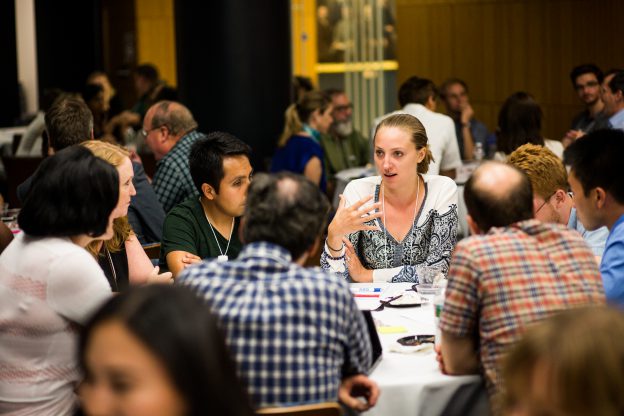
06/21/2018 – Boston, Mass. – The opening remarks were held for the Frontiers of Democracy Conference inside the Sackler Building on Thursday, June 21, 2018. (Jake Belcher for Tufts University)

You can choose to participate for the whole day remotely, joining other remote participants in Zoom rooms for the case discussions and watching the plenaries online. You are also enthusiastically welcomed to participate in-person at Tufts University’s downtown Boston campus.

Frontiers of Democracy has been held annually since 2009, with a hiatus due to the COVID-19 pandemic. It traditionally attracted about 140 activists and scholars or advanced students from many countries for relatively informal discussions of civic topics. The 2022 version is intentionally shorter and hybrid in format.


Purchase a ticket now or save the date!

Transformative Learning and Civic Studies

Newly in print: The Palgrave Handbook of Learning for Transformation, edited by Aliki Nicolaides, Saskia Eschenbacher, Petra T. Buergelt, Yabome Gilpin-Jackson, Marguerite Welch and Mitsunori Misawa (2022).

Although I am not deeply knowledgable about Transformative Learning, a movement launched by the sociologist Jack Mezirow, I like its emphasis on learning as a lifelong process of transforming one’s perspective on society.

This volume includes a chapter entitled “Reconsidering the Roots of Transformative Education: Habermas and Mezirow” by Saskia Eschenbacher and me (pp. 45-58). Our abstract:

Jack Mezirow acknowledged the deep influence of the German philosopher Jürgen Habermas (1929–) on the development of transformative learning. We describe some fundamental elements of Mezirow’s and Habermas’ thought, explore their affinities, and argue that Mezirow did not give adequate attention to two important themes in Habermas: the power and value of social movements and the need to reform the overall structure of a society to enable transformative learning. We argue that transformative learning would benefit from a deeper consideration of these topics. Finally, we introduce Civic Studies, a parallel intellectual movement that also owes much to Habermas, and we suggest a convergence.