Author Archives: Peter

About Peter

Associate Dean for Faculty and the Lincoln Filene Professor of Citizenship and Public Affairs at Tufts University's Tisch College of Civic Life. Concerned about civic education, civic engagement, and democratic reform in the United States and elsewhere.

President Obama on how he discusses policy with Republicans

Jonathan Chait’s entire interview with the president is fascinating. It offers Obama’s perspective on his own presidency, which is not the objective reality, but it is full of insights.

For instance, Chait asks, “So it’s January 27, 2009, and you hear Boehner say he is against the stimulus. I’ve heard complaints from Republicans about what you’re like in these meetings. They say you’re didactic and you lecture. In a situation like that, are you trying to discuss Keynesian theory and saying, ‘Do you believe in stimulus?’ At what level is the discussion held?”

Obama first responds, “You know, the truth of the matter is, it’s hard for me to characterize myself. You’re probably better off talking to some staff members who sit in on these meetings.” He’s right about that: none of us can objectively assess how we appear in interactions with others, especially in tense and difficult situations. No one would accuse this president of being unprepared, uninformed, or intentionally offensive, but it’s possible that his professorial manner alienates some people who read him as acting superior. As he acknowledges, he’s not the one to judge that.

He does, however, review his good relationships with Republicans in the Illinois legislature. He believes his problem with Republicans in Washington is strategic rather than personal: they decided to block his entire agenda in 2009, both to reverse their electoral losses and to appease their base.

Then he gives a window into how the conversations would actually unfold:

Look, typically what would happen, certainly at the outset, it would be that I would say, “We’ve got a big problem: We’re losing 800,000 jobs a month. Every economist I’ve talked to, including Republican economists, thinks that we need to do a big stimulus, and I’m willing to work with you to figure out how this package looks.”

Note the combination of a policy argument–which could be considered didactic, although it’s also correct–followed by an invitation to discuss.

And typically, what you’d get would be, “Well, Mr. President, I’m not sure that this big spending approach is the right one, and families are tightening their belts right now, and I don’t hear a lot of my constituents saying that they want a bunch of big bureaucracies taking their hard-earned tax money and wasting it on a bunch of make-work projects around the country. So we think that government’s got to do that same thing that families do.” So you kind of hit that ideological wall. I’m sure that after about four or five of those sessions, at some point, I might say, “Look, guys, we have a history here dating back to the Great Depression,” and I might at that point try to introduce some strong policy arguments. What I can say unequivocally is that there has never been a time in which I did not say, “Look, you tell me how you want to do this. Give me a sense of how you want to approach it.”

A common criticism of the president is that he’s too cerebral; he doesn’t know how to appeal to self-interest and make a deal. He offers three responses to that charge.

First, Republicans did not think it was in their self-interest to negotiate at all. “During the health-care debate, you know, there was a point in time where, after having had multiple negotiations with [Iowa senator Chuck] Grassley … in exasperation I finally just said …, ‘Is there any form of health-care reform that you can support?’ and he shrugged and looked a little sheepish and said, ‘Probably not.'”

Second, Obama insists that he did work the phones. “It’s interesting, in 2011, when the left had really gotten irritated with me because of the budget negotiations, there was always this contrast between Obama and LBJ, who really worked Congress. But I tell you, those two weeks, that was full LBJ. I think [White House photographer] Pete Souza has a picture series of every meeting and phone call that I was making during the course of that, which is actually pretty fun to see.”

oval

The president calling a Member of Congress on March 19, 2010

Third, a 21st century president just doesn’t have the bargaining tools that were available to an LBJ, not to mention an Abe Lincoln. “And one of the things that’s changed from the Johnson era obviously is I don’t have a postmaster job. … Good-government reforms have hamstrung an administration, which I think is for the most part for the best. But it means that what you’re really saying to them is, ‘This is the right thing to do and I’ll come to your fund-raiser in Podunk and I will make sure that I’ve got your back.'”

I’d add that not only patronage but the whole legislative process has changed in ways that reduce a president’s ability to deal transactionally with Members of Congress. Just to name one change, Congress now sends relatively few bills to the president, and they tend to be omnibus compromises that he more or less has to sign. Thus he can’t use a targeted veto threat to get a Member’s vote. Johnson received about eight times more bills from Congress than Obama gets.

The president is good at understanding and addressing differences of principle. For instance, “[Former congressman] Bart Stupak was a very sincere, pro-life legislator and a Democrat, a really good man who worked really hard with me to try to get to yes and ended up getting there, working along with Sister Carol [Keehan], the head of the Catholic hospitals, despite strong opposition from the Catholic bishops. So in some cases there really were legitimate difficulties, substantive issues that had to be worked through.”

The president has not been as successful at winning zero-sum negotiations, but I have often felt that he’s played a weak hand pretty well.
introspect to reenchant the inner life

John Stewart Stuart Mill was the son of a great classical utilitarian. He was taught that happiness could be measured on a one-dimensional scale from pain to pleasure. Since he was only one of many millions of human beings, he should focus on helping others to be happy by serving them directly and by reforming laws and policies to maximize happiness. Happiness was a simple quantity determined by circumstances beyond the individual.

As a young man, Mill became deeply depressed. He asked himself:

“Suppose that all your objects in life were realized; that all the changes in institutions and opinions which you are looking forward to, could be completely effected at this very instant: would this be a great joy and happiness to you?” And an irrepressible self-consciousness distinctly answered, “No!” At this my heart sank within me: the whole foundation on which my life was constructed fell down. All my happiness was to have been found in the continual pursuit of this end. The end had ceased to charm, and how could there ever again be any interest in the means? I seemed to have nothing left to live for.

Mill realized that other people could not make him happy, and the same was true of everyone else. Each person had to pay attention to her own wellbeing or everyone would be miserable. One reason is that we do not fall on a single spectrum from agony to ecstasy. Instead, we experience a heterogeneous batch of emotions (joy, peace, pain, acceptance, delight, equanimity, and many more) that may be in tension with each other. Mill’s ultimate response was to develop a richer philosophy in which the inner life regained its independent standing and was no longer a mere outcome of justice. “The important change which my opinions at this time underwent, was that I, for the first time, gave its proper place, among the prime necessities of human well-being, to the internal culture of the individual. I ceased to attach almost exclusive importance to the ordering of outward circumstances.”

This kind of reflection recalls the intrinsic value–the beauty, complexity, and richness–of inner life itself. Introspection counters an avoidable modern tendency to disenchant the self.

Many centuries ago, the world seemed thoroughly enchanted. There were spirits, angels, or demons in the air, the forest, the water, and everywhere else. It seemed natural that there should also be a spirit inside each of us that was similarly invisible, unpredictable, powerful, and precious.

Natural science has not demonstrated that the only real things are visible and predictable. On the contrary, natural science has discovered quarks and bosons, forces and dimensions. It had yielded a world full of strange and heterogeneous objects. But natural science does presume (rather than discover) that every true statement is about something that one can demonstrate experimentally. As natural science has progressed, the enchanted world has shrunk: we now know that hot and cold fronts rather than demons cause storms, and bacteria and viruses rather than witches cause disease.

An object inside us that we might call a soul, a self, or a will seems likely to disappear for the same reasons. After all, a soul can never be observed or experimentally verified. And science is building an alternative story about networks of neurons that fire (because of forces acting on them) and cause mental states such as desire and will. In turn, these networks of neurons evolved over many millions of years to make species like ours more fit to survive. The implication is that human beings are ultimately just complicated machines, and an experience like freedom of the will is an illusion. Our thinking belongs to the same network of cause-and-effect that explains why a computer opens an application when you push a button, or a tree sprouts a leaf when the sun shines on it.

The premises seem correct, but the conclusion does not follow. Natural science may explain why mental states occur. It cannot not explain what those states are. By analogy: biology explains why most leaves look green, but it wouldn’t convey to a truly color-blind person what green looks like. Likewise, a conscious person actually experiences will, choice, and a host of other complex mental states. To say what will is, one must describe it closely and insightfully from the perspective of the person who wills something. Under close inspection, a simple thing like “will” refracts into many related emotions and beliefs. One must address questions like these: What does it feel like to want something? Can you want it and not want it at the same time? Does wanting an object feel the same as wanting a person? How does will relate to love? To happiness? What thoughts and mental practices enhance and constrain will? What forms of willing are good and which are bad?

Such introspective questions are appropriate even in a world in which natural science works just as well as advertised. If you want to know why human beings think, it’s appropriate to turn to neuroscience and evolutionary biology. But if you want to know what thought is, you must attend to thinking. Even more so, if you want to decide which thoughts are good, you must evaluate the complex, subtle, mysterious world of your own consciousness.

Both the Talmud and the Qur’an propose that to murder one person is to destroy a whole world, and to save a life is to save a whole world. Perhaps those passages reflect a recognition that each human consciousness is an immense accumulation of experience. The whole universe of which I am aware (from distant galaxies to microscopic organisms swimming in a drop of water) is all in my head. My mind contains not one thing but many things connected by a whole network of relations. And each of these things carries value. Consciousness thus requires and rewards exploration. Montaigne wrote: 

For, as Pliny says, each person is a very good lesson to himself, provided he has the audacity to look from up close. This [the book of Essays] is not my teaching, it is my studying; it is not a lesson for anyone else, but for myself. What helps me just might help another. … It is a tricky business, and harder than it seems, to follow such a wandering quarry as our own spirit, to penetrate its deep darknesses and inner folds. …This is a new and extraordinary pastime that withdraws us from the typical occupations of the world, indeed, even from the most commendable activities. For many years now, my thoughts have had no object but myself; I investigate and study nothing but me, and if I study something else, I immediately apply it to myself–or (better put) within myself. … My vocation and my art is to live (ii.6).

the world’s first and only Civic Studies rap

(Washington) And now for something different … My colleague Prof. Jonathan Garlick was a participant in last summer’s Institute of Civic Studies at Tufts’ Tisch College of Civic Life. After two weeks of wrestling with theorists like Jurgen Habermas and Eleanor Ostrom–along with fellow academics and practitioners from half a dozen nations–Jonathan summarized it all up in a rap:

“Now, Habermas’ and Ostrom’s inquiries
Are still a bit unclear to me
So let’s elucudiate these mysteries
By clarifyin their philosophies
Picture them both in a rap repartee
As they exchange views and realities
A civic rap battle of history …”

Here are the rest of the lyrics in PowerPoint.

the grammar of the four Noble Truths

We’re reading about Buddhist ethics in my Introduction to Philosophy course, and the Four Noble Truths are our focus. Here is how the first Truth is presented in the Sermon at Benares (attributed to the Buddha himself):

“Now, this, O bhikkhus [monks], is the noble truth concerning suffering: Birth is attended with pain, decay is painful, disease is painful, death is painful. Union with the unpleasant is painful, painful is separation from the pleasant; and any craving that is unsatisfied, that too is painful. In brief, bodily conditions which spring from attachment are painful. This, then, O bhikkhus, is the noble truth concerning suffering.”

The remaining three Truths take similar forms. First comes a headline or name for the Truth (respectively: suffering, the origins of suffering, the destruction of suffering, and the way to the destruction of suffering). Then–at least for the first two Truths–comes a list of factual claims, e.g., “Birth is attended with pain.” The paragraph ends, “This is the noble truth concerning [the topic of the truth].”

Presumably “this” does not refer simply to the preceding factual claims. The Truth is broader than that; the claims are illustrative or supportive. My instinct is to translate the final sentence into a proposition, a statement or assertion that expresses a judgment or opinion. I don’t think my instinct is uniquely “Western” (whatever that means) or philosophical. Buddhist thinkers have been debating the propositional content of the Truths for two millennia. This debate persists because it’s not self-evident how to restate the Truths as propositions. Should we say: “All life is intrinsically suffering”? “All human (or sentient) life is intrinsically suffering?” “All life includes some suffering, even if there are also happy moments”? “All life begins and terminates in suffering”? Etc.

This choice seems worth debating; the resulting conversation is fruitful. But there is also a good reason for the final sentence to take the form that it does. To assent to a proposition about suffering will not change your life. Your life may change if you really internalize the significance of suffering. In that case, you will understand the “truth of suffering.”

It’s like saying that social injustice in the US is not just a list of injustices. It is an overall condition of the society that you can absorb until it influences your whole stance toward politics. Whether you should take that stance depends on all the separate propositions about particular injustices, so you should evaluate those propositions critically. The (ostensible) Truth of Social Injustice is debatable among reasonable Americans. But the question is whether you should–and whether you have–absorbed that truth.

The Buddha’s way of thinking reminds me of Epicurus and the other founders of Hellenistic schools. Epicurus’ Letter to Menoeceus includes a formal argument that we should not fear death. Death is a lack of sensation, so we will feel nothing bad once we’re dead. To have a distressing feeling of fear now, when we are not yet dead, is irrational. The famous conclusion follows logically enough: “Death is nothing to us.” (Note that this is a proposition.) But Epicurus knows that such conclusions will not alone counteract the ingrained mental habit of fearing death. So he ends his letter by advising Menoeceus “to practice the thought of this and similar things day and night, both alone and with someone who is like you” (my translation). The main verb here could be translated as “exercise,” “practice,” or “meditate on.” You will be better off if you internalize the truth concerning death; but that takes practice, and it requires a community of people devoted to the same end. The same is true, it seems to me, of the Four Noble Truths of Buddhism.

See also: three truths and a question about happiness; Philosophy as a Way of Life (on Pierre Hadot); and on philosophy as a way of life; and when East and West were one.

help shape the strategy for civic renewal in America

The 2016 Annual Conference on Citizenship is co-hosted and co-planned by my colleagues and me at the Jonathan M. Tisch College of Civic Life at Tufts University and will specifically focus on issues of diversity, equity, and inclusion in civic life. Unless we make progress on these issues, we cannot move our country forward.

This year’s conference will be interactive; the whole group will think together about what civic life in America would look like if it strove for equity, diversity, and inclusion.

Participants will help shape the agenda for civic renewal in America and will leave with contacts and practical ideas to strengthen their own work.

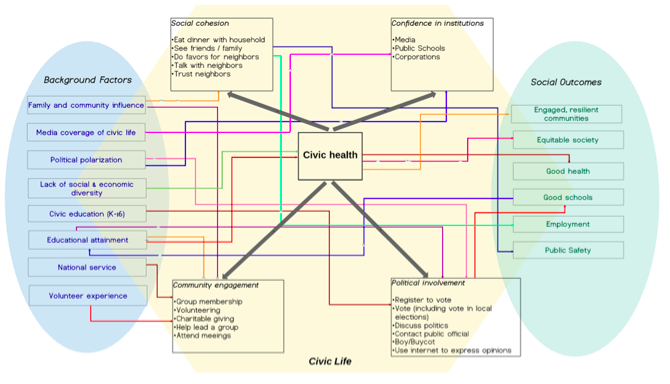
During the day, we will work together to revise and improve our collective understanding of civic life. The map below will be a starting place.

screen-shot-2016-09-27-at-11-37-57-am

On the left are factors that may affect civic life, for better or worse. In the middle is “Civic Health” as it has been measured by the National Conference on Citizenship (NCoC) and its partners over the past decade. Civic Health has four major components that radiate out from the center. On the right are valuable outcomes of having a healthy civic life, such as resilient communities and good schools.

The arrows show connections uncovered by NCoC, Tisch College, and others. For example, we know that k-12 civic education can boost political involvement, that communities with more political engagement have better schools, and that good schools boost educational attainment, so all of those boxes are connected with arrows.

This is just a start, and during the day, we will ask participants to add, edit, or move boxes and arrows to help build a better diagram. We will also ask you to place yourself on the map.

There will be opportunities to hear from inspiring and well informed speakers. Click here to view the agenda at-a-glance.

Please join us for this important convening and invite other colleagues whose voices need to be heard. Register today!