Author Archives: Peter

About Peter

Associate Dean for Research and the Lincoln Filene Professor of Citizenship and Public Affairs at Tufts University's Tisch College of Civic Life. Concerned about civic education, civic engagement, and democratic reform in the United States and elsewhere.

Gandhi on the primacy of means over ends

I don’t think that Gandhi really said, “Be the change you want to see in the world,” but he did hold a challenging view of the relationship between means (or strategies) and ends. “Be the change” could serve as a shorthand for his view, if it’s properly understood. It’s not about individual lifestyle choices but about social and cultural transformation.

Since the 1960s in the English-speaking world, political philosophy has focused on defining justice, understood as an end-state, a goal. Political ethics then involves a set of questions about whether various means (e.g., civil disobedience, misinformation, compromise, or violence) are acceptable–or necessary–when pursuing justice under various circumstances.

A century ago, as Karuna Mantena notes, there was a more vibrant debate about political means.[1] The central question was not what constituted justice but whether and when to use party politics and elections, strikes, boycotts, assassinations, or revolutions, among other options. Mantena reads Gandhi as a participant in that debate who developed and defended nonviolence as a cluster of strategies. Moreover, Gandhi explicitly argued that the best way to think about politics was to determine the right means or strategies, not to pretend to define justice.

“Means are after all everything,” Gandhi wrote, in response to a group of Indian political leaders who had issued an “Appeal to the Nation” in 1924. These leaders had proposed a concrete ideal of justice: the immediate creation of a new, independent “Federated Republic of the United States of India.” They argued that this end justified a wide range of strategies. They wanted to “delete the words ‘by peaceful and legitimate means’ from the Congress creed, so that men holding every shade of opinion may have no difficulty in joining” the independence struggle.

Gandhi replied that these leaders had no right to define an abstract concept of justice, such as “independence,” by themselves. The “only universal definition to give it is ‘that status of India which her people desire at a given moment.’” Furthermore, the means used to pursue swaraj (independence, in its deepest sense) had to be good. “As the means so the end. Violent means will give violent swaraj. That would be a menace to the world and to India herself.”[2]

Drawing on Mantena, I would suggest the following Gandhian reasons to focus on means rather than ends. Human beings are cognitively limited and cannot see justice far beyond our own present circumstances. Human beings are motivationally flawed and highly susceptible to various distorting and destructive impulses. Therefore, we must choose modes of politics that channel our impulses in beneficial rather than harmful directions. Forming too sharp a definition of justice (or any of its components, such as national independence) can simply excuse destructive behavior. Consequences are always difficult to predict and control, and trying to pursue elaborate ends is foolish. Finally, how we participate in politics helps to constitute the world. By acting, we don’t merely bring about a result (usually an unpredictable one); we immediately create a new reality just in virtue of our action.

For example, one of Gandhi’s strategies was the khadi campaign: a mass effort to boycott European cloth, wear only homespun Indian khadi cloth, and enlist everyone–of all classes–in personally spinning and weaving their own clothes. The khadi campaign is widely understood as a means to one of the following ends: political independence from Britain through economic pressure, rural economic development, or spiritual education for those who spun.

Gandhi thought of it differently.[3] It was impossible to know whether khadi would affect British policy, but an India full of people who wove their own clothes in the cause of independence would immediately be a different place. It would be more decentralized, equitable, ruminative, united, and free. “Through khadi we teach people the art of civil obedience to an institution which they have built up for themselves.”[4]  Khadi was educational, but equally important, it represented an institution that the people had built. Education wasn’t an outcome of spinning, as knowledge might be an outcome of schooling. In khadi, the learning was intrinsic to what Gandhi explicitly called the “public work” of building a new system for textile-production. Gandhi described the political work accomplished by a committee and the “constructive work” of weaving in the same passage, as part of the same struggle. Physical production was an essential component because “awareness is possible only through public work and not through talks.”[5]

For Gandhi, “What is justice?” was the wrong question. Our focus should be on forming groups of people who interact in ways that bring out the best in them. He saw a nation of home-weavers as such a group. We could certainly debate his specific vision of a khadi campaign, but the same general approach can take many forms. For example, Jürgen Habermas represents a dramatically different cultural context and political sensibility from Gandhi’s, but he also rejects instrumental, means/ends reasoning in favor of creating groups of people who endlessly make justice by interacting. It’s just that Habermas’ interactive groups are highly critical, explicit, and discursive, whereas Gandhi’s weavers may be literally silent.

See also: notes on the metaphysics of Gandhi and KingHabermas, Ostrom, Gandhi (II)against state-centric political theoryno justice, no peace? (on the relationship between these concepts)the I and the we: civic insights from Christian theologythe right to strike; and the kind of sacrifice required in nonviolence.

Notes

[1] Karuna Mantena, “Gandhi and the Means-Ends Question in Politics,” Institute for Advanced Study School of Social Science Paper 46 (June 2012).
[2] Gandhi, Notes,  May 22, 1924-August 15, 1924, in The Collected Works of Mahatma Gandhi (Electronic Book), New Delhi, Publications Division Government of India, 1999, 98 volumes, vol. 28, pp. 307-310, I owe the reference to Karuna Mantena, “Another Realism, the Politics of Gandhian Nonviolence,” American Political Science Review, vol. 106, no. 2 (May 2012), p. 457
[3] See Mantena, “Gandhi and the Means-Ends Question in Politics,” pp. 9-12.
[4] Gandhi interviewed by Nirmal Kumar Bose, Nov. 9-10, 1934, in The Collected Works, vol. 65, p. 317. I owe the reference to Mantena, “Gandhi and the Means-Ends Question in Politics,” p. 9.
[5] Gandhi, personal note (1925), in The Collected Works, vol. 32, 262-3. I owe this reference to Mantena, “Gandhi and the Means-Ends Question in Politics,” p.11.

the new Two Cultures

In 1959, C.P. Snow thought he observed “two cultures” in universities and intellectual life. “At one pole we have the literary intellectuals, at the other scientists, and as the most representative, the physical scientists. Between the two a gulf of mutual incomprehension.”

As evidence, he cited the fact that humanists would privately decry the “illiteracy of scientists,” yet when Snow asked them to define the Second Law of Thermodynamics, “the response [would be] cold and … also negative. Yet I was asking something which is about the scientific equivalent of: Have you read a work of Shakespeare’s?”

Conjecture: today many humanists and “literary intellectuals” would acknowledge that they have never read Shakespeare–or at least not since a high school English assignment that has no bearing on their interests. This would not be embarrassing. Many people in many disciplines may still have to look up the Second Law of Thermodynamics (now easily done, on their phones). But a different “gulf of mutual incomprehension” runs through the university today.

At one pole are researchers who are generally optimistic that technology (broadly defined) can solve problems. They think that once we’ve found a good technical solution, it should go to market so it can reach many people. Therefore, it’s appropriate for corporations and wealthy individuals to fund research, for research to move from universities to firms, and for the government to support and even to subsidize all of that.

At the opposite pole are scholars who perceive technology as a threat to cultures and nature, who critically assess market capitalism, and who see a government that supports it as the neoliberal state, captured by business.

The first pole is anchored in business schools, engineering schools, and other applied science disciplines, but it has adherents in many fields. The second pole is anchored in the cultural disciplines within the humanities, but it attracts support from some social scientists and pure natural scientists. The gulf runs right through fields such as education and public policy.

And between the two, C.P. Snow’s “mutual incomprehension.” Also, I think, a degree of disapproval is directed in both directions. If you’re at the technology-solves-problems pole, you may think that public-spirited researchers invent tools that help people and make sure that those tools are used. Spending one’s time reading and writing books may seem self-indulgent. If you’re at the opposite pole, you may think that a scholar of integrity is independent and critical of the major institutions of the society.

In one way, though, the situation is asymmetrical. I think that almost everyone realizes that universities produce pharmaceuticals, algorithms, hardware breakthroughs, materials, and a range of other products that ultimately get bought. But the critical end of the pole is sometimes invisible. Some technologists are unaware that there’s a critique of technological capitalism underway in their own universities. And humanists are partly responsible for their own invisibility, because they don’t engage the public debate effectively.

See also: college and the contradictions of capitalismwhat are the humanities? (basic points for non-humanists)the public purposes of the humanities (a brief history)does naturalism make room for the humanities?innovation in technology and the humanities.

getting to 80% voter turnout

I’m attending “Getting to 80%: A Symposium Advancing Voter Participation,” a discussion of the “moonshot” goal of raising US voter turnout to 80% (It’s at the Harvard Kennedy School.)

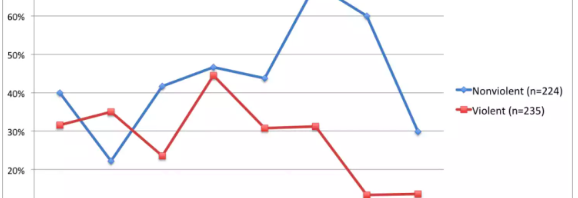
The historical context is not easy to find online, so here are two graphs that should be viewed together. The first graph, derived from sources like this, shows votes cast per people who were allowed to vote. In 1840, that meant white men (property restrictions having been dropped in most states by then); just above 80% of them voted. In 2012, that meant every citizen at least 18 years old, except for some people with felony convictions, and just under 60% voted. So the story is one of decline, mostly during the late 1800s and early 1900s. A common explanation is that powerful, identity-based, grassroots parties gave way to expert-driven government with weaker parties and less at stake in most elections. The question is how we can get back to 80% in a new political environment.

The other graph (from here) shows the proportion of the whole population that has cast popular votes for president. It shows dramatic improvement over time, with the expansion of the franchise, albeit with some stagnation in recent years. The question is how we can push the line higher to approach 80% for the first time.

the weakening bond between millennials and the middle class

(New York City) In lieu of a substantive post here today, I’ll link to a post of mine on the Biden Forum (the blog of the Biden Foundation), entitled “the weakening bond between millennials and the middle class.”

I begin:

Americans born between 1985 and 2004, known as “millennials,” are numerous enough that their generation will dominate the electorate for decades to come. Political commentators often depict millennials as egalitarian, activist, and relatively well-educated, and thus poised to support a middle-class economic agenda. But that portrait describes just a minority of the generation. In truth, many millennials are far from reaching the middle class, are skeptical about government, and are disengaged as citizens.

At the Biden Forum, I reflect on what that may mean for politics and policy.

deliberation or simulated deliberation? choices for the classroom

In an article published today (“Deliberation or Simulated Deliberation?” in Democracy and Education, 26, 1, Article 7), I respond to a valuable previous piece by Margaret S. Crocco and her colleagues, “Deliberating Public Policy Issues with Adolescents: Classroom Dynamics and Sociocultural Considerations.” These authors analyze classroom “deliberations” of current events and find disappointing results. Their analysis is rigorous and insightful. One finding particularly caught my eye.

It is interesting that even students at the school with a large immigrant population tended to talk about immigrants as “they” when they deliberated about national policy. They were essentially role-playing the government or perhaps a body of influential citizens of the United States. As Crocco and her colleagues write, “Participating in the public debate about immigration in U.S. classrooms positions one as an insider with all the privileges of excluding outsiders that result from this status” (Crocco et al., 2018). This is evidence that the students experienced the discussion as a kind of role-play.

That finding leads me to propose that discussions can vary on two dimensions. Talking can result in an actual decision, or it can be about a simulated or hypothetical decision. And the participants can either speak for themselves or role-play characters. Those distinctions produce four types, all of which can be found in actual classrooms (and in settings for adults, such as community fora.)

I think Crocco et al. provide some grounds for skepticism about simulated decision-making discussions in which the speakers represent themselves (cell 3). When we ask students (or adults) to discuss what “we” should do, where the “we” is actually a vast or distant entity, such as the US government, we position them as insiders even though they know they are outsiders. This disjunction could be fun or interesting, but I think often it just alienates.

The other cells are more promising. It’s better to be able to: (1) govern a real entity, such as a student-led association, (2) give advice to a real decision-maker, or (4) pretend that you hold a decision-making role, such as a Senator in a fictional Congress.

There are benign reasons to turn national issues into topics for small-group discussions. The goal is to make students (or others) feel that the government is theirs. It does belong to them, as a matter of justice, and it’s great if they take away that feeling. But we must be serious about their limited power, or they will perceive the discussion as fake and perhaps draw the conclusion that democracy is fundamentally a false promise. As I write in the article:

The students in these three classes did not actually decide about immigration. At most, they might shift their individual opinions on that topic, and if they encouraged others outside the class to change their opinions in similar ways, that could possibly affect national policy by influencing those people’s votes. But that is a remote form of impact for any citizen to consider, and especially for students who are not old enough to vote themselves. The United States is an “Imagined Community” (Anderson, 1991), not a group of people who literally make decisions. The real group—a classroom full of students—was pretending to deliberate.

That is how I would explain why the results were disappointing.