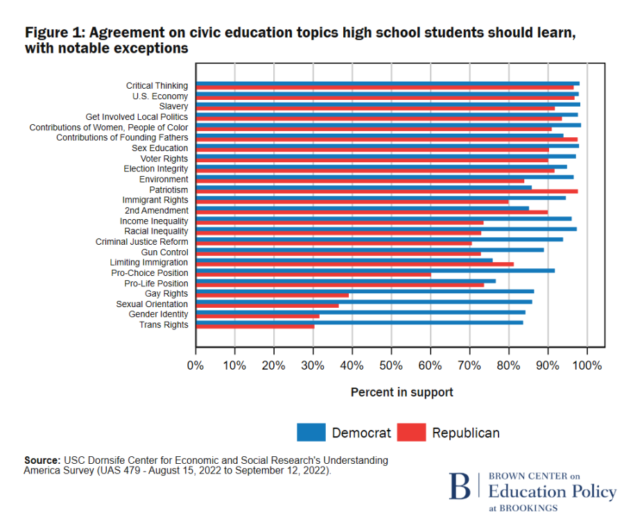
Anna Saavedra, Meira Levinson, and Morgan Polikoff report some results from the August-September Understanding America Study that reveal what Americans believe about teaching controversial issues in schools. The sample is 3,751 representative adults, and the survey is a high-quality instrument that I have previously used myself.
The headline is that Americans broadly agree about discussing many issues that might be considered controversial in high school. There is consensus about the value of discussing issues from slavery to local politics, and from sex education to the environment–plus the contributions of both the founders and women and people of color. There are no meaningful differences by political party on those items. It also doesn’t matter how most of the issues are named. For example, similar proportions support discussing “limiting immigration” and “immigration rights,” or “2nd amendment” and “gun control.”
There is much less agreement about discussing sexual orientation and related issues. Democrats are strongly supportive; Republicans oppose. The whole sample is less supportive of teaching controversial issues at all in elementary school, and there again, issues related to sexuality and gender get the lowest support.
Last spring, I noted that my own predictions for US politics had been badly wrong. I doubt that anyone was interested in the reliability of my crystal ball, but it can be useful to lay out one’s own expectations, test them against reality as events unfold, and then reflect on why you were right or wrong.
In that spirit, I currently expect Republicans to win the House–and quite likely the Senate–and to sweep more really extreme characters into state and federal office. I think the outlines of current federal policy will then remain basically unchanged, because Biden will be able to veto Republican bills, and the House GOP has a poor recent record of even mustering the votes on its own side. There may, however, be hair-raising showdowns over the debt limit and annual must-pass appropriations.
State policies will vary, with red states and blue states heading in opposite directions on abortion, policing, climate, education, and other key issues.
The Supreme Court will probably ban the use of race as a consideration in university admissions. That will not only have a major impact on who attends college (which is the main issue) but will also begin a deluge of litigation to investigate and alter pervasive practices within higher education. Documents will be subpoenaed; people will be deposed.
The Supreme may also gut the Clean Water Act and could decide Moore v. Harper in a way that allows legislatures to override the’ decisions in presidential elections, which would throw the 2024 election into grave question.
We are headed into a recession. That will cause social needs and dissatisfaction to rise and tax revenues to fall.
The probability of an international crisis is reasonably high, not only in Ukraine/Russia but also China/Taiwan and Iran. Justice may prevail in each of those cases, but the risks to the people of those regions and the world are serious.
At home, we will see more frequent acts of overt political violence and perhaps some really major politically motivated crimes.
Trump will be running for president, first unofficially and then as a declared candidate. He will easily dominate the GOP primary. Meanwhile, there is a substantial probability that he will face at least one criminal proceeding. He will use his prosecution as evidence of persecution by his political enemies.
Echoing the Clinton and Obama years, the new Republican majority will grow rapidly unpopular. Biden’s popularity will be suppressed by the recession but boosted by his opponents: Trump and the Hill GOP. Democrats will help to amplify the most extreme Republican voices. Biden will poll ahead of Trump through most of the 2024 election season, but there will be a real possibility that state legislatures and the US House will overrule the voters, especially if the Supreme Court exempts legislatures from judicial review regarding elections. Certainly, Trump will pre-announce that he cannot possibly lose, and a fair number of Republicans will echo that claim. I believe there would be resistance within the GOP, but that would be an intra-party struggle that would make everyone else into bystanders.
(By the way, if I did the math right, then according to the Social Security Administration’s actuarial tables, there’s a 73% chance that both Biden and Trump will still be alive in 2025, and a lower chance that both men will be healthy enough to serve.)
My predictions may be too pessimistic. Last time, I was overly positive. Regardless of how things play out, I’d offer two thoughts about addressing our situation.
First, a lot more Americans should be learning specific skills for organized nonviolent civil resistance. I am not arguing that nonviolence is morally superior or preferable in all situations. I do believe that only large-scale movements that are predominantly nonviolent will be relevant and plausibly effective in defense of democracy in the United States at this point. Here are few resources for learning. I am actually quite optimistic that the American people will prove hard to dominate and will resist effectively, but skills will help.
Second, we may have opportunities to build a better system, not merely preserve a flawed one. For instance, the Supreme Court has already played a problematic role in our government, and a crisis may be an opportunity for basic reform.
To take one example of a very bad-case scenario: Biden actually wins more Electoral College votes than Trump does in 2024, but several state legislatures award their votes to Trump, and the House certifies him as the president. That would be the beginning, not the end, of a chapter in American democracy. The end would depend on us.
This is a 12.5-minute video in which I introduce the republican tradition (or just “republicanism”) as it is typically discussed in political theory these days. I’m drawing on authors like G.J.A. Pocock, Quentin Skinner, Philip Pettit, and Ian Shapiro. I also refer to Melvin Rogers’ important recent work on Black American republican thought and some ideas of Brooke Ackerly about how domination (which is the main concern of republican theorists) may relate to oppression. In our Introduction to Civic Studies course, we will be reading and discussing Rogers, so an immediate purpose of my video is to give our students some definitions that they can use to understand his work. But I hope that the video may be useful for others as well.
Last week, in a course I am co-teaching on Religious Pluralism and Civic Life, we discussed a fascinating story from The Jerusalem Talmud (completed before 400 CE), with help from my Tufts colleague Yonatan Brafman:
§ Rav Yehuda [Judah bar Ezekiel, 220–299 CE] says that Rav [Abba Arikha 175–247 CE] says: When Moses ascended on High [to Mount Sinai], he found the Holy One, Blessed be He, sitting and tying crowns on the letters of the Torah [kether or decorative tags added to specific Hebrew letters]. Moses said before God: Master of the Universe, who is preventing You from giving the Torah without these additions? God said to him: There is a man who is destined to be born after several generations, and Akiva ben Yosef [50-135 CE] is his name; he is destined to derive from each and every thorn of these crowns mounds upon mounds of halakhot [laws and ordinances]. It is for his sake that the crowns must be added to the letters of the Torah.
Moses said before God: Master of the Universe, show him to me. God said to him: Return behind you. Moses went and sat at the end of the eighth row in Rabbi Akiva’s study hall and did not understand what they were saying. Moses’ strength waned, as he thought his Torah knowledge was deficient. When Rabbi Akiva arrived at the discussion of one matter, his students said to him: My teacher, from where do you derive this? Rabbi Akiva said to them: It is a halakha transmitted to Moses from Sinai. When Moses heard this, his mind was put at ease, as this too was part of the Torah that he was to receive.
Moses returned and came before the Holy One, Blessed be He, and said before Him: Master of the Universe, You have a man as great as this and yet You still choose to give the Torah through me. Why? God said to him: Be silent; this intention arose before Me. Moses said before God: Master of the Universe, You have shown me Rabbi Akiva’s Torah, now show me his reward. God said to him: Return to where you were. Moses went back and saw that they were weighing Rabbi Akiva’s flesh in a butcher shop [bemakkulin], as Rabbi Akiva was tortured to death by the Romans [for teaching the Torah]. Moses said before Him: Master of the Universe, this is Torah and this is its reward? God said to him: Be silent; this intention arose before Me.
When Moses magically enters Akiva’s classroom (maybe 1500 years in the future), he chooses to sit in the back row, like an apprehensive freshman, and then feels his confidence slip even further when he realizes that he cannot follow the sophisticated conversation. This is a metaphor for intellectual progress and growing expertise.
But then, when Akiva’s authority is challenged, the rabbi credits everything he knows to Moses (or to the commandments that Moses that had received on Sinai), which is a metaphor for original revelation. Akiva is saying that everything was already known at the beginning of the tradition.
At the moment that Moses experiences his vision of Akiva’s classroom, he has not yet received the Torah and does not know its content. He is consoled by the thought that the text that he will receive will “contain” Akiva’s interpretations of it.
The frame text (“Rav Yehuda says that Rav says …”) alerts us to the chain of pronouncements and commentary that is central to Judaism–and to many, if not all, intellectual and spiritual traditions. Ideas come from sources. Interpreters analyze and interpret these ideas, building larger bodies of thought that derive authority from their origins even when they no longer express the founders’ intentions.
One could say the same of US constitutional law. In that tradition, too, it is common to think that the founders would be bewildered by contemporary legal arguments, or that everything we argue today is somehow contained in the founding documents–or both. We might imagine:
The ghost of James Madison went and sat at the back of Larry Tribe’s Harvard con-law lecture class and didn’t understand what anyone was talking about. He ducked low in his seat in case Tribe decided to cold-call him. Madison was relieved when Tribe suddenly mentioned him as the “Father of the Constitution.”
To doubt that there is–or ought to be–any link between the founding and the present is to dispute the value of the whole framework.
At some point, it’s natural to ask why such an edifice exists, as Moses does when he asks about the “reward” of Torah. According to tradition, Akiva was tortured to death for refusing to stop teaching scripture, which dramatizes this question. The answer is: “Be silent; this intention arose before Me.” In other words: “Don’t ask.” Even the divine voice is passive, as if the “intention” arose of its own volition.
At the base of the structure is obligation, not choice–or so this Talmudic story suggests. Is that always the case?
On one hand, I am concerned about the phenomenon of white Christian nationalism in the United States. In some churches and religious networks, some people believe that the nation ought to be fundamentally white and Christian and that Christianity somehow undergirds this idea. White Christian nationalism competes with more emancipatory and inclusive theological views, but it’s influential.
On the other hand, I am still drawn to the old, Tocquevillian argument that participating in the governance of an organization that contains any diversity can teach skills and values of deliberation, tolerance, and inclusion. And churches can be such organizations.
Therefore, I am worried about people who identify as white and Christian without actually participating in maintaining communities or wrestling with the complexities required by self-government. At the same time, I am cautiously optimistic that asking people to take responsibility for real religious communities will strengthen democracy, because members can learn how to hold a group together, manage disagreements, select good leaders, interact with outsiders, and hold each other accountable.
Thus I would hypothesize that:
H1 Identifying as a white Christian will be associated with racial anxiety and intolerance, because white Christian dominance is threatened today by growing racial diversity and greater equality. But …
H2 Participating in groups that offer an element of self-governance will promote democratic values and therefore should correlate negatively with racial anxiety. (Especially if the group is diverse).
Churches are manifestations of Christian identity and places where some people receive racialized messages, but they are also groups that can offer various degrees of diversity and self-governance. Therefore:
H3 Among whites, church membership (a proxy for Christian identity) will be associated with racial anxiety and intolerance. However,
H4 Controlling for religious identity as well as race, church participation will be associated with higher tolerance. (This hypothesis is similar to the findings of Ekins 2018.)
Nationally representative survey data collected by Data for Progress from August 4-30, 2022 offer a chance to test these hypotheses. The sample is 1,899 likely voters (who differ from non-voters in the US resident population). The survey asks several questions about religious belief, identity, attendance, and participation.
The survey also asks several attitudinal questions about diversity. I chose: “It would bother me if, one day, white people were an ethnic minority in the United States.” I will label disagreement with that prompt “inclusiveness,” for the sake of using one word.*
Two limitations of the survey: It doesn’t ask about the diversity of respondents’ religious congregations or which religion people belong to. However, 94% of white Americans who identify as religious are Christian (2% are Jewish), so a relatively modest error results from assuming that white religious respondents are Christian and their congregations are churches.
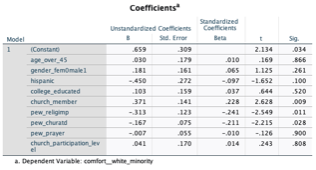
I have run Ordinary Least Squares (OLS) regressions to predict inclusiveness based on various other questions in the survey and to test the four hypotheses stated above.
H1 is correct: The importance of religion to a person is negatively correlated with their inclusiveness (when controlling for demographics). Being white, over 45, and not being college educated are also negatively associated with inclusiveness in this model.
Another way to look at the same pattern is to restrict the sample to whites (most of whom are either Christian or non-religious) and omit race from the regression. For whites, being religious, over 45, and not college educated are negatively associated with inclusiveness.
H2 is not correct: Contrary to what de Tocqueville or Dewey might predict, a person’s total number of active group memberships is negatively associated with inclusiveness. The more groups you actively participate in, the less likely you are to accept whites becoming a minority. This relationship is statistically significant but small. When looking only at whites, the relationship is no longer significant, but it isn’t positive, as I would have hoped.
Different group memberships evidently have different relationships with racial anxiety. The bivariate correlation between religious-congregation membership and inclusiveness is -.058** (Pearson), but no other forms of membership are correlated to a significant extent with this outcome. In a regression with group memberships as the only independent variables (i.e., without demographics), religious groups and sports are negatively correlated with inclusiveness; art groups are positively related.
H3 is correct: Being a member of a religious congregation is associated with less inclusiveness (controlling for demographics).
H4 is correct: Religious participation helps.
In a model that includes prayer, attendance, religiosity, congregational membership, and religious participation, membership has a significant positive correlation with inclusiveness, whereas religiosity is a negative correlate. When looking at whites only, congregational membership is a positive; religiosity and attendance are negative.
The previous sentence is my takeaway. For white Christians, being actively involved in a church builds the values that we need for a pluralistic democracy. At the same time, simply identifying as Christian and hearing Christian messages is associated with intolerant values. We need the first effect to outweigh the second one, and that is a struggle in an era when most associations (including churches) have weakened while mass and social media have expanded.
*Data for Progress actually ran a survey experiment and asked some people whether they would be bothered and others whether they would not be bothered. This difference in question-wording yielded somewhat different results. I combined the two items into one measure.