the Synagogue of Water in Ubeda

Ubeda is an astonishingly lovely Spanish town. Its harmonious renaissance buildings of honey-colored stone perch on a cliff over the Valley of the Guadalquivir. During the first half of the 16th century, local agriculture boomed and the gentry chose to build palacios in town and endow churches and public buildings. They had the benefit of a talented architect who was up-to-date in Italian Mannerism, one Andres de Vandelvira. Then the market fell and the town’s population shrank. In the 1910s, the great poet Antonio Machado found the area deeply depressed:

But what vitality for a dying people? With two thirds of our territory uncultivated, the greatest number of desperate emigrants from Europe, minimal population, are we still talking about confidence in our vitality, in our prolific strength and in our future? Isn’t it absurd to talk about trust? Our starting point must be a “desperate insubordination.”

Depopulation at least preserved the renaissance architecture, and now Ubeda and the neighboring town of Baeza appear prosperous.

In 2007, a local entrepreneur, Fernando Crespo, was planning to develop three connected properties when he discovered the remains of a medieval synagogue dispersed through these buildings. One of the facades still bears the insignia of the town’s inquisitor–a man whose job would have included persecuting people of Jewish descent. Crespo financed the recovery of the original synagogue, including a two-story prayer hall with a women’s gallery and a ritual bathing area that fills naturally with clean water. It makes a beautiful and moving sight.

In the local newspaper in 2011, Alberto Roman Vilchez reported that “several experts questioned whether, at this time, it can be said that the so-called Sinagoga del Agua de Ubeda is a synagogue or another type of monument.” Among the critics was Francisca Hornos, director of the Museo Provincial de Jaen, who acknowledged that the law permits anyone to say what they want about their own property, “but the typological and formal analysis of an archaeological, ethnological or artistic heritage should not be done after the fact. … Where is the archaeological excavation that was done there? Who did it? Where is the inventory of this excavation?” An archaeologist named Vicente Barba Colmenero took the view that archaeology must proceed according to “proper procedures, “with public disclosure.” Without a proper process, the building “cannot be called a synagogue.”

To this day, the amount of scholarly writing seems a bit sparse, and it’s perhaps unusual that the archaeology was conducted by the private owner, who now manages the site as a museum. However, in 2011, Pablo Jesus Lorite Cruz published a piece on the “Location and Authenticity of the Synagogue of Ubeda.” He emphasized that the upper balcony is consistent with a women’s gallery, the basement is consistent with a ritual bath, and the immediate district could well have been populated by Jews before 1492. He wrote that he had consulted documentation and a “technical architecture report defended at the Polytechnic University of Madrid on the primary building, currently in press.” He concluded, “In our humble opinion there is no doubt that what was truly discovered in Ubeda is a synagogue that in a short period of time time will reveal new ideas, hypotheses and even theses about the Jewish heritage and especially that of the city of Ubeda.”

I have not been able to find the technical report that Lorite mentioned, but Andres Domingo Lopez published a 2013 monograph on The Synagogue of the Hills: History of the Jews in Ubeda, which treats the building as a synagogue.

Apparently, a very long-standing Jewish community built a handsome temple near the city’s main square in Islamic times, and when the main Christian persecution began in 1492, this synagogue either gradually dissolved into secular buildings or was intentionally hidden in the hope that Jews might one day return. Although I wish the scholarly evidence were somewhat more transparent and robust, I was grateful to have been able to visit this place.
a Heideggerian meditation

(This is the third in a series; see also a Hegelian meditation and a Husserlian meditation.)

This is a breath: in, out. Then another. It has a certain mood, first a bit anxious, then more relaxed.

What is going on here–really going on? People have disagreed, but they tend to use the same vocabulary even when they espouse incompatible theories. Their keywords include: subject, object, language, world, mind, nature, freedom, and necessity.

Just for example, perhaps some of the material called “air” is filling lungs while brain cells are generating a subjective impression of relaxation and suggesting the words “to breathe.”

This vocabulary seems to miss or obscure what it is happening here. The experience is not of oxygen; it is of breathing, which is intrinsically an activity with purpose and value. Being there (Dasein) always comes in a mood; affect is not merely added on. But the mood can shift, and the activity can change the mood. Unconscious, hurried respiration can become meditative breathing.

Dasein unfolds over time and is aware that it must end one day. It has not chosen to be but has been thrown into the world–obliged to breathe, to have a mood at each moment, to experience time, and to adopt a language with a history. Yet Dasein can choose to become aware of its temporality, its mortality, its concerns, and its attunements to the world.

Being-there with a breath affords these insights. Letting it be-there without the usual vocabulary of philosophy and science can show Dasein what it authentically has been and is.

So: what mood is there with this particular breath? If it is anxiety or boredom, that is real. Accept it, and then change it.

See also: joys and limitations of phenomenology; the sociology of the analytic/continental divide in philosophy; on philosophy as a way of life

youth voting backlash

The New York Times‘ Neil Vigdor cites two research findings from my Tisch College colleagues in his article entitled, “Republicans Face Setbacks in Push to Tighten Voting Laws on College Campuses.”

First:

Between the 2018 and 2022 elections in Idaho, registration jumped 66 percent among 18- and 19-year-old voters, the largest increase in the nation, according to the Center for Information and Research on Civic Learning and Engagement. The nonpartisan research organization, based at Tufts University, focuses on youth civic engagement.

And then:

Nearly 59 percent of students at traditional colleges in New Hampshire came from out of state in 2020, according to the Institute for Democracy and Higher Education at Tufts.

The main thesis of the article is that Republican state legislators are introducing legislation to make voting harder for young people or for college students, particularly in states where the youth and/or college vote has been strong lately. However, only some of these bills have passed. For example, Idaho banned using student ID cards for voting, but a New Hampshire bill that would have required student voters to prove that they pay in-state tuition died in committee.

Since the 2002 election, we have consistently analyzed the youth vote and been able to show that it is especially consequential in some states and in some races. Our research has challenged the traditional view that youth never vote much, which discourages campaigns from contacting youth–a classic vicious cycle. Generating data about young voters seems essential for encouraging turnout, but when there’s good news, sharing it may sometimes trigger backlash. It’s encouraging to see some successful resistance.

Frontiers of Democracy Conference – Early Bird Special

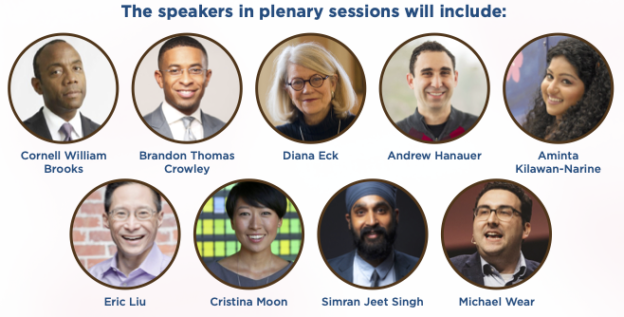
The Frontiers of Democracy conference is taking shape. We have received strong proposals for concurrent sessions on many diverse topics related to democracy in the United States and around the world. Our distinguished and exciting plenary panelists will specifically discuss religious pluralism and its relationship to democracy in multiracial societies.

We are offering early bird tickets for those who register by May 1A regular General Admission ticket purchased by then will cost $170, and current students and Tufts University community qualify for a $70 ticket. After May 1, prices will go back to their standard levels of $240 or $120. Tickets include hors d’oeuvres on July 13, breakfast and lunch on July 14, and breakfast and lunch on July 15. (If you have already purchased tickets, you will automatically receive a partial discount to the early bird rate.)

We still have space for some additional session proposals and can accept proposals until May 1. The submission form for a session requires a title and description for the conference agenda, some thoughts about your format and audience, and the contact information of confirmed collaborators.

Time and location: July 13 (5 – 7 PM) to July 15 (noon) on Tufts University’s Medford, MA campus near the Medford/Tufts Station on the Boston Green Line.

perhaps it’s not that conservatives are happier but that people with depression cluster on the left

Musa al-Gharbi has written a review essay on “How to Understand the Well-Being Gap between Liberals and Conservatives.” He summarizes studies that show that conservatives are more likely than liberals/progressives to describe themselves as happy, and this relationship holds when one controls for demographics. In other words, conservatives do not report being happier because they are more advantaged; instead, a conservative who has the same social circumstances as a progressive is likelier to be happy. Al-Garbi says that this finding is consistent across countries and extends back in time.

1. Replicating the basic pattern: conservatism is associated with happiness.

I can’t independently vouch for his overview of the research, but I can confirm the main finding with data from Tufts’ 2022 Equity in America survey. We drew a representative sample of 1,831 Americans, with large subsamples of African Americans and Latinos to allow more precise estimates of racial/ethnic differences. We also collected an extraordinary number of measures about each respondent.

We asked, “Taken all together, how would you say things are these days? Would you say you are… Very happy, Pretty happy, or Not too happy.”

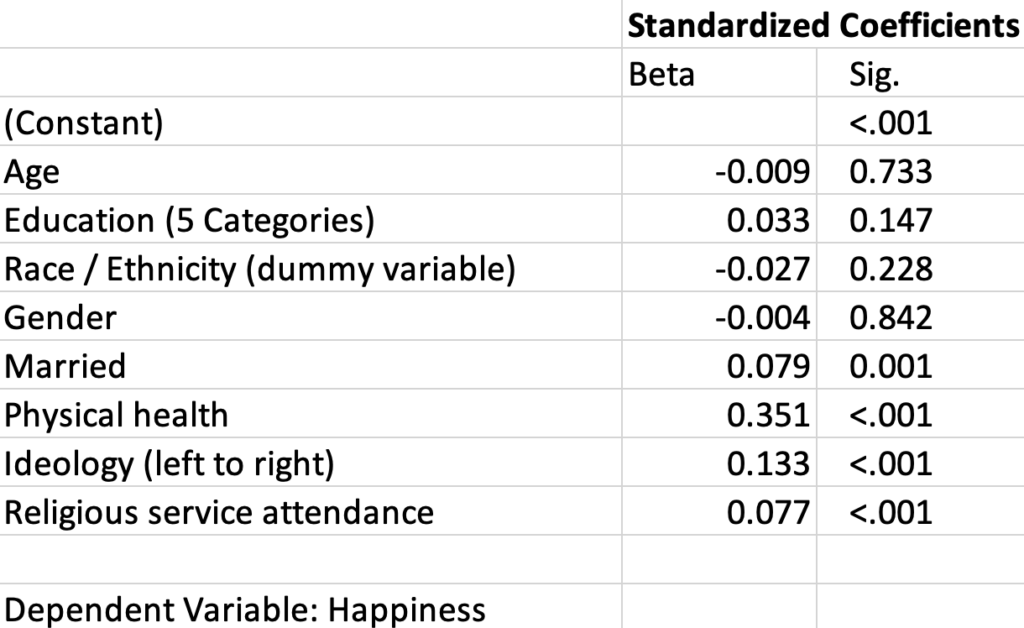
In a model with age, education, race and gender, more education and older age predict greater happiness. (We know from extensive research that the age curve is not linear; happiness dips in middle age. That pattern is invisible in a linear regression.) If I add marital status and a self-report of physical health, only those variables are significantly related to reported happiness. In other words, it looks as if older and better educated people are more likely to be married and in good health. Those factors then relate to happiness.

If I add ideology, it is also significant (p <.001), with more conservative people more likely to report being happy. If I also add religious attendance, it too is significant, and ideology stays signifiant. That implies that the ideology “effect” is not explained away by religiosity, but both matter. Here is that model. The last four variables are significant.

2. Could the explanation be progessives’ social awareness?

I think some progressives might say that they–and others on their side–are unhappy because they are rightly conscious of social injustices and dangers. Thus their unhappiness reflects social concern.

We can test this hypothesis to a limited extent with our survey. It includes a few relevant attitudinal questions along with many variables about life circumstances. I added the following four items to the above model:

  1. How bothered have you been witnessing someone in a public place being treated unfairly because of their race?
  2. How has the pandemic impacted your mental health?
  3. Thinking about climate change makes me feel anxious. [Agree/disagree]
  4. Someone [I] know has been unfairly stopped, searched, questioned, physically threatened or abused by the police. [Agree/disagree]

Except the climate question, each of these is related to unhappiness to a statistically significant degree. However, being liberal is still also related to being unhappy. That means that these specific concerns seem to accompany unhappiness but do not explain away the ideological “effect.” Or, to put it another way, someone who was not worried about these four specific things, but who identified as a liberal, would still be more likely than a conservative to be unhappy.

3. Could liberals display a negative bias?

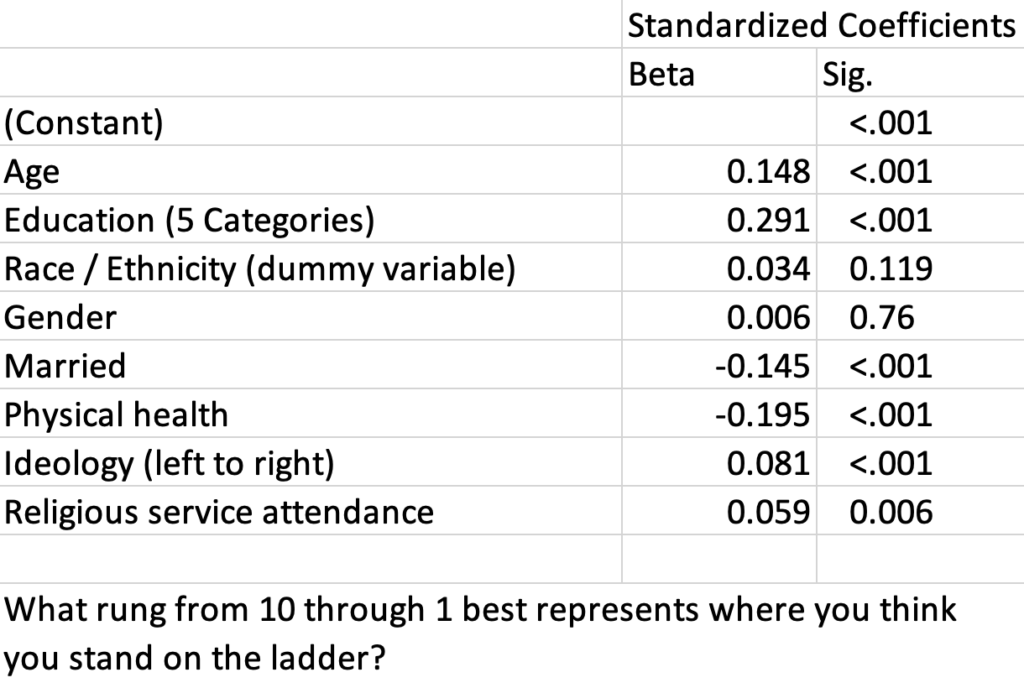
A conservative might be inclined to see progressives as negatively biased rather than socially conscious. And there may be some evidence of that in our data. We also asked: “Imagine a ladder with 10 rungs (or steps). At the top of the ladder (rung #10) are the people who are the best off, those who have the most money, most education, and best jobs. At the bottom are the people who are the worst off, those who have the least money, least education, worst jobs, or no job (rung #1). What rung from 10 through 1 best represents where you think you stand on the ladder.”

I used that item as the dependent variable in place of self-reported happiness. Liberals/progressives rated themselves lower on the ladder compared to other people when I controlled for demographics. In other words, if a liberal and a conservative have the same education, race, gender, and age, the conservative will feel more fortunate. A critic might say that liberals are people who–regardless of their actual social positions–rate their own circumstances relatively poorly, and that attitude drives their ideology and makes them unhappy or else reflects their unhappiness.

4. People with depression cluster on the left.

However, there may be a different explanation. In our sample, 281 people say they have been diagnosed with depression. If I remove them from the sample and run the first of the two regressions shown above (the one with happiness as the dependent variable), ideology is no longer statistically significant. Now, only marriage, physical health, and race are related to happiness (with whites being more likely to report being happy).

We also asked how often in the past week people had felt depressed. I subtracted the 683 people who answered more than “rarely.” Running the model without those people generated a result in which only physical health was related to happiness. Ideology again ceased to be significant.

Finally, we asked people to rate their own mental health from poor to excellent. 272 said fair or poor. When I excluded that smallish group from the sample, ideology was still significant.

In a model based on the whole population, each of the mental health measures predicts unhappiness, and liberalism does as well. Those coefficients are compatible with two theories: either most conservatives are a bit happier than most liberals, regardless of depression, or else the average happiness of liberals is lower because they include some depressed people. By excluding those who report depression or a diagnosis of depression from the analysis, I find evidence that the latter is the case. In short: people with depression are reducing the mean happiness of liberals.

Indeed, people with depression cluster on the left. In the sample as a whole, 5% of respondents identify as extremely liberal, but 14% of the people who have been diagnosed with depression are extremely liberal. Conservatives represent 18.5% of the sample but just 11% of those with diagnosed depression. This pattern is consistent with previous studies.

Saying that you are depressed or reporting a diagnosis of depression depends on many factors–not only one’s mental health and access to medical care but also one’s beliefs and attitudes about psychology, which may relate to ideology. From our survey, it is not clear whether depressed people are concentrated on the left or whether people who employ the label of depression tilt that way.

However, my own informal observations and what I hear from others suggests that a substantial subset of people who gravitate to the left have significant mental health challenges, often related to trauma. I suspect that they explain most of the association between conservative ideology and happiness.

Everyone has a right to choose and express their political views. Progressives must welcome all kinds of people onto their side. However, I think that attracting people who (regardless of their social circumstances) experience depression poses a challenge for any movement.* Also, I sometimes wonder whether progressive messages fall flat because their authors are less happy than their target audiences.

*I wanted to know whether committed activists on the left were likely to be depressed, but we only have data from 31 left-oriented people who protested in the past year, which is too small a sample to tell. See also: how predictable is the rest of your life?; the aspiration curve from youth to old age; are Americans ‘innocent of ideology’?; party identification and ideology over time.