reflections on modern Granada (Spain)

We’re leaving Granada tomorrow after living here for three months. My limited Spanish and a certain shyness have prevented me from learning a lot about contemporary life here. I feel better informed about the distant past than the present. Nevertheless, I’ll venture a few observations and hypotheses.

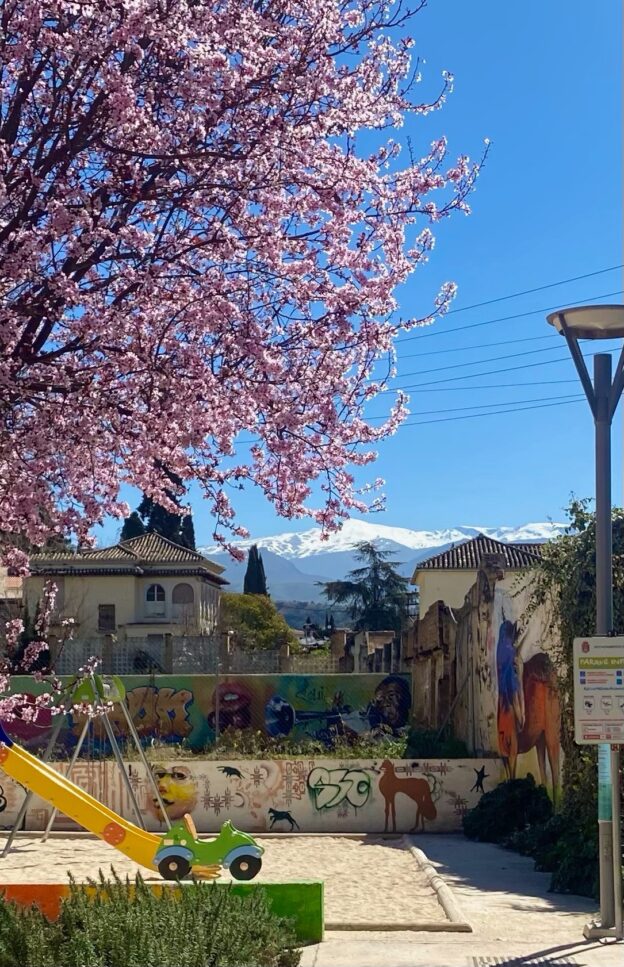
For those who have not seen it, the most salient feature of Granada is its beauty. The castle-palace of the Alhambra caps one hill, but around that romantic building are bigger summits, and the snow-capped Sierra Nevadas form the backdrop. Whitewashed houses with flowering gardens and little squares cascade down the hill of the Albaizin, where we lived. On the plain below are fine boulevards, marble-paved squares, and baroque domes.
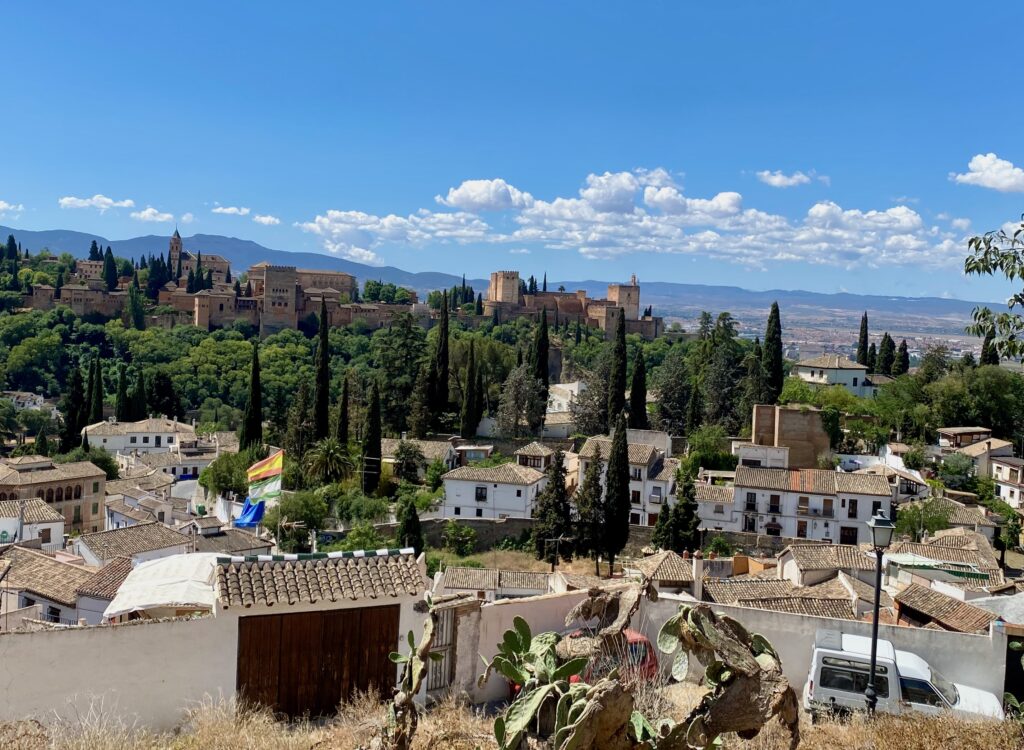
Granada is not a big city. The population of the municipality is only 230,000. Although some legally protected green space has been lost, farmland and wooded hills remain in view. The university enrolls about 60,000 students, not concentrated on one campus but distributed through several neighborhoods. Numerous foreign students either visit the university or study Spanish in private schools. As a result, the population is quite youthful and informal. Hardly a business suit is seen.

Since three million people visit the Alhambra each year, the city is full of tourists. A substantial portion are Spanish, but Granada also draws people from the rest of the world, ranging from backpackers to bourgeois families to big tour groups. And there are many expats and some refugees. No particular foreign language dominates.

Andalusia is still fairly poor and dominated by agriculture. The region’s per capita GDP is $18,500, similar to Sicily’s and much lower than $42,000 for the EU as a whole. Many rural people moved to Granada in the postwar period and settled in neighborhoods like El Zaidin, where, apparently, conditions were at first pretty rough. I have walked through every part of the city proper and found all the streets pleasant: bustling, clean, safe, and well served by public transportation (including a brand-new subway line) and other facilities. Perhaps some of the apartments are small.

Rural life usually feels far away, but not always. We could regularly hear a burro bray from our house, and once we watched a man herd his goats up a nearby street.

Granada retains a small-town feel under the surface. On the bus that I often used to take home, the older clientele would frequently greet each other by name. People walk their dogs off-leash and leave them to wait outside of stores. Many enjoy a paseo in the late afternoon.

For me, a rough indicator of globalization is the variety of food. In Granada’s supermarkets, virtually all of the ingredients are meant for Andalusian dishes or Italian-style pizza and pasta. Except in the biggest “Ipermercado” and one little shop owned by a South Asian man, stores typically offer a single shelf with a few bottles of soy sauce and some “Old El Paso”-brand seasoning as their only foreign ingredients. Likewise, 98 percent of the city’s many restaurants offer Andalusian menus with very similar dishes. The situation is completely different in Madrid, where one can buy ingredients or cooked meals from anywhere in the world.

The previous paragraph is not a complaint. For one thing, Spanish food is good! Besides, we enjoyed being immersed in a place with a distinct culture. I do think Granada might be behind the curve (for better and worse) on globalization. That doesn’t mean it is unsophisticated, although some Castilians and Catalans may think so. For instance, the city boasts at least 14 independent bookstores, presumably serving the university community. It seems characteristic of Granada that these stores stock many new books for serious readers, yet almost every volume is in Spanish, and most are by Spanish authors. The same was true at the extensive annual book fair. One gets a sense of mild insularity–and pride.

There is a long and rich literary tradition of describing Granada as melancholy. As I wrote recently, Richard Wright observed Granada and all of Andalusia as fanatically Catholic, haunted by history, and static. I am reminded of how writers use the Turkish word hüzün (meaning something like “communal sadness”) to describe Istanbul. In both cases, outsiders are inspired by the tragic remains of past grandeur. In both cases, some local people adopt the visitors’ melancholy as their own. And both descriptions mislead.

In fact, Granada can give an impression of frivolity and subversiveness. Spanish people from other regions like to visit the city for pre-wedding parties. They dress in crazy matching costumes and tease the blindfolded fiancés. Although they are generally segregated into “hen” and “stag” groups, you see individuals expressing various gender identities. For every nun in a habit, there must be a hundred young people with tattoos and piercings. The graffiti art by El Niño de las Pinturas and others is well-known.
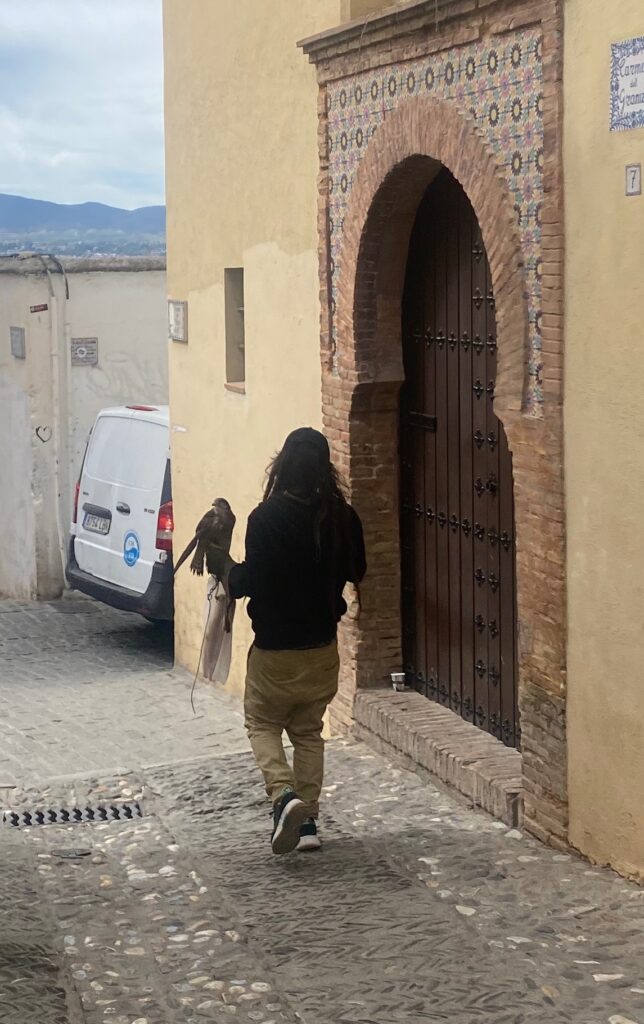
The first thing that Castilians say about Granada is that the Arab-Islamic heritage is strong there. They are not wrong. In our neighborhood, the layout, the surrounding walls, and the water system all date to the Emirate of Granada; and at the bottom of our hill, the Guadalquivir is simply the Wadi al-Kabir: the Big River.* More subtly, the streets are still repaved with black and white stones, a continuous practice since the Arab period; and even modern doors often have rows of iron studs that, in medieval times, would have been painted to indicate that the owner had accomplished the Hajj. Under our living room is a cistern, an aljibe, that is part of the irrigation system of Arab origin.

But I want to complicate this impression. First, the influence of Arab Islamic culture is far deeper in other places than many people realize. In English, there are about 900 words of Arabic origin, including “sugar” and “alcohol,” and there are about 4,000 in Spanish. Not only in Granada, but also in Chile and Texas, people use a lot of Arabic words. Americans eat meals in courses, wear lighter colors during the summer, and do many other things as a result of the customs of Arab al-Andalus.

Also, some of the explicitly Arabic influences in Andalusia are probably “invented traditions,” in Eric Hobsbawm’s phrase.

For instance, it’s worth experiencing an “Andalusian hammam” or Arab bath. That tradition dates all the way back to 1988. The Alcaicería is the city’s “bazaar” neighborhood, a warren of quaint shops. It burned to the ground in 1843, and the architecture you see there today is a Victorian fantasy of the Middle East. The Alhambra is one of the world’s greatest expressions of classical Arab culture, yet it probably consists of a selection of medieval buildings that had various owners and functions. Ferdinand and Isabella seized, heavily renovated and modified, and connected these buildings to form one renaissance-style palace, and then the rest of the neighborhood gradually vanished. The Alhambra has never stopped being transformed by ambitious architects who are responsible for things like the incongruous Victorian roofs and everything about its lovely gardens.

Arab and Romani/Gitano influences were as important for Granada’s modernists, Lorca and Manuel de Falla, as they have been for its folk arts, like flamenco. But this is not simply a case of the past influencing the present. For one thing, Arabs and Romani constitute living communities in Granada. In 2003, the Moroccan immigrant community of almost 5,000 people opened a beautiful new mosque across from the Alhambra, and Romani still dominate the Sacromonte district.

When audiences cry ¡Olé! to appreciate a flamenco dancer, they may be saying wa Ilâh (“by God”) in Arabic. Or that may be a false etymology that persisted as a myth because it sounded so romantic. In short, there is a long and complex history here of assimilation, appropriation, “othering,” ambivalence, celebration, nostalgia, and sheer invention. Andalusians have been hybrid and have been choosing to present themselves as hybrid ever since the Emirate.

Sad to leave Granada, I think of the last sultan, “Boabdil” (actually, Muhammad XII), and his famous “Moor’s Sigh” as he turned to face the Alhambra for the last time. Or of Carlos Cano’s lyrics:

Deep in the cistern, what should appear
But the sadness that killed Boabdil the emir.
And I left it under the shadow of an almond tree
On my way to the mountains of Guajar-Faragüit.

To see whether, during the time of honey,
There was a flowering of the light of thought,
And whether the town will recover its color,
That old-time Berber green-and-white.

Oh, country children,
Tender spikelets,
Go and run to tell the earth

That the poor wait for her at dawn.
At dawn, old earth, at dawn…

[my translation]
En el fondo de un aljibe me encontré
la tristeza que matara al rey Boabdil.
Y a la sombra de un almendro la dejé
por los montes de Guajar-Faragüit.

Por ver si cuando el tiempo de la miel
la luz del pensamiento diera flor
y el pueblo recobrara su color
verdiblanco de origen bereber.

Ay niños del campo,
espiguitas tiernas,
echad a correr.

Decidle a la tierra
que el pobre la espera
al amanecer.

Al amanecer la tierra,
al amanecer…

Then again, maybe nothing could be more typical of Granada than an American tourist (think: Washington Irving) recalling a mythologized medieval Andalusian Arab to taste some melancholic sublime on a cheerful day in a thriving city of tourists and students.

*Correction: the river at the bottom of our hill is the Darro, a tributary. See also: Richard Wright’s Pagan Spain; challenging the Reconquista; Lorca’s rivers; sabbatical update (from when we first arrived.)
Analyzing Political Opinions and Discussions as Networks of Ideas

This is a talk that I have prepared for the Universidad Carlo III in Madrid tomorrow. It is a summary of recent work that I have been conducting with colleagues at Northeastern, Wisconsin, and Oxford and that I’m beginning to develop into a book manuscript.

In the model that I present, an individual holds potentially connected beliefs about political or moral issues, which we can represent with nodes and links (an “idiodictuon”). Whether and how the various ideas are linked in the person’s network influences that individual’s actions and opinions. When people discuss political or ethical issues, they share portions of their respective networks of which they are conscious at the time and may bring ideas from their interlocutors into their own idiodictuons.

Some network structures are better than others for discussion: overly centralized or scattered networks are problematic. Individuals tend to demonstrate similar network structures on different issues, so that having a proclivity for a certain form of network is a character trait.

People, with their respective networks of ideas, are also embedded in social networks. An idea is more likely to spread depending on features of both the social network and the idea networks of the people who interact. Specifically, the odds that an idea will spread from a given person depend on how many people receive communications from that person and how much they trust the communicator. It is reasonable to take into account the trustworthiness of a source when assessing an idea.

As a whole, a population may develop a shared network structure. An idea that is widely shared and frequently central in individuals’ networks becomes a norm. Such norms play important roles in institutions. A community or a culture is a single network or phylodictuon that encompasses disagreement. Ultimately, all such networks interconnect to form a network of human ideas.

whether to make the election a referendum on MAGA

In an interesting conversation between Ryan Grimm and Dimitri Melhorn (who represent two very different strands in today’s Democratic Party), Melhorn says:

So, imagine you’re the average voter, and you’re saying, OK, there are three things you can choose to believe about politics, and adjust your behavior accordingly. One, politics can do nothing for you. Two, politics can make your life better. Three, politics can make your life worse. People will believe the third. They normally default to the first, but they will believe the third. Within a rounding error, for electorally viable purposes, nobody believed the second, other than Bernie [Sanders] and his staffers and, you know, some other folks. It doesn’t work that way. I wish it did. It doesn’t.

I won’t dispute that Dmitri is right about the USA right now, and perhaps his theory would apply in Britain and much of the EU. It’s hard to persuade undecided voters that new or different leaders or policies will improve their lives. They are ready to believe that some current proposals would hurt them, and this fear can persuade them that voting matters. In turn, many of the current proposals that frighten the most Americans come from the hard right. Thus, Melhorn argues, the path to a Democratic victory is to make the election a referendum on right-wing ideas while downplaying ambitious progressive ones.

Although Dmitri may be correct about the present, this can’t be a law of nature. Surely FDR persuaded Americans that “politics can make your life better.” Maybe Roosevelt didn’t need a positive case to win against Herbert Hoover in 1932, but he and his party did argue for a New Deal, and the result was a whole new social contract, not only some electoral victories. Likewise for Clement Atlee in Britain (1945-51) and many other cases. Skepticism about the positive potential of elections and policy is a particular feature of our time.

Nor is skepticism universal now. In the 2020 American National Election Study, when presented with a forced choice, 42% of adults said “the less government, the better,” but 58% said there are “more things government should be doing.”

I would acknowledge that general pro-government sentiment doesn’t always translate into support for actual candidates who propose to do specific things. For one thing, almost a quarter of those who voted for Trump wanted government to do more, and they may not have the same kinds of interventions in mind that I do. Worse for progressives, the level of openness to more government was weakest where government might do the most good. In 2020, people without any college experience were split 50%/50% on the value of more government, whereas those with bachelor’s degrees favored more government by a 36-point margin (68%-32%). Black people were nine points less likely to support increasing government than white people (60% vs. 68%).

This class inversion has profoundly bad implications for our politics (and not just for progressives), but it is not historically typical. It’s a trap we must get out of.

During the Biden Administration, Democrats are actually making dramatic policy changes that might–if they succeed–make people’s lives better. When the Inflation Reduction Act passed last August, it was predicted to provide $270 billion in tax credits for green energy and manufacturing. Now the CBO is projecting the law’s cost at $553 billion. Goldman Sachs predicts that the “law will cost roughly $1.2 trillion — three times more than the official government forecast — and spur trillions more in private-sector investments.”

These estimates are being circulated as evidence of a budgetary problem, but for me, they are hugely hopeful (if true). Several trillion dollars in green investments could save the planet and improve people’s lives. Arguably, Congress recently enacted those policies.

It would therefore be ironic if Democrats’ best path to reelection was to make voters fear Republican ideas while offering largely symbolic proposals of their own, such as background checks for guns. That is like smuggling a new social contract past the voters.

Again, I would not be surprised if “Stop Republican craziness” polls better than “We are the midst of transforming the economy.” But that is a symptom of deeper troubles. The situation was different during the Clinton Administration, when Democrats actually did little except to block some GOP proposals. But during the Biden years, when the party is beginning to transform the economy, not to be able to run on that record is very odd.

See also: class inversion as an alternative to the polarization thesis; social class inversion in the 2022 US elections; using federal spending to strengthen democracy

does doubting the existence of the self tame the will?

I like the following argument, versions of which can be found in many traditions from different parts of the world:

  1. A cause of many kinds of suffering is the will (when it is somehow excessive or misplaced).
  2. Gaining something that you desire does not reduce your suffering; you simply will something else.
  3. However, one’s will can be tamed.
  4. Generally, the best way to manage the will is to focus one’s mind on other people instead of oneself. Thus,
  5. Being ethical reduces one’s suffering.

In some traditions, notably in major strands of Buddhism and in Pyrrhonism, two additional points are made:

  1. The self does not actually exist. Therefore,
  2. It is irrational to will things for oneself.

Point #7 is supposed to provide both a logical and a psychological basis for #4. By realizing that I do not really exist, I reduce my attachment to my (illusory) self and make more space to care about others, which, in turn, makes me happier.

Point #6 is perfectly respectable. Plenty of philosophers (and others) who have considered the problem of personal identity have concluded that an ambitious form of the self does not really exist. (For instance, David Hume.)

But if the self doesn’t exist, does it really follow that we should pay more attention to other people? We might just as well reason as follows:

  1. The self does not really exist. Therefore,
  2. a. Other people do not really exist as selves. Therefore,
  3. a. It is irrational to be concerned about them.

Or

  1. The self does not really exist. Therefore,
  2. b. It is impossible for me to change my character in any lasting way. Therefore,
  3. b. There is no point in trying to make myself more ethical.

Striving to be a better or happier person is not a sound reason for doubting the existence of the self. This doubt may do more harm than good. If there actually is no self, that is a good reason not to believe in one. But then we are obliged to incorporate skepticism about personal identity into a healthy overall view. The best way might be some version of this:

  1. The self does not really exist. Nevertheless,
  2. c. I would be wise to treat other people as if they were infinitely precious, durable, unique, and persistent things (selves).

I think it is worth getting metaphysics right, to the best of our ability. For example, it is worth trying to reason about what kind of a thing (if anything) a self is. However, I don’t believe that metaphysical beliefs entail ways of life in a straightforward way, with monotonic logic.

Any given metaphysical view is usually compatible with many different ways of being. It may even strongly encourage several different forms of life, depending on how a person absorbs the view. Thus I am not surprised that some people (notably, thoughtful Buddhists) have gained compassion and equanimity by adopting the doctrine of no-self, even though the same doctrine could encourage selfishness in others, and some people may become more compassionate by believing in the existence of durable selves. In fact, many have believed in the following argument:

  1. Each person (or sentient being) has a unique, durable, essential being
  2. I am but one out of billions of these beings. Therefore,
  1. It is irrational to will things for myself.

The relationship between an abstract idea and a way of being is mediated by “culture,” meaning all our other relevant beliefs, previous examples, stories, and role-models. We cannot assess the moral implications of an idea without understanding the culture in which it is used. For instance, the doctrine of no-self will have different consequences in a Tibetan monastery versus a Silicon Valley office park.

We cannot simply adopt or join a new culture. That would require shedding all our other experiences and beliefs, which is impossible. Therefore, we are often in the position of having to evaluate a specific idea as if it were a universal or culturally neutral proposition that we could adopt all by itself. For instance, that is what we do when we read Hume and Kant (or Nagarjuna) on the question of personal identity and try to decide what to think about it. This seems a respectable activity; I only doubt that, on its own, it will make us either better or worse people.

See also: notes on religion and cultural appropriation: the case of US Buddhism; Buddhism as philosophy; how to think about the self (Buddhist and Kantian perspectives); individuals in cultures: the concept of an idiodictuon. And see “The Philosophic Buddha” by Kieran Setiya, which prompted these thoughts.

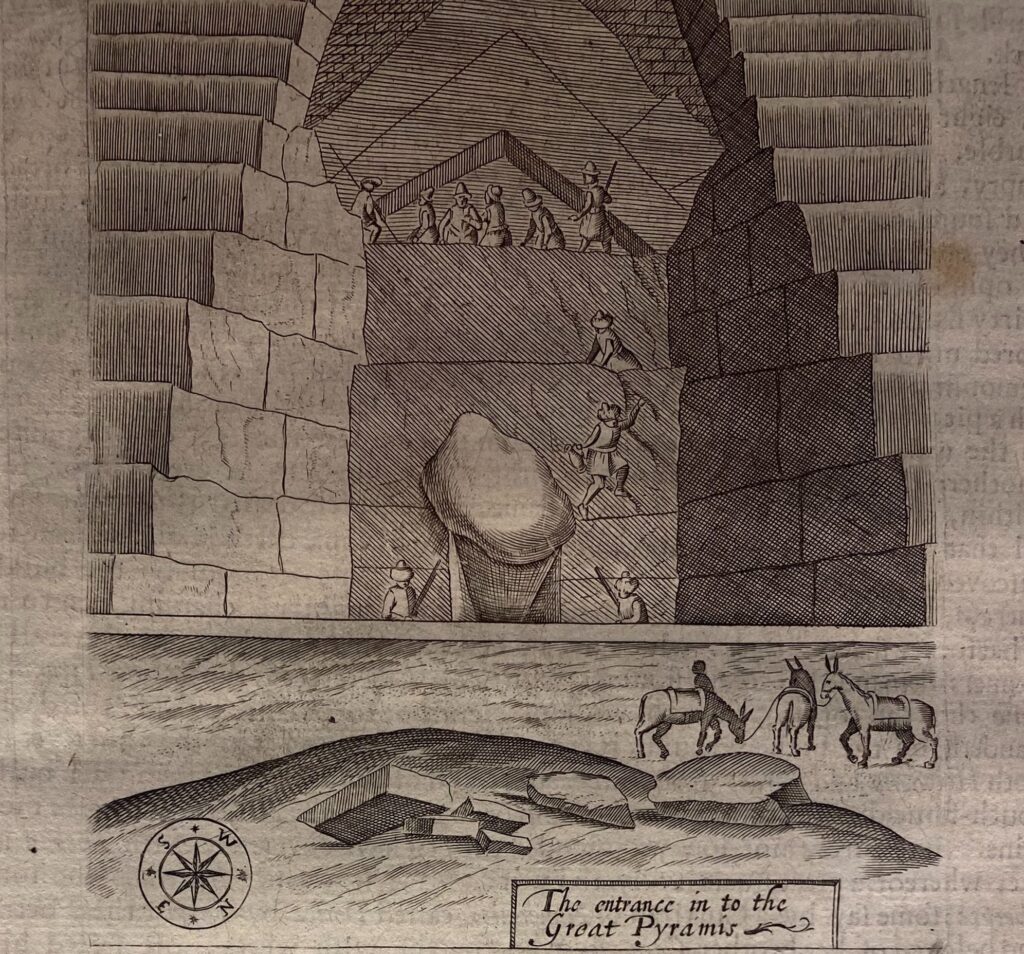
The Entrance to the Great Pyramid, from George Sandys

a seventeenth-century Englishman inside the Great Pyramid

This is an excerpt from George Sandy’s The Relation of a Journey begun [in] 1610, shared for no reason except that I found the narrative reminiscent of Tolkien or Dungeons & Dragons. (And I can find no reliable digital text online.) I have modernized the spelling and added paragraph-breaks and a few commas. Otherwise, it is verbatim.

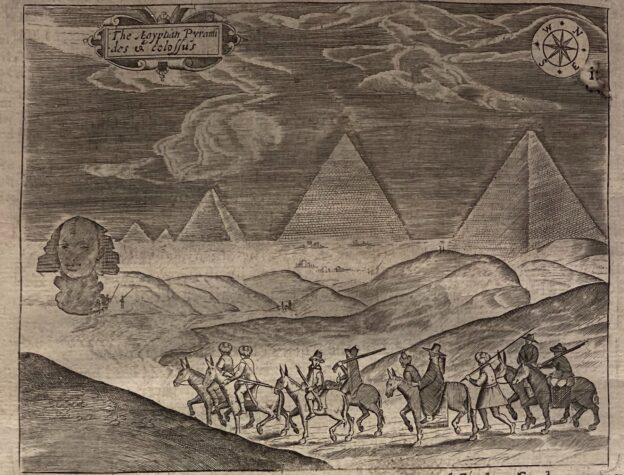
The top, at length, we ascended with many pauses and much difficulty, from whence, with delighted eyes, we beheld that Sovereign of Streams [the Nile], and most excellent of Countries [Egypt]. Southward and near [at] hand the Mumm[i]es: afar, of divers huge Pyramides, each of which, were this away, might supply the repute of a wonder. During of a great part of the day, it catcheth no shadow of the earth, but is at once illuminated on all sides.

Descending again, on the East side below, from each corner equally distant, we approached the entrance, seeming heretofore to have been closed up, or so intended, both by the place itself, as appeareth by the following Picture and conveyances within.

“The Entrance to the Great Pyramid”
Into this our Janissaries discharged their arquebuses, lest some should have skulked within to do us mischief, and guarded the mouth whilst we entered, for fear of the wild Arabs.  To take the better footing, we put off our shoes, and most of our apparel, foretold of the heat within not inferior to a Stove. Our guide (a Moor) went foremost: every one of us with our lights in our hands. 

A most dreadful passage, and no less cumbersome; not above a yard in breadth, and four feet in height, each stone containing that measure. So that always stooping, and sometimes creeping, by reason of the rubbish, we descended (not by stairs, but as down the steep of a hill) a hundred feet, where the place for a little circuit enlarged, and the fearful descent continued, which they say none ever durst attempt any farther. Save that a Bassa [a bashaw or person of rank?] of Cairo, curious to search into the secrets thereof, caused divers condemned persons to undertake the performance, well stored with lights, and other provision: and that some of them ascended again well-nigh thirty miles off in the Deserts.  

A Fable deviled only to beget wonder. But others have written, that at the bottom there is a spacious Pit, eighty and fix Cubits deep, filled at the over-flow by concealed Conduits; in the middle little Island, and on that a Tomb containing the body of Cheops, a King of Eypt, and the builder of this Pyramid: which with the truth hath a greater affinity. For since I have been told by one out of his own experience, that in the uppermost depth there is a large square place, (though without water) into which he was led by another entry opening to the South, known but unto few (that now open, being shut by some order) and entered at this place where we feared to descend. 

A turning on the right hand leadeth into a little room: which by reason of the noisome savor and uneasy passage, we refused to enter. Clambering over the mouth of the aforesaid dungeon, we ascended as upon the bow of an arch, the way no larger than the former, about an hundred and twenty feet. Here we passed through a long entry, which led directly forward [illegible] follow, that it took even from us that uneasy benefit of sloping. Which brought us into a little Room with a compact Roof, more long than broad, of polished Marble in whose Grave-like smell, half full of Rubbish, forced our quick return. Climbing also over this entrance, we ascended as before, about 'an hundred and twenty feet higher. 

This entry was of an exceeding height, yet no broader from side to side than a man may fathom [illegible], benched on each side, and closed above with admirable Architecture: the Marble so great, and so cunningly joined, as it had been hewn through the living Rock. At the top we entered into a goodly Chamber, twenty foot wide, and forty in length; the Roof of a marvelous height, and the Stones so great, that eighty floors it, eight roofs it, eight flag the ends, and sixteen the sides, all of well-wrought [?] Marble. 

Athwart the Room at the upper end there standeth a Tomb, uncovered, empty, and all of [?] high, seven feet in length, not four in breadth, and sounding like a Bell. In this no doubt; lay the body of the builder. They erecting such costly Monuments, not only out of a vain ostentation, but being of the opinion, that after the dissolution of the [body?] the soul should survive, and when thirty-six thousand years were expired, again be joined unto the self-same body restored unto his former condition, gathered in their conceits from Astronomical demonstrations.

Against one end of the Tomb, and close to the wall, there openeth a Pit with a long and narrow mouth, which leadeth into an under Chamber. In [the] walls on each side of the upper Room there are two holes, one opposite to another, their ends not discernible, nor big enough to be crept into; sooty within, and made as they say, by a flame of fire which darted through it. ...