Gillray and Blake

During the “Age of Revolution,” London was a hub of rapid technological, aesthetic, and economic change in the marketplace for political communications, foreshadowing our current experiences with digital media and propaganda.

James Gillray has been called the father of the political cartoon. As Clare Bucknell notes, he and William Blake, the visionary Romantic artist and poet, studied academic drawing and painting at the Royal Academy Schools in Somerset House around 1778. Later, Blake demonstrably borrowed from specific prints by Gillray (Marcus Wood, 1990). They were both part of the same London scene of artistic and technical experimentation, mass publishing, and political debate and censorship that Esther Chadwick, among others, explores. Their similarities and differences are interesting to trace.

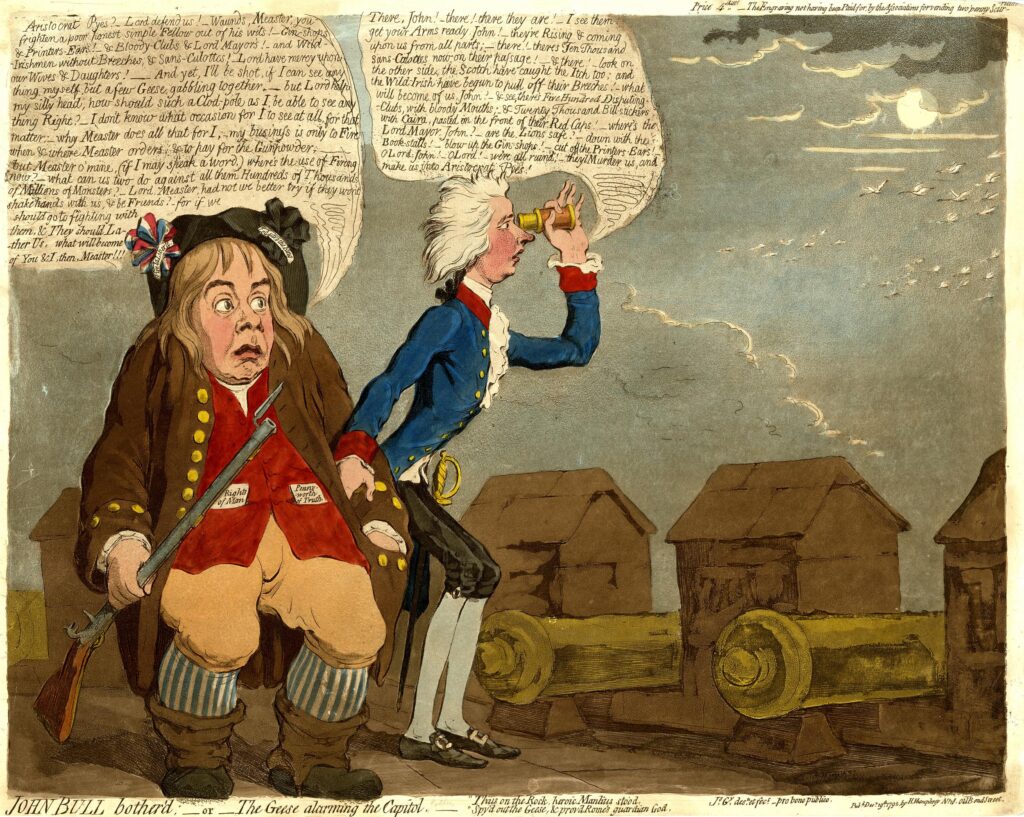
The first illustration with this post offers a taste of Gillray. With the French Revolution at full tilt and a rebellion brewing in Ireland, the Prime Minister, William Pitt, called up the militia. The leader of the opposition, Charles James Fox, accused Pitt of stoking fear to confuse and oppress the people. Gillray depicts Pitt atop a coastal fort, clinging to the personification of England, John Bull, who is depicted as a yokel with symbols of both the French Revolution and the British monarchy attached to his hat.

James Gillray, John Bull bother’d:-or-the geese alarming the Capitol (1792) Copyright British Museum. Creative Commons

Watching geese through binoculars, Pitt cries, “There, John! – there! there they are! – I see them – get your Arms ready, John! – they’re Rising & coming upon us from all parts.” He claims he sees French revolutionary mobs, “the Scotch [who] have caught the Itch too; and the Wild-Irish have begun to pull off their Breeches!” He issues panicked orders to address the crisis: “down with the Book-stalls! – blow up the Gin-shops! – cut off the Printers Ears!”

John Bull answers, “Wounds, Measter, you frighten a poor honest simple Fellow out of his wits! – Gin-Shops & Printers-Ears! – & Bloody-Clubs & Lord Mayors! – and Wild-Irishmen without Breeches, & Sans-Culottes! Lord have mercy upon our Wives & Daughters! – And yet, I’ll be shot, if I can see any thing myself, but a few Geese, gabbling together – But Lord help my silly head, how should, such a Clod-pole as I, be able to see any thing Right?”

The gabbling geese might be a metaphor for the “public sphere” of political debate, treated as powerless. This is a satire of conservative nationalism and propaganda, by an artist who was equally adept at mocking radical ideas–and who accepted money to design cartoons for and against both parties at various times.

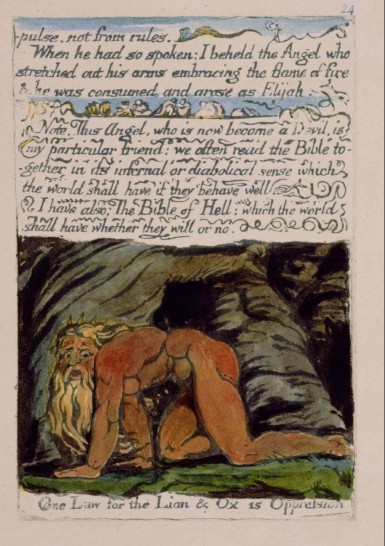
And here is an image by Blake from just about the same moment.

William Blake, Plate from Marriage of Heaven and Hell (1793), depicting Nebuchadnezzar, via Wikimedia Commons

The Devil has just said, “I tell you, no virtue can exist without breaking these ten commandments. Jesus was all virtue, and acted from impulse, not from rules.” The text in the image reads, “When he had so spoken, I beheld the Angel, who stretched out his arms embracing the flame of fire, and he was consumed, and arose as Elijah.”

Blake appends a “Note.—This Angel, who is now become a Devil, is my particular friend; we often read the Bible together in its infernal or diabolical sense, which the world shall have if they behave well. I have also the Bible of Hell, which the world shall have whether they will or no. One law for the lion and ox is Oppression.” The next section is entitled “A SONG OF LIBERTY” and offers numbered points, beginning:

  1. The Eternal Female groan’d; it was heard over all the earth:
  2. Albion’s coast is sick silent; the American meadows faint.
  3. Shadows of prophecy shiver along by the lakes and the rivers, and mutter across the ocean. France, rend down thy dungeon!

It’s likely that Blake really did experience a devil as his particular friend and read the Bible with him; mystical experiences influenced him as strongly as partisan cash motivated GIilray. Here Blake sings the very song that terrifies Pitt, the song of radical liberation.

Both Gillray and Blake incorporate their own handwritten text into their etchings or engravings. In both cases, the dialogue is fevered, histrionic. Neither has patience for the stuffed shirts of their day or any allegiance to “rules,” whether artistic, social, or sexual.

(Supposedly, Gillray and his business and personal partner, Hannah Humphrey, were on their way to church to be married when he remarked, “This is a foolish affair, methinks, Miss Humphrey. We live very comfortably together; we had better let well alone.” Blake and his spouse were once found stark naked in their garden, doing a dramatic reading of Paradise Lost.)

Those are similarities, but Blake was intensely earnest, whereas Gillray seems to have been a manic cynic (unless he was a canny subversive). I’d love to know what they said to each other when they were studying drawing and history-painting under Sir Joshua Reynolds.

See also: the role of communications in the French Revolution

Statistics

(Apologies to Wislawa Szymborska)

Attentive to all in a conversation:
Ten percent of the population. 
Someone's shame provokes a laugh:
Often true for over half. 
Ready and willing to reconcile:
Rare below the top quintile. 
Twenty percent, plus-or-minus three:
Those who’ll let an eccentric be. 
Almost three out of every four
Are quick to pity the sick or poor,
But doing something to counter hate: 
No more than one in any eight. 
Scoring high on all these measures:
We've found no such human treasures.
Of compassion, pure examples?
One or two in all our samples. 
But needing someone’s forgiving love:
Ninety-nine percent thereof.

See also: Cuttings: A book about happiness

Private investments in clean energy, batteries, or biomanufacturing leveraged by the Biden-ere spending bills

federal spending for both climate and democracy

Two huge problems may have the same solution. If this is true, it makes a powerful case for the main strategies of the Biden Administration.

The first problem is climate change, disastrous for both natural ecosystems and human lives and welfare. Underlying that problem is the fact that many constituencies around the globe benefit from burning carbon: not only authoritarian governments and powerful corporations (although they deserve the most criticism), but also regular communities and the parties and unions that represent them. As long as people who benefit in the short run from burning carbon have preponderant political weight, it is hard to pass truly satisfactory policy solutions.

The second problem is the marked tendency of poorer people to vote for the right, not only in the USA but in many other countries—in an eerie echo of the 1930s. Parties of the right that have lower-income constituencies cannot offer their voters tax cuts or deregulation. Instead they typically promise to strengthen the state to the exclusion of–or even against–minority groups or foreign populations. Unlike libertarianism, this form of politics has no natural limits; state power can keep ratcheting up until it reaches genuine fascism. Meanwhile, the center-left parties that are left with relatively upscale voters may try to defend individual rights, but they won’t address deep social inequities.

Federal finding authorized by Congress in Biden’s first two years addresses both problems. It tilts toward poorer districts (including those that are predominantly white and nowadays Republican) and green industries. The “theory of change” might be: 1) use federal funds to 2) “leverage” private investments in new industry that 3) mitigate climate change while 4) providing good jobs, thereby 5) building constituencies for green policies.

I am all for also using other strategies simultaneously, such as regulating or taxing carbon and divesting. I just think the Biden theory of change may be a necessary complement.

The map with this post (from the White House website) shows the locations of private investments in clean energy, batteries, and biomanufacturing that have been leveraged by new federal spending in the Biden years. Many observers have noted that a majority of this money–perhaps two-thirds–goes to districts represented by Republicans, who generally voted against the bills. I would draw attention to the concentration of projects along the Appalachian spine and in the heart of the Rust Belt. These are poor regions that happen, today, to be dominated by Republican representatives.

The effects are not yet evident in polling. In Pew’s June survey, 62% of all Americans disapprove of Biden, 41% very strongly. He receives net approval from college graduates but the disapproval of 66% of people with high school diplomas or less. He performs best among those who classify themselves as upper income and faces 2-1 disapproval among everyone else. Fifty-six percent of whites without college strongly disapprove of him, as do 57% of rural people.

This political strategy will take several years to work. People will have to see clear and sustained benefits from state action that is both equitable and green. The argument must begin now, but it will take time to change minds.

Energy Secretary Jennifer Granholm and some of her cabinet colleagues are visiting the locations of major new investments, most of which are in Republican districts. If Granholm were trying to affect the 2024 election, this trip would probably be a waste of her effort, since many of these districts are very safe for the GOP. For instance, she recently visited the district of Rep. Patrick McHenry, who won his last reelection by 45 points. Transportation Secretary Pete Buttigieg is going to Kentucky’s fifth district, which GOP Rep. Hal Rogers won by 65 points last time and which has been Republican since 1962. These trips may generate some social media calling out Republicans’ hypocrisy, but that won’t change minds. However, I do think actual jobs can shift people’s fundamental beliefs about both government and climate. For that purpose, both the federal spending and visits by Democratic leaders to tout it can be seen as highly promising.

See also: the major shift in climate strategy; Civic Engagement in American Climate Policy: Collaborative Models; social class inversion in the 2022 US elections; class inversion as an alternative to the polarization thesis; the social class inversion as a threat to democracy; investing in the Appalachian cities

benefits of virtue-signaling: professors’ antiracist tweets predict private behavior

(Dayton, OH) Deivis Angeli, Matt Lowe, and a group called The Village Team sent emails requesting informational meetings about graduate school to 18,514 academics in the USA, none of whom were Black. Half of the requests were signed by a prospective student with a “distinctively Black name,” and half with “a distinctively White name.”*

Overall, the professors did not discriminate, accepting 30-31% of the requests from people whose names sounded Black or White. In a separate survey of graduate students, most of them predicted that professors would discriminate in this situation, and it turns out these students were too pessimistic.

However, there were differences among the professors. Those who had tweeted at least once between January 2020 and March 2022 with a “racial justice-related word or phrase (e.g. racism, George Floyd)” were 1.9 percentage points more likely to accept a meeting with a person they might assume was Black, whereas those who never used a racial-justice word in their tweets during that period were “5.3 percentage points … less likely to accept a meeting with a Black student than with a White student.”

In other words, an academic with a Twitter handle who never tweeted about racism in those years would be somewhat likely to discriminate against a Black prospective student, whereas an academic who had tweeted about racial justice would be more prone to meet with a prospective student who is Black than with one who is White. For a prospective student, a tweet–which is a cheap expression of opinion–provides a meaningful signal about the professor’s likely personal behavior. Even though academics as a whole would not discriminate, there is some anti-Black bias, and it is concentrated among those who never take a public stance against racism.

I take Musa al-Gharbi’s points that “very public demonstrations of morality” typically have “impure motives” and that “the whites who seem most eager to condemn ‘ideological racism’ … and who are most ostentatious in demonstrating their own ‘wokeness,’ also tend to be the people who benefit the most from what sociologists describe as ‘institutional’ or ‘systemic’ racism.”

For instance, we college professors hold valuable, protected social roles in institutions that disproportionately serve white people, and many (like me) also benefit from policies like zoning, policing, and school-district boundaries that we rarely work to change. Writ large, the Democratic Party’s coalition tilts toward advantaged people, even as the party expresses rhetorical commitment to equity.** These are troubling phenomena at the group level. They help to explain our failure to achieve deeper change.

Al-Gharbi quotes an apt warning from the New Testament:

Beware of practicing your righteousness before men to be noticed by them; otherwise you have no reward with your Father who is in heaven. So when you give to the poor, do not sound a trumpet before you, as the hypocrites do in the synagogues and in the streets, so that they may be honored by men. Truly I say to you, they have their reward in full… When you pray, you are not to be like the hypocrites; for they like to stand and pray in the synagogues and on the street corners so that they may be seen by men. Truly, I say to you, they have their reward in full.

Matthew 6: 1-16

But it is also interesting that public expressions of anti-racism correlate with private acts that promote equity–more so than most students believe. Angeli et al. can reject a hypothesis about individual hypocrisy among the people they investigated. In this context, “virtue-signaling” may serve both to reinforce valuable group norms and to convey genuine information about an individual’s likely behavior.

We do suffer from contradictions at the group level–in other words, from systematic failures to address social inequities that benefit the people who denounce them. It’s perhaps no surprise that people are willing to put their beliefs into practice by, for example, taking half an hour to talk to a prospective student online, yet they won’t transform institutions that benefit them. But it is actually difficult to change systems, or even to know how to start. It may be that people are not so much hypocrites as bad at making systemic change.

*Angeli, Deivis and Lowe, Matt and Team, The Village, Virtue Signals (2022). CESifo Working Paper No. 10475. ** Social class inversion in the 2022 US elections. See also how intuitions relate to reasons: a social approach.

vestiges of feudalism in Emma; or, why the gentry acts as it does

Here is a passage–one of thousands from many sources–in which a member of the landed gentry expresses mild disdain for people who make their money by working. Since it’s by Jane Austen (Emma, chapter 22), it satirizes this prejudice without entirely eschewing it.

Philip Elton (a vicar, or priest) has rejected Emma’s friend Harriet as socially inferior and has returned to their community with a different fiancée on his arm. The narrator, partaking a little of Mr. Elton’s perspective, introduces this newcomer: “The charming Augusta Hawkins, in addition to all the usual advantages of perfect beauty and merit, was in possession of an independent fortune.”

But Emma “thought very little” of this lady.

What she was, must be uncertain; but who she was, might be found out; and setting aside the £10,000 it did not appear that she was at all Harriet’s superior. She brought no name, no blood, no alliance. Miss Hawkins was the youngest of the two daughters of a Bristol — merchant, of course, he must be called. … Though the father and mother had died some years ago, an uncle remained — in the law line — nothing more distinctly honourable was hazarded of him, than that he was in the law line; and with him the daughter had lived. Emma guessed him to be the drudge of some attorney, and too stupid to rise. And all the grandeur of the connection seemed dependent on the elder sister, who was very well married, to a gentleman in a great way, near Bristol, who kept two carriages! That was the wind-up of the history; that was the glory of Miss Hawkins.

(If Augusta’s uncle is a toiling “attorney,” then he is involved in trade, like his brother, whereas a barrister would be a gentleman.)

Emma’s distinctions are familiar from distant times and places. The varnas in Vedic Hinduism were the Brahmins (priests, like Mr Elton), the Kshatriyas (rulers and warriors of a class like Emma’s father), and the Vaishyas (who include merchants, like Augusta’s father), as well as the Shudras, or servants and laborers. Kshatriyas were not supposed to marry Vaishyas. Around 893 CE, King Alfred said that any realm needs three orders: “praying men, fighting men and working men.” The Four Occupations in ancient China were the shi (gentry and scholars), the nong (peasant farmers), the gong (artisans and craftsmen), and the shang (merchants and traders). Mande-speaking groups in West Africa have classified people as nobles, vassals, or as various specific craftspeople. And so on.

All these systems could be called “feudal.” It’s important to notice the differences among them and not to resort to a crude theory of universal “stages” in which feudalism always precedes capitalism. In fact, according to Arif Dirlik, “Marx’s remarks on feudalism,” which “were scattered throughout his work,” “were not meant to define a universal social type but only to describe the process whereby European feudalism was transformed into European capitalism.”

Nevertheless, we can imagine the general functions that are served by the distinctions in Emma’s mind.

First, most human beings have spent their lives working on the land to produce food. Land can be apportioned in many ways–for instance, it can belong to a village as a common resource or be traversed by nomads. But it has been common to allocate specific acres to individual owners.

Private ownership can concentrate so that a few people own most of the land. They might gain it by violent force, or it could accumulate due to luck, inheritance, and trade–or a mix of these. Emma’s family, the Woodhouses, “had been settled for several generations at Hartfield, the younger branch of a very ancient family.” Emma acknowledges that the “landed property of Hartfield” is just a “sort of notch in the Donwell Abbey estate,” which is vast. Nevertheless, the Woodhouses have a fortune “from other sources” (presumably, rents from other land) that “make[s] them scarcely secondary to Donwell Abbey itself,” and as a result, they have “a high place in the consideration of the neighbourhood” (ch. 16).

In any case, once land has concentrated, it is very much in the owner’s interests not to work but to live on the surplus of other’s labor, whether the laborers are employees, tenants, vassals, or serfs or slaves. (For Marx and Engels in the German Ideology of 1845-6, a feudal system specifically requires serfs, but I would ignore that detail.) Mr. Woodhouse is introduced as a “valetudinarian [overly anxious about his health] all his life, without activity of mind or body” (ch. 1). He evidently lives passively from the income of his estates and likes to “while away the morning” with “books of engravings, drawers of medals, cameos, corals, shells, and every other family collection” (ch. 6).

The many who labor may resent the few who don’t and may seek their land. Therefore, the landowning class has motivations to monopolize violence by training and arming themselves as professional warriors and employing military followers, by capturing the state if it is an effective mechanism of control, by promoting an ideology that justifies their status, by bequeathing each family’s land to one heir so that it doesn’t get diluted (primogeniture), and by restricting the size of their group by socializing and marrying only amongst themselves (endogamy).

These traditions have weakened by Emma Woodhouse’s time, but they still explain why many men in her circles pursue military careers and carry swords, why they dominate Parliament, why the gentry teaches and reinforces a cultural disdain for working with one’s hands, why they monopolize the main sources of ideology, such as the established Church of England, and why they prefer to marry their own. The function of these strategies is to preserve their ability to live well without working.

Emma must dramatically reassess her aspirations for Harriet once she learns that her friend’s late father had been a tradesman, not a landed gentleman:

Harriet’s parentage became known. She proved to be the daughter of a tradesman, rich enough to afford her the comfortable maintenance which had ever been hers, and decent enough to have always wished for concealment.—Such was the blood of gentility which Emma had formerly been so ready to vouch for!—It was likely to be as untainted, perhaps, as the blood of many a gentleman: but what a connexion had she been preparing for Mr. Knightley—or for the Churchills—or even for Mr. Elton!—The stain of illegitimacy, unbleached by nobility or wealth, would have been a stain indeed (ch. 19).

The novel is almost over by this point, but Emma retains a firmly feudal attitude toward inherited “gentility.”

A major complication is that there are rarely just two kinds of people: landowners and manual workers. As in the examples cited above, there may also be clergy, merchants, and manufacturers who produce at larger scales than craftspeople. What to do with these groups if you want to preserve the prerogatives of the landed gentry?

The clergy (or “men who pray”) can be handled in either of two ways. They can form their own caste, like Brahmans or (to some extent) priests in Orthodox Christianity. These men inherit religious endowments, much as the gentry inherit land. Priests and great landowners naturally cooperate, since they share stakes in the current system. Alternatively, the clergy can be denied the right to have legitimate heirs, as in Catholicism or Buddhist monasticism. Then each new cleric does not create a competitor to the gentry, but his career concludes with his death. Clerical positions are useful placements for the younger sons of gentry and for ambitious commoners.

(The English case was a complex hybrid, because some clerical positions provided income from land endowments, or “livings,” which could be retained by specific families, but others were more like jobs. Anglican priests can marry, but churches are not literally inherited.)

Merchants and manufacturers pose a different threat. Their segments of the economy can be more dynamic than agriculture, and some may build fortunes that become sources of power.

One response is to ignore them. In the Waning of the Middle Ages (1919), J. Huizinga notes that the wealth of advanced parts of medieval Europe like Burgundy came from trade and industry, Merchant-bankers were commoners, but they could have more power than monarchs. However, even though “nobility and feudalism had ceased to be really essential factors in the state and in society, they continued to impress the mind as dominant forms of life. The men of the fifteenth century could not understand that the real moving powers of political and social evolution might be looked for anywhere else than in the doings of a warlike or courtly nobility.” For instance, Georges Chastellain, a Burgundian chronicler, could only explain his realm’s prosperity as a result of its knights’ honor. Huizinga notes: “Chastellain still calls the rich burghers simply villeins.”

But this won’t work for long. If even a king needs loans to maintain his power, he can’t continue to treat his creditors like peasants. Another solution is to absorb the most successful merchants into the gentry by allowing them to buy land and live from rents and to marry their children to members of the landed class, as long as they stop trading. That proviso is important because it prevents their fortunes from continuing to grow rapidly, which would destabilize the system. This is what seems to have happened with Augusta’s family in Emma. Her father was a merchant (possibly involved in slavery), but her sister is said to have married a gentleman from the countryside, and she has landed a vicar for a husband. Any children she has with Mr. Elton will never have to work for income. But her £10,000 will not grow rapidly, because it will be invested in land.

Unfortunately for the landed gentry, the rewards of continuing to be a merchant can be high. If there’s an available ideology–such as Calvinism or Methodism–that justifies continuing to make money from trade and industry, then successful merchants may not want to retire to landed estates. They can keep getting richer, and they may be able to seize political power from the class whose wealth comes from passive land-ownership. This is the transition to capitalism that Marx observed. In the early 1900s, when Liberal parliaments voted high property taxes “to free the land that from this very hour is shackled with the chains of feudalism” (Lloyd George), it was clear that new classes of people had seized the state from the landed gentry and were even willing to bankrupt them.

Then again, even in the 21st century, some people still distinguish ordinary work from “professional” occupations that require liberal educations and that involve a lot of autonomy and reading, writing, and talking. Some parents who make money from trade or industry still give their children educations that inculcate values derived from the traditional gentry; then those children pursue professions that were considered respectable for gentlemen in Austen’s day, and they marry one another. It remains desirable not to labor at others’ direction but to spend one’s time, like old Mr. Woodhouse, reading and conversing–even if, nowadays, that usually means holding a job classified as “professional.”

See also: defining capitalism; the gentry as caste and class (from 2007); when chivalry died; the politics of Wind in the Willows; the neo-feudalism thesis; British exceptionalism 2: the unique nature of the aristocracy; David Brooks/Pierre Bourdieu; the links between capital and education.